Vehicular Hazard
2
• Germany’s federal council, the Bundesrat, has
passed a resolution calling for a ban on
combustion engine cars by 2030.
3
Vehicle
• A vehicle is a mobile machine that transports people
or cargo.
• Typical vehicles include wagons, bicycles, motor
vehicles, railed vehicles, watercraft, aircraft and
spacecraft.
• A motor vehicle is a self-propelled road
vehicle or off-road vehicle, commonly wheeled, that
does not operate on rails, such as trains or trams and
used for the transportation of passengers, or
passengers and property.
4
Vehicle
• Motorized vehicle consisting of four wheels and powered by
an internal engine. Automobiles are used to transport people
and items from one location to another location. After years
or various designs, inventors were able to develop a
functional general design that is utilized by major automakers
as the foundation of their designs.
• Automobiles generally use gasoline to fuel the internal
engine, but technological advances have led to the design of
cars that run on electricity and even water.
5
Vehicles
• Air crafts
• Land Crafts
• Water crafts
6
Vehicles in Nepal
• Bus
• Minibus/Mini Truck
• Crane/Excavator/ Tuck/Tipper
• Car/Jeep/Van
• Pick up
• Micro
• Tempo
• Motorcycle
• Tractor/Power tailor
(Sources: Website of Transportation management office)
7
• Any types of hazards related to vehicle or
transportation.
Category of vehicular hazards:
 emission,
 noise,
 Congestion
 accidents etc.
8
Vehicular hazards
Categories of Vehicular Hazards
– Paradoxical (Transportation and Economy)
– Environmental Externalities
– Vehicles : Sources of emission and multiple environmental
impacts
• Direct Impacts: Emission, Noise
• Indirect Impacts: Secondary effects of transport activities on
environmental systems.
• Cumulative Impacts: The additive, multiplicative or synergetic
consequences of transport activities. E.g. Climate change,
9
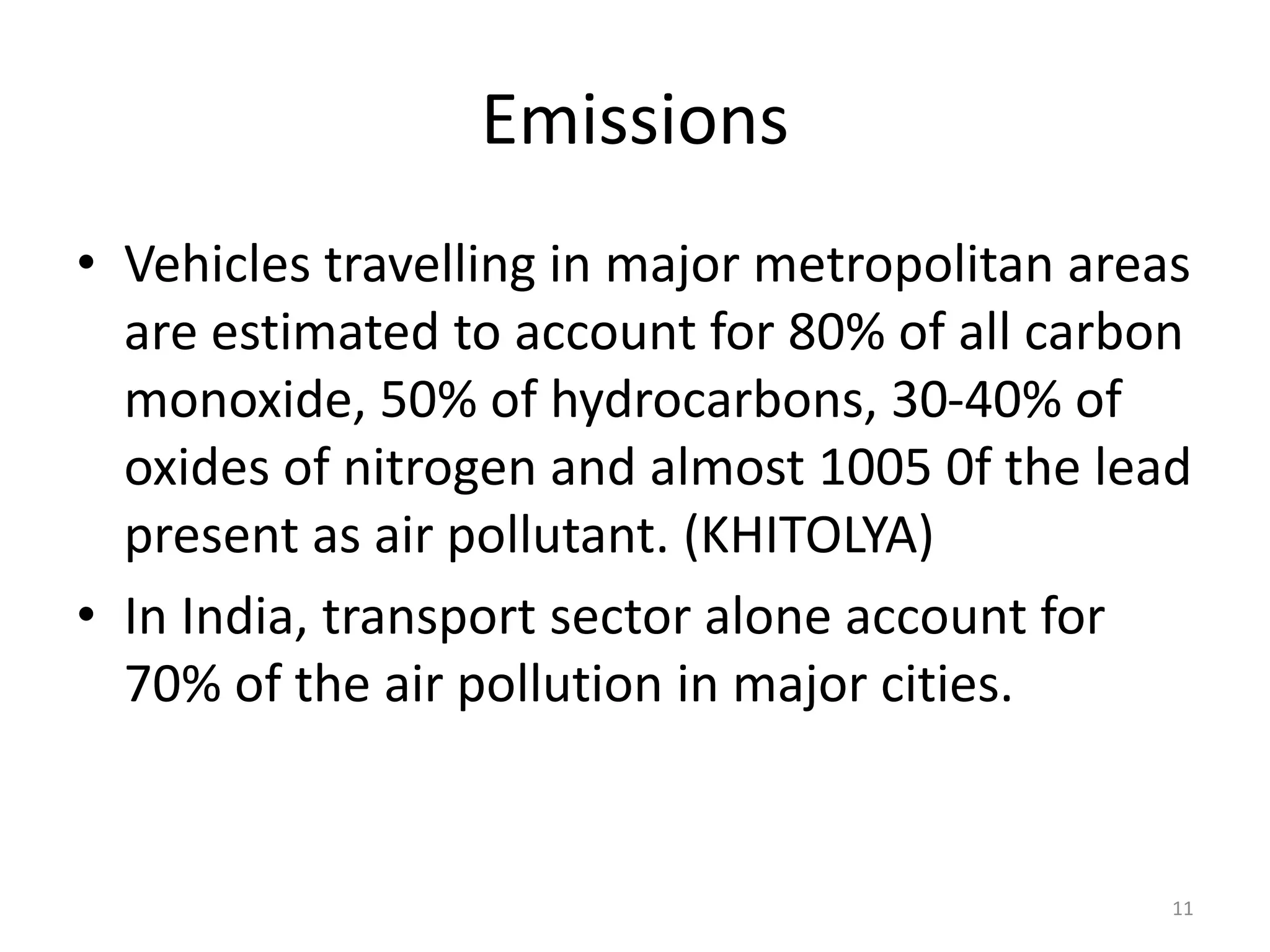
Emissions
• Cars and trucks produce air pollution
throughout their life, including pollution
emitted during vehicle operation, refueling,
manufacturing, and disposal. Additional
emissions are associated with the refining and
distribution of vehicle fuel.
10
Emissions
• Vehicles travelling in major metropolitan areas
are estimated to account for 80% of all carbon
monoxide, 50% of hydrocarbons, 30-40% of
oxides of nitrogen and almost 1005 0f the lead
present as air pollutant. (KHITOLYA)
• In India, transport sector alone account for
70% of the air pollution in major cities.
11
Main causes of Pollution from vehicle
• Fuel Tank: Leakage or evaporation
• Crank Case: Improper or worn out rings
• Fuel Pump: Improper condition of elementss,
delivery valves etc
• Nozzle: Improper opening or nozzle pressure
• Overflow valve: Improper working resullts in
excessive fuel consumption
• And Return pipe: Release of excessive smoke
• Engine Head: Improper working of Inlet/Exhaust
valve
12
Major emissions
• Partuculate Matter (PM)
• Diseal Particulate
• Hydrocarbons (HC)
• Nitrogen oxides (NOx)
• Carbon monoxide (CO)
• Sulfur dioxide (SO2)
• Hazardous air pollutants
(toxics)
• Greenhouse gases
(GHGs) 13
• Particulate matter (PM):
– Murky color (soots and metals)
– Can penetrate deep into lungs
– Mostly formed by incomplete combustion of
diesel fuel.
– Secondary pollution from hydrocarbons, nitrogen
oxides, and sulfer dioxides
14
• HC
– React with Nox in the presence of sunlight to form
ground level ozone, a primary ingredient in smog.
– In ground level this gas irritates the respiratory
system, causing coughing, choking, and reduced
lung capacity
15
• Nitrogen oxides (NOx)
– These pollutants cause lung irritation and weaken
the body's defenses against respiratory infections
such as pneumonia and influenza.
– In addition, they assist in the formation of ground
level ozone and particulate matter.
16
• Carbon monoxide (CO).
– This odorless, colorless, and poisonous gas is
formed by the combustion of fossil fuels such as
gasoline and is emitted primarily from cars and
trucks.
– When inhaled, CO blocks oxygen from the brain,
heart, and other vital organs.
– Fetuses, newborn children, and people with
chronic illnesses are especially susceptible to the
effects of CO.
17
• Sulfur dioxide (SO2).
– Power plants and motor vehicles create this
pollutant by burning sulfur-containing fuels,
especially diesel.
– Sulfur dioxide can react in the atmosphere to form
fine particles and poses the largest health risk to
young children and asthmatics.
18
• Hazardous air pollutants (toxics).
– These chemical compounds have been linked to
birth defects, cancer, and other serious illnesses.
– The EPA estimates that the air toxics emitted from
cars and trucks — which include Benzene,
acetaldehyde, and 1,3-butadiene — account
for half of all cancers caused by air pollution.
19
• Greenhouse gases.
– Motor vehicles also emit pollutants, such as
carbon dioxide.
– In fact, cars and trucks account for over one-fifth
of the United States' total global warming
pollution; transportation, which includes freight,
trains, and airplanes, accounts for around thirty
percent of all heat-trapping gas emissions.
20
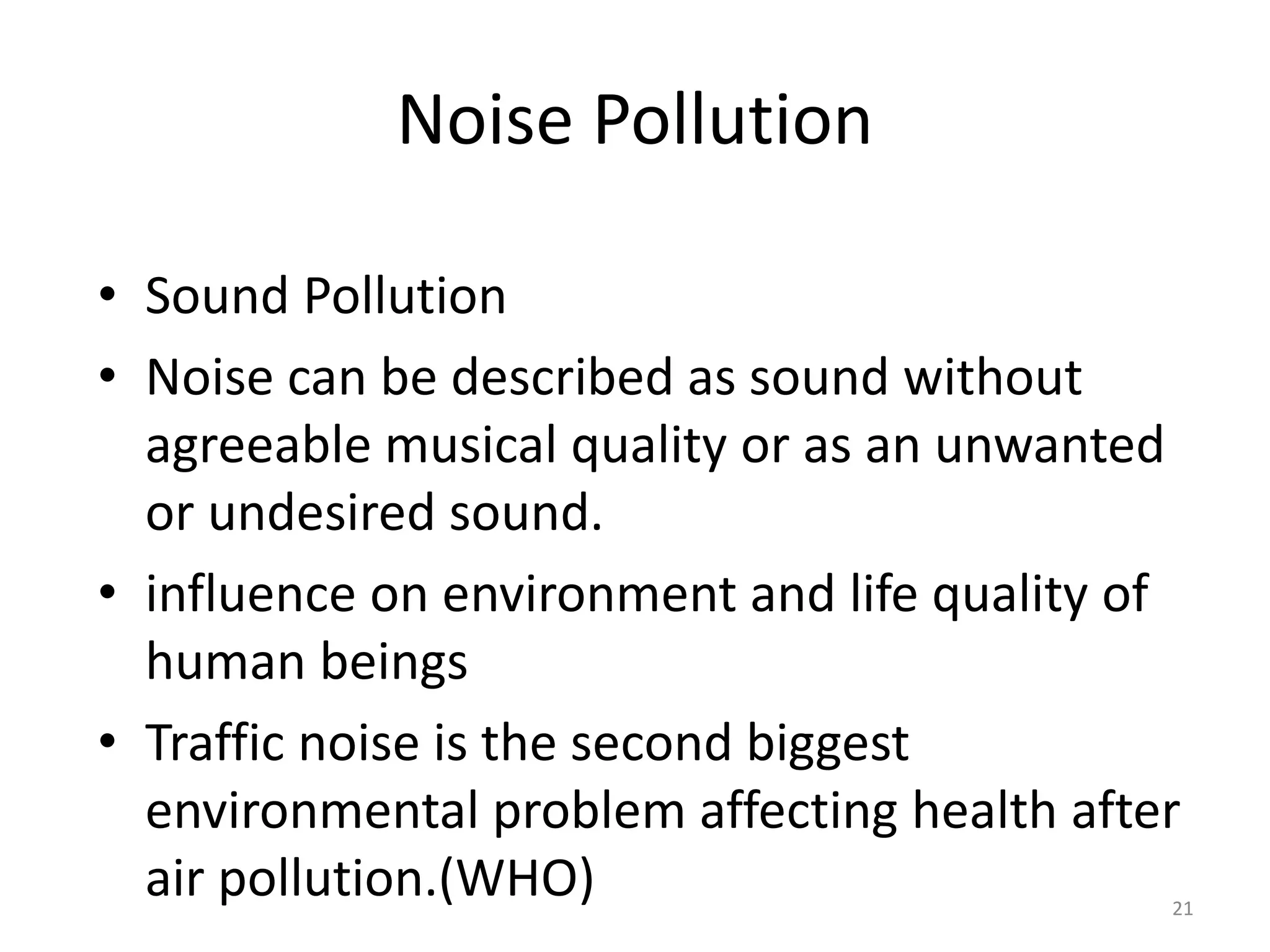
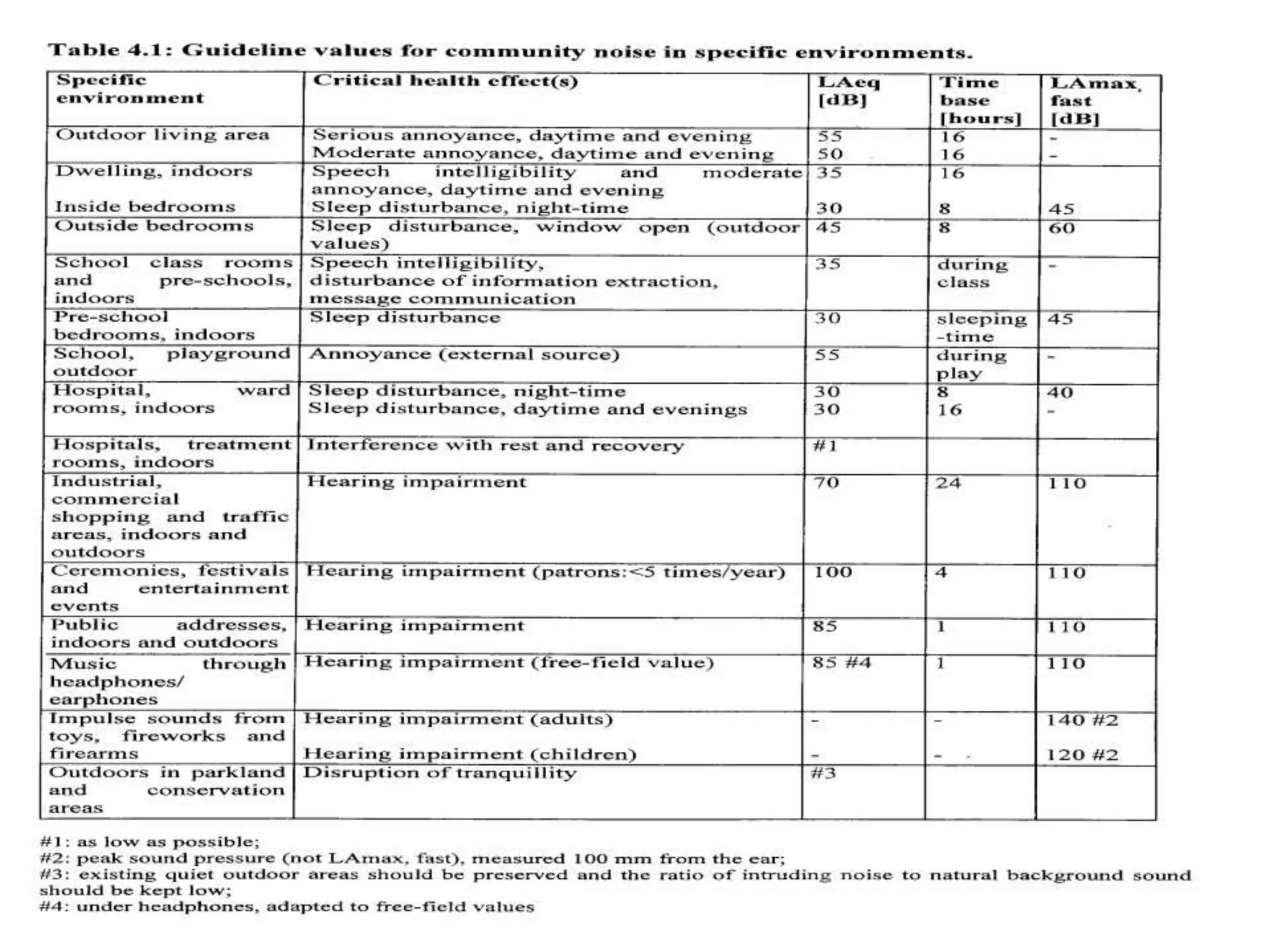
Noise Pollution
• Sound Pollution
• Noise can be described as sound without
agreeable musical quality or as an unwanted
or undesired sound.
• influence on environment and life quality of
human beings
• Traffic noise is the second biggest
environmental problem affecting health after
air pollution.(WHO) 21
Noise
• Environmental noise
• “noise emitted from all sources except for
noise at the industrial workplace”
• “unwanted or harmful outdoor sound created
by human activities, including noise from
road, rail, airports and from industrial sites”.
– Guidelines for community Noise (WHO)
22
Noise Pollution
23
Causes of Noise Pollution
• Industrialization
• Poor Urban Planning
• Social Events
• Transportation
• Construction Activities
• Household Chores
24
Causes of Traffic Noise
Noise is produced by defective mufflers,
produced by engine, exhaust and tiers.
• The volume of traffic
• The speed of the traffic
• The number of trucks in the flow of traffic.
The traffic noise is not usually a serious problem
for people who live more than 500 feet from
heavily travelled freeways or more than 100 to
200 feet from lightly travelled roads.
25
Vehicular Noise
• Main source of environmental noise
• Generally, Heavier vehicle: more noise ( Except
helicopter, 2 or 3 wheeler vehicles)
• Noise generation: inside engine, frictional
contacts
26
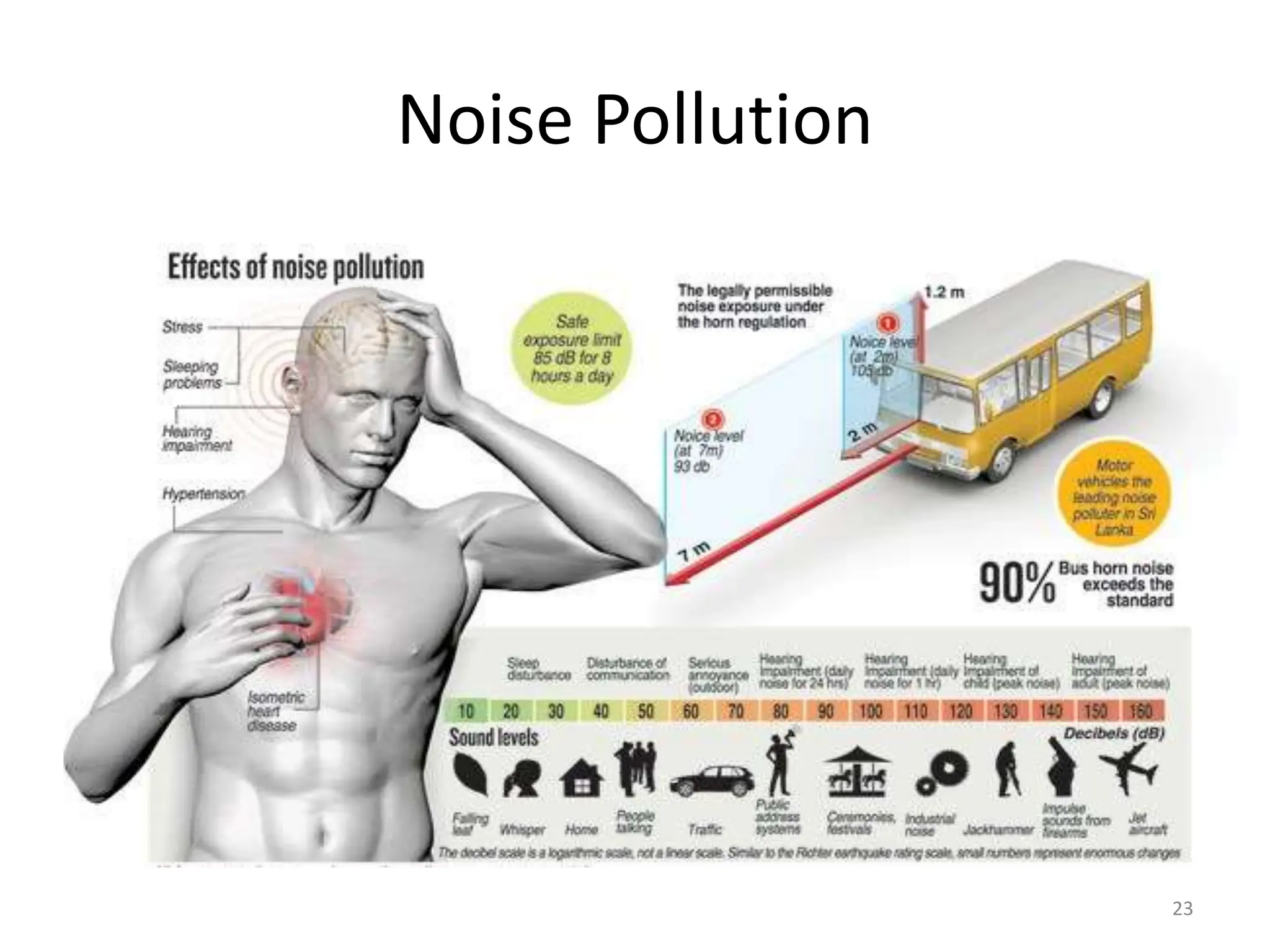
Noise Level
• Amount of Noise
• Time of exposure
• Sound louder than 80 decibels are potential
hazardous
27
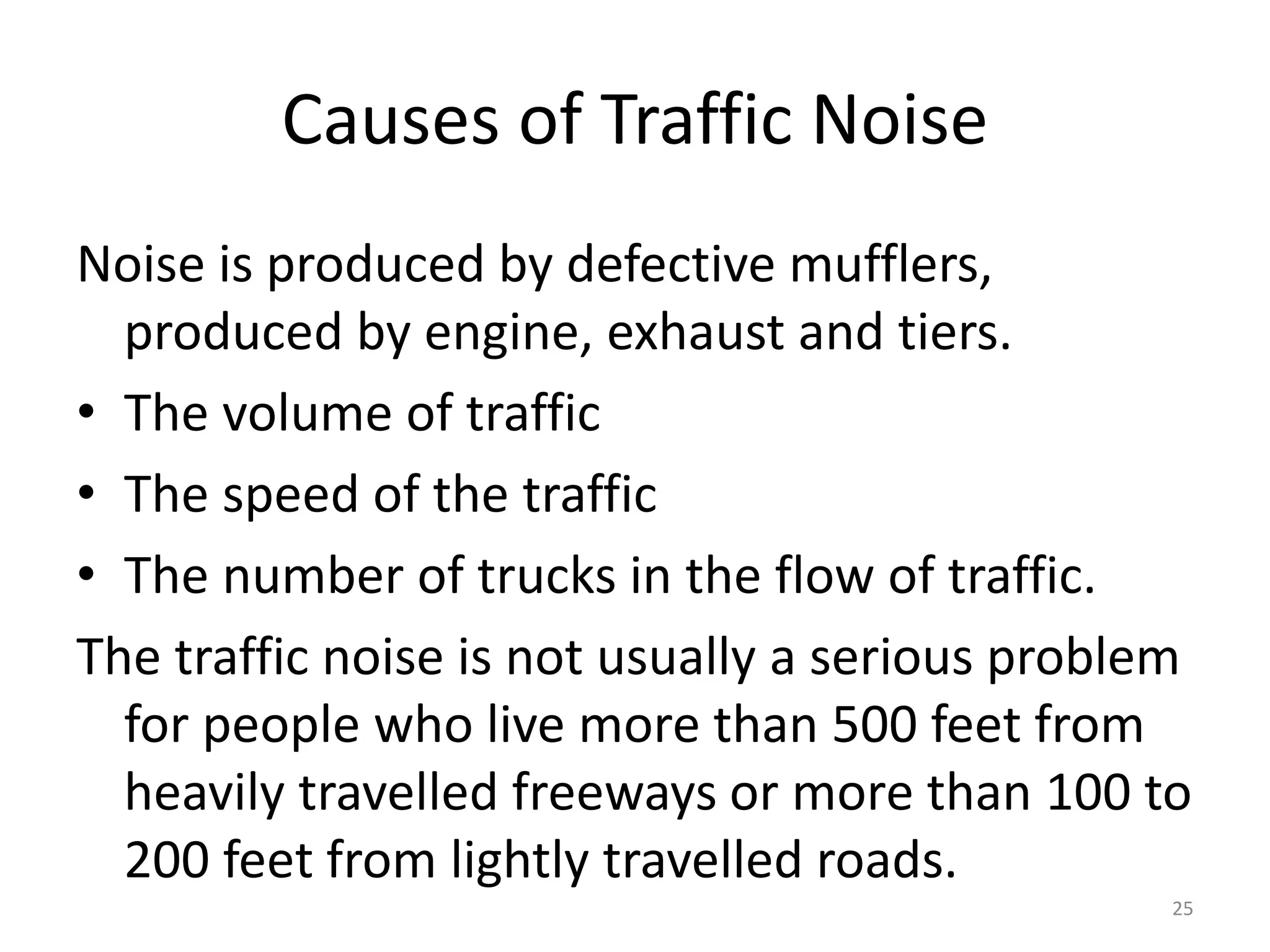
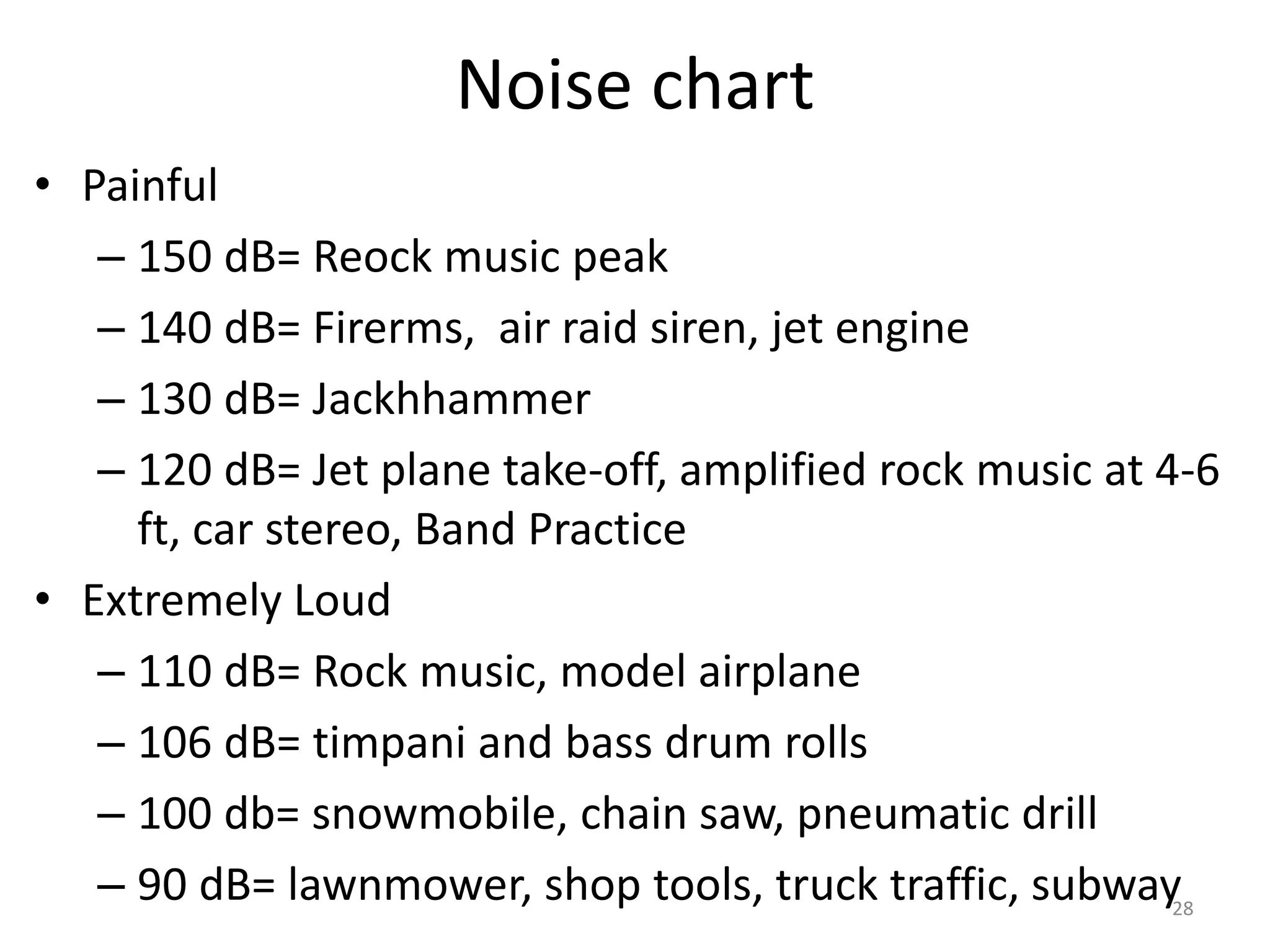
Noise chart
• Painful
– 150 dB= Reock music peak
– 140 dB= Firerms, air raid siren, jet engine
– 130 dB= Jackhhammer
– 120 dB= Jet plane take-off, amplified rock music at 4-6
ft, car stereo, Band Practice
• Extremely Loud
– 110 dB= Rock music, model airplane
– 106 dB= timpani and bass drum rolls
– 100 db= snowmobile, chain saw, pneumatic drill
– 90 dB= lawnmower, shop tools, truck traffic, subway28
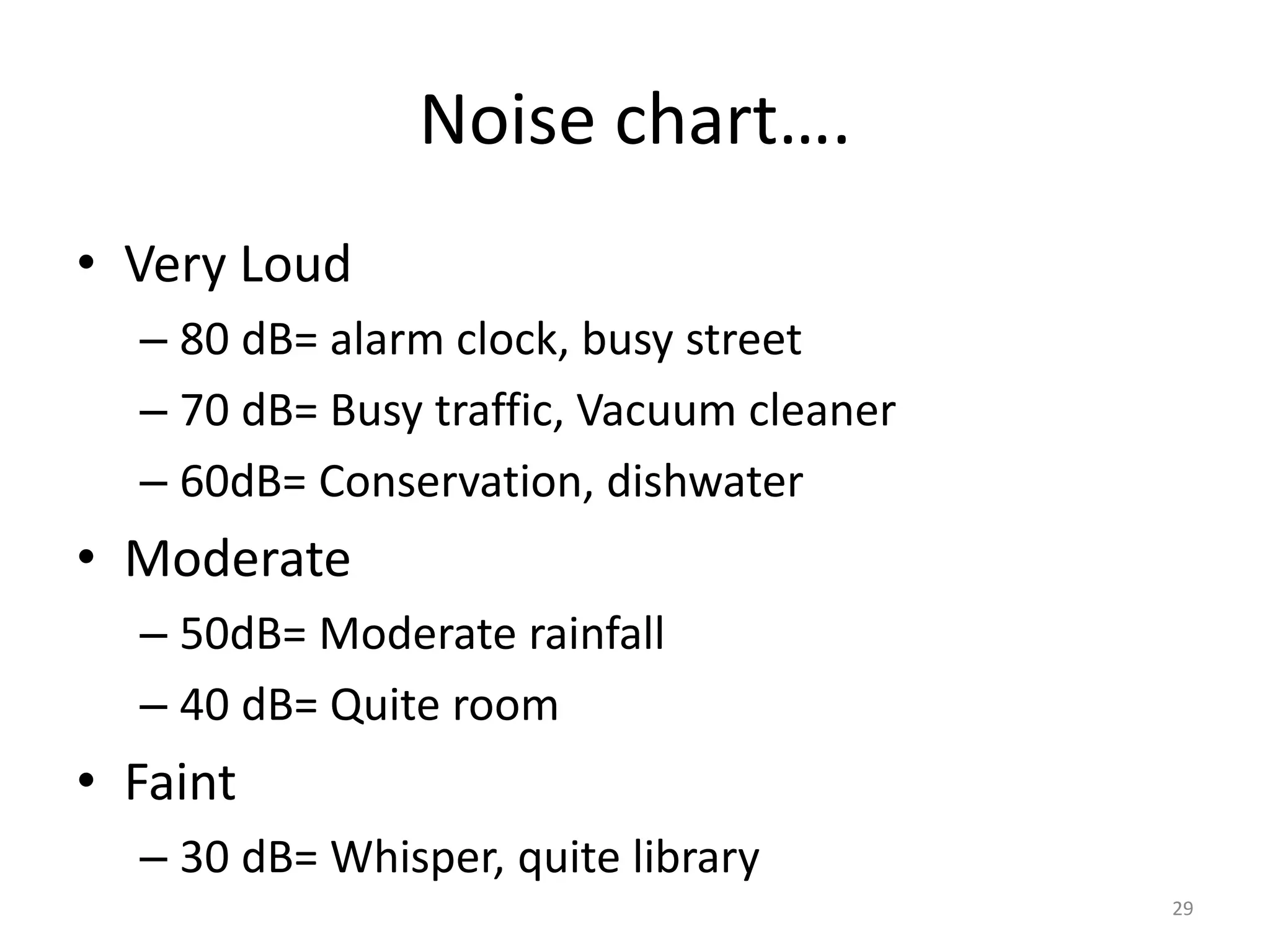
Noise chart….
• Very Loud
– 80 dB= alarm clock, busy street
– 70 dB= Busy traffic, Vacuum cleaner
– 60dB= Conservation, dishwater
• Moderate
– 50dB= Moderate rainfall
– 40 dB= Quite room
• Faint
– 30 dB= Whisper, quite library
29
30
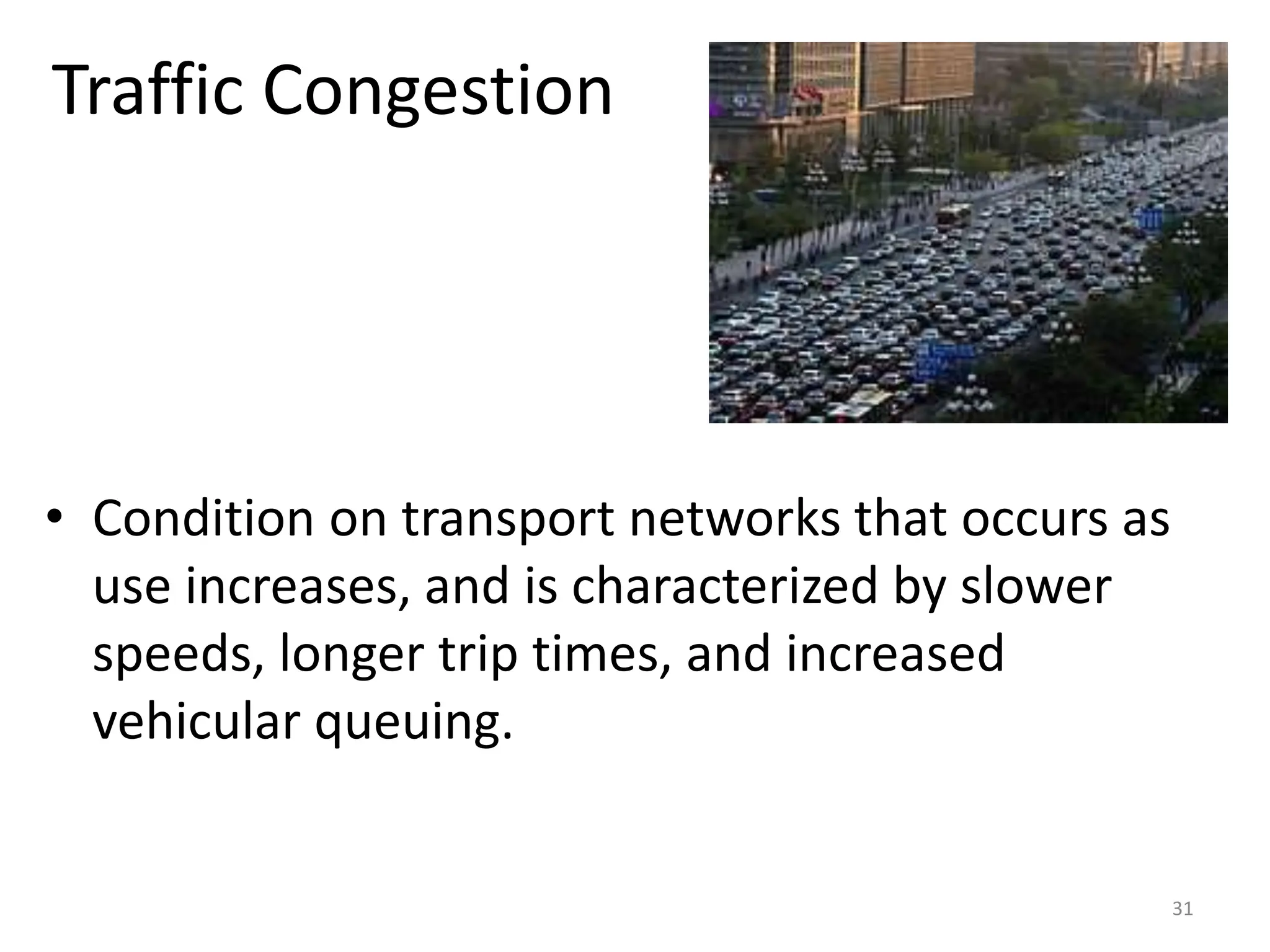
Traffic Congestion
• Condition on transport networks that occurs as
use increases, and is characterized by slower
speeds, longer trip times, and increased
vehicular queuing.
31
Traffic Congestions
• When traffic demand is great enough that the
interaction between vehicles slows the speed
of the traffic stream, this results in some
congestion.
32
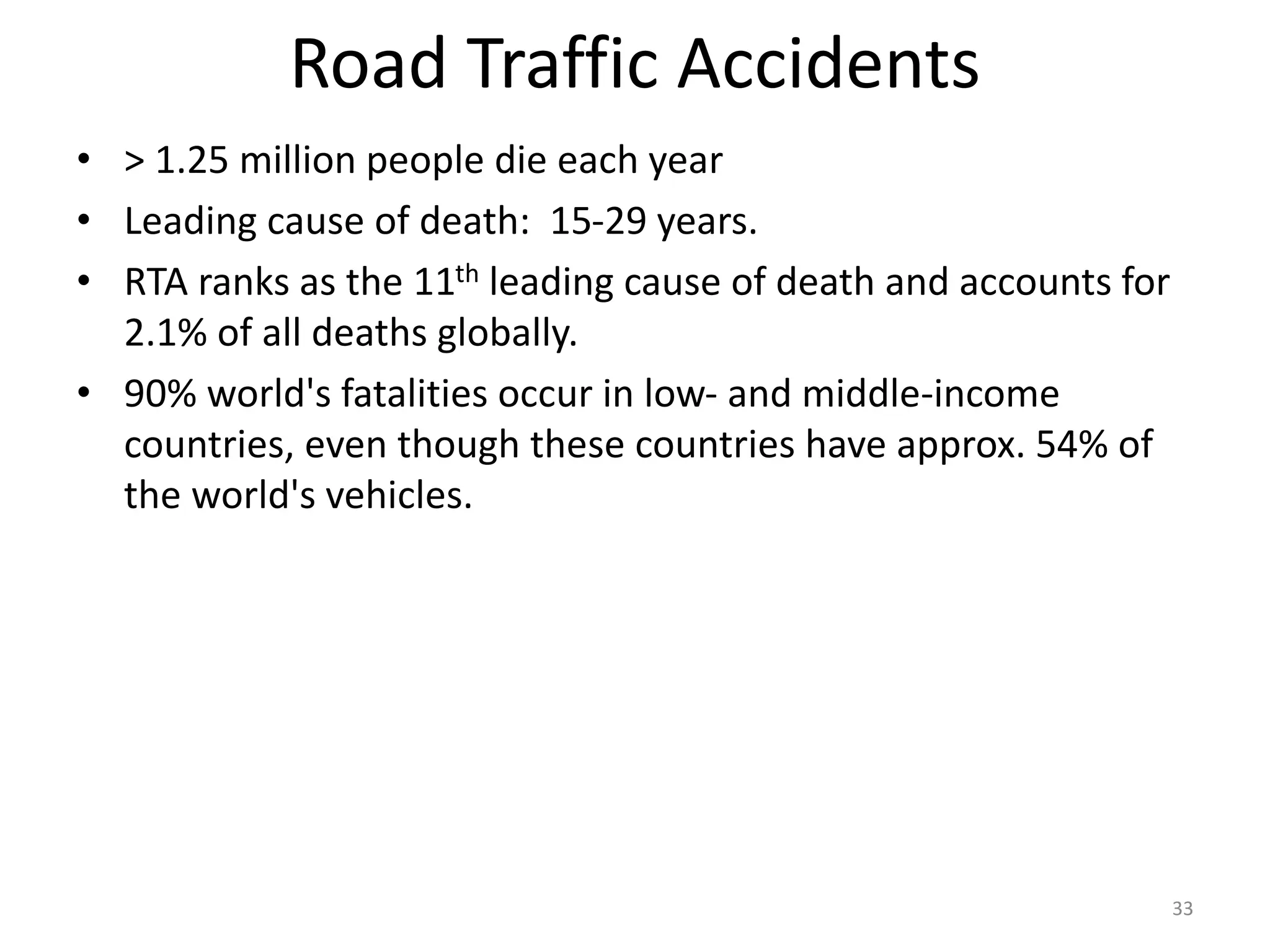
Road Traffic Accidents
• > 1.25 million people die each year
• Leading cause of death: 15-29 years.
• RTA ranks as the 11th leading cause of death and accounts for
2.1% of all deaths globally.
• 90% world's fatalities occur in low- and middle-income
countries, even though these countries have approx. 54% of
the world's vehicles.
33
Road Traffic Accidents
• Nearly 50% of death of are “vulnerable road users”:
pedestrians, cyclists, and motorcyclists.
• RT crashes cost most countries 3% of their GDP
• Without sustained action, RT crashes are predicted
to become the seventh leading cause of death by
2030.
• The newly adopted 2030 Agenda for SDG has set an
ambitious target of halving the global number of
deaths and injuries from RT crashes by 2020.
34
Risk of RTA
• Speeding (An adult pedestrian’s risk of dying is less than 20%
if struck by a car at 50 km/h and almost 60% if hit at 80 km/h.)
• Driving under the influence of alcohol and other psychoactive
substances (BAC is ≥ 0.04 g/dl)
• Nonuse of motorcycle helmets, seat-belts, and child restraints
• Distracted driving
• Unsafe road infrastructure
• Unsafe vehicles
• Inadequate post-crash care
• Inadequate law enforcement of traffic laws
35
Characteristics of Vehicular Hazard
free environment
• Major source of air pollution is obstructed
• Makes urban life more easier
• Help to Improve air quality.
• Ideal state
• Produces less harmful impacts to the environment.
• Less impacts on Human Health
• No emission of Pollutant like CO, CO2, Nox.
• Control threats to harms
• Prevention of Global warming
• Foster clean and safe physical environment
• Alternative fuels except gasoline
36
Characteristics of Vehicular Hazard
free environment
• Eco-friendly materials
• Safe to Drive
• Cost Effective
• Reduced Noise Pollution
• No Traffic jams
• Less number of death and injuries from road
traffic accidents
37
Need for a vehicular hazards free
environment for healthful living
• Physical
– Provides fresh air for breathing
– Provides physical exercise
– Low health problems
– Calm environment
• Social
– Provide peacefulness
– Prevention from congestion
• Mental
– Irriytabilty, anxiety reduction
38
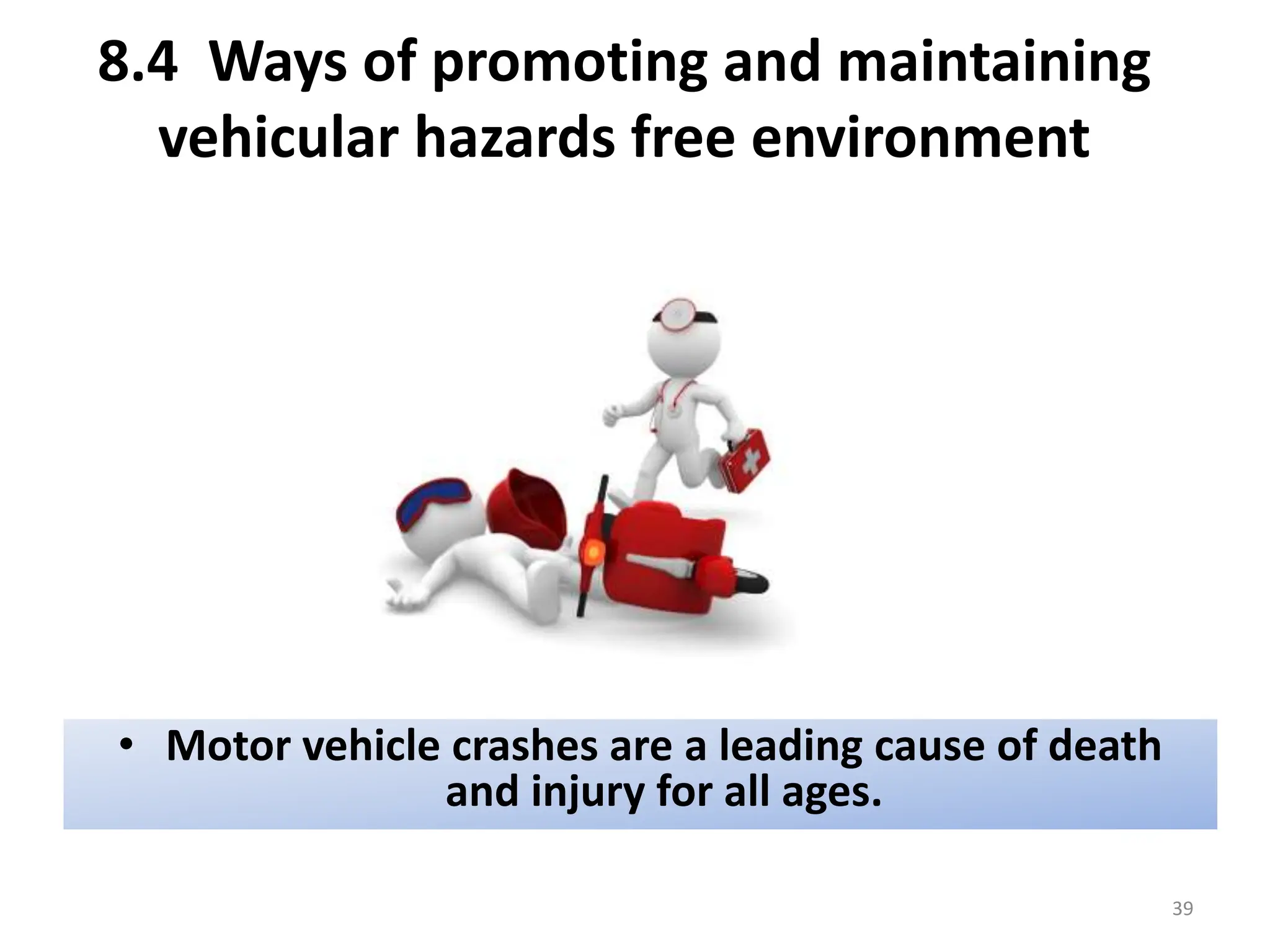
8.4 Ways of promoting and maintaining
vehicular hazards free environment
• Motor vehicle crashes are a leading cause of death
and injury for all ages.
39
10 ways …. promotion
1. Senior Management Commitment & Employee
Involvement
2. Written Policies and Procedures
3. Driver Agreements
4. Motor Vehicle Record (MVR) Checks
5. Crash Reporting and Investigation
6. Vehicle Selection, Maintenance and Inspection
7. Disciplinary Action System
8. Reward/Incentive Program
9. Driver Training/Communication
10. Regulatory Compliance
40
Measurement of vehicular hazards
free environment
• Discussions??
41
Characteristics of hazardous vehicular environment (air pollution, noise
hazards, congestion, accidents)
Emission
• Major emissions are CO2, CO, Nox, SO2 , GHGs.
• The vehicles discharge which consists of poisonous gases like CO, SO2, Nox etc.
• Excessive emission are relapsed by the vehicle which are not properly maintained.
• The Chemical compounds emitted from vehicles linked to birth defects, cancer,
and other serious illnesses
Noise
• Noise pollution is considered as an offence. It’s a public nuisance.
• Vehicles are the major sources of noise.
• Noise doesn’t pollute the air, water or land but it can cause discomfort, irritability
and hearing problems.
42
Characteristics of hazardous vehicular environment (air
pollution, noise hazards, congestion, accidents)
Accidents
• RTA ranks as the 11th leading cause of death and accounts for
2.1% of all deaths globally.
• 90% of the RTA deaths occur in the low income and middle
income countries.
• The most vulnerable road users are pedestrians, cyclists, two-
wheeler riders, and passengers on public transport.
• RTA injuries are becoming the third largest contributor to the
global burden of diseases by 2020.
• RTA deaths are predicted to increase by 83% in developing
countries and to decrease by 27% in the developed countries.
43
Mechanisms of health effects of
vehicular hazards
• Emission: Entry into lungs and blood
circulation, Allergies etc.
• Hazardous Noise: Exposure may lead to effects
on inner air, tympanic membrane and hearing
mechanism.
• Accidents: injury and death
44
Measurement of vehicular hazards (air pollution,
noise hazards, congestion, accidents)
• Air pollution:
– Level of emissions
• Noise:
– Level of noise
– Exposure time
• Accident
– Mortality and morbidity due to RTA
– Case fatality
– Number of accident per year
45
Vehicular environment related human behaviors that need to be encouraged
or discouraged
Encouraged
• Regular servicing of vehicle
• Helmets
• Seatbelts
• Strengthening vehicle emission standard
• Use of electric/solar vehicle
• Deleaded petrol
• Low sulphure in diseal
• Improvement in public transportation system
• Mask and Personal protective Equipment
46
• Discouraged
– Over speed
– Using old vehicles
– Low standards fuels
47
Vehicular environment related human behaviors that need to be encouraged
or discouraged
Don’t for Road safety
• Don't apply breaks suddenly; someone could hit you from
behind.
• Don't get lost in the music in your car.
• Don't let a minor drive your vehicle
• Don't drive if feeling dizzy, or sleepy.
• Don't be rash, lest you crash
• Don't unbalance your vehicle.
• Don't keep ducky of your car open
• Don't mix drinking & driving.
48
Ways of preventing vehicular
hazards
49
Ways of Preventing from emission
hazard
• Reduction in benzene content
• Use of Deleaded petro
• Low sculpture diesel
• Alternative Fuel
• Electric Vehicle
• Hybrid vehicle
50
Ways of Preventing Noise polltion
caused by Vehicle
• Reduce noise at the sources
– Regular and thorough maintainence and servicing of vehicle.
– Lower speed limit
– Maintain traffic volume
• Block the path of noise
– Planting trees around the house/road (Noise barrier)
– Highly absorptive materials. (Acoustic panel, clear plastic sheet etc)
• Increase the path of length
– Municipal lane
– Cycle lane
• Protect the recipient
– Earplugs, earmuffs
51
Preventive Measures for RTA
• Vehicles
– Well-maintained vehicles with good breaks, lighting, tyres etc. will
reduce accidents.
– Older vehicles and highly polluting vehicles should be phased out.
– Vehicles should be provided with seat belts and other necessary safety
provisions (like airbags).
• Condition of roads
– Roads should be well maintained with frequent relaying of road
surfaces and markings of road safety signs.
– Provide proper footpaths for pedestrians and pedestrian crossings at
intersections.
– Provide separate lanes for slow-moving and fast-moving vehicles.
– Roads and junctions should be wide and well lit so that visibility is
good.
52
Preventive Measures for RTA
• Human factor
– Drivers can significantly contribute to reducing the accidents.
– Issuing of the driving license should be strictly based on the minimum proficiency
acquired by the learners from designated driving schools.
– Minimum qualifications should be fixed for different categories of drivers.
– All drivers should be properly trained and should posses a valid driving license.
– Educate the drivers and traveling public about traffic rules.
– Carry out periodic medical checkup especially vision and hearing for the drivers.
– Training on first aid should be compulsory along with heath education and traffic
education for the general public to prevent accidents.
– Indiscriminate honking to be avoided, except as a means of greeting or in dire
emergencies.
• Legislation
– Rules for compulsory wearing of helmets by two wheelers and seat belts by four
wheelers must be implemented.
– Enforce traffic rules by the concerned authorities strictly.
– Removal of stray animals like cattle and removal of encroachments on footpath and road
margins will enable smooth flow of traffic.
– Preventing haphazard parking of vehicles on busy roads and intersections to ensure free
flow of traffic.
53
Preventive Measures for RTA
Management of accident victims
• The importance of the “Golden Hour” in giving adequate treatment to the
accident victim in saving the injured should be highlighted to both the
health personals and the community.
• Provision of medical care/first aid care facilities on highways and busy
roads.
• Provision of ambulances and trained health personals in shifting and
transporting the injured person to nearby hospitals for treatment.
• Awareness creation among all sections of the society to treat accident
victims with sympathy and without fear so that the morbidity and
mortality can be reduced.
54
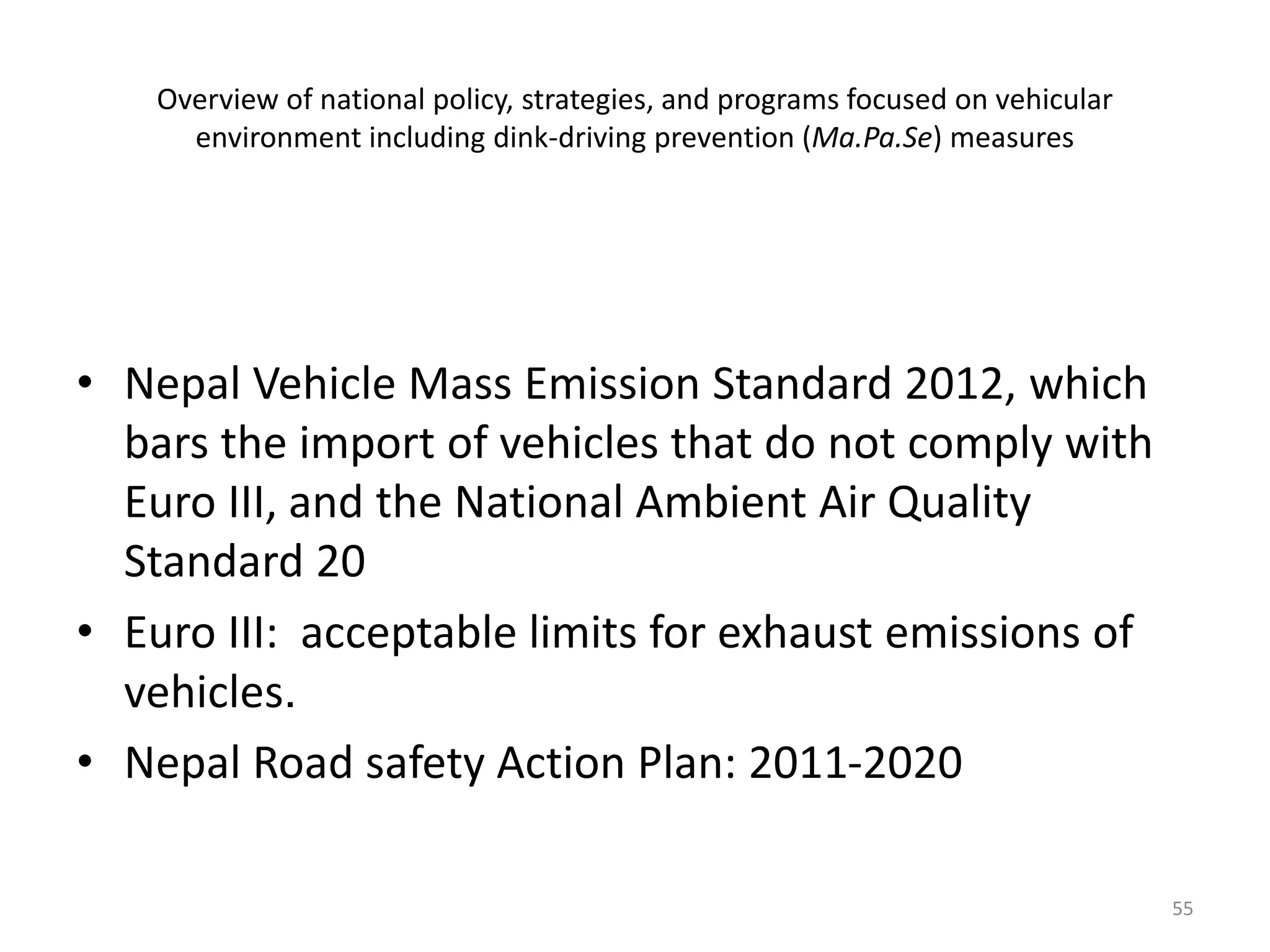
Overview of national policy, strategies, and programs focused on vehicular
environment including dink-driving prevention (Ma.Pa.Se) measures
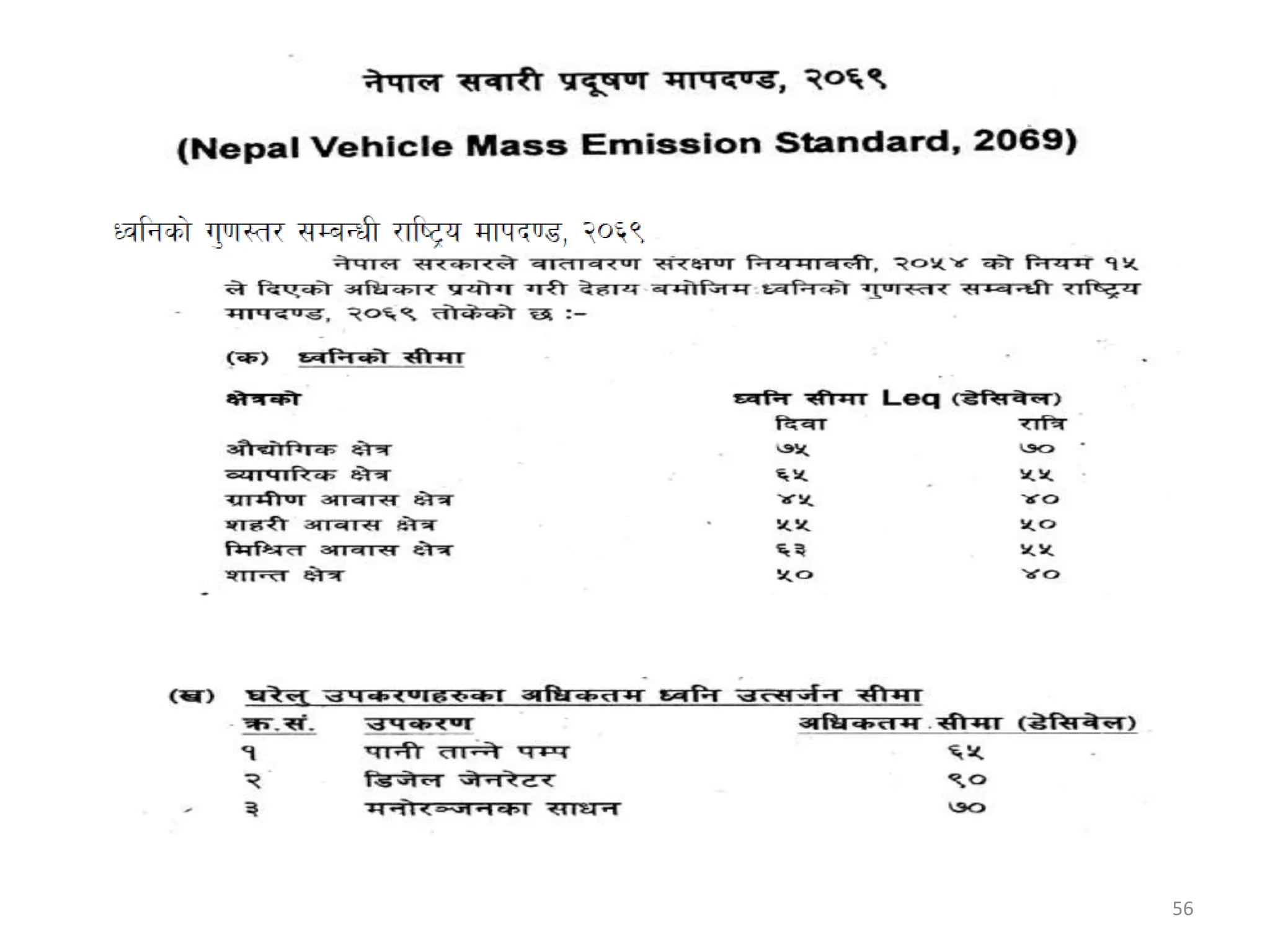
• Nepal Vehicle Mass Emission Standard 2012, which
bars the import of vehicles that do not comply with
Euro III, and the National Ambient Air Quality
Standard 20
• Euro III: acceptable limits for exhaust emissions of
vehicles.
• Nepal Road safety Action Plan: 2011-2020
55
56
How alcohol affects driving?
Many of the functions that we depend on to drive safely are
affected when we drink alcohol:
– The brain takes longer to receive messages from the eye
– Processing information becomes more difficult
– Instructions to the body's muscles are delayed resulting in slower
reaction times.
– blurred and double vision, which affects ability to see things clearly
while driving. And more likely to take potentially dangerous risks act
on urges you normally repress.
57
Breathalyzer
• A breathalyzer or breathalyser (a portmanteau
of breath and analyzer/analyser) is a device
for estimating blood alcohol content(BAC)
from a breath sample.
• Breathalyzer is the brand name (a generalized
trademark) for the instrument that tests the
alcohol level developed by inventor Robert
Frank Borkenstein.
58
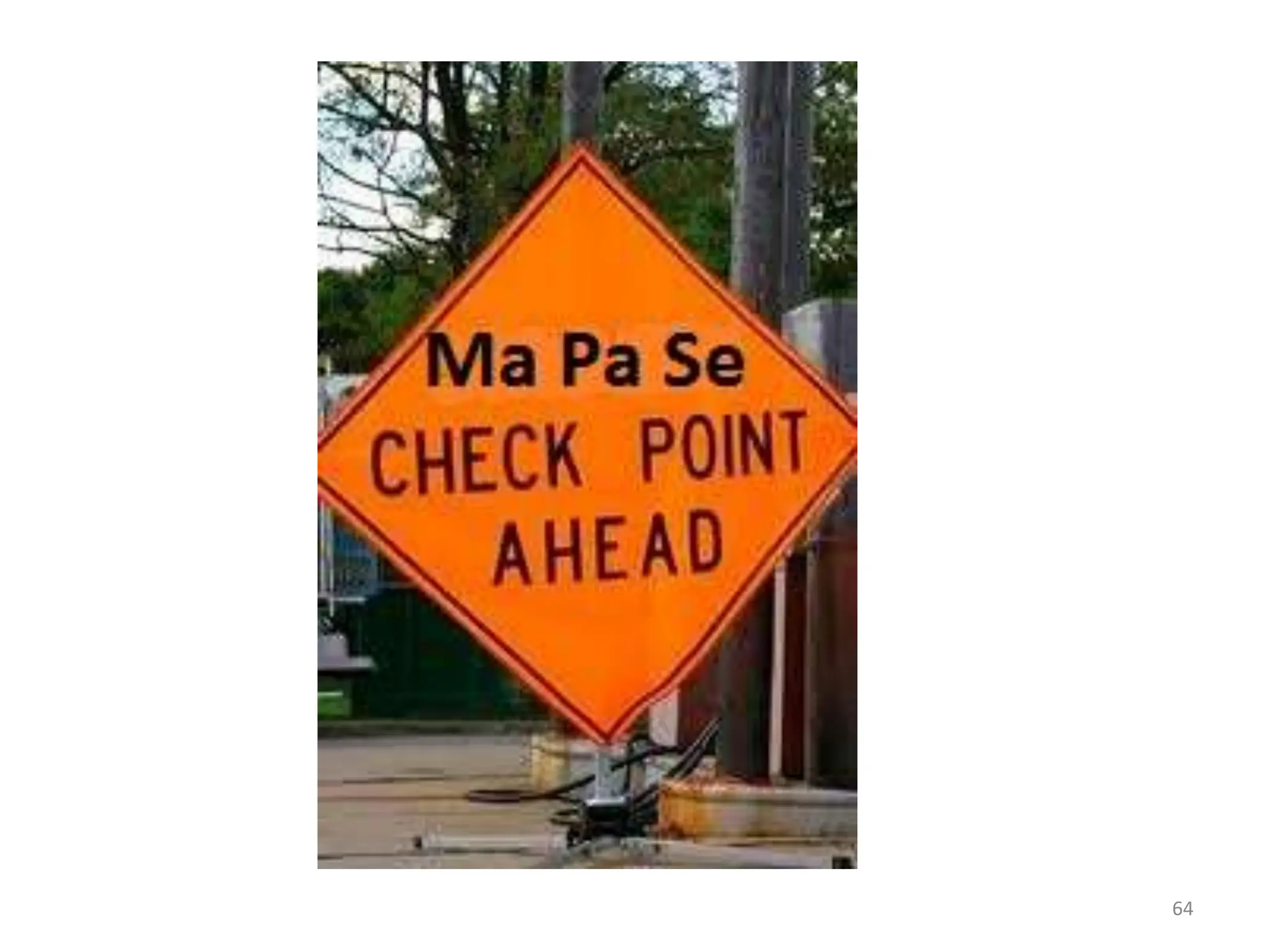
Ma. Pa. Se.
• Breathalyzer testing is regularly used in major
cities like Kathmandu, Pokhara, Biratnagar and
Highways.
• For more verification, driver will be taken to
nearest hospitals for blood and urine test (if
demanded by the driver).
• Licence will be seized instantly. Driver will get
the licence back after attending anti-alcoholic
classes run by Nepal Traffic Police and fine will
be charged NRS 1000 59
MA. PA. SE
• Blood Alcohol Concentration (BAC) is ≥ 0.8 g/dl
• Anti drink drive campaign was started by traffic
police from December 2011.
• Drivers of Public Transport vehicles are taken in
custody and charged under “Public Offence Act.”
• Traffic Police is conducting Awareness
Campaigns/classes for Drink & Drive and Lane
Discipline Violators which is compulsory.
• Everyday 100-120 drink and drive violators are
found.
60
MA. PA. SE
• Everyday 100-120 drink and drive violators are
found.
• Positive Response by Societies/social
harmony.
• The lower limit of alcohol is not determined
(Zero Figure).
• Need to be more Equipped (Blood, Urine Test-
kit).
61
VEHICLE AND TRANSPORT
MANAGEMENT ACT 2049
• Article 142 : Driving under influence of alcohol
is prohibited.
• Article 164 (j) : Transport Inspector or at least
ASI can fine Rs. 25, 50-100, 200 for drink and
drive.
• Article 170 has delegated Authority to the
Traffic Police to fine Rs. 1000.
62
Roles and responsibilities of public health professionals/workers
regarding vehicular environment including hazards
63
64
Thank you……………
65

Vehicular Hazards and Nepal learning material

  • 1.
  • 2.
  • 3.
    • Germany’s federalcouncil, the Bundesrat, has passed a resolution calling for a ban on combustion engine cars by 2030. 3
  • 4.
    Vehicle • A vehicleis a mobile machine that transports people or cargo. • Typical vehicles include wagons, bicycles, motor vehicles, railed vehicles, watercraft, aircraft and spacecraft. • A motor vehicle is a self-propelled road vehicle or off-road vehicle, commonly wheeled, that does not operate on rails, such as trains or trams and used for the transportation of passengers, or passengers and property. 4
  • 5.
    Vehicle • Motorized vehicleconsisting of four wheels and powered by an internal engine. Automobiles are used to transport people and items from one location to another location. After years or various designs, inventors were able to develop a functional general design that is utilized by major automakers as the foundation of their designs. • Automobiles generally use gasoline to fuel the internal engine, but technological advances have led to the design of cars that run on electricity and even water. 5
  • 6.
    Vehicles • Air crafts •Land Crafts • Water crafts 6
  • 7.
    Vehicles in Nepal •Bus • Minibus/Mini Truck • Crane/Excavator/ Tuck/Tipper • Car/Jeep/Van • Pick up • Micro • Tempo • Motorcycle • Tractor/Power tailor (Sources: Website of Transportation management office) 7
  • 8.
    • Any typesof hazards related to vehicle or transportation. Category of vehicular hazards:  emission,  noise,  Congestion  accidents etc. 8 Vehicular hazards
  • 9.
    Categories of VehicularHazards – Paradoxical (Transportation and Economy) – Environmental Externalities – Vehicles : Sources of emission and multiple environmental impacts • Direct Impacts: Emission, Noise • Indirect Impacts: Secondary effects of transport activities on environmental systems. • Cumulative Impacts: The additive, multiplicative or synergetic consequences of transport activities. E.g. Climate change, 9
  • 10.
    Emissions • Cars andtrucks produce air pollution throughout their life, including pollution emitted during vehicle operation, refueling, manufacturing, and disposal. Additional emissions are associated with the refining and distribution of vehicle fuel. 10
  • 11.
    Emissions • Vehicles travellingin major metropolitan areas are estimated to account for 80% of all carbon monoxide, 50% of hydrocarbons, 30-40% of oxides of nitrogen and almost 1005 0f the lead present as air pollutant. (KHITOLYA) • In India, transport sector alone account for 70% of the air pollution in major cities. 11
  • 12.
    Main causes ofPollution from vehicle • Fuel Tank: Leakage or evaporation • Crank Case: Improper or worn out rings • Fuel Pump: Improper condition of elementss, delivery valves etc • Nozzle: Improper opening or nozzle pressure • Overflow valve: Improper working resullts in excessive fuel consumption • And Return pipe: Release of excessive smoke • Engine Head: Improper working of Inlet/Exhaust valve 12
  • 13.
    Major emissions • PartuculateMatter (PM) • Diseal Particulate • Hydrocarbons (HC) • Nitrogen oxides (NOx) • Carbon monoxide (CO) • Sulfur dioxide (SO2) • Hazardous air pollutants (toxics) • Greenhouse gases (GHGs) 13
  • 14.
    • Particulate matter(PM): – Murky color (soots and metals) – Can penetrate deep into lungs – Mostly formed by incomplete combustion of diesel fuel. – Secondary pollution from hydrocarbons, nitrogen oxides, and sulfer dioxides 14
  • 15.
    • HC – Reactwith Nox in the presence of sunlight to form ground level ozone, a primary ingredient in smog. – In ground level this gas irritates the respiratory system, causing coughing, choking, and reduced lung capacity 15
  • 16.
    • Nitrogen oxides(NOx) – These pollutants cause lung irritation and weaken the body's defenses against respiratory infections such as pneumonia and influenza. – In addition, they assist in the formation of ground level ozone and particulate matter. 16
  • 17.
    • Carbon monoxide(CO). – This odorless, colorless, and poisonous gas is formed by the combustion of fossil fuels such as gasoline and is emitted primarily from cars and trucks. – When inhaled, CO blocks oxygen from the brain, heart, and other vital organs. – Fetuses, newborn children, and people with chronic illnesses are especially susceptible to the effects of CO. 17
  • 18.
    • Sulfur dioxide(SO2). – Power plants and motor vehicles create this pollutant by burning sulfur-containing fuels, especially diesel. – Sulfur dioxide can react in the atmosphere to form fine particles and poses the largest health risk to young children and asthmatics. 18
  • 19.
    • Hazardous airpollutants (toxics). – These chemical compounds have been linked to birth defects, cancer, and other serious illnesses. – The EPA estimates that the air toxics emitted from cars and trucks — which include Benzene, acetaldehyde, and 1,3-butadiene — account for half of all cancers caused by air pollution. 19
  • 20.
    • Greenhouse gases. –Motor vehicles also emit pollutants, such as carbon dioxide. – In fact, cars and trucks account for over one-fifth of the United States' total global warming pollution; transportation, which includes freight, trains, and airplanes, accounts for around thirty percent of all heat-trapping gas emissions. 20
  • 21.
    Noise Pollution • SoundPollution • Noise can be described as sound without agreeable musical quality or as an unwanted or undesired sound. • influence on environment and life quality of human beings • Traffic noise is the second biggest environmental problem affecting health after air pollution.(WHO) 21
  • 22.
    Noise • Environmental noise •“noise emitted from all sources except for noise at the industrial workplace” • “unwanted or harmful outdoor sound created by human activities, including noise from road, rail, airports and from industrial sites”. – Guidelines for community Noise (WHO) 22
  • 23.
  • 24.
    Causes of NoisePollution • Industrialization • Poor Urban Planning • Social Events • Transportation • Construction Activities • Household Chores 24
  • 25.
    Causes of TrafficNoise Noise is produced by defective mufflers, produced by engine, exhaust and tiers. • The volume of traffic • The speed of the traffic • The number of trucks in the flow of traffic. The traffic noise is not usually a serious problem for people who live more than 500 feet from heavily travelled freeways or more than 100 to 200 feet from lightly travelled roads. 25
  • 26.
    Vehicular Noise • Mainsource of environmental noise • Generally, Heavier vehicle: more noise ( Except helicopter, 2 or 3 wheeler vehicles) • Noise generation: inside engine, frictional contacts 26
  • 27.
    Noise Level • Amountof Noise • Time of exposure • Sound louder than 80 decibels are potential hazardous 27
  • 28.
    Noise chart • Painful –150 dB= Reock music peak – 140 dB= Firerms, air raid siren, jet engine – 130 dB= Jackhhammer – 120 dB= Jet plane take-off, amplified rock music at 4-6 ft, car stereo, Band Practice • Extremely Loud – 110 dB= Rock music, model airplane – 106 dB= timpani and bass drum rolls – 100 db= snowmobile, chain saw, pneumatic drill – 90 dB= lawnmower, shop tools, truck traffic, subway28
  • 29.
    Noise chart…. • VeryLoud – 80 dB= alarm clock, busy street – 70 dB= Busy traffic, Vacuum cleaner – 60dB= Conservation, dishwater • Moderate – 50dB= Moderate rainfall – 40 dB= Quite room • Faint – 30 dB= Whisper, quite library 29
  • 30.
  • 31.
    Traffic Congestion • Conditionon transport networks that occurs as use increases, and is characterized by slower speeds, longer trip times, and increased vehicular queuing. 31
  • 32.
    Traffic Congestions • Whentraffic demand is great enough that the interaction between vehicles slows the speed of the traffic stream, this results in some congestion. 32
  • 33.
    Road Traffic Accidents •> 1.25 million people die each year • Leading cause of death: 15-29 years. • RTA ranks as the 11th leading cause of death and accounts for 2.1% of all deaths globally. • 90% world's fatalities occur in low- and middle-income countries, even though these countries have approx. 54% of the world's vehicles. 33
  • 34.
    Road Traffic Accidents •Nearly 50% of death of are “vulnerable road users”: pedestrians, cyclists, and motorcyclists. • RT crashes cost most countries 3% of their GDP • Without sustained action, RT crashes are predicted to become the seventh leading cause of death by 2030. • The newly adopted 2030 Agenda for SDG has set an ambitious target of halving the global number of deaths and injuries from RT crashes by 2020. 34
  • 35.
    Risk of RTA •Speeding (An adult pedestrian’s risk of dying is less than 20% if struck by a car at 50 km/h and almost 60% if hit at 80 km/h.) • Driving under the influence of alcohol and other psychoactive substances (BAC is ≥ 0.04 g/dl) • Nonuse of motorcycle helmets, seat-belts, and child restraints • Distracted driving • Unsafe road infrastructure • Unsafe vehicles • Inadequate post-crash care • Inadequate law enforcement of traffic laws 35
  • 36.
    Characteristics of VehicularHazard free environment • Major source of air pollution is obstructed • Makes urban life more easier • Help to Improve air quality. • Ideal state • Produces less harmful impacts to the environment. • Less impacts on Human Health • No emission of Pollutant like CO, CO2, Nox. • Control threats to harms • Prevention of Global warming • Foster clean and safe physical environment • Alternative fuels except gasoline 36
  • 37.
    Characteristics of VehicularHazard free environment • Eco-friendly materials • Safe to Drive • Cost Effective • Reduced Noise Pollution • No Traffic jams • Less number of death and injuries from road traffic accidents 37
  • 38.
    Need for avehicular hazards free environment for healthful living • Physical – Provides fresh air for breathing – Provides physical exercise – Low health problems – Calm environment • Social – Provide peacefulness – Prevention from congestion • Mental – Irriytabilty, anxiety reduction 38
  • 39.
    8.4 Ways ofpromoting and maintaining vehicular hazards free environment • Motor vehicle crashes are a leading cause of death and injury for all ages. 39
  • 40.
    10 ways ….promotion 1. Senior Management Commitment & Employee Involvement 2. Written Policies and Procedures 3. Driver Agreements 4. Motor Vehicle Record (MVR) Checks 5. Crash Reporting and Investigation 6. Vehicle Selection, Maintenance and Inspection 7. Disciplinary Action System 8. Reward/Incentive Program 9. Driver Training/Communication 10. Regulatory Compliance 40
  • 41.
    Measurement of vehicularhazards free environment • Discussions?? 41
  • 42.
    Characteristics of hazardousvehicular environment (air pollution, noise hazards, congestion, accidents) Emission • Major emissions are CO2, CO, Nox, SO2 , GHGs. • The vehicles discharge which consists of poisonous gases like CO, SO2, Nox etc. • Excessive emission are relapsed by the vehicle which are not properly maintained. • The Chemical compounds emitted from vehicles linked to birth defects, cancer, and other serious illnesses Noise • Noise pollution is considered as an offence. It’s a public nuisance. • Vehicles are the major sources of noise. • Noise doesn’t pollute the air, water or land but it can cause discomfort, irritability and hearing problems. 42
  • 43.
    Characteristics of hazardousvehicular environment (air pollution, noise hazards, congestion, accidents) Accidents • RTA ranks as the 11th leading cause of death and accounts for 2.1% of all deaths globally. • 90% of the RTA deaths occur in the low income and middle income countries. • The most vulnerable road users are pedestrians, cyclists, two- wheeler riders, and passengers on public transport. • RTA injuries are becoming the third largest contributor to the global burden of diseases by 2020. • RTA deaths are predicted to increase by 83% in developing countries and to decrease by 27% in the developed countries. 43
  • 44.
    Mechanisms of healtheffects of vehicular hazards • Emission: Entry into lungs and blood circulation, Allergies etc. • Hazardous Noise: Exposure may lead to effects on inner air, tympanic membrane and hearing mechanism. • Accidents: injury and death 44
  • 45.
    Measurement of vehicularhazards (air pollution, noise hazards, congestion, accidents) • Air pollution: – Level of emissions • Noise: – Level of noise – Exposure time • Accident – Mortality and morbidity due to RTA – Case fatality – Number of accident per year 45
  • 46.
    Vehicular environment relatedhuman behaviors that need to be encouraged or discouraged Encouraged • Regular servicing of vehicle • Helmets • Seatbelts • Strengthening vehicle emission standard • Use of electric/solar vehicle • Deleaded petrol • Low sulphure in diseal • Improvement in public transportation system • Mask and Personal protective Equipment 46
  • 47.
    • Discouraged – Overspeed – Using old vehicles – Low standards fuels 47 Vehicular environment related human behaviors that need to be encouraged or discouraged
  • 48.
    Don’t for Roadsafety • Don't apply breaks suddenly; someone could hit you from behind. • Don't get lost in the music in your car. • Don't let a minor drive your vehicle • Don't drive if feeling dizzy, or sleepy. • Don't be rash, lest you crash • Don't unbalance your vehicle. • Don't keep ducky of your car open • Don't mix drinking & driving. 48
  • 49.
    Ways of preventingvehicular hazards 49
  • 50.
    Ways of Preventingfrom emission hazard • Reduction in benzene content • Use of Deleaded petro • Low sculpture diesel • Alternative Fuel • Electric Vehicle • Hybrid vehicle 50
  • 51.
    Ways of PreventingNoise polltion caused by Vehicle • Reduce noise at the sources – Regular and thorough maintainence and servicing of vehicle. – Lower speed limit – Maintain traffic volume • Block the path of noise – Planting trees around the house/road (Noise barrier) – Highly absorptive materials. (Acoustic panel, clear plastic sheet etc) • Increase the path of length – Municipal lane – Cycle lane • Protect the recipient – Earplugs, earmuffs 51
  • 52.
    Preventive Measures forRTA • Vehicles – Well-maintained vehicles with good breaks, lighting, tyres etc. will reduce accidents. – Older vehicles and highly polluting vehicles should be phased out. – Vehicles should be provided with seat belts and other necessary safety provisions (like airbags). • Condition of roads – Roads should be well maintained with frequent relaying of road surfaces and markings of road safety signs. – Provide proper footpaths for pedestrians and pedestrian crossings at intersections. – Provide separate lanes for slow-moving and fast-moving vehicles. – Roads and junctions should be wide and well lit so that visibility is good. 52
  • 53.
    Preventive Measures forRTA • Human factor – Drivers can significantly contribute to reducing the accidents. – Issuing of the driving license should be strictly based on the minimum proficiency acquired by the learners from designated driving schools. – Minimum qualifications should be fixed for different categories of drivers. – All drivers should be properly trained and should posses a valid driving license. – Educate the drivers and traveling public about traffic rules. – Carry out periodic medical checkup especially vision and hearing for the drivers. – Training on first aid should be compulsory along with heath education and traffic education for the general public to prevent accidents. – Indiscriminate honking to be avoided, except as a means of greeting or in dire emergencies. • Legislation – Rules for compulsory wearing of helmets by two wheelers and seat belts by four wheelers must be implemented. – Enforce traffic rules by the concerned authorities strictly. – Removal of stray animals like cattle and removal of encroachments on footpath and road margins will enable smooth flow of traffic. – Preventing haphazard parking of vehicles on busy roads and intersections to ensure free flow of traffic. 53
  • 54.
    Preventive Measures forRTA Management of accident victims • The importance of the “Golden Hour” in giving adequate treatment to the accident victim in saving the injured should be highlighted to both the health personals and the community. • Provision of medical care/first aid care facilities on highways and busy roads. • Provision of ambulances and trained health personals in shifting and transporting the injured person to nearby hospitals for treatment. • Awareness creation among all sections of the society to treat accident victims with sympathy and without fear so that the morbidity and mortality can be reduced. 54
  • 55.
    Overview of nationalpolicy, strategies, and programs focused on vehicular environment including dink-driving prevention (Ma.Pa.Se) measures • Nepal Vehicle Mass Emission Standard 2012, which bars the import of vehicles that do not comply with Euro III, and the National Ambient Air Quality Standard 20 • Euro III: acceptable limits for exhaust emissions of vehicles. • Nepal Road safety Action Plan: 2011-2020 55
  • 56.
  • 57.
    How alcohol affectsdriving? Many of the functions that we depend on to drive safely are affected when we drink alcohol: – The brain takes longer to receive messages from the eye – Processing information becomes more difficult – Instructions to the body's muscles are delayed resulting in slower reaction times. – blurred and double vision, which affects ability to see things clearly while driving. And more likely to take potentially dangerous risks act on urges you normally repress. 57
  • 58.
    Breathalyzer • A breathalyzeror breathalyser (a portmanteau of breath and analyzer/analyser) is a device for estimating blood alcohol content(BAC) from a breath sample. • Breathalyzer is the brand name (a generalized trademark) for the instrument that tests the alcohol level developed by inventor Robert Frank Borkenstein. 58
  • 59.
    Ma. Pa. Se. •Breathalyzer testing is regularly used in major cities like Kathmandu, Pokhara, Biratnagar and Highways. • For more verification, driver will be taken to nearest hospitals for blood and urine test (if demanded by the driver). • Licence will be seized instantly. Driver will get the licence back after attending anti-alcoholic classes run by Nepal Traffic Police and fine will be charged NRS 1000 59
  • 60.
    MA. PA. SE •Blood Alcohol Concentration (BAC) is ≥ 0.8 g/dl • Anti drink drive campaign was started by traffic police from December 2011. • Drivers of Public Transport vehicles are taken in custody and charged under “Public Offence Act.” • Traffic Police is conducting Awareness Campaigns/classes for Drink & Drive and Lane Discipline Violators which is compulsory. • Everyday 100-120 drink and drive violators are found. 60
  • 61.
    MA. PA. SE •Everyday 100-120 drink and drive violators are found. • Positive Response by Societies/social harmony. • The lower limit of alcohol is not determined (Zero Figure). • Need to be more Equipped (Blood, Urine Test- kit). 61
  • 62.
    VEHICLE AND TRANSPORT MANAGEMENTACT 2049 • Article 142 : Driving under influence of alcohol is prohibited. • Article 164 (j) : Transport Inspector or at least ASI can fine Rs. 25, 50-100, 200 for drink and drive. • Article 170 has delegated Authority to the Traffic Police to fine Rs. 1000. 62
  • 63.
    Roles and responsibilitiesof public health professionals/workers regarding vehicular environment including hazards 63
  • 64.
  • 65.