Elderly health
Nabin Lamichhane
MPH (BPKIHS), M. Phil. (TU)
Elderly health
• Concept of elderly women’s/men health, including healthy and
active aging in relation to public health promotion, prevention,
protection point of view)
• Indicators of healthy and active aging and their measurement
• Overview of health problems, health risks and diseases of elderly
people
• Characteristics of public health service to the elderly people
• Concept and methods of palliative service to the elderly people,
including pain management, comfortable and dignified dying
• Role of family, society, government and the health system for
ensuring health of the aged
• Situation analysis, problems and issues, gaps and public health
concerns and ways forward : in the context of national and global
perspective
• Critical appraisal of elderly health policies, programs, guidelines and
implementation strategies from the perspective of adequacy of
public health measures
• AGING is NOT a Disease
• AGING is a Developmental Process
Aging
• When talking about ageing, it is essential to
distinguish between population or demographic
ageing as “the process whereby older individuals
become a proportionately larger share of the total
population "and individual ageing, the process of
individuals growing older. This individual process of
ageing is multidimensional and involves physical,
psychological and social changes.
• Individual ageing in terms of health and well-being
and experiences of later life, so the main focus should
be given on population ageing.
Concept of Aging/old
• 60 years: UN
• However, in many developed countries, Age
65 used as a reference point for older persons
as this is often the age at which persons
become eligible for old-age social security
benefits.
• So, there is no exact definition of “old” as this
concept has different meanings in different
societies.
Who is “Old”?
• Defining “old” is further challenged by the
changing average lifespan of human beings.
Around 1900, average life expectancy was
between 45 and 50 years in the developed
countries of that time. Now, life expectancy in
developed countries reaches 80 years.
Concept of Old age
• There are other definitions of “old” that
go beyond chronological age. Old age as
a social construct is often associated with
a change of social roles and activities, for
example, becoming a grandparent or a
pensioner. Older persons often define old
age as a stage at which functional, mental
and physical capacity is decline and
people are more prone to disease or
disabilities.
Concept of Old age
• Chronological definitions of old age were not
viewed as so important in signifying old age as
changes in physical and mental capacity.
• Older persons are a highly diverse population
group, in terms of, for example, age, sex,
ethnicity, education, income and health. It is
important to recognize this in order to
adequately address the needs of all older
persons, especially the most vulnerable.
Gender differences: Aging
• Women tend to live longer than men, with the result that
there are more older women worldwide than older men.
In 2012, for every 100 women aged 60, there were 84
men. The proportion of women rises further with age.
For every 100 women aged 80 or over worldwide, there
are only 61 men. The so-called “feminization of ageing”,
particularly the relatively large proportion of the “oldest
old” who are women, has important implications for
policy.
• Women and men differ on several issues that are relevant
for ageing policies. They have different health and
morbidity patterns and women usually have lower
income but larger and better family support networks.
Older women
• Men and women experience old age differently.
• Older women tend to have stronger social networks than men
and there is evidence that mothers are more likely than fathers to
receive material and emotional support from their adult children.
• Older women are also more likely than older men to be
caregivers of children or sick relatives, particularly in families
affected by migration or illness. Men’s greater economic role
means that loss of earning power can have negative
consequences for their roles in society after they have retired.
• Traditional roles in the household can result in older men
becoming more isolated once they retire from their jobs.
Old Women ….
• Both older men and older women may
face age discrimination.
• However, older women also face the
cumulative effects of gender
discrimination throughout their lives,
including less access to education and
health services, lower earning capacity
and limited access to rights to land
ownership, contributing to their
vulnerability in older age.
Older woman
• A combination of age and sex discrimination also
puts older women at increased risk of violence
and abuse.
• Despite significant progress in the development of
international legal norms, standards and policies,
data on elder abuse of women are very limited.
• In general, a lack of key indicators and data
disaggregated by age and sex is a barrier to
improving programmes and designing laws and
policies that respond effectively to the different
situations of older women and men
• The loss of a spouse can also make women more
vulnerable.
Older Women
• While the emphasis in incorporating
gender concerns into policies and
programmes related to ageing is typically
on the vulnerabilities of older women, a
more balanced perspective that
recognizes gender as a potential marker
of vulnerability for various aspects of
well-being is needed to address both male
and female disadvantages.
The reason for investing public
resources in older people
• Older people are a valuable and productive
economic resource that should not be stifled
by outmoded public policies such as
mandatory retirement or other disincentives
to work beyond certain ages.
• Inherent in the challenge of population ageing
are huge opportunities, because older people
who live healthy lives can continue to be
productive for longer than in the past.
The reason for investing public
resources in older people
• On ethical and humanitarian grounds, devoting
resources to older people is arguably the right
thing to do, the fair thing to do and a just thing to
do.
• Older people have a fundamental human right to
make claims on social resources, such as health
care. These claims are grounded in and justified
by international law, for example, in the 1948
Universal Declaration of Human Rights.
The reason for investing public
resources in older people
• The formation of social capital and societies
that are cohesive, peaceful, equitable, and
secure requires that we attend to the needs of
all groups, especially the most vulnerable,
such as older people. Doing so will strengthen
societal and cross-generational cohesion.
The reason for investing public
resources in older people
• Governments have a natural and fundamental
role to play in the health sector, for everyone,
including older people, because unregulated
markets do a poor job of achieving socially
desirable and economically efficient levels of
health provision. Infectious disease puts
communities at risk, health providers can use
their informational advantages to exploit health
consumers, and problems of moral hazard and
adverse selection exist.
Promoting health and well-being at older ages
• Changes are needed around the globe to continue
to adapt health systems to serve a growing number
and proportion of older persons and to maximize
health and well-being at all ages. The WHO
emphasizes that these changes need not imply
exorbitant increases in national health budgets,
even in countries with rapidly ageing populations.
Indeed, technology-related changes in health care,
growth in personal incomes and cultural norms and
attitudes surrounding end-of-life care are far more
influential than shifts in population age structure in
driving increases in health care expenditures.
Promoting health and well-being at older ages
• Older persons are tremendously diverse with
respect to their health and wellbeing.
• Whether the growing numbers of older persons
are living their later years in good health is a
crucial consideration for policy development. If
the added years of life expectancy are spent with
disability, then demographic trends could
portend substantially increased demand for
health care.
• Viewed as a whole the problem of ageing is no
problem at all. It is only the pessimistic way of
looking at a great triumph of civilization. …
Notestein, 1954
Challenges of an Ageing Population
• Rapid Population Ageing in Developing
Countries
• Disability and the Double Burden of Disease
• Changing An Outdated Paradigm
• The Feminization of Ageing
• Ethics and Inequities
Healthy Ageing
WHO
• Healthy Ageing is about creating the
environments and opportunities that enable
people to be and do what they value throughout
their lives. Everybody can experience Healthy
Ageing. Being free of disease or infirmity is not a
requirement for Healthy Ageing as many older
adults have one or more health conditions that,
when well controlled, have little influence on
their wellbeing.
Active Ageing
• If ageing is to be a positive experience, longer
life must be accompanied by continuing
opportunities for independence and health,
productivity, and protection. WHO uses the
term “active ageing” (Adopted in late 1990) to
express the process for achieving this vision
Active Aging
• “Active ageing is the process of optimizing
opportunities for physical, social, and mental well-
being throughout the life course, in order to extend
healthy life expectancy, productivity and quality of
life in older age.”- WHO
• Other international organizations, academic circles
and governmental groups (including the G8, the
Organization for Economic Cooperation and
Development, the International Labour Organization
and the Commission of the European Communities)
are also using “active ageing”, primarily to express
the idea of continuing involvement in socially
productive activities and meaningful work
Active Aging
• The word “active” refers to continuing
involvement in social, economic, spiritual,
cultural and civic affairs, not just the ability to
be physically active.
• Older people who are ill or have physical
restrictions due to disabilities can remain
active contributors to their families, peers,
communities and nations.
Active Aging
• An active ageing approach to policy and
programme development has the potential to
address all of the challenges of both individual
and population ageing.
Active Aging
• Potentially, when health, labour market, employment,
education and social policies support active ageing:
– Fewer adults will die prematurely in the highly productive
stages of life
– Fewer older people will have disabilities and pain
associated with chronic diseases
– More older people will remain independent and enjoy a
positive quality of life
– More older people will continue to make a productive
contribution to the economy and to important social,
cultural and political aspects of society in paid and unpaid
jobs and in domestic and family life
– Fewer older people will need costly medical treatment and
care services (WHO, forthcoming).
Active Aging: Role of Public Health
• To promote active ageing, health policies and programmes
need to:
– Reduce the burden of excess disabilities, especially in poor and
marginalized populations
– Reduce the risk factors associated with the causes of major
diseases and increase the factors that protect health and well-
being throughout the life course
– Develop primary health care systems that emphasize health
promotion, disease prevention and the provision of cost-
effective, equitable and dignified long-term care.
– Advocate and collaborate with other sectors (such as education,
housing and employment) to affect positive changes in the
broad determinants of healthy, active ageing .
DEFINITION OF THE INDICATORS OF
POPULATION AGEING
• AGEING INDEX
• DEPENDENCY RATIO
• GROWTH RATE
• ILLITERACY RATE
• LABOUR FORCE PARTICIPATION
• LIFE EXPECTANCY
• MEDIAN AGE
• PARENT SUPPORT RATIO
• POTENTIAL SUPPORT RATIO
• SEX RATIO
• SURVIVAL RATE
• TOTAL FERTILITY RATE
Source: Population Division, DESA, United Nations
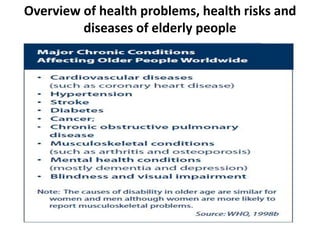
Overview of health problems, health risks and
diseases of elderly people
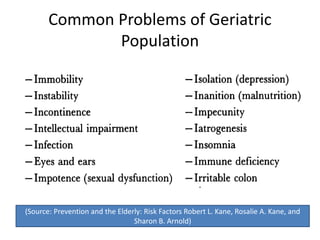
Common Problems of Geriatric
Population
(Source: Prevention and the Elderly: Risk Factors Robert L. Kane, Rosalie A. Kane, and
Sharon B. Arnold)
Health characteristics in older age
• Movement Functions
– After a peak in early adulthood, muscle mass tends to
decline with increasing age, and this can be associated
with declines in strength and musculoskeletal function.
– Ageing is also associated with significant changes in bones
and joints. With age, bone mass, or density, tends to fall,
particularly among postmenopausal women.
(Osteoporosis)
– Gait speed is influenced by muscle strength, joint
limitations and other factors, such as coordination and
proprioception, and has been demonstrated to be one of
the most powerful predictors of future outcomes in older
age.
Health characteristics in older age
• Sensory functions
– Ageing is frequently associated with declines in both vision and
hearing, although there is marked diversity in how this is
experienced at an individual level.
– Age-related hearing loss (known as presbycusis) is bilateral and
most marked at higher frequencies. It results from cochlear
ageing; environmental exposures, such as noise; genetic
predisposition; and increased vulnerability from physiological
stressors and modifiable lifestyle behaviours
– Age is also associated with complex functional changes in the
eye that result in presbyopia, a decrease in focusing ability that
leads to the blurring of near vision, which often becomes
apparent in midlife
– increasing opacity of the crystalline lens, which can ultimately
result in cataract.
Health characteristics in older age
• Cognitive functions
– Deterioration in memory and the speed of
information processing is common, and complaints
about it are frequently reported by older people.
– Ageing is associated with reductions in the capacity to
learn and master tasks that involve active
manipulation, reorganization, integration or
anticipation of various memory items, there is little
association with memory for factual information,
knowledge of words and concepts, memory related to
the personal past, and procedural memory (for
example, for the skills needed to ride a bicycle)
Health characteristics in older age
• Immune function
– Immune function, particularly T-cell activity,
declines with age
– The capacity to respond to new infecWorld report
on ageing and health Chapter 3 Health in older
age 57 tions (and vaccination) falls in later life, a
trend known as immunosenescence
Health characteristics in older age
• Sexuality
– sexual activity in older age are limited
– These impacts may be either direct (for example,
vascular disease resulting in erectile dysfunction)
or indirect (for example, the medication required
for an unrelated disease may cause decreased
libido), or result from the psychosocial
consequences of a disease or its treatment (for
example, the changes in self-image in women that
may occur after a mastectomy).
Health characteristics in older age
• Functions of the skin
– Skin suffers progressive decrements with age that
result from damage caused by physiological
mechanisms, genetic predisposition and external
insults, particularly sun exposure
– The loss of collagen and elastin fibres in the
dermis can reduce the tensile strength of the skin,
and progressive vascular atrophies can leave
patients more susceptible to dermatitis, pressure
ulcers and skin tears
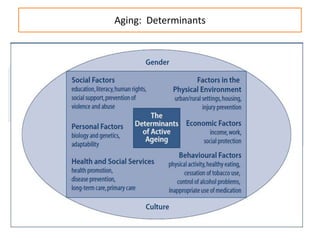
Aging: Determinants
Risk factors of ill health among older
people
• As people age, they become more susceptible
to disease and disability.
– Injury: Falls (steeply with age), Accidents
– Development of non-communicable diseases
(Poor nutrition, low physical activity, tobacco,
alcohol, smoking, lack of exercise etc)
– poverty
– Social isolation and exclusion, mental health
disorders
– Elder maltreatment.
Characteristics of public health
service to the elderly people
• As people age, their health needs tend to become more
complex with a general trend towards declining capacity
and the increased likelihood of having one or more chronic
diseases. Health services are often designed to cure acute
conditions or symptoms and tend to manage health issues
in disconnected and fragmented ways that lack
coordination across care providers, settings and time.
Health systems need to be transformed so that they can
ensure affordable access to evidence-based medical
interventions that respond to the needs of older people
and can help prevent care dependency later in life.
Characteristics of public health
service to the elderly people
• The Age-friendly Health services Principles
address three areas:
– Information, education, communication and
training,
– Health care management systems, and
– The physical environment of the primary health
care centre.
Characteristics of public health
service to the elderly people
• Integrated care for older people (ICOPE): WHO
– a comprehensive assessment and care plan shared
with all providers
– common care and treatment goals across different
providers
– community outreach and home-based
interventions
– support for self-management
– comprehensive referral and monitoring processes
– community engagement and caregiver support
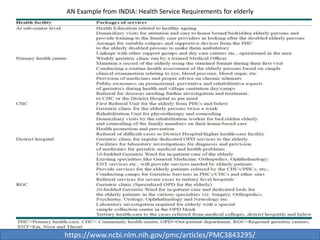
AN Example from INDIA: Health Service Requirements for elderly
https://www.ncbi.nlm.nih.gov/pmc/articles/PMC3843295/
Concept and methods of palliative
service to the elderly people,
• Palliative care : An important public health
issue due to population ageing, the increasing
number of older people in most societies and
insufficient attention to their complex needs.
• Focuses on improving the symptoms, dignity
and quality of life of people approaching the
end of their lives and on the care of and
support for their families and friends.
Need for palliative care to elderly
• Ageing demographics
• Changing disease patterns
• Complex needs of older people
Palliative care
WHO Definition
• “…an approach that improves the quality of life of
patients and their families facing the problem associated
with life-threatening illness, through the prevention and
relief of suffering by means of early identification and
impeccable assessment and treatment of pain and other
problems, physical, psychosocial and spiritual.
Palliative care:
– … affirms life and regards dying as a normal process;
– intends neither to hasten nor to postpone death;
[and]
– uses a team approach to address the needs of
patients and their families, including bereavement
counseling if indicated. …”
Palliative care
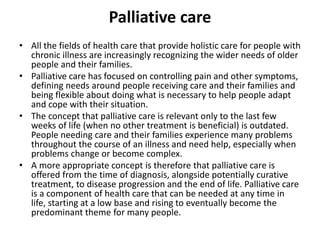
• All the fields of health care that provide holistic care for people with
chronic illness are increasingly recognizing the wider needs of older
people and their families.
• Palliative care has focused on controlling pain and other symptoms,
defining needs around people receiving care and their families and
being flexible about doing what is necessary to help people adapt
and cope with their situation.
• The concept that palliative care is relevant only to the last few
weeks of life (when no other treatment is beneficial) is outdated.
People needing care and their families experience many problems
throughout the course of an illness and need help, especially when
problems change or become complex.
• A more appropriate concept is therefore that palliative care is
offered from the time of diagnosis, alongside potentially curative
treatment, to disease progression and the end of life. Palliative care
is a component of health care that can be needed at any time in
life, starting at a low base and rising to eventually become the
predominant theme for many people.
Palliative care
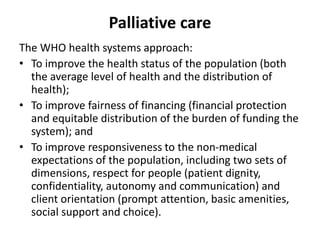
The WHO health systems approach:
• To improve the health status of the population (both
the average level of health and the distribution of
health);
• To improve fairness of financing (financial protection
and equitable distribution of the burden of funding the
system); and
• To improve responsiveness to the non-medical
expectations of the population, including two sets of
dimensions, respect for people (patient dignity,
confidentiality, autonomy and communication) and
client orientation (prompt attention, basic amenities,
social support and choice).
Palliative Care
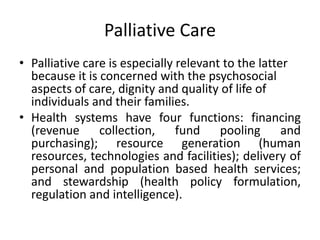
• Palliative care is especially relevant to the latter
because it is concerned with the psychosocial
aspects of care, dignity and quality of life of
individuals and their families.
• Health systems have four functions: financing
(revenue collection, fund pooling and
purchasing); resource generation (human
resources, technologies and facilities); delivery of
personal and population based health services;
and stewardship (health policy formulation,
regulation and intelligence).
Palliative Care…..
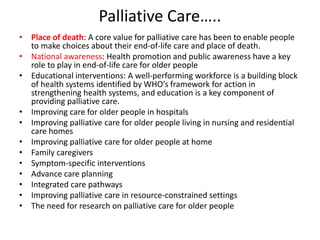
• Place of death: A core value for palliative care has been to enable people
to make choices about their end-of-life care and place of death.
• National awareness: Health promotion and public awareness have a key
role to play in end-of-life care for older people
• Educational interventions: A well-performing workforce is a building block
of health systems identified by WHO’s framework for action in
strengthening health systems, and education is a key component of
providing palliative care.
• Improving care for older people in hospitals
• Improving palliative care for older people living in nursing and residential
care homes
• Improving palliative care for older people at home
• Family caregivers
• Symptom-specific interventions
• Advance care planning
• Integrated care pathways
• Improving palliative care in resource-constrained settings
• The need for research on palliative care for older people
Palliative care: pain
management
• Better knowledge about the age-related
changes of the pharmacokinetics of opiates
for pain management and the polypharmacy
(more drugs are prescribed than clinically
indicated or there are too many to take)
associated with comorbidity.
Situation Analysis: Global
• A population is classified as ageing when older people
become a proportionately larger share of the total
population.
• Declining fertility rates and increasing survival (calculated
based on life expectancy at birth) at older ages have led to
population ageing.
• Life expectancy at birth has risen substantially across the
world.
• In 2010-2015, life expectancy is 78 years in developed
countries and 68 years in developing regions.
• By 2045-2050, newborns can expect to live to 83 years in
developed regions and 74 years in developing regions.
Situation Analysis: Global
• The global population aged 60 years or over numbered 962 million
in 2017, more than twice as large as in 1980 when there were 382
million older persons worldwide. The number of older persons is
expected to double again by 2050, when it is projected to reach
nearly 2.1 billion.
• In 2030, older persons are expected to outnumber children under
age 10 (1.41 billion versus 1.35 billion); in 2050, projections indicate
that there will be more older persons aged 60 or over than
adolescents and youth at ages 10-24 (2.1 billion versus 2.0 billion).
• In Asia, in Africa and in Latin America and the Caribbean, well over
half of persons aged 60 or over co-resided with a child circa 2010;
by contrast, in Europe and in Northern America only around 20 per
cent of older persons co-resided with their children.
Source: (WPA Report, 2015)
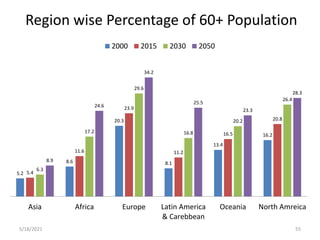
Region wise Percentage of 60+ Population
5.2
8.6
20.3
8.1
13.4
16.2
5.4
11.6
23.9
11.2
16.5
20.8
6.3
17.2
29.6
16.8
20.2
26.4
8.9
24.6
34.2
25.5
23.3
28.3
Asia Africa Europe Latin America
& Carebbean
Oceania North Amreica
2000 2015 2030 2050
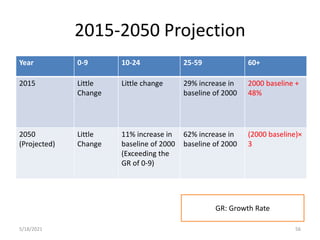
5/18/2021 55
2015-2050 Projection
Year 0-9 10-24 25-59 60+
2015 Little
Change
Little change 29% increase in
baseline of 2000
2000 baseline +
48%
2050
(Projected)
Little
Change
11% increase in
baseline of 2000
(Exceeding the
GR of 0-9)
62% increase in
baseline of 2000
(2000 baseline)×
3
GR: Growth Rate
5/18/2021 56
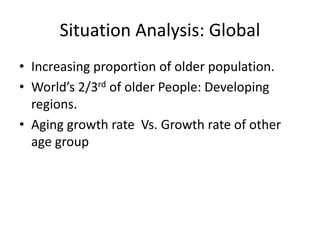
Situation Analysis: Global
• Increasing proportion of older population.
• World’s 2/3rd of older People: Developing
regions.
• Aging growth rate Vs. Growth rate of other
age group
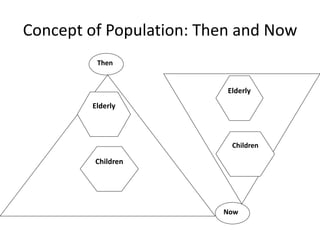
Concept of Population: Then and Now
Then
Now
Elderly
Children
Elderly
Children
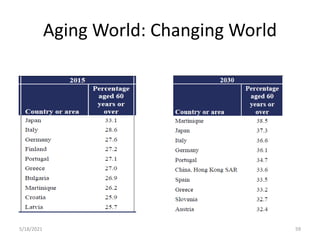
Aging World: Changing World
5/18/2021 59
Global Initiative
• Global strategy and action plan on ageing and
health 2016-2020.
1. Commit to action
2. Age-friendly environments
3. Health systems that meet the needs of older
people
4. Long-term-care systems
5. Data and research
Global Initiative
• Healthy Ageing and the Sustainable
Development Goals
– SDG 3: Good Health and Wellbeing for all ages
• Ensuring continued and equitable access to disease
prevention, promotion, treatment and rehabilitation
throughout all stages of life;
• Developing robust, integrated systems of health and long-
term care orientated around maximizing function in older
age; and
• Making available medicines and assistive technologies that
support the maintenance of functional ability where
necessary.
Global Initiative
• The International Day of Older Persons is
observed on October 1 each year. On
December 14, 1990 the United Nations
General Assembly voted to establish October
1 as the International Day of Older Persons.
Nepal: Aging
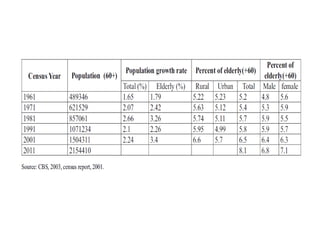
• Aging Population: 8.13% of Total Population
• Elderly people (WHO definition for above 60
years of age) are addressed as Senior Citizens in
Nepal by the Senior Citizen Act, 2063 BS.
• It differs by various sectors for benefits and
retirement age.
• Increase in 75% of elderly population over 60
years from 1952/53 to 2011 period (5% to 8.1%).
• It is estimated to be at 10% in 2014 and double at
20% by next census 2021.
Senior Citizen Act and Rules
• Senior Citizen Act 2006 AD (2063 BS) and
Rules under the Maintenance & Welfare of
Parents & Senior Citizens Act, 2007 (2065 BS)
Provisions in the ACTS
• Respect senior citizens and provide maintenance and
care to them
• Power to procure service of elderly people
• Facilities and concessions for Senior citizens: provide
necessary services, facility and assistance to the senior
citizens in any public vehicles, public undertakings,
medical services, religious and public places.
• Establishment of central and district level Senior Citizen
Welfare Committees and its functions, duties and
powers in favor of senior citizens.
• Establishment of a Senior Citizen Welfare Fund
• Establishment and operation of senior citizen care
centers under the prescribed norms under approval of
the prescribed authority.
Local Self Governance Act 1998
• Includes provisions for protection of elderly
people
• Monthly allowance of Rs.200 to elderly above
the age of 75 years
• Persons above 60 years with no source of
income, no family support, no personal assets
and widows without husband's pension are
eligible for monthly allowance of Rs.150
Aging: Periodic Plans
• Eighth Plan (1992-1997): Announcement of OAA
and allowance to widows of a sum of
Rs.100/month and free health care.
• Ninth Plan 1998-2000:
– Outlined a separate policy, strategy and programs to
safeguard the rights of elderly and providing essential
service and facilities
– Provision of subsidized treatment, setting up geriatric
wards in all zonal hospitals, establishment of elderly
homes by development regions,
– Utilization of experience, skills and knowledge of
elderly people in development programs.
Aging: Periodic Plans
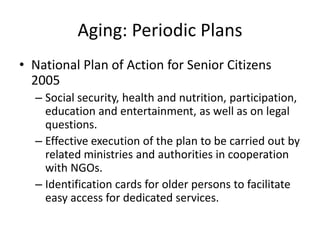
• National Plan of Action for Senior Citizens
2005
– Social security, health and nutrition, participation,
education and entertainment, as well as on legal
questions.
– Effective execution of the plan to be carried out by
related ministries and authorities in cooperation
with NGOs.
– Identification cards for older persons to facilitate
easy access for dedicated services.
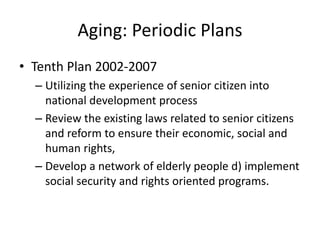
Aging: Periodic Plans
• Tenth Plan 2002-2007
– Utilizing the experience of senior citizen into
national development process
– Review the existing laws related to senior citizens
and reform to ensure their economic, social and
human rights,
– Develop a network of elderly people d) implement
social security and rights oriented programs.
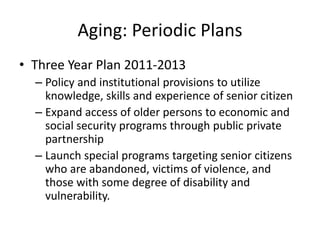
Aging: Periodic Plans
• Three Year Plan 2011-2013
– Policy and institutional provisions to utilize
knowledge, skills and experience of senior citizen
– Expand access of older persons to economic and
social security programs through public private
partnership
– Launch special programs targeting senior citizens
who are abandoned, victims of violence, and
those with some degree of disability and
vulnerability.
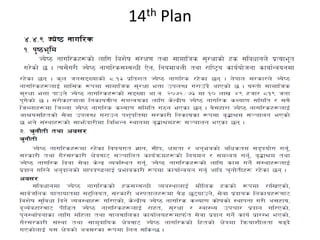
14th Plan
CRITICAL ANALYSIS
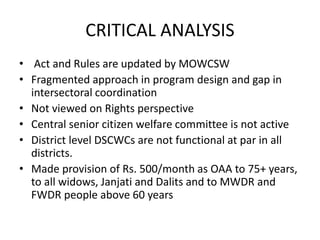
• Act and Rules are updated by MOWCSW
• Fragmented approach in program design and gap in
intersectoral coordination
• Not viewed on Rights perspective
• Central senior citizen welfare committee is not active
• District level DSCWCs are not functional at par in all
districts.
• Made provision of Rs. 500/month as OAA to 75+ years,
to all widows, Janjati and Dalits and to MWDR and
FWDR people above 60 years
CRITICAL ANALYSIS
• Central Senior Citizen Welfare Fund is not
functional.
• Guideline for establishment and monitoring of
old age homes is updated by MOWCSW
• Proposed Senior Citizen Commission
establishment is yet awaited.
• A large number of senior citizens are deprived of
Old age pension due to lack of citizenship
certificates and local level embezzlement by VDCs
Ongoing initiatives from GON
• Initiated establishment of Geriatric wards in few
hospitals, geriatric OPDs and training of Doctors
and Nurses
• Free medicine and treatment up to NRs 2000 at a
time
• Free care for heart and kidney patient of 75 years
of age and above
• Source book on elderly people that informs
vulnerability of old age and care needs.
• National Aging Survey started in 2014
References
• PALLIATIVE CARE FOR OLDER PEOPLE: BETTER PRACTICES , WHO Regional Office for
Europe.
(http://www.euro.who.int/__data/assets/pdf_file/0017/143153/e95052.pdf)
• Risk factors of ill health among older people (http://www.euro.who.int/en/health-
topics/Life-stages/healthy-ageing/data-and-statistics/risk-factors-of-ill-health-
among-older-people)
• Integrated Care for Older People, http://www.who.int/ageing/health-
systems/integrated-care/en/
• World Population Aging Report 2015,
http://www.un.org/en/development/desa/population/publications/pdf/ageing/W
PA2017_Highlights.pdf
• Health Workforce for aging Population. http://www.who.int/ageing/health-
systems/who-health-workforce-ageing-populations.pdf?ua=1
• Healthy Aging. http://www.who.int/ageing/healthy-ageing/en/
• 14th periodic plan, NPC
• https://www.ncbi.nlm.nih.gov/pmc/articles/PMC3843295/

Aging

  • 1.
    Elderly health Nabin Lamichhane MPH(BPKIHS), M. Phil. (TU)
  • 2.
    Elderly health • Conceptof elderly women’s/men health, including healthy and active aging in relation to public health promotion, prevention, protection point of view) • Indicators of healthy and active aging and their measurement • Overview of health problems, health risks and diseases of elderly people • Characteristics of public health service to the elderly people • Concept and methods of palliative service to the elderly people, including pain management, comfortable and dignified dying • Role of family, society, government and the health system for ensuring health of the aged • Situation analysis, problems and issues, gaps and public health concerns and ways forward : in the context of national and global perspective • Critical appraisal of elderly health policies, programs, guidelines and implementation strategies from the perspective of adequacy of public health measures
  • 3.
    • AGING isNOT a Disease • AGING is a Developmental Process
  • 4.
    Aging • When talkingabout ageing, it is essential to distinguish between population or demographic ageing as “the process whereby older individuals become a proportionately larger share of the total population "and individual ageing, the process of individuals growing older. This individual process of ageing is multidimensional and involves physical, psychological and social changes. • Individual ageing in terms of health and well-being and experiences of later life, so the main focus should be given on population ageing.
  • 5.
    Concept of Aging/old •60 years: UN • However, in many developed countries, Age 65 used as a reference point for older persons as this is often the age at which persons become eligible for old-age social security benefits. • So, there is no exact definition of “old” as this concept has different meanings in different societies.
  • 6.
    Who is “Old”? •Defining “old” is further challenged by the changing average lifespan of human beings. Around 1900, average life expectancy was between 45 and 50 years in the developed countries of that time. Now, life expectancy in developed countries reaches 80 years.
  • 7.
    Concept of Oldage • There are other definitions of “old” that go beyond chronological age. Old age as a social construct is often associated with a change of social roles and activities, for example, becoming a grandparent or a pensioner. Older persons often define old age as a stage at which functional, mental and physical capacity is decline and people are more prone to disease or disabilities.
  • 8.
    Concept of Oldage • Chronological definitions of old age were not viewed as so important in signifying old age as changes in physical and mental capacity. • Older persons are a highly diverse population group, in terms of, for example, age, sex, ethnicity, education, income and health. It is important to recognize this in order to adequately address the needs of all older persons, especially the most vulnerable.
  • 9.
    Gender differences: Aging •Women tend to live longer than men, with the result that there are more older women worldwide than older men. In 2012, for every 100 women aged 60, there were 84 men. The proportion of women rises further with age. For every 100 women aged 80 or over worldwide, there are only 61 men. The so-called “feminization of ageing”, particularly the relatively large proportion of the “oldest old” who are women, has important implications for policy. • Women and men differ on several issues that are relevant for ageing policies. They have different health and morbidity patterns and women usually have lower income but larger and better family support networks.
  • 10.
    Older women • Menand women experience old age differently. • Older women tend to have stronger social networks than men and there is evidence that mothers are more likely than fathers to receive material and emotional support from their adult children. • Older women are also more likely than older men to be caregivers of children or sick relatives, particularly in families affected by migration or illness. Men’s greater economic role means that loss of earning power can have negative consequences for their roles in society after they have retired. • Traditional roles in the household can result in older men becoming more isolated once they retire from their jobs.
  • 11.
    Old Women …. •Both older men and older women may face age discrimination. • However, older women also face the cumulative effects of gender discrimination throughout their lives, including less access to education and health services, lower earning capacity and limited access to rights to land ownership, contributing to their vulnerability in older age.
  • 12.
    Older woman • Acombination of age and sex discrimination also puts older women at increased risk of violence and abuse. • Despite significant progress in the development of international legal norms, standards and policies, data on elder abuse of women are very limited. • In general, a lack of key indicators and data disaggregated by age and sex is a barrier to improving programmes and designing laws and policies that respond effectively to the different situations of older women and men • The loss of a spouse can also make women more vulnerable.
  • 13.
    Older Women • Whilethe emphasis in incorporating gender concerns into policies and programmes related to ageing is typically on the vulnerabilities of older women, a more balanced perspective that recognizes gender as a potential marker of vulnerability for various aspects of well-being is needed to address both male and female disadvantages.
  • 14.
    The reason forinvesting public resources in older people • Older people are a valuable and productive economic resource that should not be stifled by outmoded public policies such as mandatory retirement or other disincentives to work beyond certain ages. • Inherent in the challenge of population ageing are huge opportunities, because older people who live healthy lives can continue to be productive for longer than in the past.
  • 15.
    The reason forinvesting public resources in older people • On ethical and humanitarian grounds, devoting resources to older people is arguably the right thing to do, the fair thing to do and a just thing to do. • Older people have a fundamental human right to make claims on social resources, such as health care. These claims are grounded in and justified by international law, for example, in the 1948 Universal Declaration of Human Rights.
  • 16.
    The reason forinvesting public resources in older people • The formation of social capital and societies that are cohesive, peaceful, equitable, and secure requires that we attend to the needs of all groups, especially the most vulnerable, such as older people. Doing so will strengthen societal and cross-generational cohesion.
  • 17.
    The reason forinvesting public resources in older people • Governments have a natural and fundamental role to play in the health sector, for everyone, including older people, because unregulated markets do a poor job of achieving socially desirable and economically efficient levels of health provision. Infectious disease puts communities at risk, health providers can use their informational advantages to exploit health consumers, and problems of moral hazard and adverse selection exist.
  • 18.
    Promoting health andwell-being at older ages • Changes are needed around the globe to continue to adapt health systems to serve a growing number and proportion of older persons and to maximize health and well-being at all ages. The WHO emphasizes that these changes need not imply exorbitant increases in national health budgets, even in countries with rapidly ageing populations. Indeed, technology-related changes in health care, growth in personal incomes and cultural norms and attitudes surrounding end-of-life care are far more influential than shifts in population age structure in driving increases in health care expenditures.
  • 19.
    Promoting health andwell-being at older ages • Older persons are tremendously diverse with respect to their health and wellbeing. • Whether the growing numbers of older persons are living their later years in good health is a crucial consideration for policy development. If the added years of life expectancy are spent with disability, then demographic trends could portend substantially increased demand for health care.
  • 20.
    • Viewed asa whole the problem of ageing is no problem at all. It is only the pessimistic way of looking at a great triumph of civilization. … Notestein, 1954
  • 21.
    Challenges of anAgeing Population • Rapid Population Ageing in Developing Countries • Disability and the Double Burden of Disease • Changing An Outdated Paradigm • The Feminization of Ageing • Ethics and Inequities
  • 22.
    Healthy Ageing WHO • HealthyAgeing is about creating the environments and opportunities that enable people to be and do what they value throughout their lives. Everybody can experience Healthy Ageing. Being free of disease or infirmity is not a requirement for Healthy Ageing as many older adults have one or more health conditions that, when well controlled, have little influence on their wellbeing.
  • 23.
    Active Ageing • Ifageing is to be a positive experience, longer life must be accompanied by continuing opportunities for independence and health, productivity, and protection. WHO uses the term “active ageing” (Adopted in late 1990) to express the process for achieving this vision
  • 24.
    Active Aging • “Activeageing is the process of optimizing opportunities for physical, social, and mental well- being throughout the life course, in order to extend healthy life expectancy, productivity and quality of life in older age.”- WHO • Other international organizations, academic circles and governmental groups (including the G8, the Organization for Economic Cooperation and Development, the International Labour Organization and the Commission of the European Communities) are also using “active ageing”, primarily to express the idea of continuing involvement in socially productive activities and meaningful work
  • 25.
    Active Aging • Theword “active” refers to continuing involvement in social, economic, spiritual, cultural and civic affairs, not just the ability to be physically active. • Older people who are ill or have physical restrictions due to disabilities can remain active contributors to their families, peers, communities and nations.
  • 26.
    Active Aging • Anactive ageing approach to policy and programme development has the potential to address all of the challenges of both individual and population ageing.
  • 27.
    Active Aging • Potentially,when health, labour market, employment, education and social policies support active ageing: – Fewer adults will die prematurely in the highly productive stages of life – Fewer older people will have disabilities and pain associated with chronic diseases – More older people will remain independent and enjoy a positive quality of life – More older people will continue to make a productive contribution to the economy and to important social, cultural and political aspects of society in paid and unpaid jobs and in domestic and family life – Fewer older people will need costly medical treatment and care services (WHO, forthcoming).
  • 28.
    Active Aging: Roleof Public Health • To promote active ageing, health policies and programmes need to: – Reduce the burden of excess disabilities, especially in poor and marginalized populations – Reduce the risk factors associated with the causes of major diseases and increase the factors that protect health and well- being throughout the life course – Develop primary health care systems that emphasize health promotion, disease prevention and the provision of cost- effective, equitable and dignified long-term care. – Advocate and collaborate with other sectors (such as education, housing and employment) to affect positive changes in the broad determinants of healthy, active ageing .
  • 29.
    DEFINITION OF THEINDICATORS OF POPULATION AGEING • AGEING INDEX • DEPENDENCY RATIO • GROWTH RATE • ILLITERACY RATE • LABOUR FORCE PARTICIPATION • LIFE EXPECTANCY • MEDIAN AGE • PARENT SUPPORT RATIO • POTENTIAL SUPPORT RATIO • SEX RATIO • SURVIVAL RATE • TOTAL FERTILITY RATE Source: Population Division, DESA, United Nations
  • 30.
    Overview of healthproblems, health risks and diseases of elderly people
  • 31.
    Common Problems ofGeriatric Population (Source: Prevention and the Elderly: Risk Factors Robert L. Kane, Rosalie A. Kane, and Sharon B. Arnold)
  • 32.
    Health characteristics inolder age • Movement Functions – After a peak in early adulthood, muscle mass tends to decline with increasing age, and this can be associated with declines in strength and musculoskeletal function. – Ageing is also associated with significant changes in bones and joints. With age, bone mass, or density, tends to fall, particularly among postmenopausal women. (Osteoporosis) – Gait speed is influenced by muscle strength, joint limitations and other factors, such as coordination and proprioception, and has been demonstrated to be one of the most powerful predictors of future outcomes in older age.
  • 33.
    Health characteristics inolder age • Sensory functions – Ageing is frequently associated with declines in both vision and hearing, although there is marked diversity in how this is experienced at an individual level. – Age-related hearing loss (known as presbycusis) is bilateral and most marked at higher frequencies. It results from cochlear ageing; environmental exposures, such as noise; genetic predisposition; and increased vulnerability from physiological stressors and modifiable lifestyle behaviours – Age is also associated with complex functional changes in the eye that result in presbyopia, a decrease in focusing ability that leads to the blurring of near vision, which often becomes apparent in midlife – increasing opacity of the crystalline lens, which can ultimately result in cataract.
  • 34.
    Health characteristics inolder age • Cognitive functions – Deterioration in memory and the speed of information processing is common, and complaints about it are frequently reported by older people. – Ageing is associated with reductions in the capacity to learn and master tasks that involve active manipulation, reorganization, integration or anticipation of various memory items, there is little association with memory for factual information, knowledge of words and concepts, memory related to the personal past, and procedural memory (for example, for the skills needed to ride a bicycle)
  • 35.
    Health characteristics inolder age • Immune function – Immune function, particularly T-cell activity, declines with age – The capacity to respond to new infecWorld report on ageing and health Chapter 3 Health in older age 57 tions (and vaccination) falls in later life, a trend known as immunosenescence
  • 36.
    Health characteristics inolder age • Sexuality – sexual activity in older age are limited – These impacts may be either direct (for example, vascular disease resulting in erectile dysfunction) or indirect (for example, the medication required for an unrelated disease may cause decreased libido), or result from the psychosocial consequences of a disease or its treatment (for example, the changes in self-image in women that may occur after a mastectomy).
  • 37.
    Health characteristics inolder age • Functions of the skin – Skin suffers progressive decrements with age that result from damage caused by physiological mechanisms, genetic predisposition and external insults, particularly sun exposure – The loss of collagen and elastin fibres in the dermis can reduce the tensile strength of the skin, and progressive vascular atrophies can leave patients more susceptible to dermatitis, pressure ulcers and skin tears
  • 38.
  • 39.
    Risk factors ofill health among older people • As people age, they become more susceptible to disease and disability. – Injury: Falls (steeply with age), Accidents – Development of non-communicable diseases (Poor nutrition, low physical activity, tobacco, alcohol, smoking, lack of exercise etc) – poverty – Social isolation and exclusion, mental health disorders – Elder maltreatment.
  • 41.
    Characteristics of publichealth service to the elderly people • As people age, their health needs tend to become more complex with a general trend towards declining capacity and the increased likelihood of having one or more chronic diseases. Health services are often designed to cure acute conditions or symptoms and tend to manage health issues in disconnected and fragmented ways that lack coordination across care providers, settings and time. Health systems need to be transformed so that they can ensure affordable access to evidence-based medical interventions that respond to the needs of older people and can help prevent care dependency later in life.
  • 42.
    Characteristics of publichealth service to the elderly people • The Age-friendly Health services Principles address three areas: – Information, education, communication and training, – Health care management systems, and – The physical environment of the primary health care centre.
  • 43.
    Characteristics of publichealth service to the elderly people • Integrated care for older people (ICOPE): WHO – a comprehensive assessment and care plan shared with all providers – common care and treatment goals across different providers – community outreach and home-based interventions – support for self-management – comprehensive referral and monitoring processes – community engagement and caregiver support
  • 44.
    AN Example fromINDIA: Health Service Requirements for elderly https://www.ncbi.nlm.nih.gov/pmc/articles/PMC3843295/
  • 45.
    Concept and methodsof palliative service to the elderly people, • Palliative care : An important public health issue due to population ageing, the increasing number of older people in most societies and insufficient attention to their complex needs. • Focuses on improving the symptoms, dignity and quality of life of people approaching the end of their lives and on the care of and support for their families and friends.
  • 46.
    Need for palliativecare to elderly • Ageing demographics • Changing disease patterns • Complex needs of older people
  • 47.
    Palliative care WHO Definition •“…an approach that improves the quality of life of patients and their families facing the problem associated with life-threatening illness, through the prevention and relief of suffering by means of early identification and impeccable assessment and treatment of pain and other problems, physical, psychosocial and spiritual. Palliative care: – … affirms life and regards dying as a normal process; – intends neither to hasten nor to postpone death; [and] – uses a team approach to address the needs of patients and their families, including bereavement counseling if indicated. …”
  • 48.
    Palliative care • Allthe fields of health care that provide holistic care for people with chronic illness are increasingly recognizing the wider needs of older people and their families. • Palliative care has focused on controlling pain and other symptoms, defining needs around people receiving care and their families and being flexible about doing what is necessary to help people adapt and cope with their situation. • The concept that palliative care is relevant only to the last few weeks of life (when no other treatment is beneficial) is outdated. People needing care and their families experience many problems throughout the course of an illness and need help, especially when problems change or become complex. • A more appropriate concept is therefore that palliative care is offered from the time of diagnosis, alongside potentially curative treatment, to disease progression and the end of life. Palliative care is a component of health care that can be needed at any time in life, starting at a low base and rising to eventually become the predominant theme for many people.
  • 49.
    Palliative care The WHOhealth systems approach: • To improve the health status of the population (both the average level of health and the distribution of health); • To improve fairness of financing (financial protection and equitable distribution of the burden of funding the system); and • To improve responsiveness to the non-medical expectations of the population, including two sets of dimensions, respect for people (patient dignity, confidentiality, autonomy and communication) and client orientation (prompt attention, basic amenities, social support and choice).
  • 50.
    Palliative Care • Palliativecare is especially relevant to the latter because it is concerned with the psychosocial aspects of care, dignity and quality of life of individuals and their families. • Health systems have four functions: financing (revenue collection, fund pooling and purchasing); resource generation (human resources, technologies and facilities); delivery of personal and population based health services; and stewardship (health policy formulation, regulation and intelligence).
  • 51.
    Palliative Care….. • Placeof death: A core value for palliative care has been to enable people to make choices about their end-of-life care and place of death. • National awareness: Health promotion and public awareness have a key role to play in end-of-life care for older people • Educational interventions: A well-performing workforce is a building block of health systems identified by WHO’s framework for action in strengthening health systems, and education is a key component of providing palliative care. • Improving care for older people in hospitals • Improving palliative care for older people living in nursing and residential care homes • Improving palliative care for older people at home • Family caregivers • Symptom-specific interventions • Advance care planning • Integrated care pathways • Improving palliative care in resource-constrained settings • The need for research on palliative care for older people
  • 52.
    Palliative care: pain management •Better knowledge about the age-related changes of the pharmacokinetics of opiates for pain management and the polypharmacy (more drugs are prescribed than clinically indicated or there are too many to take) associated with comorbidity.
  • 53.
    Situation Analysis: Global •A population is classified as ageing when older people become a proportionately larger share of the total population. • Declining fertility rates and increasing survival (calculated based on life expectancy at birth) at older ages have led to population ageing. • Life expectancy at birth has risen substantially across the world. • In 2010-2015, life expectancy is 78 years in developed countries and 68 years in developing regions. • By 2045-2050, newborns can expect to live to 83 years in developed regions and 74 years in developing regions.
  • 54.
    Situation Analysis: Global •The global population aged 60 years or over numbered 962 million in 2017, more than twice as large as in 1980 when there were 382 million older persons worldwide. The number of older persons is expected to double again by 2050, when it is projected to reach nearly 2.1 billion. • In 2030, older persons are expected to outnumber children under age 10 (1.41 billion versus 1.35 billion); in 2050, projections indicate that there will be more older persons aged 60 or over than adolescents and youth at ages 10-24 (2.1 billion versus 2.0 billion). • In Asia, in Africa and in Latin America and the Caribbean, well over half of persons aged 60 or over co-resided with a child circa 2010; by contrast, in Europe and in Northern America only around 20 per cent of older persons co-resided with their children. Source: (WPA Report, 2015)
  • 55.
    Region wise Percentageof 60+ Population 5.2 8.6 20.3 8.1 13.4 16.2 5.4 11.6 23.9 11.2 16.5 20.8 6.3 17.2 29.6 16.8 20.2 26.4 8.9 24.6 34.2 25.5 23.3 28.3 Asia Africa Europe Latin America & Carebbean Oceania North Amreica 2000 2015 2030 2050 5/18/2021 55
  • 56.
    2015-2050 Projection Year 0-910-24 25-59 60+ 2015 Little Change Little change 29% increase in baseline of 2000 2000 baseline + 48% 2050 (Projected) Little Change 11% increase in baseline of 2000 (Exceeding the GR of 0-9) 62% increase in baseline of 2000 (2000 baseline)× 3 GR: Growth Rate 5/18/2021 56
  • 57.
    Situation Analysis: Global •Increasing proportion of older population. • World’s 2/3rd of older People: Developing regions. • Aging growth rate Vs. Growth rate of other age group
  • 58.
    Concept of Population:Then and Now Then Now Elderly Children Elderly Children
  • 59.
    Aging World: ChangingWorld 5/18/2021 59
  • 60.
    Global Initiative • Globalstrategy and action plan on ageing and health 2016-2020. 1. Commit to action 2. Age-friendly environments 3. Health systems that meet the needs of older people 4. Long-term-care systems 5. Data and research
  • 61.
    Global Initiative • HealthyAgeing and the Sustainable Development Goals – SDG 3: Good Health and Wellbeing for all ages • Ensuring continued and equitable access to disease prevention, promotion, treatment and rehabilitation throughout all stages of life; • Developing robust, integrated systems of health and long- term care orientated around maximizing function in older age; and • Making available medicines and assistive technologies that support the maintenance of functional ability where necessary.
  • 62.
    Global Initiative • TheInternational Day of Older Persons is observed on October 1 each year. On December 14, 1990 the United Nations General Assembly voted to establish October 1 as the International Day of Older Persons.
  • 63.
    Nepal: Aging • AgingPopulation: 8.13% of Total Population • Elderly people (WHO definition for above 60 years of age) are addressed as Senior Citizens in Nepal by the Senior Citizen Act, 2063 BS. • It differs by various sectors for benefits and retirement age. • Increase in 75% of elderly population over 60 years from 1952/53 to 2011 period (5% to 8.1%). • It is estimated to be at 10% in 2014 and double at 20% by next census 2021.
  • 64.
    Senior Citizen Actand Rules • Senior Citizen Act 2006 AD (2063 BS) and Rules under the Maintenance & Welfare of Parents & Senior Citizens Act, 2007 (2065 BS)
  • 65.
    Provisions in theACTS • Respect senior citizens and provide maintenance and care to them • Power to procure service of elderly people • Facilities and concessions for Senior citizens: provide necessary services, facility and assistance to the senior citizens in any public vehicles, public undertakings, medical services, religious and public places. • Establishment of central and district level Senior Citizen Welfare Committees and its functions, duties and powers in favor of senior citizens. • Establishment of a Senior Citizen Welfare Fund • Establishment and operation of senior citizen care centers under the prescribed norms under approval of the prescribed authority.
  • 66.
    Local Self GovernanceAct 1998 • Includes provisions for protection of elderly people • Monthly allowance of Rs.200 to elderly above the age of 75 years • Persons above 60 years with no source of income, no family support, no personal assets and widows without husband's pension are eligible for monthly allowance of Rs.150
  • 67.
    Aging: Periodic Plans •Eighth Plan (1992-1997): Announcement of OAA and allowance to widows of a sum of Rs.100/month and free health care. • Ninth Plan 1998-2000: – Outlined a separate policy, strategy and programs to safeguard the rights of elderly and providing essential service and facilities – Provision of subsidized treatment, setting up geriatric wards in all zonal hospitals, establishment of elderly homes by development regions, – Utilization of experience, skills and knowledge of elderly people in development programs.
  • 68.
    Aging: Periodic Plans •National Plan of Action for Senior Citizens 2005 – Social security, health and nutrition, participation, education and entertainment, as well as on legal questions. – Effective execution of the plan to be carried out by related ministries and authorities in cooperation with NGOs. – Identification cards for older persons to facilitate easy access for dedicated services.
  • 69.
    Aging: Periodic Plans •Tenth Plan 2002-2007 – Utilizing the experience of senior citizen into national development process – Review the existing laws related to senior citizens and reform to ensure their economic, social and human rights, – Develop a network of elderly people d) implement social security and rights oriented programs.
  • 70.
    Aging: Periodic Plans •Three Year Plan 2011-2013 – Policy and institutional provisions to utilize knowledge, skills and experience of senior citizen – Expand access of older persons to economic and social security programs through public private partnership – Launch special programs targeting senior citizens who are abandoned, victims of violence, and those with some degree of disability and vulnerability.
  • 71.
  • 75.
    CRITICAL ANALYSIS • Actand Rules are updated by MOWCSW • Fragmented approach in program design and gap in intersectoral coordination • Not viewed on Rights perspective • Central senior citizen welfare committee is not active • District level DSCWCs are not functional at par in all districts. • Made provision of Rs. 500/month as OAA to 75+ years, to all widows, Janjati and Dalits and to MWDR and FWDR people above 60 years
  • 76.
    CRITICAL ANALYSIS • CentralSenior Citizen Welfare Fund is not functional. • Guideline for establishment and monitoring of old age homes is updated by MOWCSW • Proposed Senior Citizen Commission establishment is yet awaited. • A large number of senior citizens are deprived of Old age pension due to lack of citizenship certificates and local level embezzlement by VDCs
  • 77.
    Ongoing initiatives fromGON • Initiated establishment of Geriatric wards in few hospitals, geriatric OPDs and training of Doctors and Nurses • Free medicine and treatment up to NRs 2000 at a time • Free care for heart and kidney patient of 75 years of age and above • Source book on elderly people that informs vulnerability of old age and care needs. • National Aging Survey started in 2014
  • 78.
    References • PALLIATIVE CAREFOR OLDER PEOPLE: BETTER PRACTICES , WHO Regional Office for Europe. (http://www.euro.who.int/__data/assets/pdf_file/0017/143153/e95052.pdf) • Risk factors of ill health among older people (http://www.euro.who.int/en/health- topics/Life-stages/healthy-ageing/data-and-statistics/risk-factors-of-ill-health- among-older-people) • Integrated Care for Older People, http://www.who.int/ageing/health- systems/integrated-care/en/ • World Population Aging Report 2015, http://www.un.org/en/development/desa/population/publications/pdf/ageing/W PA2017_Highlights.pdf • Health Workforce for aging Population. http://www.who.int/ageing/health- systems/who-health-workforce-ageing-populations.pdf?ua=1 • Healthy Aging. http://www.who.int/ageing/healthy-ageing/en/ • 14th periodic plan, NPC • https://www.ncbi.nlm.nih.gov/pmc/articles/PMC3843295/