Adjective Clauses


     Identifying
      Writing
     Combining
4c4 - Analyze sentences containing descriptive adjectives,
  adverbs, prepositional phrases (functioning as adjectives or
adverbs), appositive phrases, adjective clauses, adverb clauses
                      and noun clauses.

                            LS 3
                            WS 2


                  Objectives
Complex

A complex sentence is
 made up of an
 independent clause and
 a dependent clause.
Three Types

There are three types of
 dependent clauses:
 adjective clause
 adverb clause
 noun clause
Adjective Clause

• The adjective clause is used to
  modify a noun or a pronoun.

• It will begin with a relative
  pronoun (who, whose, whom,
  which, and that) or a subordinate
  conjunction (when, where, and
  since).
Rule

• Those are the only words that
  can be used to introduce an
  adjective clause.
Rule
• The introductory word will
  always rename the word that
  it follows and modifies except
  when used with a preposition
  which will come between the
  introductory word and the word
  it renames.
Examples:

• The student whose hand was
  up gave the wrong answer.
• Whose hand was up is the
  adjective clause with whose,
  the relative pronoun, renaming
  and modifying student.
Examples

• Jane is a person in whom I can place
  my confidence.
• In whom I can place my confidence
  is the adjective clause with whom,
  the relative pronoun, with the
  preposition in between it and person,
  the word that whom renames and
  modifies.
Find the adjective clause in the following
  sentences and tell which word it modifies.

• 1. I play a kind of music that nobody likes.
• 2. The man whom you saw was not the famous actor.
• 3. I remember the day when I took my first airplane
  ride.
• 4. I have a neighbor whose parents live in Australia.
• 5. The hint that I learned about cleaning the walk
  saved me much work.
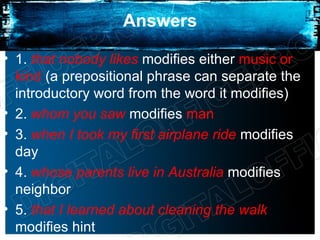
Answers

• 1. that nobody likes modifies either music or
  kind (a prepositional phrase can separate the
  introductory word from the word it modifies)
• 2. whom you saw modifies man
• 3. when I took my first airplane ride modifies
  day
• 4. whose parents live in Australia modifies
  neighbor
• 5. that I learned about cleaning the walk
  modifies hint
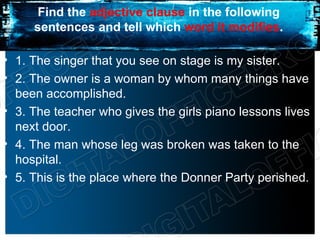
Find the adjective clause in the following
     sentences and tell which word it modifies.

• 1. The singer that you see on stage is my sister.
• 2. The owner is a woman by whom many things have
  been accomplished.
• 3. The teacher who gives the girls piano lessons lives
  next door.
• 4. The man whose leg was broken was taken to the
  hospital.
• 5. This is the place where the Donner Party perished.
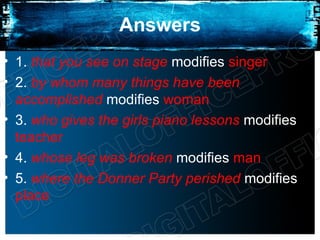
Answers
• 1. that you see on stage modifies singer
• 2. by whom many things have been
  accomplished modifies woman
• 3. who gives the girls piano lessons modifies
  teacher
• 4. whose leg was broken modifies man
• 5. where the Donner Party perished modifies
  place
Combining Sentences
• Using the various kinds of clauses
  can give variety to your
  sentences.
• Adjective clauses can be used for
  this purpose.
Use an adjective clause to combine the following sentences. Use the
  introductory words who, whose, whom, which, that, when,
  where, or since to begin the adjective clause.

• 1. The doctor examined the patient. The patient had
  fallen from a cliff.
• 2. The mechanic repaired my sister's car. The car had
  a warped block.
• 3. The restaurant has closed permanently. The
  customers loved to eat there.
• 4. The day was a wonderful day. Terri was married on
  that day.
• 5. The parents had great respect for the teacher. The
  teacher had taught their children.
Answers
• 1. The doctor examined the patient who had fallen
  from a cliff.
• 2. The mechanic repaired my sister's car that had a
  warped block.
• 3. The restaurant where the customers loved to eat
  has closed permanently.
• 4. The day when Terri was married was wonderful.
• 5. The parents had great respect for the teacher who
  had taught their children.
Use an adjective clause to combine the following sentences. Use the
introductory words who, whose, whom, which, that, when, where, and
since for the adjective clause.


• 1. They followed the strange man. He had just come
  from the dark alley.
• 2. The lot is covered with salt grass. We play baseball
  there.
• 3. A minute passed in complete silence. Terri
  announced her wedding plans then.
• 4. The newspaper had been delivered late. It is the
  one I receive.
• 5. I bought Jim a book. The book is about magic.
Answers
• 1. They followed the strange man who had just come
  from the dark alley.
• 2. The lot where we play baseball is covered with salt
  grass.
• 3. A minute when Terri announced her wedding plans
  passed in complete silence.
• 4. The newspaper that I receive had been delivered
  late.
• 5. I bought Jim a book which is about magic.
Placement of Adjective Clauses

• In using an adjective clause, you
  should always place it as near to
  the word it modifies as possible.

• If you misplace the adjective
  clause, the result is a ridiculous
  sentence or one that is unclear.
Examples:
• (incorrect) = I waved to my dog from the car
  that had just licked my face. (The car did not
  lick my face; the dog did.)

• (correct) = From the car I waved to my dog
  that had just licked my face. (Now the clause
  is as close as it can be to the word it
  modifies. That is, next to dog.)
Rewrite the following sentences placing
   the adjective clause in the correct place.
• 1. They drove to the lake in their new car where they
  love to fish for bass.
• 2. The large limousine pulled up to the curb which was
  loaded with students for the prom.
• 3. The new tricycle was smashed on the driveway that
  had been delivered yesterday.
• 4. We showed the pictures to our friends that we had
  taken at the wedding.
• 5. We caught several fish with the new bait which we
  cooked for dinner.
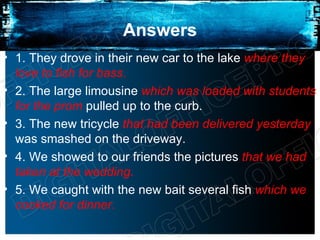
Answers
• 1. They drove in their new car to the lake where they
  love to fish for bass.
• 2. The large limousine which was loaded with students
  for the prom pulled up to the curb.
• 3. The new tricycle that had been delivered yesterday
  was smashed on the driveway.
• 4. We showed to our friends the pictures that we had
  taken at the wedding.
• 5. We caught with the new bait several fish which we
  cooked for dinner.
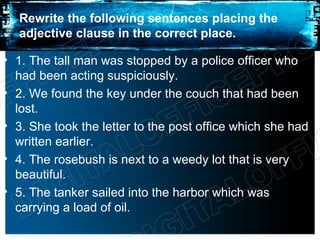
Rewrite the following sentences placing the
  adjective clause in the correct place.

• 1. The tall man was stopped by a police officer who
  had been acting suspiciously.
• 2. We found the key under the couch that had been
  lost.
• 3. She took the letter to the post office which she had
  written earlier.
• 4. The rosebush is next to a weedy lot that is very
  beautiful.
• 5. The tanker sailed into the harbor which was
  carrying a load of oil.
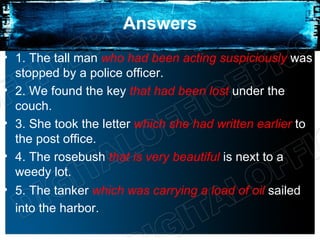
Answers
• 1. The tall man who had been acting suspiciously was
  stopped by a police officer.
• 2. We found the key that had been lost under the
  couch.
• 3. She took the letter which she had written earlier to
  the post office.
• 4. The rosebush that is very beautiful is next to a
  weedy lot.
• 5. The tanker which was carrying a load of oil sailed
  into the harbor.

Adjective clauses powerpoint (ms standard 4c4)

  • 1.
    Adjective Clauses Identifying Writing Combining
  • 2.
    4c4 - Analyzesentences containing descriptive adjectives, adverbs, prepositional phrases (functioning as adjectives or adverbs), appositive phrases, adjective clauses, adverb clauses and noun clauses. LS 3 WS 2 Objectives
  • 3.
    Complex A complex sentenceis made up of an independent clause and a dependent clause.
  • 4.
    Three Types There arethree types of dependent clauses: adjective clause adverb clause noun clause
  • 5.
    Adjective Clause • Theadjective clause is used to modify a noun or a pronoun. • It will begin with a relative pronoun (who, whose, whom, which, and that) or a subordinate conjunction (when, where, and since).
  • 6.
    Rule • Those arethe only words that can be used to introduce an adjective clause.
  • 7.
    Rule • The introductoryword will always rename the word that it follows and modifies except when used with a preposition which will come between the introductory word and the word it renames.
  • 8.
    Examples: • The studentwhose hand was up gave the wrong answer. • Whose hand was up is the adjective clause with whose, the relative pronoun, renaming and modifying student.
  • 9.
    Examples • Jane isa person in whom I can place my confidence. • In whom I can place my confidence is the adjective clause with whom, the relative pronoun, with the preposition in between it and person, the word that whom renames and modifies.
  • 10.
    Find the adjectiveclause in the following sentences and tell which word it modifies. • 1. I play a kind of music that nobody likes. • 2. The man whom you saw was not the famous actor. • 3. I remember the day when I took my first airplane ride. • 4. I have a neighbor whose parents live in Australia. • 5. The hint that I learned about cleaning the walk saved me much work.
  • 11.
    Answers • 1. thatnobody likes modifies either music or kind (a prepositional phrase can separate the introductory word from the word it modifies) • 2. whom you saw modifies man • 3. when I took my first airplane ride modifies day • 4. whose parents live in Australia modifies neighbor • 5. that I learned about cleaning the walk modifies hint
  • 12.
    Find the adjectiveclause in the following sentences and tell which word it modifies. • 1. The singer that you see on stage is my sister. • 2. The owner is a woman by whom many things have been accomplished. • 3. The teacher who gives the girls piano lessons lives next door. • 4. The man whose leg was broken was taken to the hospital. • 5. This is the place where the Donner Party perished.
  • 13.
    Answers • 1. thatyou see on stage modifies singer • 2. by whom many things have been accomplished modifies woman • 3. who gives the girls piano lessons modifies teacher • 4. whose leg was broken modifies man • 5. where the Donner Party perished modifies place
  • 14.
    Combining Sentences • Usingthe various kinds of clauses can give variety to your sentences. • Adjective clauses can be used for this purpose.
  • 15.
    Use an adjectiveclause to combine the following sentences. Use the introductory words who, whose, whom, which, that, when, where, or since to begin the adjective clause. • 1. The doctor examined the patient. The patient had fallen from a cliff. • 2. The mechanic repaired my sister's car. The car had a warped block. • 3. The restaurant has closed permanently. The customers loved to eat there. • 4. The day was a wonderful day. Terri was married on that day. • 5. The parents had great respect for the teacher. The teacher had taught their children.
  • 16.
    Answers • 1. Thedoctor examined the patient who had fallen from a cliff. • 2. The mechanic repaired my sister's car that had a warped block. • 3. The restaurant where the customers loved to eat has closed permanently. • 4. The day when Terri was married was wonderful. • 5. The parents had great respect for the teacher who had taught their children.
  • 17.
    Use an adjectiveclause to combine the following sentences. Use the introductory words who, whose, whom, which, that, when, where, and since for the adjective clause. • 1. They followed the strange man. He had just come from the dark alley. • 2. The lot is covered with salt grass. We play baseball there. • 3. A minute passed in complete silence. Terri announced her wedding plans then. • 4. The newspaper had been delivered late. It is the one I receive. • 5. I bought Jim a book. The book is about magic.
  • 18.
    Answers • 1. Theyfollowed the strange man who had just come from the dark alley. • 2. The lot where we play baseball is covered with salt grass. • 3. A minute when Terri announced her wedding plans passed in complete silence. • 4. The newspaper that I receive had been delivered late. • 5. I bought Jim a book which is about magic.
  • 19.
    Placement of AdjectiveClauses • In using an adjective clause, you should always place it as near to the word it modifies as possible. • If you misplace the adjective clause, the result is a ridiculous sentence or one that is unclear.
  • 20.
    Examples: • (incorrect) =I waved to my dog from the car that had just licked my face. (The car did not lick my face; the dog did.) • (correct) = From the car I waved to my dog that had just licked my face. (Now the clause is as close as it can be to the word it modifies. That is, next to dog.)
  • 21.
    Rewrite the followingsentences placing the adjective clause in the correct place. • 1. They drove to the lake in their new car where they love to fish for bass. • 2. The large limousine pulled up to the curb which was loaded with students for the prom. • 3. The new tricycle was smashed on the driveway that had been delivered yesterday. • 4. We showed the pictures to our friends that we had taken at the wedding. • 5. We caught several fish with the new bait which we cooked for dinner.
  • 22.
    Answers • 1. Theydrove in their new car to the lake where they love to fish for bass. • 2. The large limousine which was loaded with students for the prom pulled up to the curb. • 3. The new tricycle that had been delivered yesterday was smashed on the driveway. • 4. We showed to our friends the pictures that we had taken at the wedding. • 5. We caught with the new bait several fish which we cooked for dinner.
  • 23.
    Rewrite the followingsentences placing the adjective clause in the correct place. • 1. The tall man was stopped by a police officer who had been acting suspiciously. • 2. We found the key under the couch that had been lost. • 3. She took the letter to the post office which she had written earlier. • 4. The rosebush is next to a weedy lot that is very beautiful. • 5. The tanker sailed into the harbor which was carrying a load of oil.
  • 24.
    Answers • 1. Thetall man who had been acting suspiciously was stopped by a police officer. • 2. We found the key that had been lost under the couch. • 3. She took the letter which she had written earlier to the post office. • 4. The rosebush that is very beautiful is next to a weedy lot. • 5. The tanker which was carrying a load of oil sailed into the harbor.