Adjective Clauses with
6         Subject Relative
          Pronouns

    Famous Faces
     and Places

Focus on Grammar 4
Part VI, Unit 13
By Ruth Luman, Gabriele Steiner, and BJ Wells
Copyright © 2006. Pearson Education, Inc. All rights reserved.
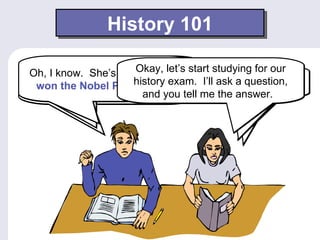
History 101

Oh, IShe’s a She’s thewhose who start studying for our
  She discovered a woman let’s answers. Okay, next
                       Okay,
      know. scientist element of
                       Wow. Good
radium, which isPrize inquestion. Who she question,
                      history exam. I’ll ask a discover?
 won the Nobelhave greatly What is Marie Curie?
   discoveries used in1903.X-rays. did was Gandhi?
  affected the medical field. Whome the answer.
                        and you tell
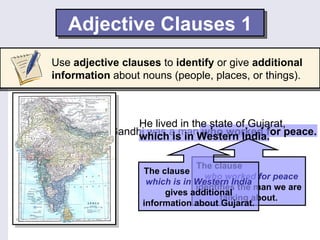
Adjective Clauses 1
Use adjective clauses to identify or give additional
information about nouns (people, places, or things).


                 He lived in the state of Gujarat,
            Gandhi was a manWestern India. peace.
                 which is in who worked for

                               The clause
                  The clause
                                 who worked for peace
                   which is in Western India
                               identifies the man we are
                       gives additional
                                     talking about.
                  information about Gujarat.
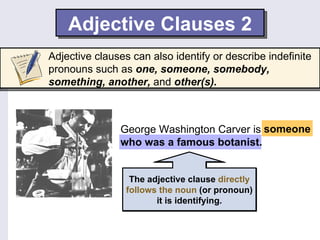
Adjective Clauses 2
Adjective clauses can also identify or describe indefinite
pronouns such as one, someone, somebody,
something, another, and other(s).


               George Washington Carver is someone
                                           someone
               who was a famous botanist.


                  The adjective clause directly
                 follows the noun (or pronoun)
                        it is identifying.
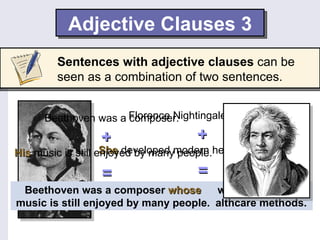
Adjective Clauses 3
        Sentences with adjective clauses can be
        seen as a combination of two sentences.


      Beethoven was a Florence Nightingale was a nurse.
                      composer.
                 +                   +
His music is still enjoyed by manymodern healthcare methods.
                    She developed people.

                 =                   =
 Beethoven was aFlorence Nightingale was a nurse who
                     composer whose
music is still enjoyed by many people.
                   developed modern healthcare methods.
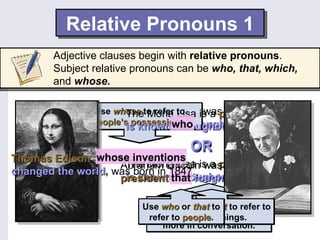
Relative Pronouns 1
        Adjective clauses begin with relative pronouns.
        Subject relative pronouns can be who, that, which,
        and whose.

                     Abraham Lincolnis a painting which
                       The Mona Lisa was an American
               Use whose to refer to
               people’s possessions. fought against slavery.
                        possessions
                     president who                  slavery
                      is known throughout the world.
                                              world
                                     OR
Thomas Edison, whose inventions
       Edison
                    Abraham Lincolnis a painting that
                     The Mona Lisa was an American
changed the world, was born in 1847.
            world    is known throughout the world.
                                               world
                    president that fought against slavery.
                                                   slavery

                          Use That is less formal than to
                            Use which or that to refer
                              who or that to
                             who places or and used
                                  and which
                           refer to people. things.
                                    people
                               more in conversation.
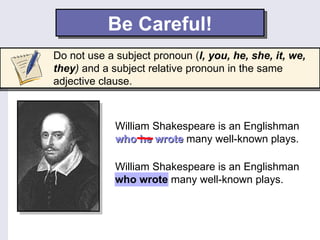
Be Careful!
Do not use a subject pronoun (I, you, he, she, it, we,
they) and a subject relative pronoun in the same
adjective clause.


             William Shakespeare is an Englishman
             who he wrote many well-known plays.

             William Shakespeare is an Englishman
             who wrote many well-known plays.
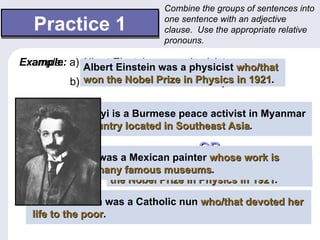
Combine the groups of sentences into

   Practice 1                 one sentence with an adjective
                              clause. Use the appropriate relative
                              pronouns.

Example:
Example: a) Albert Einstein was aaphysicist. who/that
            Albert Einstein was physicist
           b) He won the Nobel Prize Physics in in 1921.
              won the Nobel Prize in in Physics 1921.

1. a) Ang San Su Kyi is a Burmesepeace activist in Myanmar
                                   peace activist in Myanmar.
    Ang San Su Kyi Albert Einstein was a physicist who won
                    is a Burmese
   b) Myanmar is a thelocatedPrize in Southeast Asia.
    which is a country Nobel in Southeast Asia.1921.
                                            Asia
                   country located in Physics in 1921
                                       OR
2. a) Diego Rivera was a Mexican painter.
    Diego Rivera was a Mexican painter whose work is
    displayed is displayed Einstein was a physicist that won
                    Albert
   b) His workin many famous museums. museums.
                               museums
                           in many famous
                    the Nobel Prize in Physics in 1921.
                                                  1921
3. a) Mother Teresa was a Catholic nun.
    Mother Teresa was a Catholic nun who/that devoted her
   b) She the poor.her life to the poor.
    life to devoted
               poor
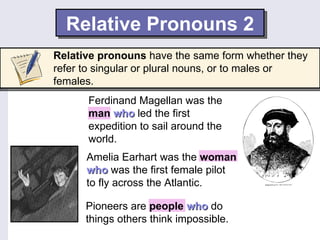
Relative Pronouns 2
Relative pronouns have the same form whether they
refer to singular or plural nouns, or to males or
females.
      Ferdinand Magellan was the
      man who led the first
      expedition to sail around the
      world.
      Amelia Earhart was the woman
      who was the first female pilot
      to fly across the Atlantic.

      Pioneers are people who do
      things others think impossible.
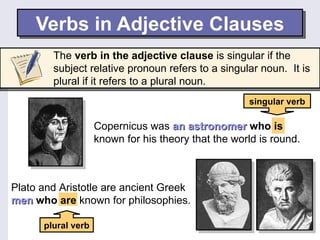
Verbs in Adjective Clauses
        The verb in the adjective clause is singular if the
        subject relative pronoun refers to a singular noun. It is
        plural if it refers to a plural noun.
                                                     singular verb

                    Copernicus was an astronomer who is
                    known for his theory that the world is round.


Plato and Aristotle are ancient Greek
men who are known for philosophies.

      plural verb
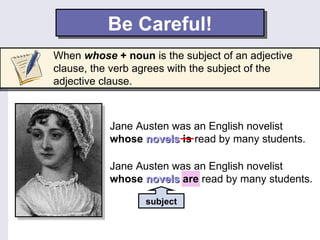
Be Careful!
When whose + noun is the subject of an adjective
clause, the verb agrees with the subject of the
adjective clause.


           Jane Austen was an English novelist
           whose novels is read by many students.

           Jane Austen was an English novelist
           whose novels are read by many students.

                  subject
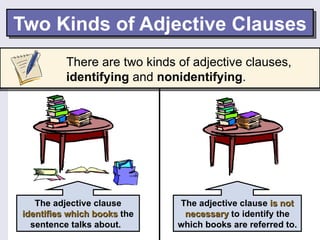
Two Kinds of Adjective Clauses
         There are two kinds of adjective clauses,
         identifying and nonidentifying.


   The adjective clause       The adjective clause is not
The books which are on
identifies which books the
                             The books,to identify the
                               necessary
                                           which are on
the table belong to me.
  sentence talks about.      the table, belong to me.
                             which books are referred to.
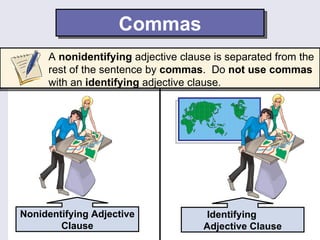
Commas
     A nonidentifying adjective clause is separated from the
     rest of the sentence by commas. Do not use commas
     with an identifying adjective clause.


The map, which is on
Nonidentifying Adjective        The map which is on the
                                     Identifying
the table, is new.
        Clause                  table is new. Clause
                                    Adjective
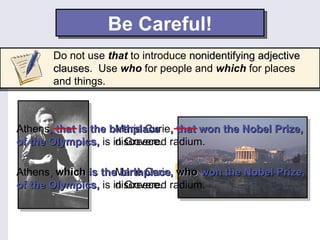
Be Careful!
       Do not use that to introduce nonidentifying adjective
       clauses. Use who for people and which for places
       clauses
       and things.


Athens, that is the birthplace , that won the Nobel Prize,
                     Marie Curie
of the Olympics, is in Greece. radium.
                     discovered

Athens, which is theMarie Curie, who won the Nobel Prize,
                      birthplace
of the Olympics, is in Greece. radium.
                     discovered
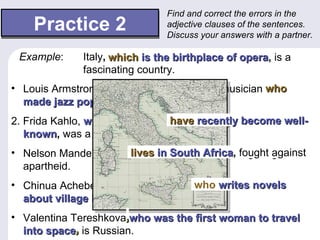
Find and correct the errors in the
    Practice 2                  adjective clauses of the sentences.
                                Discuss your answers with a partner.

 Example:     Italy, which is the birthplace of opera, is a
                     that is the birthplace of opera, is a
                                               opera
                                                 opera
              fascinating country.
• Louis Armstrong was a famous American musician who he
  made jazz popular.
            popular
2. Frida Kahlo, whose paintings have recently become well-
                                has recently become well-
   known, was a Mexican painter.
   known
                      lives in South Africa, fought against
• Nelson Mandela, who live in South Africa, fought against
                                     Africa
                                    Africa
  apartheid.
• Chinua Achebe is a Nigerian author who writes novels
                                     which writes novels
  about village life.
                life
• Valentina Tereshkova,who was the first woman to travel
  into space, is Russian.
References

Copyright © 2006 Pearson Education and
its licensors. All rights reserved.
Photo credit:
Ghandi: © Silvio Fiore / SuperStock

Adjective clauses

  • 1.
    Adjective Clauses with 6 Subject Relative Pronouns Famous Faces and Places Focus on Grammar 4 Part VI, Unit 13 By Ruth Luman, Gabriele Steiner, and BJ Wells Copyright © 2006. Pearson Education, Inc. All rights reserved.
  • 2.
    History 101 Oh, IShe’sa She’s thewhose who start studying for our She discovered a woman let’s answers. Okay, next Okay, know. scientist element of Wow. Good radium, which isPrize inquestion. Who she question, history exam. I’ll ask a discover? won the Nobelhave greatly What is Marie Curie? discoveries used in1903.X-rays. did was Gandhi? affected the medical field. Whome the answer. and you tell
  • 3.
    Adjective Clauses 1 Useadjective clauses to identify or give additional information about nouns (people, places, or things). He lived in the state of Gujarat, Gandhi was a manWestern India. peace. which is in who worked for The clause The clause who worked for peace which is in Western India identifies the man we are gives additional talking about. information about Gujarat.
  • 4.
    Adjective Clauses 2 Adjectiveclauses can also identify or describe indefinite pronouns such as one, someone, somebody, something, another, and other(s). George Washington Carver is someone someone who was a famous botanist. The adjective clause directly follows the noun (or pronoun) it is identifying.
  • 5.
    Adjective Clauses 3 Sentences with adjective clauses can be seen as a combination of two sentences. Beethoven was a Florence Nightingale was a nurse. composer. + + His music is still enjoyed by manymodern healthcare methods. She developed people. = = Beethoven was aFlorence Nightingale was a nurse who composer whose music is still enjoyed by many people. developed modern healthcare methods.
  • 6.
    Relative Pronouns 1 Adjective clauses begin with relative pronouns. Subject relative pronouns can be who, that, which, and whose. Abraham Lincolnis a painting which The Mona Lisa was an American Use whose to refer to people’s possessions. fought against slavery. possessions president who slavery is known throughout the world. world OR Thomas Edison, whose inventions Edison Abraham Lincolnis a painting that The Mona Lisa was an American changed the world, was born in 1847. world is known throughout the world. world president that fought against slavery. slavery Use That is less formal than to Use which or that to refer who or that to who places or and used and which refer to people. things. people more in conversation.
  • 7.
    Be Careful! Do notuse a subject pronoun (I, you, he, she, it, we, they) and a subject relative pronoun in the same adjective clause. William Shakespeare is an Englishman who he wrote many well-known plays. William Shakespeare is an Englishman who wrote many well-known plays.
  • 8.
    Combine the groupsof sentences into Practice 1 one sentence with an adjective clause. Use the appropriate relative pronouns. Example: Example: a) Albert Einstein was aaphysicist. who/that Albert Einstein was physicist b) He won the Nobel Prize Physics in in 1921. won the Nobel Prize in in Physics 1921. 1. a) Ang San Su Kyi is a Burmesepeace activist in Myanmar peace activist in Myanmar. Ang San Su Kyi Albert Einstein was a physicist who won is a Burmese b) Myanmar is a thelocatedPrize in Southeast Asia. which is a country Nobel in Southeast Asia.1921. Asia country located in Physics in 1921 OR 2. a) Diego Rivera was a Mexican painter. Diego Rivera was a Mexican painter whose work is displayed is displayed Einstein was a physicist that won Albert b) His workin many famous museums. museums. museums in many famous the Nobel Prize in Physics in 1921. 1921 3. a) Mother Teresa was a Catholic nun. Mother Teresa was a Catholic nun who/that devoted her b) She the poor.her life to the poor. life to devoted poor
  • 9.
    Relative Pronouns 2 Relativepronouns have the same form whether they refer to singular or plural nouns, or to males or females. Ferdinand Magellan was the man who led the first expedition to sail around the world. Amelia Earhart was the woman who was the first female pilot to fly across the Atlantic. Pioneers are people who do things others think impossible.
  • 10.
    Verbs in AdjectiveClauses The verb in the adjective clause is singular if the subject relative pronoun refers to a singular noun. It is plural if it refers to a plural noun. singular verb Copernicus was an astronomer who is known for his theory that the world is round. Plato and Aristotle are ancient Greek men who are known for philosophies. plural verb
  • 11.
    Be Careful! When whose+ noun is the subject of an adjective clause, the verb agrees with the subject of the adjective clause. Jane Austen was an English novelist whose novels is read by many students. Jane Austen was an English novelist whose novels are read by many students. subject
  • 12.
    Two Kinds ofAdjective Clauses There are two kinds of adjective clauses, identifying and nonidentifying. The adjective clause The adjective clause is not The books which are on identifies which books the The books,to identify the necessary which are on the table belong to me. sentence talks about. the table, belong to me. which books are referred to.
  • 13.
    Commas A nonidentifying adjective clause is separated from the rest of the sentence by commas. Do not use commas with an identifying adjective clause. The map, which is on Nonidentifying Adjective The map which is on the Identifying the table, is new. Clause table is new. Clause Adjective
  • 14.
    Be Careful! Do not use that to introduce nonidentifying adjective clauses. Use who for people and which for places clauses and things. Athens, that is the birthplace , that won the Nobel Prize, Marie Curie of the Olympics, is in Greece. radium. discovered Athens, which is theMarie Curie, who won the Nobel Prize, birthplace of the Olympics, is in Greece. radium. discovered
  • 15.
    Find and correctthe errors in the Practice 2 adjective clauses of the sentences. Discuss your answers with a partner. Example: Italy, which is the birthplace of opera, is a that is the birthplace of opera, is a opera opera fascinating country. • Louis Armstrong was a famous American musician who he made jazz popular. popular 2. Frida Kahlo, whose paintings have recently become well- has recently become well- known, was a Mexican painter. known lives in South Africa, fought against • Nelson Mandela, who live in South Africa, fought against Africa Africa apartheid. • Chinua Achebe is a Nigerian author who writes novels which writes novels about village life. life • Valentina Tereshkova,who was the first woman to travel into space, is Russian.
  • 16.
    References Copyright © 2006Pearson Education and its licensors. All rights reserved. Photo credit: Ghandi: © Silvio Fiore / SuperStock