TAG QUESTIONS
TAG QUESTIONS   Tag question is a special construction in English. It is a statement followed by a mini-question. The whole sentence is a "tag question", and the mini-question at the end is called a "question tag".
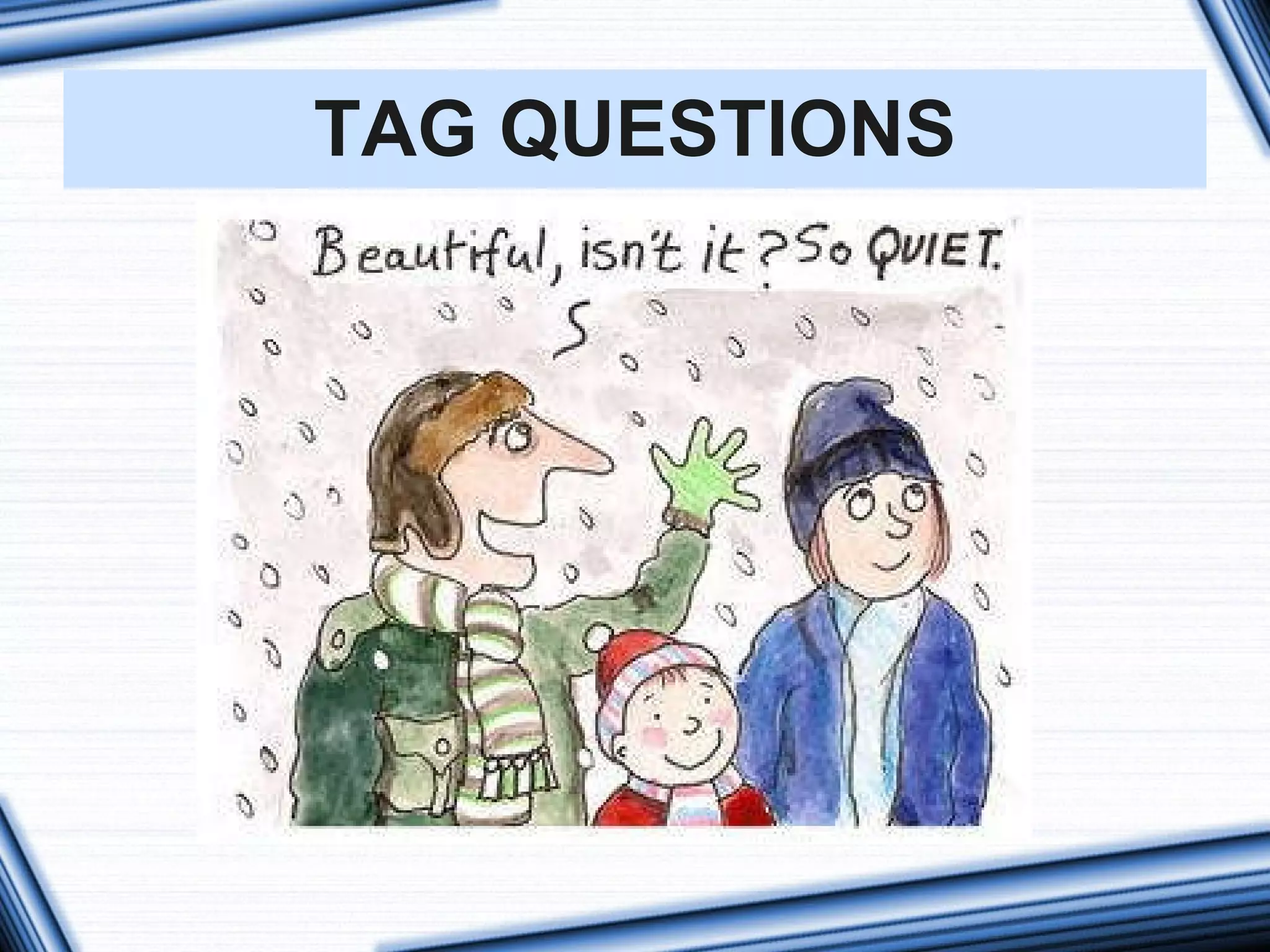
We use tag questions at the end of statements to ask for confirmation. They mean something like: "Am I right?" or "Do you agree?" They are very common in English. TAG QUESTIONS
TAG QUESTIONS  BASIC STRUCTURE + Positive statement - Negative tag? It is a great day, isn’t it? -  Negative statement  + Positive tag? You don’t know her, do you?
TAG QUESTIONS
Examples with positive statements Positive statement [ + ] Negative tag [ -  ] Subject Auxiliary Main verb Auxiliary Not  Personal pronoun (same as subject) She  is  cooking, is n’t she? You  like icecream, do n’t you? They  will stay home, wo n’t they? He  can play chess, can n’t he? We should go home, should n’t we? Jenny was busy, was n’t she? You  are French, are n’t you? They have finished have n’t they?
Examples with positive statements
Examples with negative statements Negative statement [ - ] Positive tag [ + ] Subject  Auxiliary Main verb auxiliary Personal pronouns It  is n’t snowing, is It? You have never been there have you? She  does n’t like pork, does she? they did n’t practice today did they? he can n’t come, can he? We  should n’t drink much, should we? They  are n’t home, are they? Jane was n’t sick was she?
Special cases I  am  right,  are n't I? aren't I ( not  amn't I) You  have  to go,  do n't you? you (do) have to go... I  have been  answering,  have n't I? use first auxiliary Nothing  came in the post,  did  it? treat statements with nothing, nobody etc like negative statements Let's  go, shall we? let's = let us He 'd  better do it,  had n't he? he had better (no auxiliary)
 
MIXED EXAMPLES But you don't really love her, do you? This will work, won't it? Well, I couldn't help it, could I? But you'll tell me if she calls, won't you? We'd never have known, would we? The weather's bad, isn't it? You won't be late, will you? Nobody knows, do they?
INTONATION We can change the meaning of a tag question with the musical pitch of our voice. With rising intonation, it sounds like a real question. But if our intonation falls, it sounds more like a statement that doesn't require a real answer:
INTONATION intonation You don't know where my wallet is, do you? rising real question It's a beautiful view, isn't it? falling not a real question
QUESTIONS TAGS WITH IMPERATIVES Sometimes we use question tags with imperatives (invitations, orders), but the sentence remains an imperative and does not require a direct answer. We use  won't  for invitations. We use  can, can't, will, would  for orders.
QUESTIONS TAGS WITH IMPERATIVES Imperative + question tags Notes: invitation Take a seat, won't you? polite order Help me, can you? quite friendly Help me, can't you? quite friendly (some irritation?) Close the door, would you? quite polite Do it now, will you? less polite Don't forget, will you? with negative imperatives only  will  is possible
By CAMILO HERRERA  JORGE MOLINA Fundación Universitaria Luis Amigó Faculty of Education
REFERENCES http://www.englishclub.com/grammar/verbs-questions-tag.htm

Tag questions

  • 1.
  • 2.
    TAG QUESTIONS  Tag question is a special construction in English. It is a statement followed by a mini-question. The whole sentence is a "tag question", and the mini-question at the end is called a "question tag".
  • 3.
    We use tagquestions at the end of statements to ask for confirmation. They mean something like: "Am I right?" or "Do you agree?" They are very common in English. TAG QUESTIONS
  • 4.
    TAG QUESTIONS BASIC STRUCTURE + Positive statement - Negative tag? It is a great day, isn’t it? - Negative statement + Positive tag? You don’t know her, do you?
  • 5.
  • 6.
    Examples with positivestatements Positive statement [ + ] Negative tag [ - ] Subject Auxiliary Main verb Auxiliary Not Personal pronoun (same as subject) She is cooking, is n’t she? You like icecream, do n’t you? They will stay home, wo n’t they? He can play chess, can n’t he? We should go home, should n’t we? Jenny was busy, was n’t she? You are French, are n’t you? They have finished have n’t they?
  • 7.
  • 8.
    Examples with negativestatements Negative statement [ - ] Positive tag [ + ] Subject Auxiliary Main verb auxiliary Personal pronouns It is n’t snowing, is It? You have never been there have you? She does n’t like pork, does she? they did n’t practice today did they? he can n’t come, can he? We should n’t drink much, should we? They are n’t home, are they? Jane was n’t sick was she?
  • 9.
    Special cases I am  right,  are n't I? aren't I ( not  amn't I) You  have  to go,  do n't you? you (do) have to go... I  have been  answering,  have n't I? use first auxiliary Nothing  came in the post,  did  it? treat statements with nothing, nobody etc like negative statements Let's  go, shall we? let's = let us He 'd  better do it,  had n't he? he had better (no auxiliary)
  • 10.
  • 11.
    MIXED EXAMPLES Butyou don't really love her, do you? This will work, won't it? Well, I couldn't help it, could I? But you'll tell me if she calls, won't you? We'd never have known, would we? The weather's bad, isn't it? You won't be late, will you? Nobody knows, do they?
  • 12.
    INTONATION We canchange the meaning of a tag question with the musical pitch of our voice. With rising intonation, it sounds like a real question. But if our intonation falls, it sounds more like a statement that doesn't require a real answer:
  • 13.
    INTONATION intonation Youdon't know where my wallet is, do you? rising real question It's a beautiful view, isn't it? falling not a real question
  • 14.
    QUESTIONS TAGS WITHIMPERATIVES Sometimes we use question tags with imperatives (invitations, orders), but the sentence remains an imperative and does not require a direct answer. We use  won't  for invitations. We use  can, can't, will, would  for orders.
  • 15.
    QUESTIONS TAGS WITHIMPERATIVES Imperative + question tags Notes: invitation Take a seat, won't you? polite order Help me, can you? quite friendly Help me, can't you? quite friendly (some irritation?) Close the door, would you? quite polite Do it now, will you? less polite Don't forget, will you? with negative imperatives only  will  is possible
  • 16.
    By CAMILO HERRERA JORGE MOLINA Fundación Universitaria Luis Amigó Faculty of Education
  • 17.