ADJECTIVES
Adjectives
    An adjective modifies a noun or
    a pronoun by describing,
    identifying, or quantifying words.
    An adjective usually precedes
    the noun or the pronoun which it
    modifies. In the following
    examples, the highlighted words
    are adjectives:
Examples
  A battered music box sat on the
   mahogany sideboard.
  The back room was filled with large,
   yellow rain boots.
  The truck-shaped balloon floated
   over the treetops.
  Many stores have already begun to
   play Christmas music.
Adjectives
   Adjectives always answer the questions:
     WHAT KIND?
     WHICH ONE?
     HOW MANY?
     HOW MUCH?

   The process by which an adjective
    modifies a word is called modification.
Parts of Speech Used as Adjectives

 Articles
 Nouns
 Pronouns
        my,your,his,her,its,our,their
        this,that,these,those
        which,what,whose
   Indefinite pronouns
       Another,each,either,neither,
       Both,few,many,several
       All,any,more,most,other,some
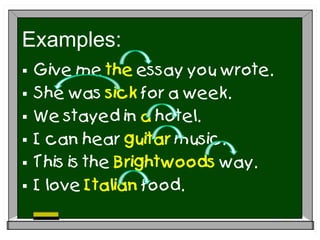
Examples:






Examples:














DEGREES OF COMPARISON
Degrees of Comparison
   Adjectives can express degrees of
    modification:
       Gladys is a rich woman, but Josie is richer than
        Gladys, and Sandie is the richest woman in town.
 The degrees of comparison are known as the
  positive, the comparative, and the superlative.
 We use the comparative for comparing two
  things and the superlative for comparing three
    or more things.
Positive       Comparative     Superlative                 Irregular Comparative and Superlative Forms


                                                  good                  better              best
rich           richer          richest
                                                  bad                   worse               worst
                                                  little                less                least
lovely         lovelier        loveliest
                                                  much
                                                  many                  more                most
beautiful      more beautiful most beautiful      some
                                                  far                   farther             farthest


       Be careful, also, not to use more along with a comparative adjective formed with -er nor to use most
       along with a superlative adjective formed with -est (e.g., do not write that something
       is more heavier or most heaviest).
       The as — as construction is used to create a comparison expressing equality:
             He is as foolish as he is large.
             She is as bright as her mother.
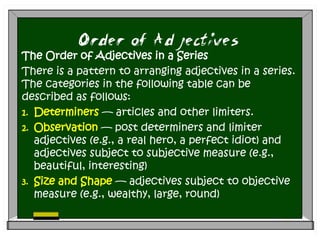
Order of Adjectives
The Order of Adjectives in a Series
There is a pattern to arranging adjectives in a series.
The categories in the following table can be
described as follows:
1. Determiners — articles and other limiters.
2. Observation — post determiners and limiter
   adjectives (e.g., a real hero, a perfect idiot) and
   adjectives subject to subjective measure (e.g.,
   beautiful, interesting)
3. Size and Shape — adjectives subject to objective
   measure (e.g., wealthy, large, round)
Order of Adjectives
4.    Age — adjectives denoting age (e.g., young, old, new,
      ancient)
5.   Color — adjectives denoting color (e.g., red, black,
     pale)
6.   Origin — denominal adjectives denoting source of
     noun (e.g., French, American, Canadian)
7.   Material — denominal adjectives denoting what
     something is made of (e.g., woolen, metallic, wooden)
8.   Qualifier — final limiter, often regarded as part of the
     noun (e.g., rocking chair, hunting cabin, passenger car,
     book cover)
Adjectives

Adjectives

  • 1.
  • 2.
    Adjectives  An adjective modifies a noun or a pronoun by describing, identifying, or quantifying words. An adjective usually precedes the noun or the pronoun which it modifies. In the following examples, the highlighted words are adjectives:
  • 3.
    Examples  Abattered music box sat on the mahogany sideboard.  The back room was filled with large, yellow rain boots.  The truck-shaped balloon floated over the treetops.  Many stores have already begun to play Christmas music.
  • 4.
    Adjectives  Adjectives always answer the questions:  WHAT KIND?  WHICH ONE?  HOW MANY?  HOW MUCH?  The process by which an adjective modifies a word is called modification.
  • 5.
    Parts of SpeechUsed as Adjectives  Articles  Nouns  Pronouns  my,your,his,her,its,our,their  this,that,these,those  which,what,whose
  • 6.
    Indefinite pronouns  Another,each,either,neither,  Both,few,many,several  All,any,more,most,other,some
  • 7.
  • 8.
  • 9.
  • 10.
  • 11.
  • 12.
    Degrees of Comparison  Adjectives can express degrees of modification:  Gladys is a rich woman, but Josie is richer than Gladys, and Sandie is the richest woman in town.  The degrees of comparison are known as the positive, the comparative, and the superlative.  We use the comparative for comparing two things and the superlative for comparing three or more things.
  • 13.
    Positive Comparative Superlative Irregular Comparative and Superlative Forms good better best rich richer richest bad worse worst little less least lovely lovelier loveliest much many more most beautiful more beautiful most beautiful some far farther farthest Be careful, also, not to use more along with a comparative adjective formed with -er nor to use most along with a superlative adjective formed with -est (e.g., do not write that something is more heavier or most heaviest). The as — as construction is used to create a comparison expressing equality: He is as foolish as he is large. She is as bright as her mother.
  • 14.
    Order of Adjectives TheOrder of Adjectives in a Series There is a pattern to arranging adjectives in a series. The categories in the following table can be described as follows: 1. Determiners — articles and other limiters. 2. Observation — post determiners and limiter adjectives (e.g., a real hero, a perfect idiot) and adjectives subject to subjective measure (e.g., beautiful, interesting) 3. Size and Shape — adjectives subject to objective measure (e.g., wealthy, large, round)
  • 15.
    Order of Adjectives 4. Age — adjectives denoting age (e.g., young, old, new, ancient) 5. Color — adjectives denoting color (e.g., red, black, pale) 6. Origin — denominal adjectives denoting source of noun (e.g., French, American, Canadian) 7. Material — denominal adjectives denoting what something is made of (e.g., woolen, metallic, wooden) 8. Qualifier — final limiter, often regarded as part of the noun (e.g., rocking chair, hunting cabin, passenger car, book cover)