GROUP 2
NAME : 1. KHOFIATUN NIDA
2. NUKHA ZULFATUL MUFIDAH
3. FAISAL YUSUF
CLASS : TBI F
ADJECTIVE CLAUSE
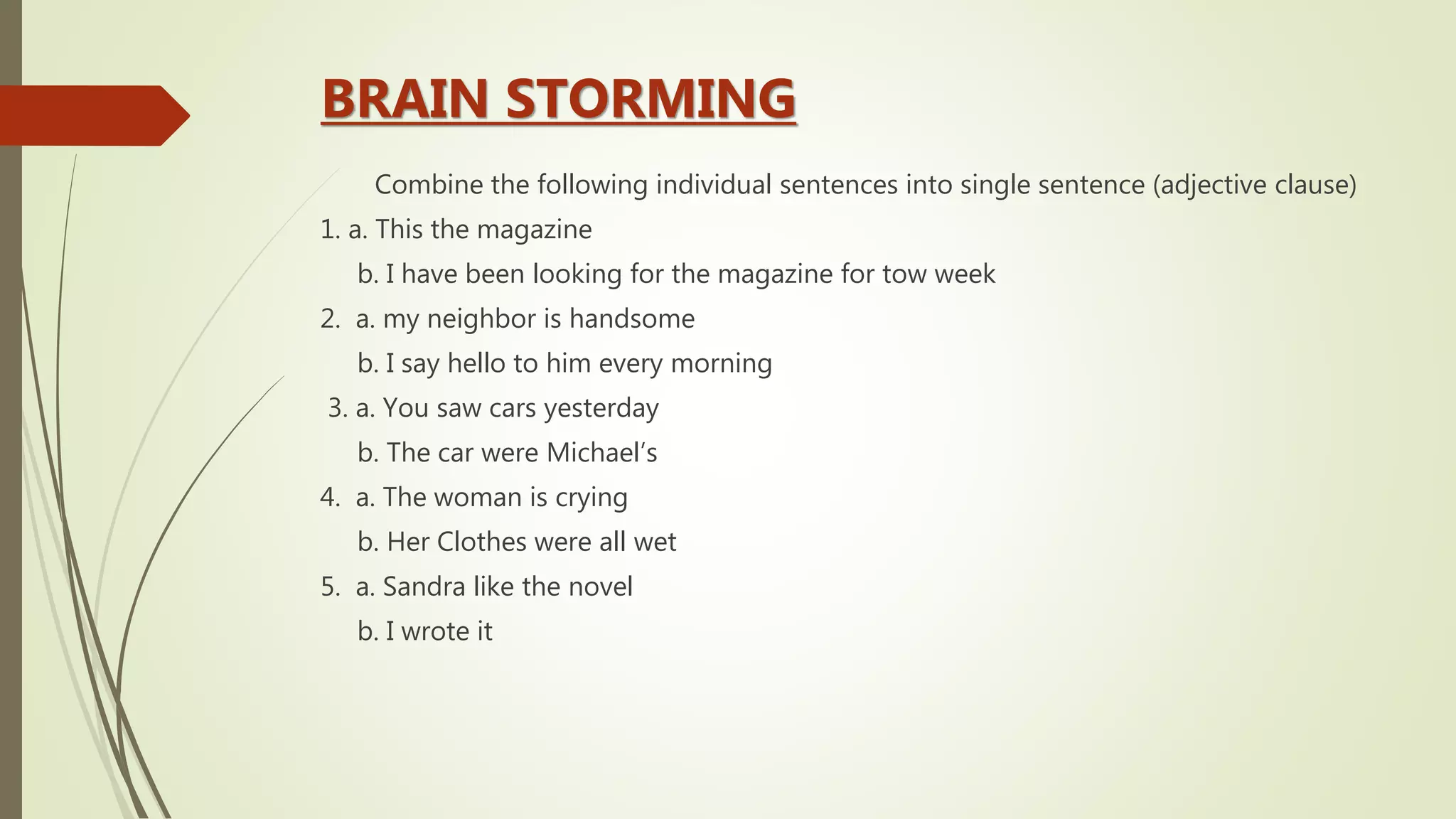
Combine the following individual sentences into single sentence (adjective clause)
1. a. This the magazine
b. I have been looking for the magazine for tow week
2. a. my neighbor is handsome
b. I say hello to him every morning
3. a. You saw cars yesterday
b. The car were Michael’s
4. a. The woman is crying
b. Her Clothes were all wet
5. a. Sandra like the novel
b. I wrote it
BRAIN STORMING
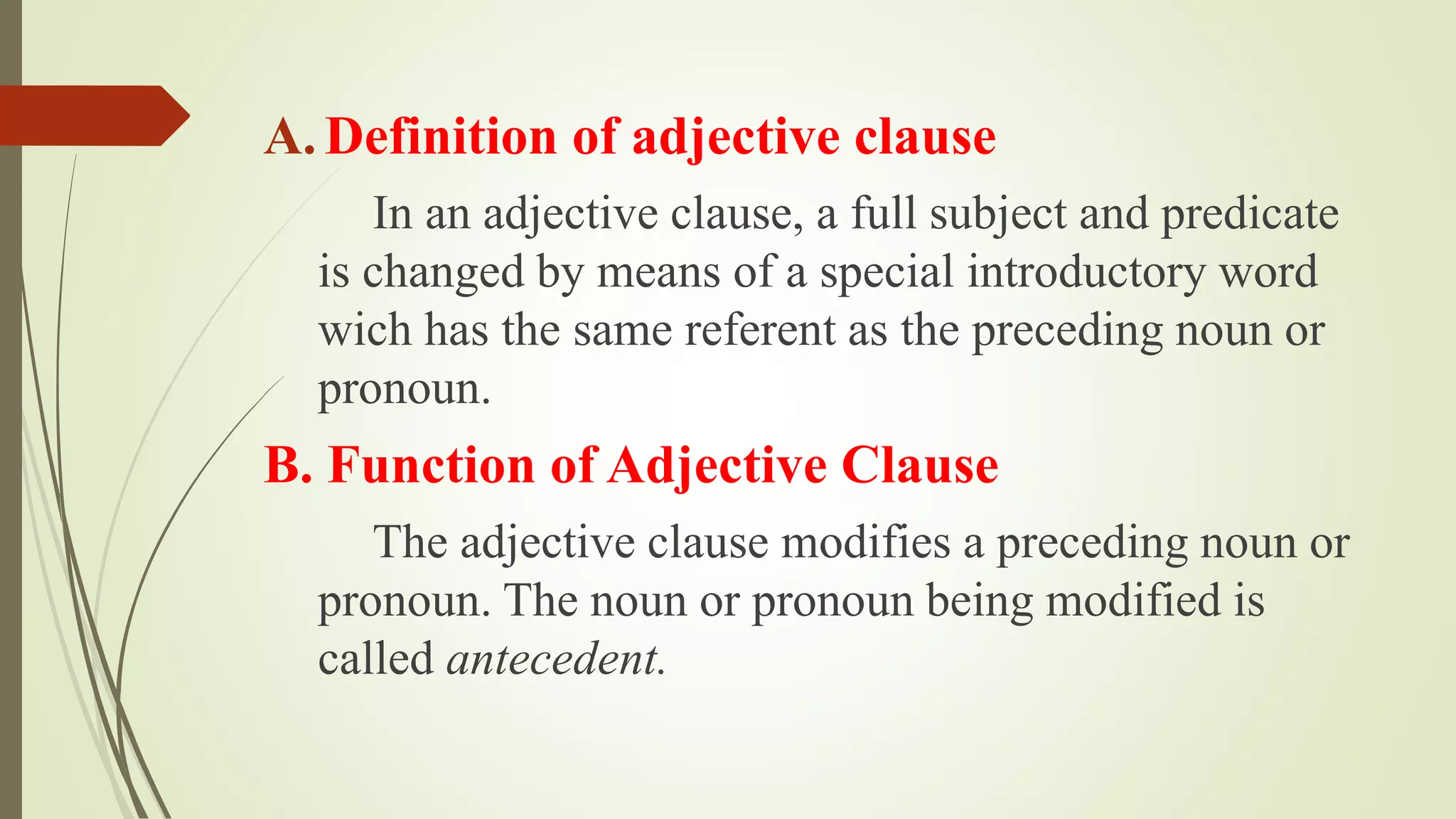
A. Definition of adjective clause
In an adjective clause, a full subject and predicate
is changed by means of a special introductory word
wich has the same referent as the preceding noun or
pronoun.
B. Function of Adjective Clause
The adjective clause modifies a preceding noun or
pronoun. The noun or pronoun being modified is
called antecedent.
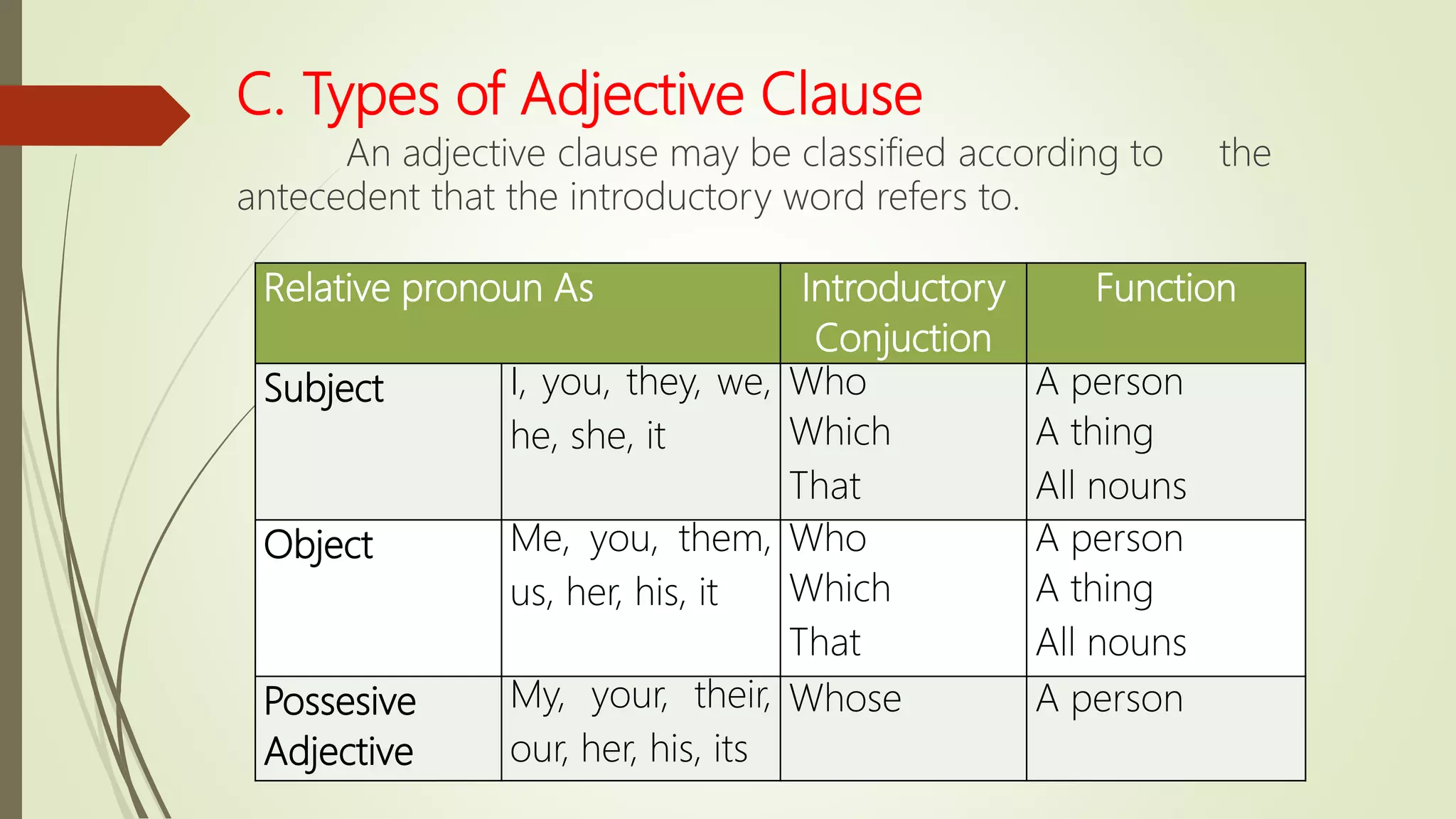
C. Types of Adjective Clause
An adjective clause may be classified according to the
antecedent that the introductory word refers to.
Relative pronoun As Introductory
Conjuction
Function
Subject I, you, they, we,
he, she, it
Who
Which
That
A person
A thing
All nouns
Object Me, you, them,
us, her, his, it
Who
Which
That
A person
A thing
All nouns
Possesive
Adjective
My, your, their,
our, her, his, its
Whose A person
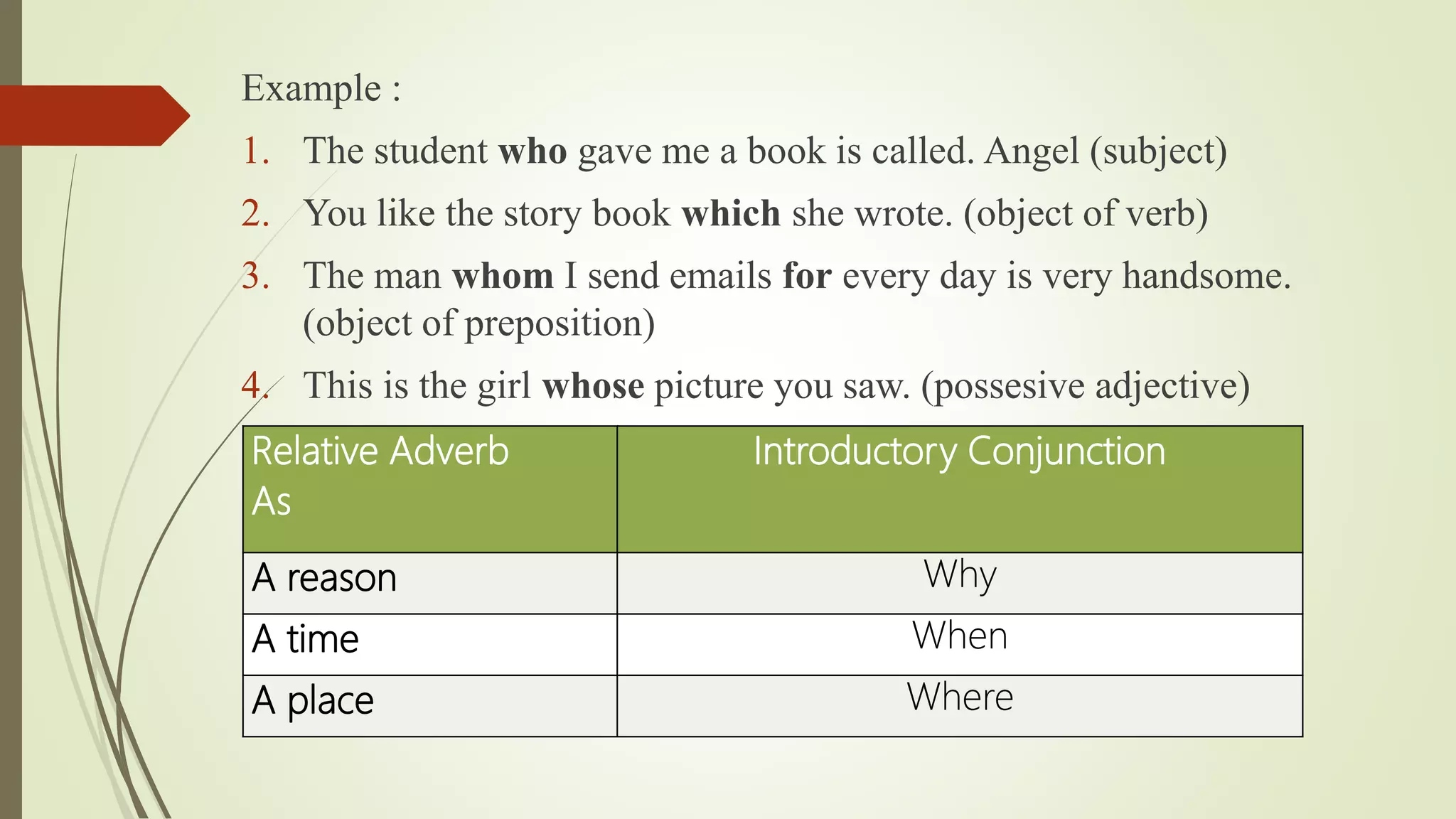
Example :
1. The student who gave me a book is called. Angel (subject)
2. You like the story book which she wrote. (object of verb)
3. The man whom I send emails for every day is very handsome.
(object of preposition)
4. This is the girl whose picture you saw. (possesive adjective)
Relative Adverb
As
Introductory Conjunction
A reason Why
A time When
A place Where
Example:
1. The reason why i came should be questioned by you.
2. The day when they were to leave this village.
3. The small town where they were to leave yesterday.
Note :
why may be interchangeable with that or it may be ommited.
Some grammarians cosider such a clause as a noun clause in
apposition with word reason.
when or where may be interchangeable with a preposition of
place plus which.
Sometimes that replace where or when.
D. Position of Adjective Clause
The normal position of adjective clause is immediately
after the noun or pronoun to which it refers. However,
sometimes a prepositional phrase or a participal phrase
may interven. He greeted all his old friends from Paris,
who were delighted to see him again. Where such a
phrase intervenes, the antecedent of the adjective clause
may be ambiguous. For example, in the sentence: The
dean wrote to the parents of the students who had
helped with thw annual carnival, it is not clear whether
the antecedent of who is the parents or the students.
Occasionally an adjective clause referring to the subject comes after the
verb, especially when the antecedent is a pronoun. For example: everyone
came who could afford the price of the ticket. Such a construction may
have a literary or even an archaic flavor:
All’s well that ends well. (shakespeare)
He prayeth best who loveth best. (coleridge)
E. Possible meaning of Adjective Clause
1. Cause : the man who had stolen the money was sought by the
police.
2. Time : the day when he could leave prison finaly arrived.
3. Place : there’s the house where I used to live.
4. Contrast : our teacher, who is very strict with us in class, is very
kind to us outside class.
R E P T I L
C O M P A S
T H E A T H
E S
S
E R
J E W E L R
C R I M I N
Y
A L S
T R E E
N E W S P A P E R
V U L C A N
B U S I N E
O
S S
A T H L E T I C S
1. Listen carefully and we will read
the question.
2. After we finish read the question.
You can raise your hand.
3. Then, you can answer the
question.
4. After you can answer the question,
you can make a sentence about
adjective clause.
5. If your answer true you get the
point.
1.
2.
3.
4.
5.
6.
7.
8.
9.
10.

Adjective clause ppt

  • 1.
    GROUP 2 NAME :1. KHOFIATUN NIDA 2. NUKHA ZULFATUL MUFIDAH 3. FAISAL YUSUF CLASS : TBI F ADJECTIVE CLAUSE
  • 2.
    Combine the followingindividual sentences into single sentence (adjective clause) 1. a. This the magazine b. I have been looking for the magazine for tow week 2. a. my neighbor is handsome b. I say hello to him every morning 3. a. You saw cars yesterday b. The car were Michael’s 4. a. The woman is crying b. Her Clothes were all wet 5. a. Sandra like the novel b. I wrote it BRAIN STORMING
  • 3.
    A. Definition ofadjective clause In an adjective clause, a full subject and predicate is changed by means of a special introductory word wich has the same referent as the preceding noun or pronoun. B. Function of Adjective Clause The adjective clause modifies a preceding noun or pronoun. The noun or pronoun being modified is called antecedent.
  • 4.
    C. Types ofAdjective Clause An adjective clause may be classified according to the antecedent that the introductory word refers to. Relative pronoun As Introductory Conjuction Function Subject I, you, they, we, he, she, it Who Which That A person A thing All nouns Object Me, you, them, us, her, his, it Who Which That A person A thing All nouns Possesive Adjective My, your, their, our, her, his, its Whose A person
  • 5.
    Example : 1. Thestudent who gave me a book is called. Angel (subject) 2. You like the story book which she wrote. (object of verb) 3. The man whom I send emails for every day is very handsome. (object of preposition) 4. This is the girl whose picture you saw. (possesive adjective) Relative Adverb As Introductory Conjunction A reason Why A time When A place Where
  • 6.
    Example: 1. The reasonwhy i came should be questioned by you. 2. The day when they were to leave this village. 3. The small town where they were to leave yesterday. Note : why may be interchangeable with that or it may be ommited. Some grammarians cosider such a clause as a noun clause in apposition with word reason. when or where may be interchangeable with a preposition of place plus which. Sometimes that replace where or when.
  • 7.
    D. Position ofAdjective Clause The normal position of adjective clause is immediately after the noun or pronoun to which it refers. However, sometimes a prepositional phrase or a participal phrase may interven. He greeted all his old friends from Paris, who were delighted to see him again. Where such a phrase intervenes, the antecedent of the adjective clause may be ambiguous. For example, in the sentence: The dean wrote to the parents of the students who had helped with thw annual carnival, it is not clear whether the antecedent of who is the parents or the students.
  • 8.
    Occasionally an adjectiveclause referring to the subject comes after the verb, especially when the antecedent is a pronoun. For example: everyone came who could afford the price of the ticket. Such a construction may have a literary or even an archaic flavor: All’s well that ends well. (shakespeare) He prayeth best who loveth best. (coleridge) E. Possible meaning of Adjective Clause 1. Cause : the man who had stolen the money was sought by the police. 2. Time : the day when he could leave prison finaly arrived. 3. Place : there’s the house where I used to live. 4. Contrast : our teacher, who is very strict with us in class, is very kind to us outside class.
  • 9.
    R E PT I L C O M P A S T H E A T H E S S E R J E W E L R C R I M I N Y A L S T R E E N E W S P A P E R V U L C A N B U S I N E O S S A T H L E T I C S 1. Listen carefully and we will read the question. 2. After we finish read the question. You can raise your hand. 3. Then, you can answer the question. 4. After you can answer the question, you can make a sentence about adjective clause. 5. If your answer true you get the point. 1. 2. 3. 4. 5. 6. 7. 8. 9. 10.