Adjective Phrase
Introduction
Most people know what an adjective is, but when it comes to
describing an adjective phrase, they get confused. Some are
mistaken and think that this type of phrase is a group of words
that has an adjective in it. Although this may be true, this is not
an effective phrase. This type of phrase is actually a group of
words that serves to describe a noun or pronoun in a sentence,
thus functioning as an adjective. You do not have to be and
English teacher or grammar buff to understand what an
adjective phrase is or how it works: in fact, we use these
phrases all of the time in writing and in spoken English without
thinking about them.
How Can I Identify an Adjective
Phrase?
Many people wonder how to pick out
adjective phrases within sentences. The
trick to identifying one in a sentence is
to look at the first word of the group of
words. If the first word is an adverb or
preposition, there is a good chance that
the phrase is an adjective phrase. Ask
yourself, what is this phrase modifying?
Is it describing the noun? If the group of
words does in fact modify the noun or
subject of the clause or sentence, then
the phrase is in fact an adjective phrase.
What Is An Adjective Phrase Made
Out Of?
An adjective phrase is formed out of
either an intensifier and an adjective,
or alternatively, more than one
adjective in a row. In the first case,
an example might be “very beautiful”
in the sentence, “The very beautiful
woman walked down the street.”
What Can These Phrases Do In a
Sentence?
Many people are surprised to learn
that adjective phrases do not just
modify nouns: they can also modify
pronouns! Look at the following two
examples: “He is from Boston” and
“Tom is from Boston” both have an
adjective phrase, namely, “from
Boston.”
It does not matter if the noun is a
pronoun or not: the adjective phrase
still functions in the same way. If you
are looking for a more complex way
to modify a noun than just using a
simple adjective, try using this type
of phrase! Use many adjectives in a
row, use a phrase with a preposition,
or a phrase starting with an adverb to
modify the noun at hand.
Strings of Adjectives:
Why use one adjective when you could
be very descriptive and use several to
describe an object? A string of
adjectives can come together as an
adjective phrase in order to describe
a noun.
For example in the sentence, “Sally is
a nice girl,” there is one adjective,
namely, nice. However, in the
sentence, “Sally is a nice, intelligent,
beautiful, and kind girl,” an adjectival
phrase is employed in order to come
together and describe Sally.
Adjective phrase vs. adjectival
phrase:
The term adjectival phrase is sometimes used
instead of adjective phrase. However, there is
tendency to call a phrase an adjectival phrase in
such a case where that phrase is functioning
like an adjective phrase would, but does not
contain an actual adjective. For example, in Mr.
Clinton is a man of wealth, the prepositional
phrase of wealth modifies a man the way an
adjective would, and it could be reworded with
an adjective, e.g. Mr. Clinton is a wealthy man.
Similarly, that boy is friendless (the adjective
"friendless" modifies the noun "boy") and That
boy is without a friend (a prepositional phrase
where "without a friend" modifies "boy").
Similarly, the term adjectival phrase is commonly
used for any phrase in attributive position,
whether it is technically an adjective phrase,
noun phrase, or prepositional phrase. These
may be more precisely distinguished as phrasal
attributives or attributive phrases. This
definition is commonly used in English style
guides for writing, where the terms attributive
and adjective are frequently treated as
synonyms, because attributive phrases are
typically hyphenated, whereas predicative
phrases generally are not, despite both
modifying a noun.
Examples of Adjective Phrases:
The best way to understand this type
of phrase and how it functions is to
examine some examples of these
phrases in action. Let’s take a look at
an example with an adjective: “The
beautiful house” and “The house that
is beautiful” mean the same thing,
but the former has an adjective,
whereas the latter has an adjectival
phrase.
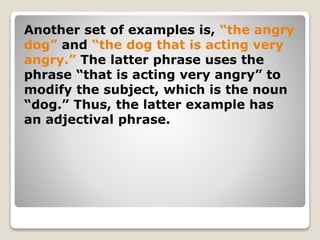
Another set of examples is, “the angry
dog” and “the dog that is acting very
angry.” The latter phrase uses the
phrase “that is acting very angry” to
modify the subject, which is the noun
“dog.” Thus, the latter example has
an adjectival phrase.
Some adjective phrases modify
nouns or noun phrases, Following
are some sentences with the
phrases underlined:
 The very small kitten jumped at the
big dog.
 The cost of the car was way too high.
 The man covered with sweat, trudged
his way home.
Other adjective phrases modify
the predicate of the sentence.
Here are some examples:
 We were saddened by the news of his
demise.
 The brownies smell deliciously sweet.
 I was delighted that he was chosen.
Adjective phrases can also modify
objects and will follow the word
they are modifying. Examples are:
 She wanted to paint her room lemony
yellow.
 My new kitten makes me very happy.
 I sometimes pity people living in
large cities.
Adjective Phrase Examples:
An adjective phrase is a group of
words that describe a noun or
pronoun in a sentence. The adjective
phrase can be placed before, or after,
the noun or pronoun in the sentence.
Adjective Phrase Examples:
 The movie was not too terribly long.
 A person smarter than me needs to
figure this out.
 The final exams were unbelievably
difficult.
 This pie is very
delicious and extremely expensive.
 She is rather fond of skiing.
Adjective Phrases in Literature:
 It was cold, bleak, biting weather. -
Charles Dickens in A Christmas Carol
 He's an extraordinary looking man,
and yet I can really name nothing out
of the way. - Robert Louis Stevenson
in The Strange Case of Dr. Jekyll and
Mr. Hyde
As you can see from the examples, an
adjective phrase can be a very helpful
grammar tool to better describe the
subject of the sentence.
Translation 3
SUBJECT:
SECTION:
362
NAMES:
Hanan Abdullah Al-Rashidi.
Deema Saleh.

T3

  • 1.
  • 2.
    Introduction Most people knowwhat an adjective is, but when it comes to describing an adjective phrase, they get confused. Some are mistaken and think that this type of phrase is a group of words that has an adjective in it. Although this may be true, this is not an effective phrase. This type of phrase is actually a group of words that serves to describe a noun or pronoun in a sentence, thus functioning as an adjective. You do not have to be and English teacher or grammar buff to understand what an adjective phrase is or how it works: in fact, we use these phrases all of the time in writing and in spoken English without thinking about them.
  • 3.
    How Can IIdentify an Adjective Phrase?
  • 4.
    Many people wonderhow to pick out adjective phrases within sentences. The trick to identifying one in a sentence is to look at the first word of the group of words. If the first word is an adverb or preposition, there is a good chance that the phrase is an adjective phrase. Ask yourself, what is this phrase modifying? Is it describing the noun? If the group of words does in fact modify the noun or subject of the clause or sentence, then the phrase is in fact an adjective phrase.
  • 5.
    What Is AnAdjective Phrase Made Out Of?
  • 6.
    An adjective phraseis formed out of either an intensifier and an adjective, or alternatively, more than one adjective in a row. In the first case, an example might be “very beautiful” in the sentence, “The very beautiful woman walked down the street.”
  • 7.
    What Can ThesePhrases Do In a Sentence?
  • 8.
    Many people aresurprised to learn that adjective phrases do not just modify nouns: they can also modify pronouns! Look at the following two examples: “He is from Boston” and “Tom is from Boston” both have an adjective phrase, namely, “from Boston.”
  • 9.
    It does notmatter if the noun is a pronoun or not: the adjective phrase still functions in the same way. If you are looking for a more complex way to modify a noun than just using a simple adjective, try using this type of phrase! Use many adjectives in a row, use a phrase with a preposition, or a phrase starting with an adverb to modify the noun at hand.
  • 10.
    Strings of Adjectives: Whyuse one adjective when you could be very descriptive and use several to describe an object? A string of adjectives can come together as an adjective phrase in order to describe a noun.
  • 11.
    For example inthe sentence, “Sally is a nice girl,” there is one adjective, namely, nice. However, in the sentence, “Sally is a nice, intelligent, beautiful, and kind girl,” an adjectival phrase is employed in order to come together and describe Sally.
  • 12.
    Adjective phrase vs.adjectival phrase:
  • 13.
    The term adjectivalphrase is sometimes used instead of adjective phrase. However, there is tendency to call a phrase an adjectival phrase in such a case where that phrase is functioning like an adjective phrase would, but does not contain an actual adjective. For example, in Mr. Clinton is a man of wealth, the prepositional phrase of wealth modifies a man the way an adjective would, and it could be reworded with an adjective, e.g. Mr. Clinton is a wealthy man. Similarly, that boy is friendless (the adjective "friendless" modifies the noun "boy") and That boy is without a friend (a prepositional phrase where "without a friend" modifies "boy").
  • 14.
    Similarly, the termadjectival phrase is commonly used for any phrase in attributive position, whether it is technically an adjective phrase, noun phrase, or prepositional phrase. These may be more precisely distinguished as phrasal attributives or attributive phrases. This definition is commonly used in English style guides for writing, where the terms attributive and adjective are frequently treated as synonyms, because attributive phrases are typically hyphenated, whereas predicative phrases generally are not, despite both modifying a noun.
  • 15.
  • 16.
    The best wayto understand this type of phrase and how it functions is to examine some examples of these phrases in action. Let’s take a look at an example with an adjective: “The beautiful house” and “The house that is beautiful” mean the same thing, but the former has an adjective, whereas the latter has an adjectival phrase.
  • 17.
    Another set ofexamples is, “the angry dog” and “the dog that is acting very angry.” The latter phrase uses the phrase “that is acting very angry” to modify the subject, which is the noun “dog.” Thus, the latter example has an adjectival phrase.
  • 18.
    Some adjective phrasesmodify nouns or noun phrases, Following are some sentences with the phrases underlined:
  • 19.
     The verysmall kitten jumped at the big dog.  The cost of the car was way too high.  The man covered with sweat, trudged his way home.
  • 20.
    Other adjective phrasesmodify the predicate of the sentence. Here are some examples:
  • 21.
     We weresaddened by the news of his demise.  The brownies smell deliciously sweet.  I was delighted that he was chosen.
  • 22.
    Adjective phrases canalso modify objects and will follow the word they are modifying. Examples are:
  • 23.
     She wantedto paint her room lemony yellow.  My new kitten makes me very happy.  I sometimes pity people living in large cities.
  • 24.
    Adjective Phrase Examples: Anadjective phrase is a group of words that describe a noun or pronoun in a sentence. The adjective phrase can be placed before, or after, the noun or pronoun in the sentence.
  • 25.
    Adjective Phrase Examples: The movie was not too terribly long.  A person smarter than me needs to figure this out.  The final exams were unbelievably difficult.  This pie is very delicious and extremely expensive.  She is rather fond of skiing.
  • 26.
    Adjective Phrases inLiterature:  It was cold, bleak, biting weather. - Charles Dickens in A Christmas Carol  He's an extraordinary looking man, and yet I can really name nothing out of the way. - Robert Louis Stevenson in The Strange Case of Dr. Jekyll and Mr. Hyde
  • 27.
    As you cansee from the examples, an adjective phrase can be a very helpful grammar tool to better describe the subject of the sentence.
  • 28.