COMMUNICATIVE GRAMMAR IV

Adjective Clauses with
Subject Relative Pronouns


    César Ochoa Cueva, M.S.Ed.
Adjective Clauses
            Adjective Clauses
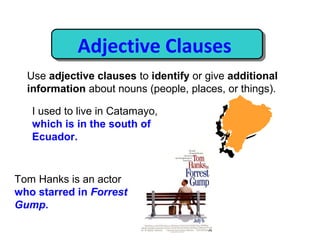
  Use adjective clauses to identify or give additional
  information about nouns (people, places, or things).

   I used to live in Catamayo,
   which is in the south of
   Ecuador.


Tom Hanks is an actor
who starred in Forrest
Gump.
Adjective Clauses
            Adjective Clauses
Adjective clauses can also identify or describe indefinite
pronouns such as one, someone, somebody, something,
another, and other (s).

 An actress is someone who plays a role in a movie.


                           The adjective clause directly
                          follows the noun (or pronoun)
                                 it is identifying.
Adjective Clauses
           Adjective Clauses
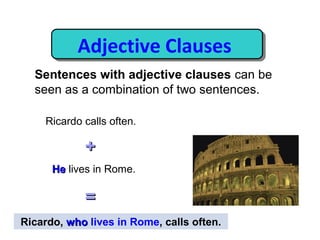
  Sentences with adjective clauses can be
  seen as a combination of two sentences.

    Ricardo calls often.

            +
      He lives in Rome.

            =
Ricardo, who lives in Rome, calls often.
Relative Pronouns
               Relative Pronouns
   Adjective clauses begin with relative pronouns. Subject
   relative pronouns can be who, that, which, and whose.

    I have a friend who/that has a castle.
                                   castle


Paris is a city which/that attracts a
lot of tourists.


He is the student whose book
is on the shelf.
          shelf
Relative Pronouns
              Relative Pronouns
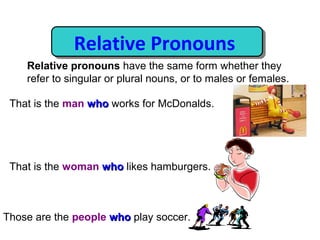
    Relative pronouns have the same form whether they
    refer to singular or plural nouns, or to males or females.

 That is the man who works for McDonalds.


 That is the woman who likes hamburgers.


Those are the people who play soccer.
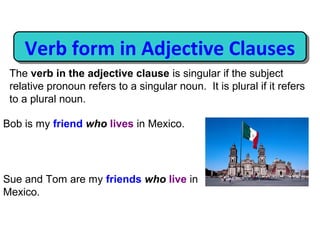
Verb form in Adjective Clauses
    Verb form in Adjective Clauses
 The verb in the adjective clause is singular if the subject
 relative pronoun refers to a singular noun. It is plural if it refers
 to a plural noun.

Bob is my friend who lives in Mexico.


Sue and Tom are my friends who live in
Mexico.
Kinds of Adjective Clauses
        Kinds of Adjective Clauses
   There are two kinds of adjective clauses,
   identifying and nonidentifying.

I have a lot of good friends. My friend who lives in New York
visits me often.

                                     The adjective clause is
                                      necessary to identify
                                         which friend.
Kinds of Adjective Clauses
      Kinds of Adjective Clauses
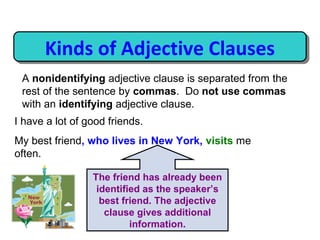
 A nonidentifying adjective clause is separated from the
 rest of the sentence by commas. Do not use commas
 with an identifying adjective clause.
I have a lot of good friends.
My best friend, who lives in New York, visits me
often.

                 The friend has already been
                  identified as the speaker’s
                   best friend. The adjective
                    clause gives additional
                          information.
Bibliography

• Fuchs, M. & Bonner, M., Focus on Grammar 4
  Pearson Education , White Plains, NY 10606,
  2006
• http://www.myenglishteacher.net
•   Photo credit: Microsoft Office

Adjective clauses with

  • 1.
    COMMUNICATIVE GRAMMAR IV AdjectiveClauses with Subject Relative Pronouns César Ochoa Cueva, M.S.Ed.
  • 2.
    Adjective Clauses Adjective Clauses Use adjective clauses to identify or give additional information about nouns (people, places, or things). I used to live in Catamayo, which is in the south of Ecuador. Tom Hanks is an actor who starred in Forrest Gump.
  • 3.
    Adjective Clauses Adjective Clauses Adjective clauses can also identify or describe indefinite pronouns such as one, someone, somebody, something, another, and other (s). An actress is someone who plays a role in a movie. The adjective clause directly follows the noun (or pronoun) it is identifying.
  • 4.
    Adjective Clauses Adjective Clauses Sentences with adjective clauses can be seen as a combination of two sentences. Ricardo calls often. + He lives in Rome. = Ricardo, who lives in Rome, calls often.
  • 5.
    Relative Pronouns Relative Pronouns Adjective clauses begin with relative pronouns. Subject relative pronouns can be who, that, which, and whose. I have a friend who/that has a castle. castle Paris is a city which/that attracts a lot of tourists. He is the student whose book is on the shelf. shelf
  • 6.
    Relative Pronouns Relative Pronouns Relative pronouns have the same form whether they refer to singular or plural nouns, or to males or females. That is the man who works for McDonalds. That is the woman who likes hamburgers. Those are the people who play soccer.
  • 7.
    Verb form inAdjective Clauses Verb form in Adjective Clauses The verb in the adjective clause is singular if the subject relative pronoun refers to a singular noun. It is plural if it refers to a plural noun. Bob is my friend who lives in Mexico. Sue and Tom are my friends who live in Mexico.
  • 8.
    Kinds of AdjectiveClauses Kinds of Adjective Clauses There are two kinds of adjective clauses, identifying and nonidentifying. I have a lot of good friends. My friend who lives in New York visits me often. The adjective clause is necessary to identify which friend.
  • 9.
    Kinds of AdjectiveClauses Kinds of Adjective Clauses A nonidentifying adjective clause is separated from the rest of the sentence by commas. Do not use commas with an identifying adjective clause. I have a lot of good friends. My best friend, who lives in New York, visits me often. The friend has already been identified as the speaker’s best friend. The adjective clause gives additional information.
  • 11.
    Bibliography • Fuchs, M.& Bonner, M., Focus on Grammar 4 Pearson Education , White Plains, NY 10606, 2006 • http://www.myenglishteacher.net • Photo credit: Microsoft Office