Adjective and Adverb
Clauses
Identifying
Identifying
Writing
Writing
Combining
Combining
A complex sentence is
made up of an
independent clause and
a dependent clause.
There are two kinds of
dependent clauses:
adjective clause
 adverb clause
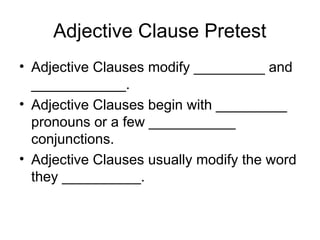
Adjective Clause Pretest
• Adjective Clauses modify _________ and
____________.
Adjective Clause Pretest
• Adjective Clauses modify _________ and
____________.
• Adjective Clauses begin with _________
pronouns or a few ___________
conjunctions.
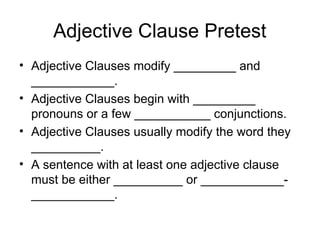
Adjective Clause Pretest
• Adjective Clauses modify _________ and
____________.
• Adjective Clauses begin with _________
pronouns or a few ___________
conjunctions.
• Adjective Clauses usually modify the word
they __________.
Adjective Clause Pretest
• Adjective Clauses modify _________ and
____________.
• Adjective Clauses begin with _________
pronouns or a few ___________ conjunctions.
• Adjective Clauses usually modify the word they
__________.
• A sentence with at least one adjective clause
must be either __________ or ____________-
____________.
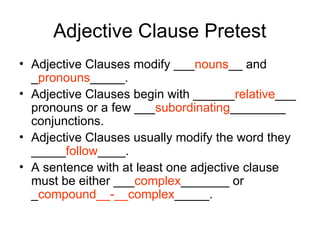
Adjective Clause Pretest
• Adjective Clauses modify ___nouns__ and
_pronouns_____.
• Adjective Clauses begin with ______relative___
pronouns or a few ___subordinating________
conjunctions.
• Adjective Clauses usually modify the word they
_____follow____.
• A sentence with at least one adjective clause
must be either ___complex_______ or
_compound__-__complex_____.
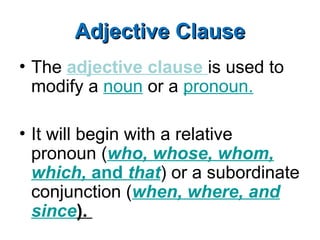
Adjective Clause
Adjective Clause
• The adjective clause is used to
modify a noun or a pronoun.
• It will begin with a relative
pronoun (who, whose, whom,
which, and that) or a subordinate
conjunction (when, where, and
since).
• The introductory word will
always rename the word that
it follows and modifies except
when used with a preposition
which will come between the
introductory word and the word
it renames.
Examples:
• The student whose hand was
up gave the wrong answer.
• Whose hand was up is the
adjective clause with whose,
the relative pronoun, renaming
and modifying student.
Examples
• Jane is a person in whom I can place my
confidence.
• In whom I can place my confidence is the
adjective clause
• Whom is the relative pronoun
• the preposition in comes between whom
and person, the word that whom renames
and modifies.
Combining Sentences
• Using the various kinds of clauses can
give variety to your sentences.
• Adjective clauses can be used for this
purpose.
• A sentence with one independent clause
and one or more adjective clauses would
be an example of a COMPLEX
SENTENCE.
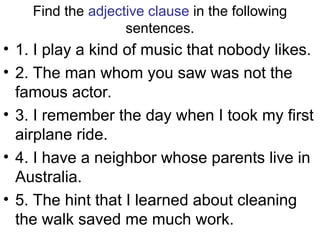
Find the adjective clause in the following
sentences.
• 1. I play a kind of music that nobody likes.
• 2. The man whom you saw was not the
famous actor.
• 3. I remember the day when I took my first
airplane ride.
• 4. I have a neighbor whose parents live in
Australia.
• 5. The hint that I learned about cleaning
the walk saved me much work.
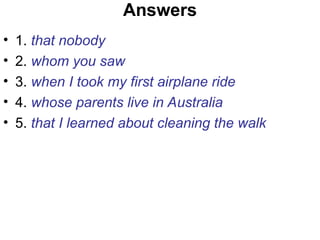
Answers
• 1. that nobody
• 2. whom you saw
• 3. when I took my first airplane ride
• 4. whose parents live in Australia
• 5. that I learned about cleaning the walk
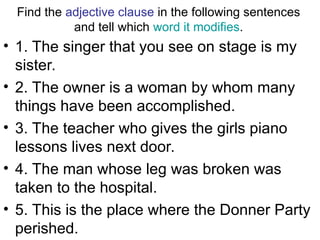
Find the adjective clause in the following sentences
and tell which word it modifies.
• 1. The singer that you see on stage is my
sister.
• 2. The owner is a woman by whom many
things have been accomplished.
• 3. The teacher who gives the girls piano
lessons lives next door.
• 4. The man whose leg was broken was
taken to the hospital.
• 5. This is the place where the Donner Party
perished.
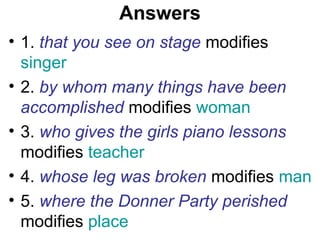
Answers
• 1. that you see on stage modifies
singer
• 2. by whom many things have been
accomplished modifies woman
• 3. who gives the girls piano lessons
modifies teacher
• 4. whose leg was broken modifies man
• 5. where the Donner Party perished
modifies place
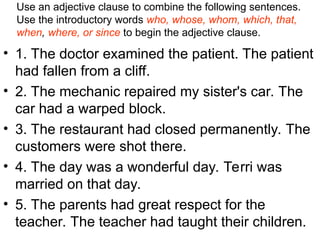
Use an adjective clause to combine the following sentences.
Use the introductory words who, whose, whom, which, that,
when, where, or since to begin the adjective clause.
• 1. The doctor examined the patient. The patient
had fallen from a cliff.
• 2. The mechanic repaired my sister's car. The
car had a warped block.
• 3. The restaurant had closed permanently. The
customers were shot there.
• 4. The day was a wonderful day. Terri was
married on that day.
• 5. The parents had great respect for the
teacher. The teacher had taught their children.
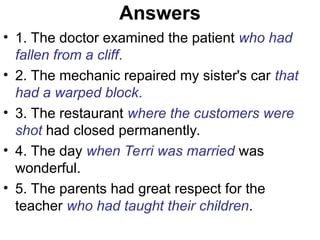
Answers
• 1. The doctor examined the patient who had
fallen from a cliff.
• 2. The mechanic repaired my sister's car that
had a warped block.
• 3. The restaurant where the customers were
shot had closed permanently.
• 4. The day when Terri was married was
wonderful.
• 5. The parents had great respect for the
teacher who had taught their children.
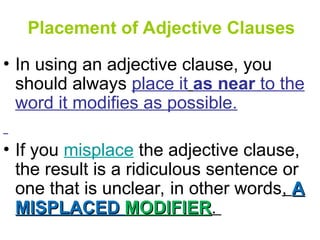
Placement of Adjective Clauses
• In using an adjective clause, you
should always place it as near to the
word it modifies as possible.
• If you misplace the adjective clause,
the result is a ridiculous sentence or
one that is unclear, in other words, A
A
MISPLACED
MISPLACED MODIFIER
MODIFIER.
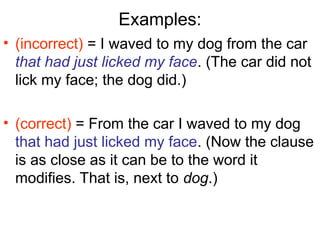
Examples:
• (incorrect) = I waved to my dog from the car
that had just licked my face. (The car did not
lick my face; the dog did.)
• (correct) = From the car I waved to my dog
that had just licked my face. (Now the clause
is as close as it can be to the word it
modifies. That is, next to dog.)
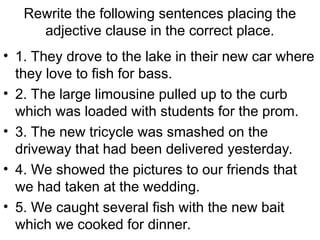
Rewrite the following sentences placing the
adjective clause in the correct place.
• 1. They drove to the lake in their new car where
they love to fish for bass.
• 2. The large limousine pulled up to the curb
which was loaded with students for the prom.
• 3. The new tricycle was smashed on the
driveway that had been delivered yesterday.
• 4. We showed the pictures to our friends that
we had taken at the wedding.
• 5. We caught several fish with the new bait
which we cooked for dinner.
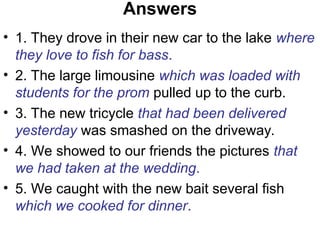
Answers
• 1. They drove in their new car to the lake where
they love to fish for bass.
• 2. The large limousine which was loaded with
students for the prom pulled up to the curb.
• 3. The new tricycle that had been delivered
yesterday was smashed on the driveway.
• 4. We showed to our friends the pictures that
we had taken at the wedding.
• 5. We caught with the new bait several fish
which we cooked for dinner.
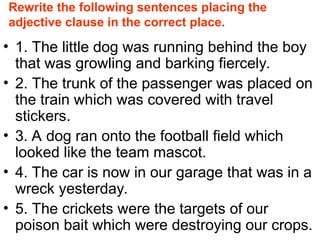
Rewrite the following sentences placing the
adjective clause in the correct place.
• 1. The little dog was running behind the boy
that was growling and barking fiercely.
• 2. The trunk of the passenger was placed on
the train which was covered with travel
stickers.
• 3. A dog ran onto the football field which
looked like the team mascot.
• 4. The car is now in our garage that was in a
wreck yesterday.
• 5. The crickets were the targets of our
poison bait which were destroying our crops.
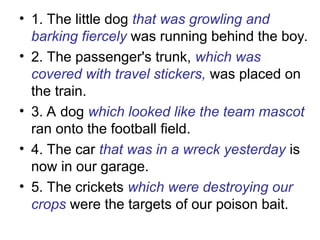
• 1. The little dog that was growling and
barking fiercely was running behind the boy.
• 2. The passenger's trunk, which was
covered with travel stickers, was placed on
the train.
• 3. A dog which looked like the team mascot
ran onto the football field.
• 4. The car that was in a wreck yesterday is
now in our garage.
• 5. The crickets which were destroying our
crops were the targets of our poison bait.
The Adverb Clause
The Adverb Clause
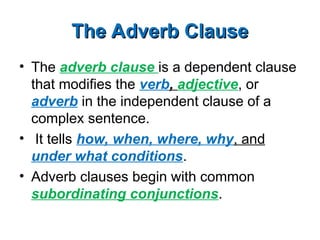
• The adverb clause is a dependent clause
that modifies the verb, adjective, or
adverb in the independent clause of a
complex sentence.
• It tells how, when, where, why, and
under what conditions.
• Adverb clauses begin with common
subordinating conjunctions.
Common Subordinating
Conjunctions
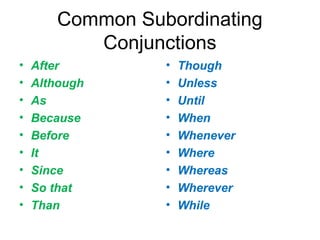
• After
• Although
• As
• Because
• Before
• It
• Since
• So that
• Than
• Though
• Unless
• Until
• When
• Whenever
• Where
• Whereas
• Wherever
• While
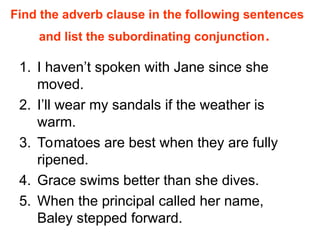
Find the adverb clause in the following sentences
and list the subordinating conjunction.
1. I haven’t spoken with Jane since she
moved.
2. I’ll wear my sandals if the weather is
warm.
3. Tomatoes are best when they are fully
ripened.
4. Grace swims better than she dives.
5. When the principal called her name,
Baley stepped forward.
Answers
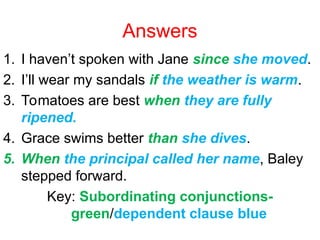
1. I haven’t spoken with Jane since she moved.
2. I’ll wear my sandals if the weather is warm.
3. Tomatoes are best when they are fully
ripened.
4. Grace swims better than she dives.
5. When the principal called her name, Baley
stepped forward.
Key: Subordinating conjunctions-
green/dependent clause blue
Adjective and Adverb Clauses Lessons.ppt

  • 1.
  • 2.
    A complex sentenceis made up of an independent clause and a dependent clause.
  • 3.
    There are twokinds of dependent clauses: adjective clause  adverb clause
  • 4.
    Adjective Clause Pretest •Adjective Clauses modify _________ and ____________.
  • 5.
    Adjective Clause Pretest •Adjective Clauses modify _________ and ____________. • Adjective Clauses begin with _________ pronouns or a few ___________ conjunctions.
  • 6.
    Adjective Clause Pretest •Adjective Clauses modify _________ and ____________. • Adjective Clauses begin with _________ pronouns or a few ___________ conjunctions. • Adjective Clauses usually modify the word they __________.
  • 7.
    Adjective Clause Pretest •Adjective Clauses modify _________ and ____________. • Adjective Clauses begin with _________ pronouns or a few ___________ conjunctions. • Adjective Clauses usually modify the word they __________. • A sentence with at least one adjective clause must be either __________ or ____________- ____________.
  • 8.
    Adjective Clause Pretest •Adjective Clauses modify ___nouns__ and _pronouns_____. • Adjective Clauses begin with ______relative___ pronouns or a few ___subordinating________ conjunctions. • Adjective Clauses usually modify the word they _____follow____. • A sentence with at least one adjective clause must be either ___complex_______ or _compound__-__complex_____.
  • 9.
    Adjective Clause Adjective Clause •The adjective clause is used to modify a noun or a pronoun. • It will begin with a relative pronoun (who, whose, whom, which, and that) or a subordinate conjunction (when, where, and since).
  • 10.
    • The introductoryword will always rename the word that it follows and modifies except when used with a preposition which will come between the introductory word and the word it renames.
  • 11.
    Examples: • The studentwhose hand was up gave the wrong answer. • Whose hand was up is the adjective clause with whose, the relative pronoun, renaming and modifying student.
  • 12.
    Examples • Jane isa person in whom I can place my confidence. • In whom I can place my confidence is the adjective clause • Whom is the relative pronoun • the preposition in comes between whom and person, the word that whom renames and modifies.
  • 13.
    Combining Sentences • Usingthe various kinds of clauses can give variety to your sentences. • Adjective clauses can be used for this purpose. • A sentence with one independent clause and one or more adjective clauses would be an example of a COMPLEX SENTENCE.
  • 14.
    Find the adjectiveclause in the following sentences. • 1. I play a kind of music that nobody likes. • 2. The man whom you saw was not the famous actor. • 3. I remember the day when I took my first airplane ride. • 4. I have a neighbor whose parents live in Australia. • 5. The hint that I learned about cleaning the walk saved me much work.
  • 15.
    Answers • 1. thatnobody • 2. whom you saw • 3. when I took my first airplane ride • 4. whose parents live in Australia • 5. that I learned about cleaning the walk
  • 16.
    Find the adjectiveclause in the following sentences and tell which word it modifies. • 1. The singer that you see on stage is my sister. • 2. The owner is a woman by whom many things have been accomplished. • 3. The teacher who gives the girls piano lessons lives next door. • 4. The man whose leg was broken was taken to the hospital. • 5. This is the place where the Donner Party perished.
  • 17.
    Answers • 1. thatyou see on stage modifies singer • 2. by whom many things have been accomplished modifies woman • 3. who gives the girls piano lessons modifies teacher • 4. whose leg was broken modifies man • 5. where the Donner Party perished modifies place
  • 18.
    Use an adjectiveclause to combine the following sentences. Use the introductory words who, whose, whom, which, that, when, where, or since to begin the adjective clause. • 1. The doctor examined the patient. The patient had fallen from a cliff. • 2. The mechanic repaired my sister's car. The car had a warped block. • 3. The restaurant had closed permanently. The customers were shot there. • 4. The day was a wonderful day. Terri was married on that day. • 5. The parents had great respect for the teacher. The teacher had taught their children.
  • 19.
    Answers • 1. Thedoctor examined the patient who had fallen from a cliff. • 2. The mechanic repaired my sister's car that had a warped block. • 3. The restaurant where the customers were shot had closed permanently. • 4. The day when Terri was married was wonderful. • 5. The parents had great respect for the teacher who had taught their children.
  • 20.
    Placement of AdjectiveClauses • In using an adjective clause, you should always place it as near to the word it modifies as possible. • If you misplace the adjective clause, the result is a ridiculous sentence or one that is unclear, in other words, A A MISPLACED MISPLACED MODIFIER MODIFIER.
  • 21.
    Examples: • (incorrect) =I waved to my dog from the car that had just licked my face. (The car did not lick my face; the dog did.) • (correct) = From the car I waved to my dog that had just licked my face. (Now the clause is as close as it can be to the word it modifies. That is, next to dog.)
  • 22.
    Rewrite the followingsentences placing the adjective clause in the correct place. • 1. They drove to the lake in their new car where they love to fish for bass. • 2. The large limousine pulled up to the curb which was loaded with students for the prom. • 3. The new tricycle was smashed on the driveway that had been delivered yesterday. • 4. We showed the pictures to our friends that we had taken at the wedding. • 5. We caught several fish with the new bait which we cooked for dinner.
  • 23.
    Answers • 1. Theydrove in their new car to the lake where they love to fish for bass. • 2. The large limousine which was loaded with students for the prom pulled up to the curb. • 3. The new tricycle that had been delivered yesterday was smashed on the driveway. • 4. We showed to our friends the pictures that we had taken at the wedding. • 5. We caught with the new bait several fish which we cooked for dinner.
  • 24.
    Rewrite the followingsentences placing the adjective clause in the correct place. • 1. The little dog was running behind the boy that was growling and barking fiercely. • 2. The trunk of the passenger was placed on the train which was covered with travel stickers. • 3. A dog ran onto the football field which looked like the team mascot. • 4. The car is now in our garage that was in a wreck yesterday. • 5. The crickets were the targets of our poison bait which were destroying our crops.
  • 25.
    • 1. Thelittle dog that was growling and barking fiercely was running behind the boy. • 2. The passenger's trunk, which was covered with travel stickers, was placed on the train. • 3. A dog which looked like the team mascot ran onto the football field. • 4. The car that was in a wreck yesterday is now in our garage. • 5. The crickets which were destroying our crops were the targets of our poison bait.
  • 26.
    The Adverb Clause TheAdverb Clause • The adverb clause is a dependent clause that modifies the verb, adjective, or adverb in the independent clause of a complex sentence. • It tells how, when, where, why, and under what conditions. • Adverb clauses begin with common subordinating conjunctions.
  • 27.
    Common Subordinating Conjunctions • After •Although • As • Because • Before • It • Since • So that • Than • Though • Unless • Until • When • Whenever • Where • Whereas • Wherever • While
  • 28.
    Find the adverbclause in the following sentences and list the subordinating conjunction. 1. I haven’t spoken with Jane since she moved. 2. I’ll wear my sandals if the weather is warm. 3. Tomatoes are best when they are fully ripened. 4. Grace swims better than she dives. 5. When the principal called her name, Baley stepped forward.
  • 29.
    Answers 1. I haven’tspoken with Jane since she moved. 2. I’ll wear my sandals if the weather is warm. 3. Tomatoes are best when they are fully ripened. 4. Grace swims better than she dives. 5. When the principal called her name, Baley stepped forward. Key: Subordinating conjunctions- green/dependent clause blue