THE ADJECTIVE CLAUSE
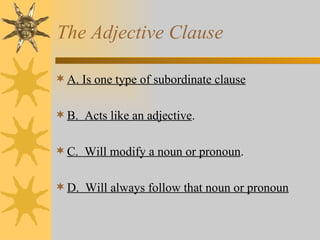
The Adjective Clause A. Is one type of subordinate clause B.  Acts like an adjective .  C.  Will modify a noun or pronoun .  D.  Will always follow that noun or pronoun
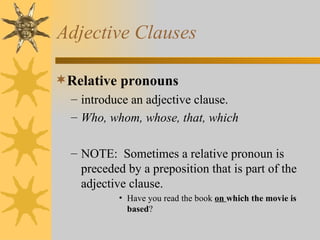
Adjective Clauses Relative pronouns   introduce an adjective clause.  Who, whom, whose, that, which NOTE:  Sometimes a relative pronoun is preceded by a preposition that is part of the adjective clause. Have you read the book  on  which the movie is based ?
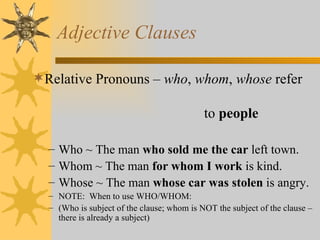
Adjective Clauses Relative Pronouns –  who ,  whom ,  whose  refer  to  people Who ~ The man  who sold me the car  left town. Whom ~ The man  for whom I work  is kind. Whose ~ The man  whose car was stolen  is angry. NOTE:  When to use WHO/WHOM: (Who is subject of the clause; whom is NOT the subject of the clause – there is already a subject)
Adjective Clauses Relative Pronouns –  which ,  that  refer  to  things & animals Which ~ Math,  which is my favorite subject , was  cancelled. That ~ The animal  that ate my mom’s salad  died.
Adjective Clauses To modify a place or a time, an adjective clause may be introduced by  when  or  where .  When used to introduce adjective clauses, these words are called  relative adverbs . The house  where  I grew up  has been destroyed. Did I tell you about the time  when  my husband was sprayed by a skunk ?
Adjective Clauses REMEMBER:  Adjective clauses are dependent clauses.  If you take them out of the sentence, you must have a complete sentence left.
Commas with Adjective Clauses When the adjective clause tells  which one , it cannot be taken out of the sentence without changing the meaning of the sentence. (essential= no commas) A clause beginning with  that  is usually essential. Clauses that add information that is not needed to understand the basic meaning are nonessential. USE COMMAS!
Adjective Clauses –  Where are they? The actors who perform in commercials receive good pay. At the zoo we saw some animals that were ferocious. Mark Twain, who was an American writer, died a poor man.
Adjective Clauses –  Where are they? The actors  who perform in commercials  receive good pay. At the zoo we saw some animals  that were ferocious. Mark Twain,  who was an American writer , died a poor man.
Adjective Clauses –  Where are they? The theatre where we saw the movie burned to the ground. Is this the student whose quick action saved Mrs. Bell? Maria, whom I knew from college, just stopped by to visit.
Adjective Clauses –  Where are they? The theatre  where we saw the movie  burned to the ground. Is this the student  whose quick action saved Mrs. Bell? Maria,  whom I knew from college , just stopped by to visit.
Adjective Clauses –  Where are they? Spring, which happens to be my favorite season, is a great time of year. The boy who ate that plant just died. Simon, whom we know ate that plant, just died.
Adjective Clauses –  Where are they? Spring,  which happens to be my favorite season , is a great time of year. The boy  who ate that plant  just died. Simon,  whom we know ate that plant , just died.
Adjective Clauses –  WRONG!!!! Who is at the door? Where is your homework for English? The man who the school just hired is Mr. Mixon. The girl that sat next to me fell asleep. I did my homework when I got home from school. A metaphor is when you compare two things.
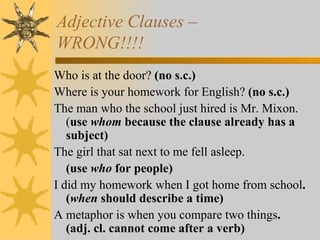
Adjective Clauses –  WRONG!!!! Who is at the door?  (no s.c.) Where is your homework for English?  (no s.c.) The man who the school just hired is Mr. Mixon. ( use  whom  because the clause already has a subject) The girl that sat next to me fell asleep.  (use  who  for people) I did my homework when I got home from school . ( when  should describe a time) A metaphor is when you compare two things .  (adj. cl. cannot come after a verb)

The Adjective Clause

  • 1.
  • 2.
    The Adjective ClauseA. Is one type of subordinate clause B. Acts like an adjective . C. Will modify a noun or pronoun . D. Will always follow that noun or pronoun
  • 3.
    Adjective Clauses Relativepronouns introduce an adjective clause. Who, whom, whose, that, which NOTE: Sometimes a relative pronoun is preceded by a preposition that is part of the adjective clause. Have you read the book on which the movie is based ?
  • 4.
    Adjective Clauses RelativePronouns – who , whom , whose refer to people Who ~ The man who sold me the car left town. Whom ~ The man for whom I work is kind. Whose ~ The man whose car was stolen is angry. NOTE: When to use WHO/WHOM: (Who is subject of the clause; whom is NOT the subject of the clause – there is already a subject)
  • 5.
    Adjective Clauses RelativePronouns – which , that refer to things & animals Which ~ Math, which is my favorite subject , was cancelled. That ~ The animal that ate my mom’s salad died.
  • 6.
    Adjective Clauses Tomodify a place or a time, an adjective clause may be introduced by when or where . When used to introduce adjective clauses, these words are called relative adverbs . The house where I grew up has been destroyed. Did I tell you about the time when my husband was sprayed by a skunk ?
  • 7.
    Adjective Clauses REMEMBER: Adjective clauses are dependent clauses. If you take them out of the sentence, you must have a complete sentence left.
  • 8.
    Commas with AdjectiveClauses When the adjective clause tells which one , it cannot be taken out of the sentence without changing the meaning of the sentence. (essential= no commas) A clause beginning with that is usually essential. Clauses that add information that is not needed to understand the basic meaning are nonessential. USE COMMAS!
  • 9.
    Adjective Clauses – Where are they? The actors who perform in commercials receive good pay. At the zoo we saw some animals that were ferocious. Mark Twain, who was an American writer, died a poor man.
  • 10.
    Adjective Clauses – Where are they? The actors who perform in commercials receive good pay. At the zoo we saw some animals that were ferocious. Mark Twain, who was an American writer , died a poor man.
  • 11.
    Adjective Clauses – Where are they? The theatre where we saw the movie burned to the ground. Is this the student whose quick action saved Mrs. Bell? Maria, whom I knew from college, just stopped by to visit.
  • 12.
    Adjective Clauses – Where are they? The theatre where we saw the movie burned to the ground. Is this the student whose quick action saved Mrs. Bell? Maria, whom I knew from college , just stopped by to visit.
  • 13.
    Adjective Clauses – Where are they? Spring, which happens to be my favorite season, is a great time of year. The boy who ate that plant just died. Simon, whom we know ate that plant, just died.
  • 14.
    Adjective Clauses – Where are they? Spring, which happens to be my favorite season , is a great time of year. The boy who ate that plant just died. Simon, whom we know ate that plant , just died.
  • 15.
    Adjective Clauses – WRONG!!!! Who is at the door? Where is your homework for English? The man who the school just hired is Mr. Mixon. The girl that sat next to me fell asleep. I did my homework when I got home from school. A metaphor is when you compare two things.
  • 16.
    Adjective Clauses – WRONG!!!! Who is at the door? (no s.c.) Where is your homework for English? (no s.c.) The man who the school just hired is Mr. Mixon. ( use whom because the clause already has a subject) The girl that sat next to me fell asleep. (use who for people) I did my homework when I got home from school . ( when should describe a time) A metaphor is when you compare two things . (adj. cl. cannot come after a verb)