Rules in Subject –
Verb Agreement
Rules in Subject – Verb Agreement
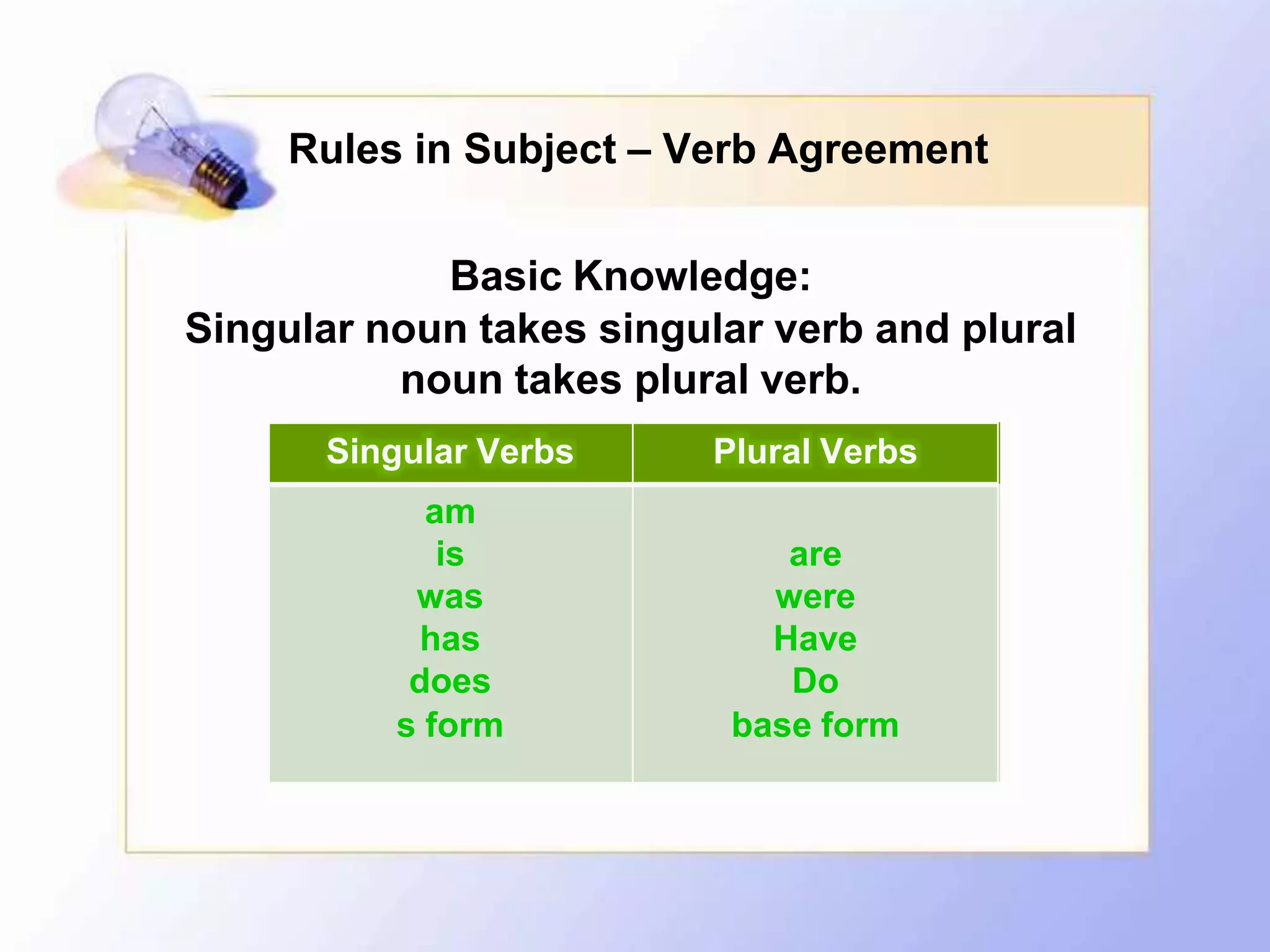
Basic Knowledge:
Singular noun takes singular verb and plural
noun takes plural verb.
Singular Verbs Plural Verbs
am
is are
was were
has Have
does Do
s form base form
Rules in Subject – Verb Agreement
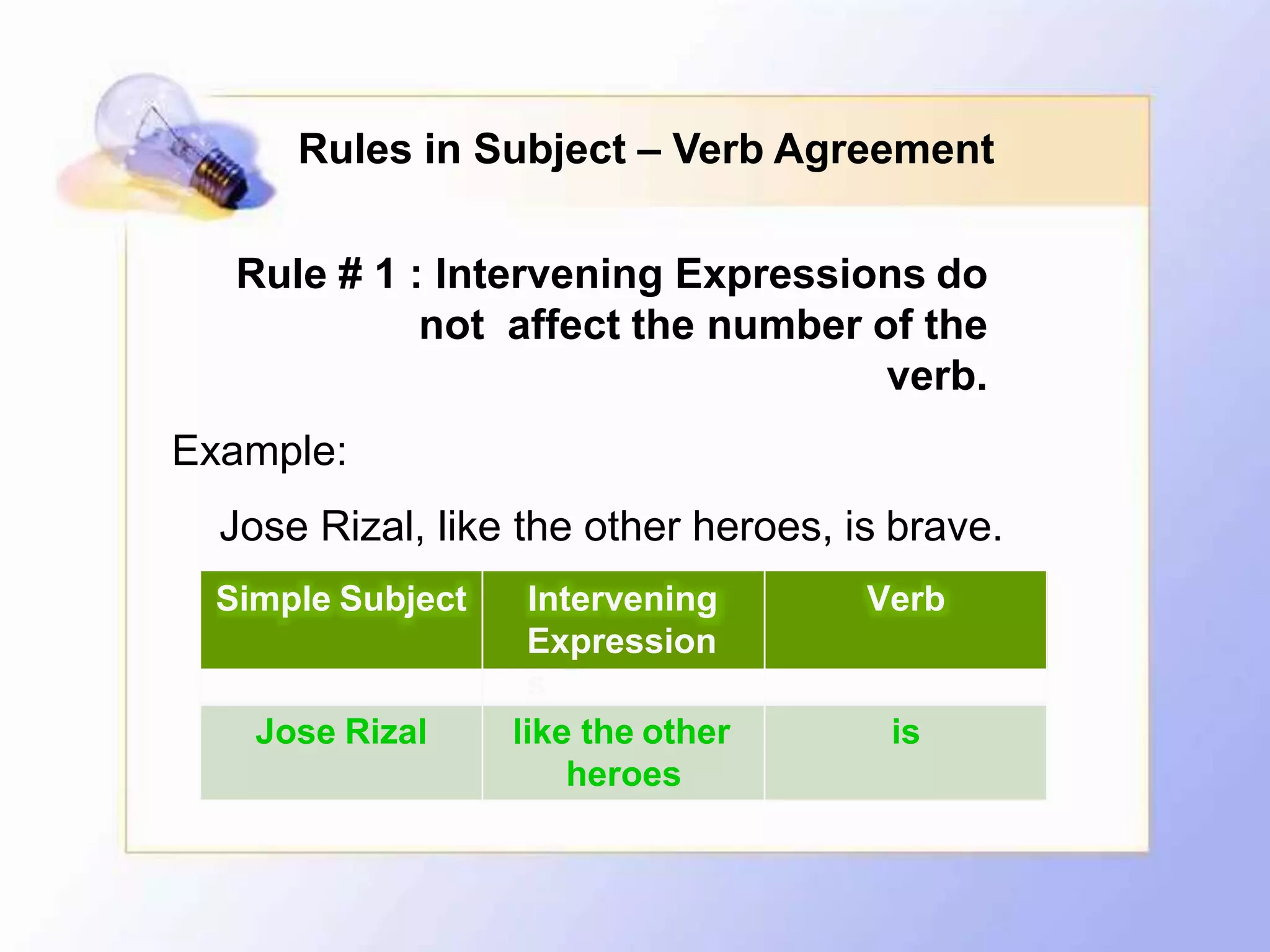
Rule # 1 : Intervening Expressions do
not affect the number of the
verb.
Example:
Jose Rizal, like the other heroes, is brave.
Simple Subject Intervening
Expression
s
Verb
Jose Rizal like the other
heroes
is
Let’s
Practice!
1. Tandang Sora, together with some neighbors, (was,
were) a great help in the fight for freedom.
2. Teodora Alonzo, many Filipinos say, (was, were)
an ideal mother.
3. The Spaniards, as well as the prisoners, (was,
were) searching the room.
4. Gabriela Silang, along with other brave women,
(has, have) a place in our hearts.
5. Our heroes, including Gregoria De Jesus, (is, are)
courageous.
Rules in Subject – Verb Agreement
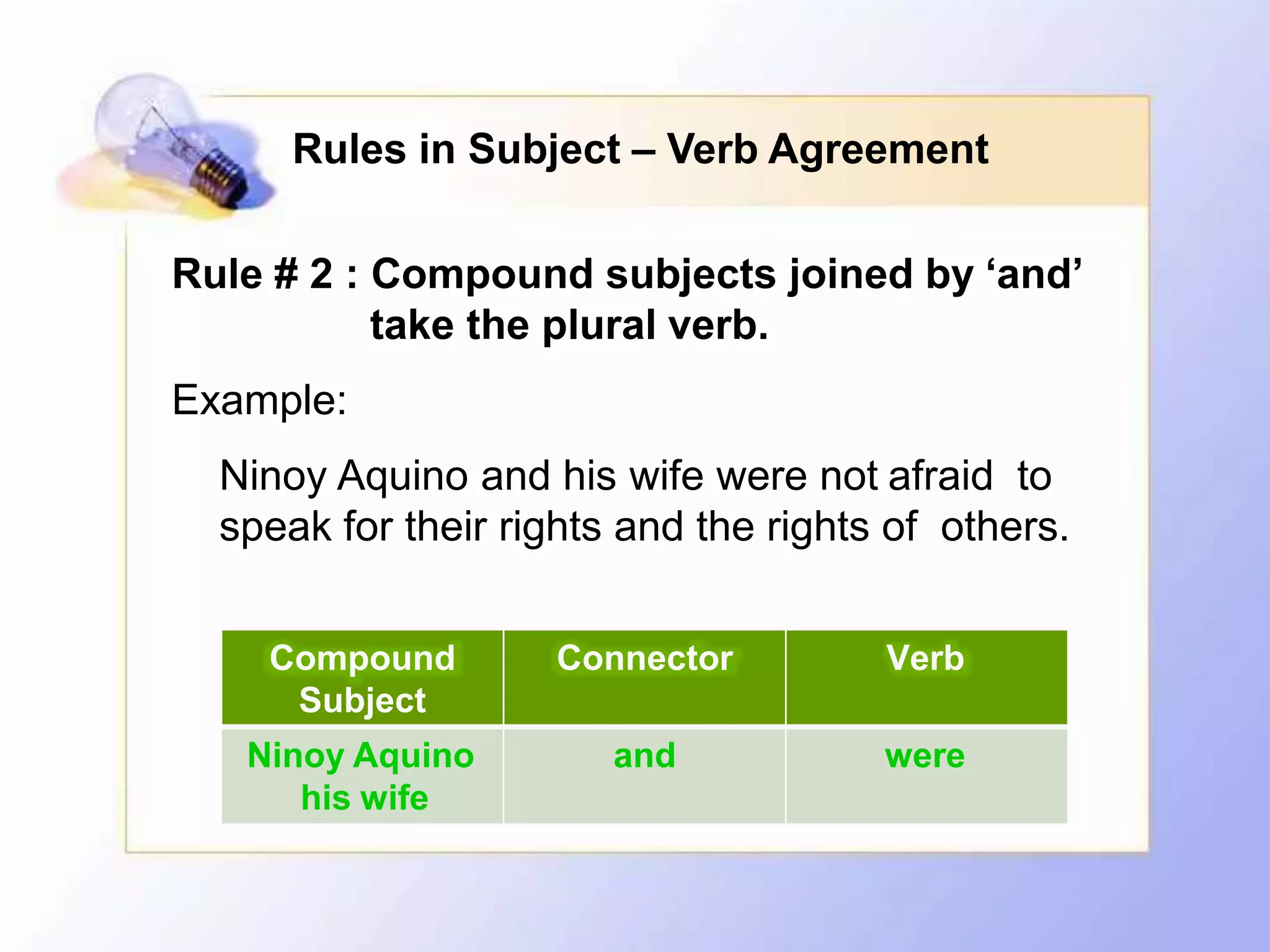
Rule # 2 : Compound subjects joined by ‘and’
take the plural verb.
Example:
Ninoy Aquino and his wife were not afraid to
speak for their rights and the rights of others.
Compound
Subject
Connector Verb
Ninoy Aquino
his wife
and were
Rules in Subject – Verb Agreement
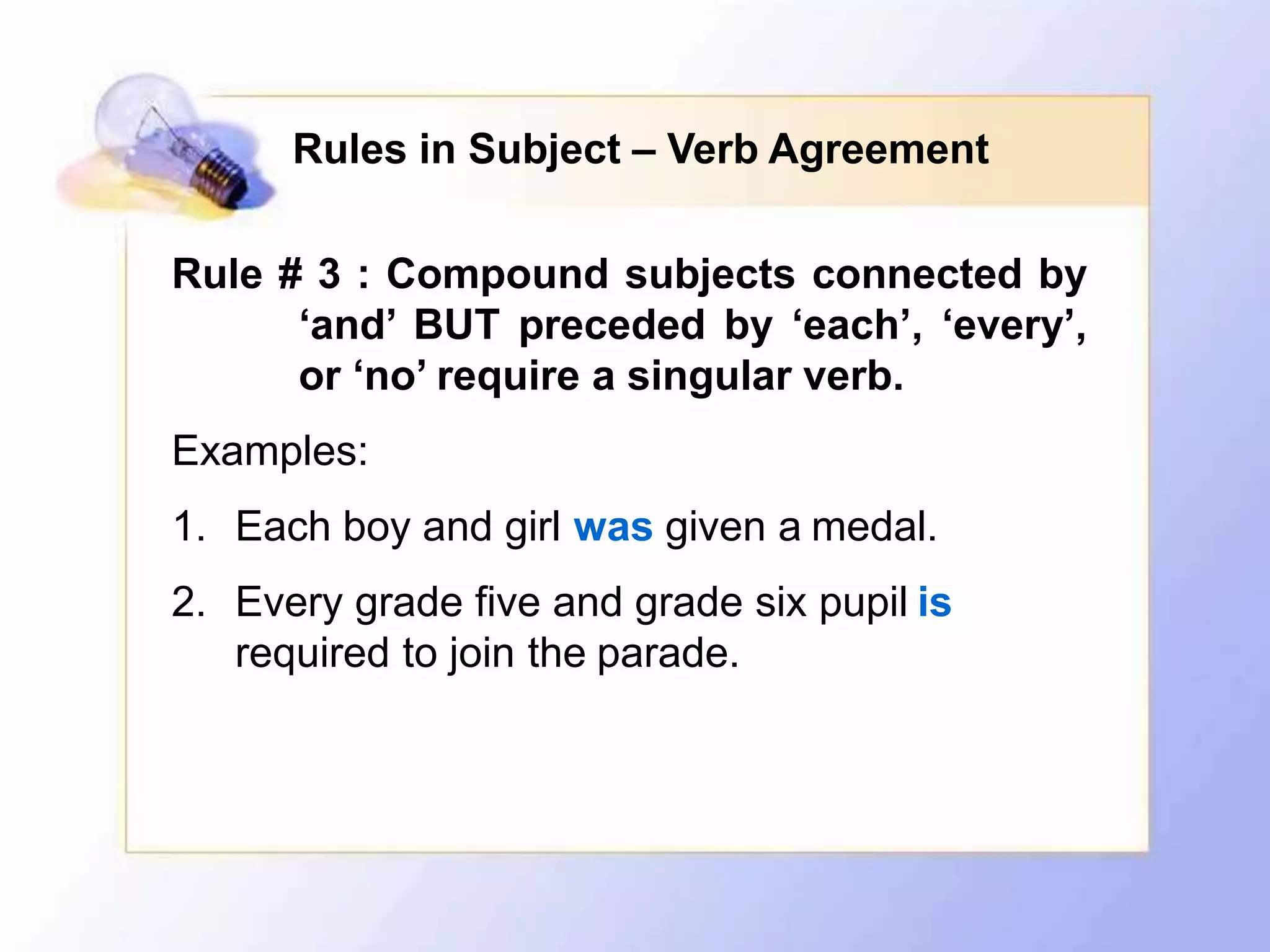
Rule # 3 : Compound subjects connected by
‘and’ BUT preceded by ‘each’, ‘every’,
or ‘no’ require a singular verb.
Examples:
1. Each boy and girl was given a medal.
2. Every grade five and grade six pupil is
required to join the parade.
Rules in Subject – Verb Agreement
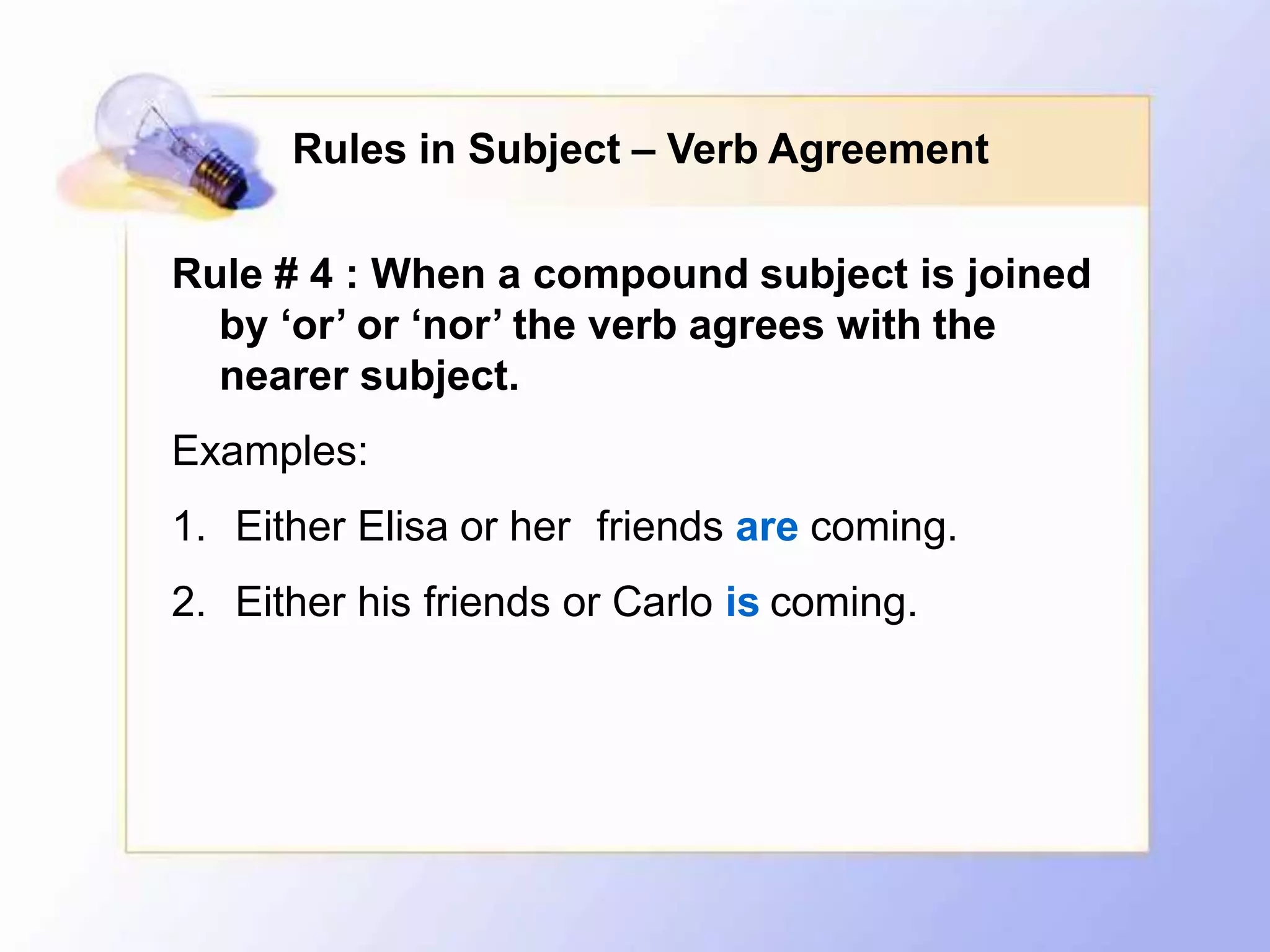
Rule # 4 : When a compound subject is joined
by ‘or’ or ‘nor’ the verb agrees with the
nearer subject.
Examples:
1. Either Elisa or her friends are coming.
2. Either his friends or Carlo is coming.
Rules in Subject – Verb Agreement
Rule # 5 : When the special pronoun “I” is one
of the two subjects connected by either/or
or neither/nor, put it second and follow it
with the singular verb “am”
Examples:
1. Neither she nor I am going to the festival.
2. Either him or I am in charge of the program.
Rules in Subject – Verb Agreement
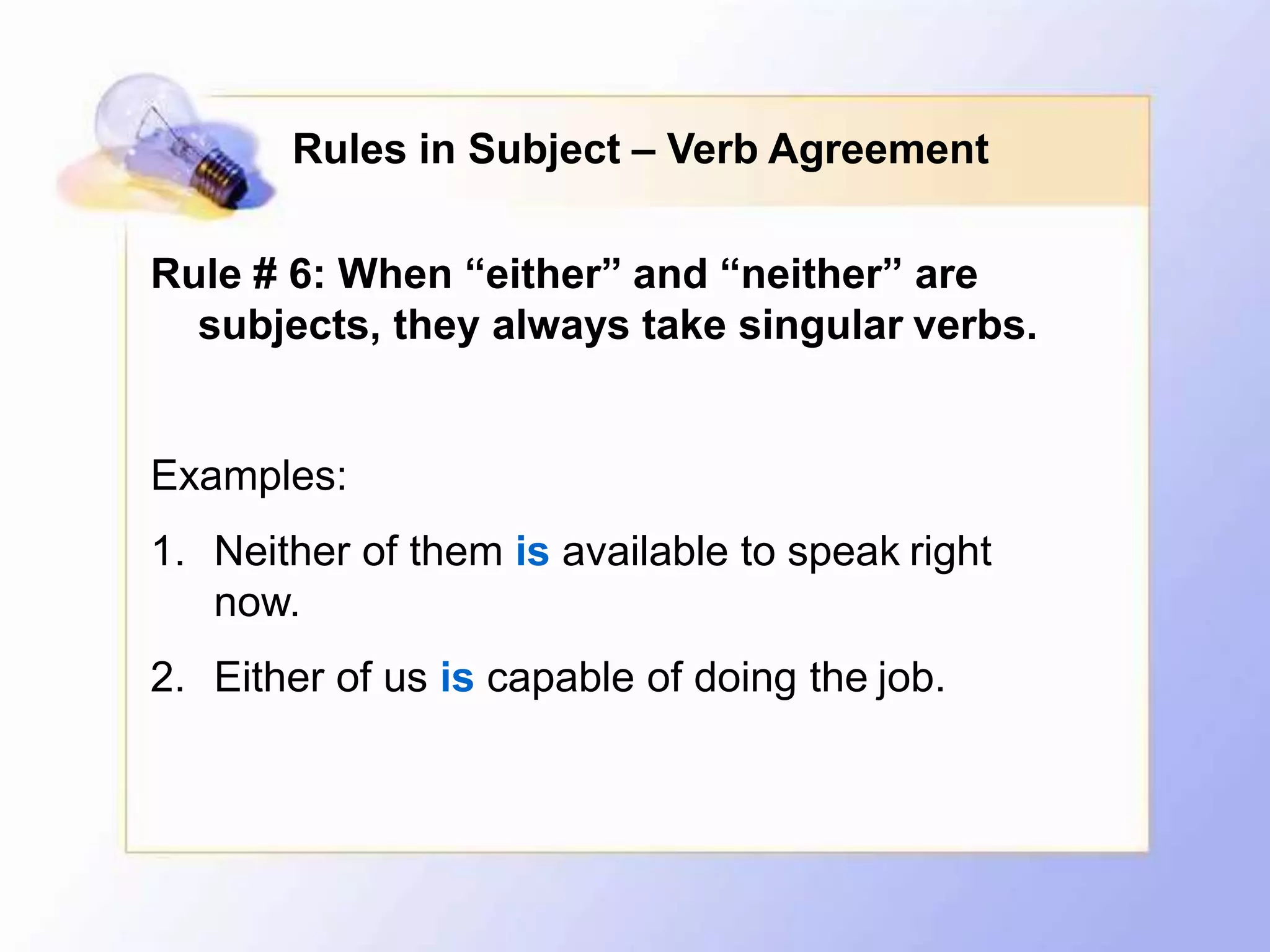
Rule # 6: When “either” and “neither” are
subjects, they always take singular verbs.
Examples:
1. Neither of them is available to speak right
now.
2. Either of us is capable of doing the job.
Let’s
Practice!
1. The pupils and teachers (is, are)
participating in the activities.
2. Men and women (has, have) something in
common.
3. Either Marissa or Melissa (is, are) coming.
4. Every Filipinos and Americans (is, are)
included with the policy.
5. Adam and Eve (was, were) deceived by the
snake.
Rules in Subject – Verb Agreement
Rule # 7 : A collective noun takes a singular verb
if the idea expressed by the subject is thought
of as a unit; it takes a plural verb when the
idea refers to separate individuals.
Examples:
1. The class has prepared a program.
(Meaning to say that the whole class prepared the
program.)
2. The class have given different suggestions.
(Meaning that the “class” is not taken as a whole butit
refers to the members of the class, separately or
individually. )
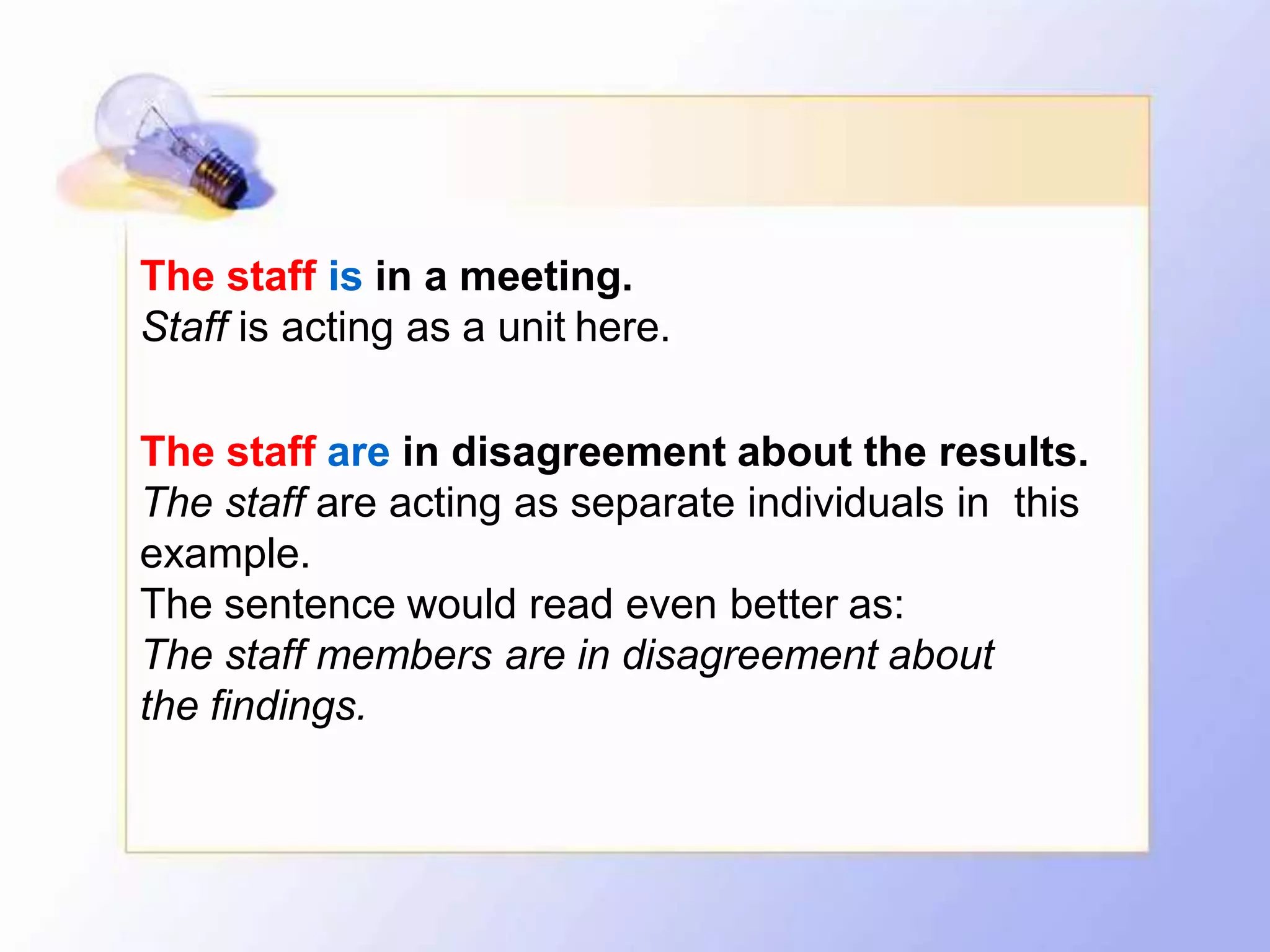
The staff is in a meeting.
Staff is acting as a unit here.
The staff are in disagreement about the results.
The staff are acting as separate individuals in this
example.
The sentence would read even better as:
The staff members are in disagreement about
the findings.
Rules in Subject – Verb Agreement
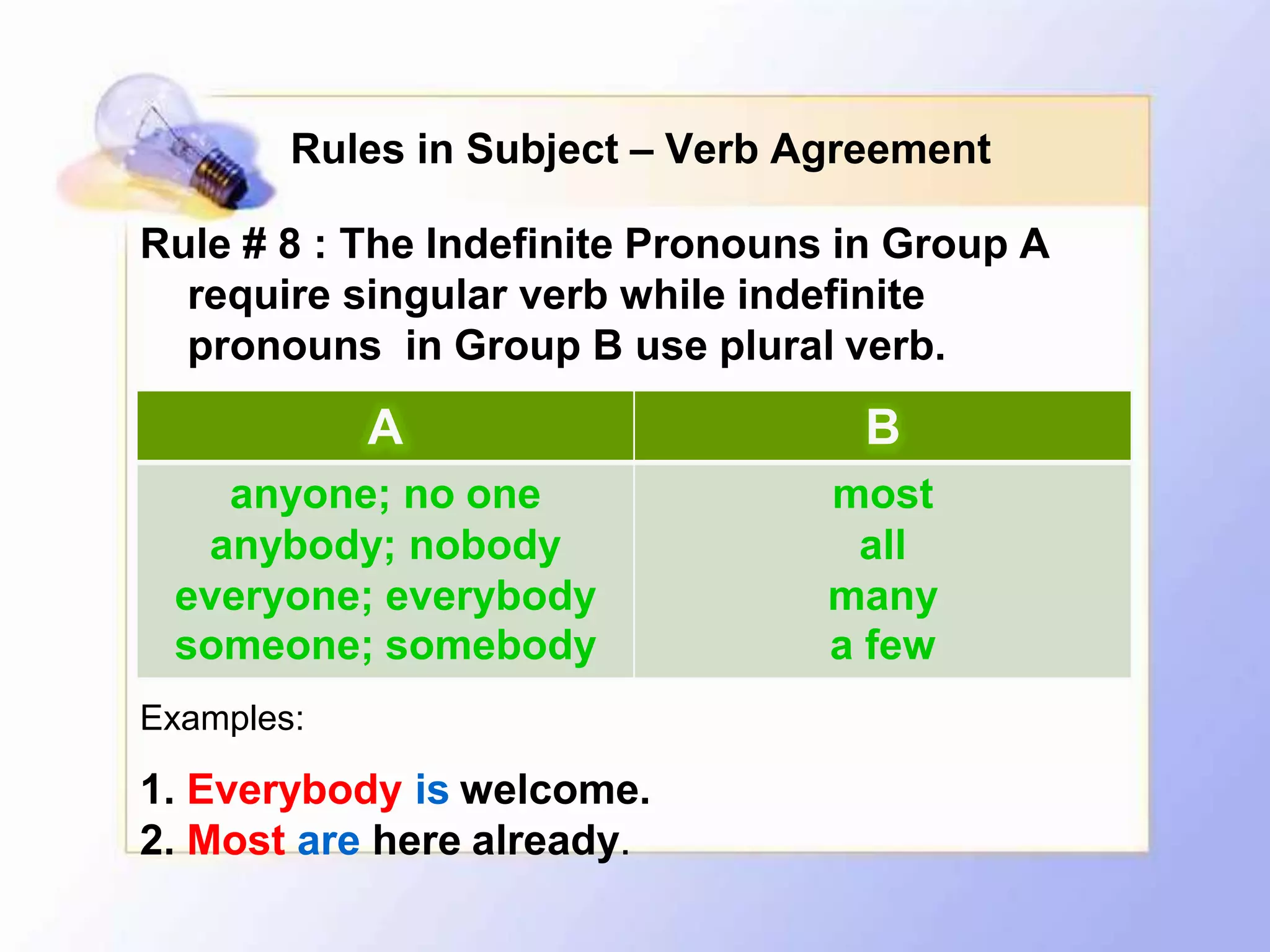
Rule # 8 : The Indefinite Pronouns in Group A
require singular verb while indefinite
pronouns in Group B use plural verb.
Examples:
1. Everybody is welcome.
2. Most are here already.
A B
anyone; no one most
anybody; nobody all
everyone; everybody many
someone; somebody a few
Rules in Subject – Verb Agreement
Rule # 9 : Some nouns that are plural in form but
singular in meaning take singular verbs.
Rule # 10 : Some nouns are considered plural and
require plural verbs.
Plural in Form but
Singular in
Meaning
Plural in Form and
Require Plural
Verbs
news, measles,
appendicitis, aerobics,
mathematics, economics,
mumps, civics, molasses
tongs, pants,
trousers,
suspenders, ashes,
clothes, shorts,
pliers, scissors
Rules in Subject – Verb Agreement
Rule # 11 : Measurements of length, time, distance
and weight take a singular verb
Examples:
1. Five meters is all I need for the uniform.
2. Two hours is required to finish the game.
Rules in Subject – Verb Agreement
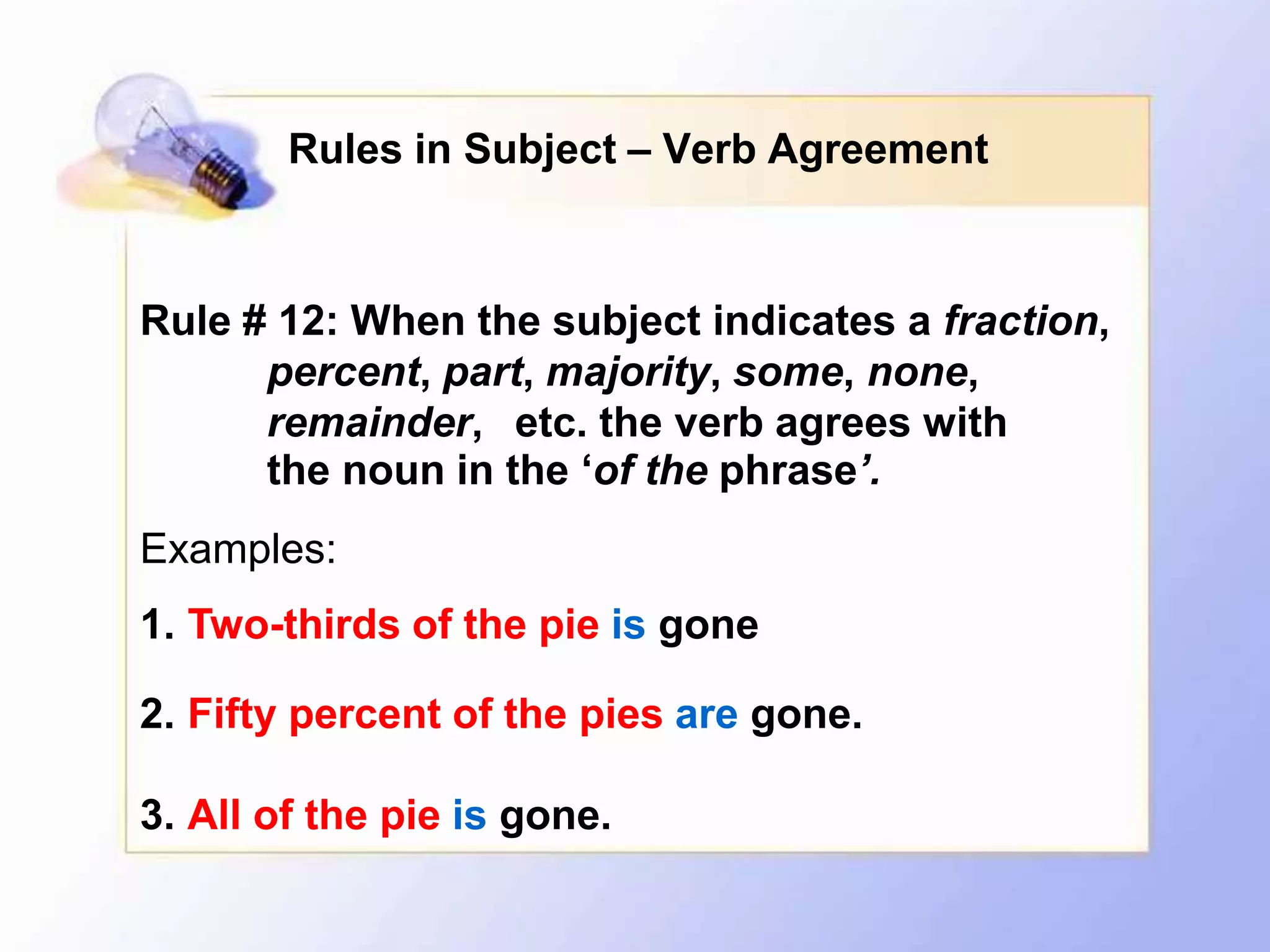
Rule # 12: When the subject indicates a fraction,
percent, part, majority, some, none,
remainder, etc. the verb agrees with
the noun in the ‘of the phrase’.
Examples:
1. Two-thirds of the pie is gone
2. Fifty percent of the pies are gone.
3. All of the pie is gone.
Rules in Subject – Verb Agreement
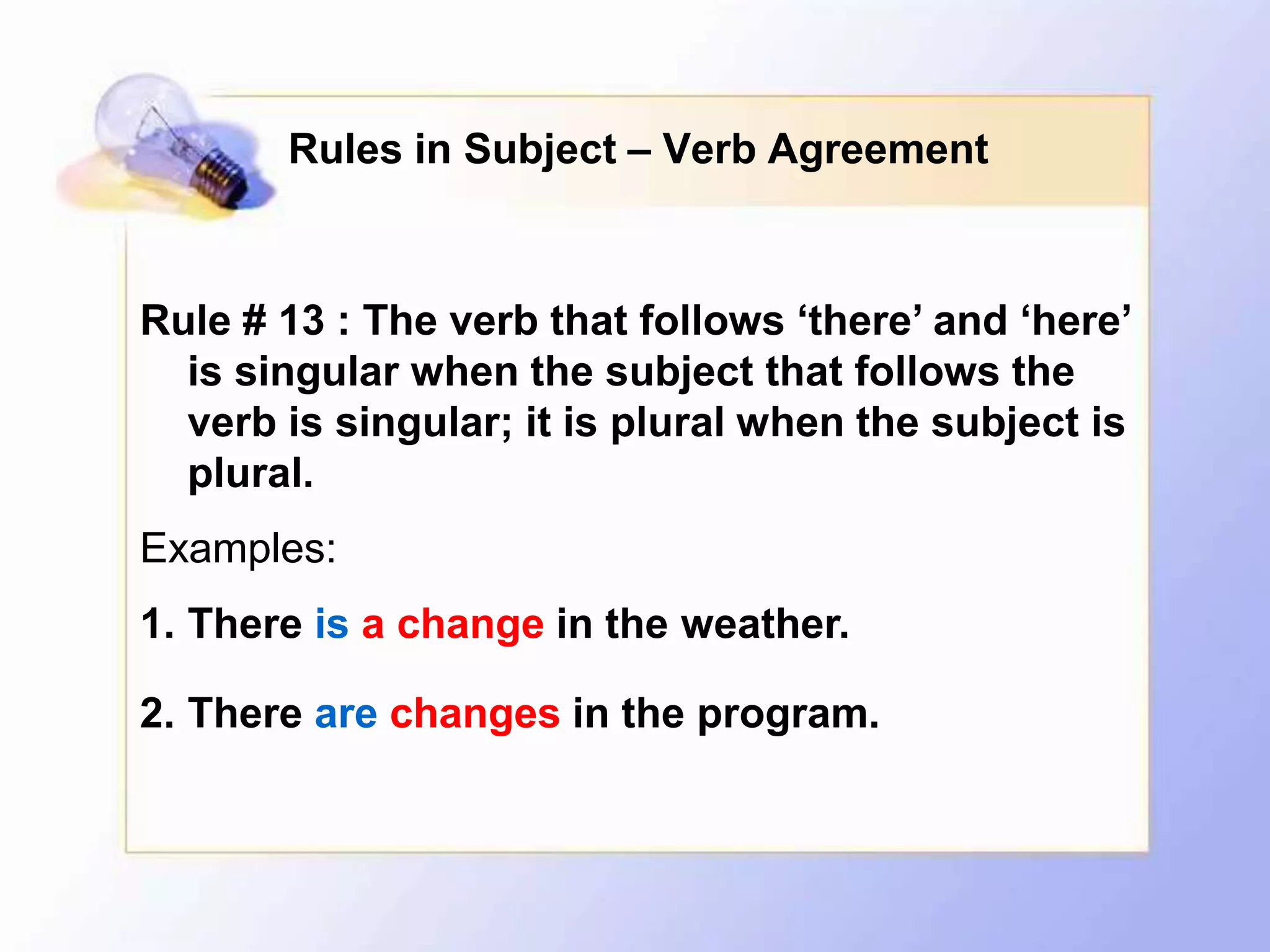
Rule # 13 : The verb that follows ‘there’ and ‘here’
is singular when the subject that follows the
verb is singular; it is plural when the subject is
plural.
Examples:
1. There is a change in the weather.
2. There are changes in the program.
Let’s
Practice!
1. There (is, are) a storm coming.
2. Here (is, are) the storm.
3. Here (is, are) the pliers.
4. There (is, are) the scissors.
5. Here (is, are) the 50 kilos of rice.
Rules in Subject – Verb Agreement
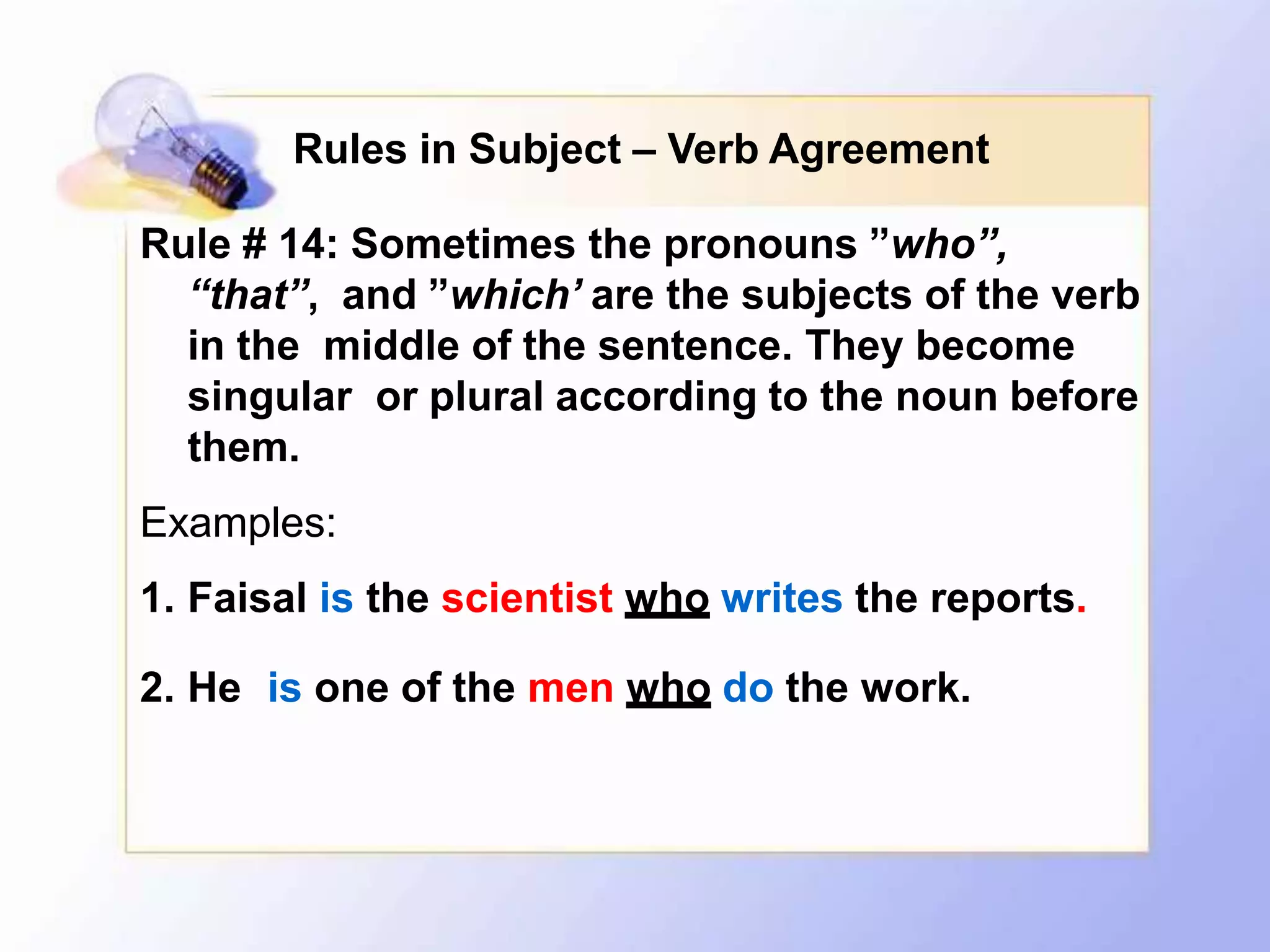
Rule # 14: Sometimes the pronouns ”who”,
“that”, and ”which’ are the subjects of the verb
in the middle of the sentence. They become
singular or plural according to the noun before
them.
Examples:
1. Faisal is the scientist who writes the reports.
2. He is one of the men who do the work.
Rules in Subject – Verb Agreement
Rule # 15: The pronoun ‘you’ always takes a
plural verb.
Examples:
1. You are so beautiful.
2. You are not alone.

Subject-verb agreement

  • 1.
    Rules in Subject– Verb Agreement
  • 2.
    Rules in Subject– Verb Agreement Basic Knowledge: Singular noun takes singular verb and plural noun takes plural verb. Singular Verbs Plural Verbs am is are was were has Have does Do s form base form
  • 3.
    Rules in Subject– Verb Agreement Rule # 1 : Intervening Expressions do not affect the number of the verb. Example: Jose Rizal, like the other heroes, is brave. Simple Subject Intervening Expression s Verb Jose Rizal like the other heroes is
  • 4.
    Let’s Practice! 1. Tandang Sora,together with some neighbors, (was, were) a great help in the fight for freedom. 2. Teodora Alonzo, many Filipinos say, (was, were) an ideal mother. 3. The Spaniards, as well as the prisoners, (was, were) searching the room. 4. Gabriela Silang, along with other brave women, (has, have) a place in our hearts. 5. Our heroes, including Gregoria De Jesus, (is, are) courageous.
  • 5.
    Rules in Subject– Verb Agreement Rule # 2 : Compound subjects joined by ‘and’ take the plural verb. Example: Ninoy Aquino and his wife were not afraid to speak for their rights and the rights of others. Compound Subject Connector Verb Ninoy Aquino his wife and were
  • 6.
    Rules in Subject– Verb Agreement Rule # 3 : Compound subjects connected by ‘and’ BUT preceded by ‘each’, ‘every’, or ‘no’ require a singular verb. Examples: 1. Each boy and girl was given a medal. 2. Every grade five and grade six pupil is required to join the parade.
  • 7.
    Rules in Subject– Verb Agreement Rule # 4 : When a compound subject is joined by ‘or’ or ‘nor’ the verb agrees with the nearer subject. Examples: 1. Either Elisa or her friends are coming. 2. Either his friends or Carlo is coming.
  • 8.
    Rules in Subject– Verb Agreement Rule # 5 : When the special pronoun “I” is one of the two subjects connected by either/or or neither/nor, put it second and follow it with the singular verb “am” Examples: 1. Neither she nor I am going to the festival. 2. Either him or I am in charge of the program.
  • 9.
    Rules in Subject– Verb Agreement Rule # 6: When “either” and “neither” are subjects, they always take singular verbs. Examples: 1. Neither of them is available to speak right now. 2. Either of us is capable of doing the job.
  • 10.
    Let’s Practice! 1. The pupilsand teachers (is, are) participating in the activities. 2. Men and women (has, have) something in common. 3. Either Marissa or Melissa (is, are) coming. 4. Every Filipinos and Americans (is, are) included with the policy. 5. Adam and Eve (was, were) deceived by the snake.
  • 11.
    Rules in Subject– Verb Agreement Rule # 7 : A collective noun takes a singular verb if the idea expressed by the subject is thought of as a unit; it takes a plural verb when the idea refers to separate individuals. Examples: 1. The class has prepared a program. (Meaning to say that the whole class prepared the program.) 2. The class have given different suggestions. (Meaning that the “class” is not taken as a whole butit refers to the members of the class, separately or individually. )
  • 12.
    The staff isin a meeting. Staff is acting as a unit here. The staff are in disagreement about the results. The staff are acting as separate individuals in this example. The sentence would read even better as: The staff members are in disagreement about the findings.
  • 13.
    Rules in Subject– Verb Agreement Rule # 8 : The Indefinite Pronouns in Group A require singular verb while indefinite pronouns in Group B use plural verb. Examples: 1. Everybody is welcome. 2. Most are here already. A B anyone; no one most anybody; nobody all everyone; everybody many someone; somebody a few
  • 14.
    Rules in Subject– Verb Agreement Rule # 9 : Some nouns that are plural in form but singular in meaning take singular verbs. Rule # 10 : Some nouns are considered plural and require plural verbs. Plural in Form but Singular in Meaning Plural in Form and Require Plural Verbs news, measles, appendicitis, aerobics, mathematics, economics, mumps, civics, molasses tongs, pants, trousers, suspenders, ashes, clothes, shorts, pliers, scissors
  • 15.
    Rules in Subject– Verb Agreement Rule # 11 : Measurements of length, time, distance and weight take a singular verb Examples: 1. Five meters is all I need for the uniform. 2. Two hours is required to finish the game.
  • 16.
    Rules in Subject– Verb Agreement Rule # 12: When the subject indicates a fraction, percent, part, majority, some, none, remainder, etc. the verb agrees with the noun in the ‘of the phrase’. Examples: 1. Two-thirds of the pie is gone 2. Fifty percent of the pies are gone. 3. All of the pie is gone.
  • 17.
    Rules in Subject– Verb Agreement Rule # 13 : The verb that follows ‘there’ and ‘here’ is singular when the subject that follows the verb is singular; it is plural when the subject is plural. Examples: 1. There is a change in the weather. 2. There are changes in the program.
  • 18.
    Let’s Practice! 1. There (is,are) a storm coming. 2. Here (is, are) the storm. 3. Here (is, are) the pliers. 4. There (is, are) the scissors. 5. Here (is, are) the 50 kilos of rice.
  • 19.
    Rules in Subject– Verb Agreement Rule # 14: Sometimes the pronouns ”who”, “that”, and ”which’ are the subjects of the verb in the middle of the sentence. They become singular or plural according to the noun before them. Examples: 1. Faisal is the scientist who writes the reports. 2. He is one of the men who do the work.
  • 20.
    Rules in Subject– Verb Agreement Rule # 15: The pronoun ‘you’ always takes a plural verb. Examples: 1. You are so beautiful. 2. You are not alone.