Presented by:
Youshaib Alam
Infinitives
Definition:
 Infinitives are a base form or root form of verb.
 An infinitive consists of the words “to + verb”.
 It names an action and is used mostly as a
complement of verb.
For Example:
• Sana loves to sing.
To + sing Infinitive
• An Infinitive is formed by placing ‘to’ before the
base verb.
• To + base verb infinitive
Infinitive as a Non-Finite verb
• An infinitive is a non-finite verb.
• It is not limited by tense, number or person
For Example:
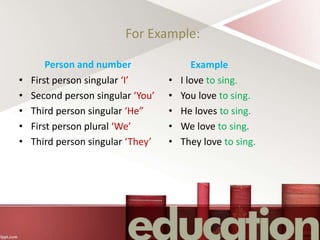
Person and number
• First person singular ‘I’
• Second person singular ‘You’
• Third person singular ‘He”
• First person plural ‘We’
• Third person singular ‘They’
Example
• I love to sing.
• You love to sing.
• He loves to sing.
• We love to sing.
• They love to sing.
For Example:
Tense
• Simple Tense
• Past Tense
• Future Tense
Example
• Sana loves to sing
• We loved to sing duet.
• She will love to sing at the party.
Types of Infinitives
Full infinitive.
Bare Infinitive
Anaphoric to
Full Infinitive:
To + verb= full infinitive
– We loved to sing
– She is agree to come
Bare Infinitive:
Only verb is used. ‘to’ is omitted here.
– I heard him say it.
– The company made him work long hour
Anaphoric to:
 It is used without verb.
 ‘to’ is used as a substitute for the infinitive and has a
reference for earlier mention verb.
 Do you want to leave this restaurant.
Yes, I want to.
Identifying Infinitives
1. Infinitives usually appear after the main
verb in the sentence.
For Example:
• They waited to meet the director.
main verb Infinitive
• Salma was dressed to go for the party.
main verb Infinitive
2. Infinitives are uses after certain verbs like
forget, learn, hope, need, want, agree,
encourage, pretend, decide, refuse, etc.
For Example:
• Sara refuses to leave.
verb Infinitive
• Why do you pretend to like me?
• Hamid forget to shut the door.
3. The infinitive form also appears after adjectives
like happy, pleased, surprise, sad, disappointed,
etc.
For Example:
• I was sad to hear the news.
Adjective Infinitive
• They are surprised to see us.
• I am pleased to welcome you.
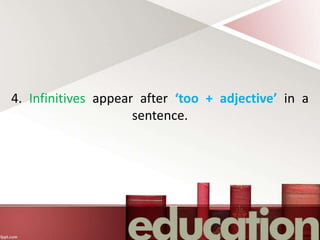
4. Infinitives appear after ‘too + adjective’ in a
sentence.
For Example:
• It is too hot to go outside.
• It is too late to turn back now.
5. Infinitives appear after ‘adjective + enough’ in a
sentence.
For Example:
• Your book is heavy enough to use.
• Ali is old enough to make his own decisions.
• You are smart enough to know this is wrong.
6. Sometimes infinitives can appear at the start of

the sentence where they are used as a subject.
For Example:
• To err is human.
• To make mistake is human.
• To pack for vacation can take long time.
7. The infinitive does not always appear with
the ‘to’ before the base verb.
For Example:
• The coach made us run on the field.
• The company makes him work long hours.
8. An infinitive can be used to join sentences.
For Example:
Every team has a captain. He leads the players.
Every team has a captain to lead the players.
8. An infinitive is also used to substitute for ‘so
that’.
For Example:
• She went to the shop so that she could help them.
• She went to the shop to help them.
Usage of Infinitives
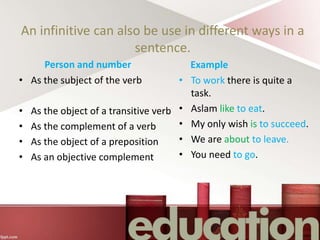
An infinitive can also be use in different ways in a
sentence.
Person and number
• As the subject of the verb
• As the object of a transitive verb
• As the complement of a verb
• As the object of a preposition
• As an objective complement
Example
• To work there is quite a
task.
• Aslam like to eat.
• My only wish is to succeed.
• We are about to leave.
• You need to go.
Infinitives

Infinitives

  • 2.
  • 3.
  • 5.
    Definition:  Infinitives area base form or root form of verb.  An infinitive consists of the words “to + verb”.  It names an action and is used mostly as a complement of verb.
  • 6.
    For Example: • Sanaloves to sing. To + sing Infinitive
  • 7.
    • An Infinitiveis formed by placing ‘to’ before the base verb. • To + base verb infinitive
  • 8.
    Infinitive as aNon-Finite verb
  • 9.
    Infinitive as aNon-Finite verb • An infinitive is a non-finite verb. • It is not limited by tense, number or person
  • 10.
    For Example: Person andnumber • First person singular ‘I’ • Second person singular ‘You’ • Third person singular ‘He” • First person plural ‘We’ • Third person singular ‘They’ Example • I love to sing. • You love to sing. • He loves to sing. • We love to sing. • They love to sing.
  • 11.
    For Example: Tense • SimpleTense • Past Tense • Future Tense Example • Sana loves to sing • We loved to sing duet. • She will love to sing at the party.
  • 12.
    Types of Infinitives Fullinfinitive. Bare Infinitive Anaphoric to
  • 13.
    Full Infinitive: To +verb= full infinitive – We loved to sing – She is agree to come
  • 14.
    Bare Infinitive: Only verbis used. ‘to’ is omitted here. – I heard him say it. – The company made him work long hour
  • 15.
    Anaphoric to:  Itis used without verb.  ‘to’ is used as a substitute for the infinitive and has a reference for earlier mention verb.  Do you want to leave this restaurant. Yes, I want to.
  • 16.
  • 17.
    1. Infinitives usuallyappear after the main verb in the sentence.
  • 18.
    For Example: • Theywaited to meet the director. main verb Infinitive • Salma was dressed to go for the party. main verb Infinitive
  • 19.
    2. Infinitives areuses after certain verbs like forget, learn, hope, need, want, agree, encourage, pretend, decide, refuse, etc.
  • 20.
    For Example: • Sararefuses to leave. verb Infinitive • Why do you pretend to like me? • Hamid forget to shut the door.
  • 21.
    3. The infinitiveform also appears after adjectives like happy, pleased, surprise, sad, disappointed, etc.
  • 22.
    For Example: • Iwas sad to hear the news. Adjective Infinitive • They are surprised to see us. • I am pleased to welcome you.
  • 23.
    4. Infinitives appearafter ‘too + adjective’ in a sentence.
  • 24.
    For Example: • Itis too hot to go outside. • It is too late to turn back now.
  • 25.
    5. Infinitives appearafter ‘adjective + enough’ in a sentence.
  • 26.
    For Example: • Yourbook is heavy enough to use. • Ali is old enough to make his own decisions. • You are smart enough to know this is wrong.
  • 27.
    6. Sometimes infinitivescan appear at the start of the sentence where they are used as a subject.
  • 28.
    For Example: • Toerr is human. • To make mistake is human. • To pack for vacation can take long time.
  • 29.
    7. The infinitivedoes not always appear with the ‘to’ before the base verb.
  • 30.
    For Example: • Thecoach made us run on the field. • The company makes him work long hours.
  • 31.
    8. An infinitivecan be used to join sentences.
  • 32.
    For Example: Every teamhas a captain. He leads the players. Every team has a captain to lead the players.
  • 33.
    8. An infinitiveis also used to substitute for ‘so that’.
  • 34.
    For Example: • Shewent to the shop so that she could help them. • She went to the shop to help them.
  • 35.
  • 36.
    An infinitive canalso be use in different ways in a sentence. Person and number • As the subject of the verb • As the object of a transitive verb • As the complement of a verb • As the object of a preposition • As an objective complement Example • To work there is quite a task. • Aslam like to eat. • My only wish is to succeed. • We are about to leave. • You need to go.