Warm Up On your own paper… Copy the following sentences, correcting all errors 1.  Yesterday my parents give me a birthday present. 2. Our band are looking for a new drummer. 3. The players works together to win as a team. 4. Elkton winning last night’s game. 5. When I tell Mr. Brown, he will believed me. 6. We needs a responsible team player that have a good sense of humor.
Verbs in Use! Tenses and Agreement
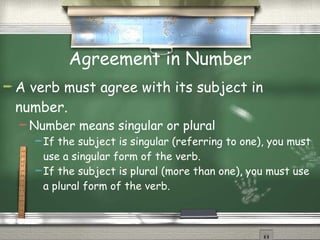
Agreement in Number A verb must agree with its subject in number. Number means singular or plural If the subject is singular (referring to one), you must use a singular form of the verb. If the subject is plural (more than one), you must use a plural form of the verb.
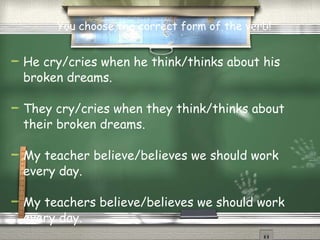
You choose the correct form of the verb! He cry/cries when he think/thinks about his broken dreams. They cry/cries when they think/thinks about their broken dreams. My teacher believe/believes we should work every day. My teachers believe/believes we should work every day.
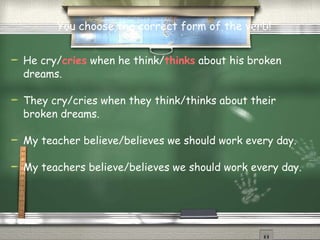
You choose the correct form of the verb! He cry/ cries  when he think/ thinks  about his broken dreams. They cry/cries when they think/thinks about their broken dreams. My teacher believe/believes we should work every day. My teachers believe/believes we should work every day.
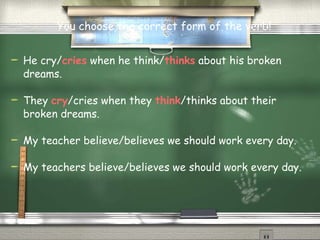
You choose the correct form of the verb! He cry/ cries  when he think/ thinks  about his broken dreams. They  cry /cries when they  think /thinks about their broken dreams. My teacher believe/believes we should work every day. My teachers believe/believes we should work every day.
You choose the correct form of the verb! He cry/ cries  when he think/ thinks  about his broken dreams. They  cry /cries when they  think /thinks about their broken dreams. My teacher believe/ believes  we should work every day. My teachers believe/believes we should work every day.
You choose the correct form of the verb! He cry/ cries  when he think/ thinks  about his broken dreams. They  cry /cries when they  think /thinks about their broken dreams. My teacher believe/ believes   we should work every day. My teachers  believe /believes we should work every day.
Simple Tenses A tense is a verb form that shows the time of an action or condition Verbs have three simple tenses: Present Tense Past Tense Future Tense
Simple Tenses The car door  opens  easily.
Simple Tenses The car door  opens  easily. The present tense shows that an action or condition occurs NOW
Simple Tenses The car door  opens  easily. The present tense shows that an action or condition occurs NOW The car door  opened , and the man  stepped  out.
The car door  opens  easily. The present tense shows that an action or condition occurs NOW The car door  opened , and the man  stepped  out. The past tense shows that an action or condition was completed in the past
The car door  opens  easily. The present tense shows that an action or condition occurs NOW The car door  opened , and the man  stepped  out. The past tense shows that an action or condition was completed in the past The car door  will open , and I  will jump  out.
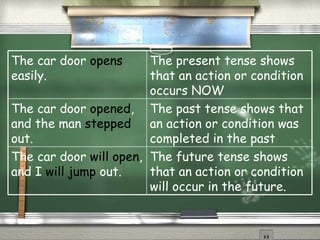
The car door  opens  easily. The present tense shows that an action or condition occurs NOW The car door  opened , and the man  stepped  out. The past tense shows that an action or condition was completed in the past The car door  will open , and I  will jump  out. The future tense shows that an action or condition will occur in the future.
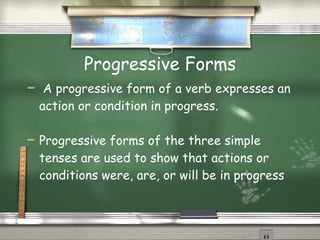
Progressive Forms A progressive form of a verb expresses an action or condition in progress. Progressive forms of the three simple tenses are used to show that actions or conditions were, are, or will be in progress
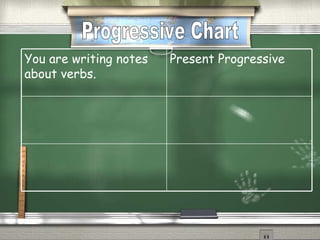
Progressive Chart You are writing notes about verbs.
Progressive Chart You are writing notes about verbs. Present Progressive
Progressive Chart You are writing notes about verbs. Present Progressive You were reading novels earlier.
Progressive Chart You are writing notes about verbs. Present Progressive You were reading novels earlier.  Past Progressive
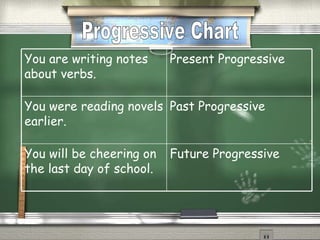
Progressive Chart You are writing notes about verbs. Present Progressive You were reading novels earlier.  Past Progressive You will be cheering on the last day of school. Future Progressive
Open your Language Network books to page 107. Complete # 1-10. APPLY IT !
Perfect Tenses The present perfect tense places an action or condition in a stretch of time leading up to the present.
Perfect Tenses The present perfect tense places an action or condition in a stretch of time leading up to the present. Many people have rafted through the Grand Canyon
Perfect Tenses The present perfect tense places an action or condition in a stretch of time leading up to the present. Many people  have rafted  through the Grand Canyon People rafted through the canyon at unspecified times before the present.
Perfect Tenses The past perfect tense places an action or condition before another past action or condition.
Perfect Tenses The past perfect tense places an action or condition before another past action or condition. After the guide had straightened the raft, we entered the rapids.
Perfect Tenses The past perfect tense places an action or condition before another past action or condition. After the guide  had straightened  the raft, we entered the rapids. The straightening occurred before the entering.
Perfect Tenses The future perfect tense places a future action or condition before another future action or condition.
Perfect Tenses The future perfect tense places a future action or condition before another future action or condition. We will have cleared many rapids before the trip ends
Perfect Tenses The future perfect tense places a future action or condition before another future action or condition. We  will have cleared  many rapids before the trip ends The clearing will occur before the ending.
APPLY IT ! Page 109 in Language Network Book, Copy the forming Perfect Tenses Chart into your notes. Language Network Book page 110 Complete #1-10

Verb Tense And Number

  • 1.
    Warm Up Onyour own paper… Copy the following sentences, correcting all errors 1. Yesterday my parents give me a birthday present. 2. Our band are looking for a new drummer. 3. The players works together to win as a team. 4. Elkton winning last night’s game. 5. When I tell Mr. Brown, he will believed me. 6. We needs a responsible team player that have a good sense of humor.
  • 2.
    Verbs in Use!Tenses and Agreement
  • 3.
    Agreement in NumberA verb must agree with its subject in number. Number means singular or plural If the subject is singular (referring to one), you must use a singular form of the verb. If the subject is plural (more than one), you must use a plural form of the verb.
  • 4.
    You choose thecorrect form of the verb! He cry/cries when he think/thinks about his broken dreams. They cry/cries when they think/thinks about their broken dreams. My teacher believe/believes we should work every day. My teachers believe/believes we should work every day.
  • 5.
    You choose thecorrect form of the verb! He cry/ cries when he think/ thinks about his broken dreams. They cry/cries when they think/thinks about their broken dreams. My teacher believe/believes we should work every day. My teachers believe/believes we should work every day.
  • 6.
    You choose thecorrect form of the verb! He cry/ cries when he think/ thinks about his broken dreams. They cry /cries when they think /thinks about their broken dreams. My teacher believe/believes we should work every day. My teachers believe/believes we should work every day.
  • 7.
    You choose thecorrect form of the verb! He cry/ cries when he think/ thinks about his broken dreams. They cry /cries when they think /thinks about their broken dreams. My teacher believe/ believes we should work every day. My teachers believe/believes we should work every day.
  • 8.
    You choose thecorrect form of the verb! He cry/ cries when he think/ thinks about his broken dreams. They cry /cries when they think /thinks about their broken dreams. My teacher believe/ believes we should work every day. My teachers believe /believes we should work every day.
  • 9.
    Simple Tenses Atense is a verb form that shows the time of an action or condition Verbs have three simple tenses: Present Tense Past Tense Future Tense
  • 10.
    Simple Tenses Thecar door opens easily.
  • 11.
    Simple Tenses Thecar door opens easily. The present tense shows that an action or condition occurs NOW
  • 12.
    Simple Tenses Thecar door opens easily. The present tense shows that an action or condition occurs NOW The car door opened , and the man stepped out.
  • 13.
    The car door opens easily. The present tense shows that an action or condition occurs NOW The car door opened , and the man stepped out. The past tense shows that an action or condition was completed in the past
  • 14.
    The car door opens easily. The present tense shows that an action or condition occurs NOW The car door opened , and the man stepped out. The past tense shows that an action or condition was completed in the past The car door will open , and I will jump out.
  • 15.
    The car door opens easily. The present tense shows that an action or condition occurs NOW The car door opened , and the man stepped out. The past tense shows that an action or condition was completed in the past The car door will open , and I will jump out. The future tense shows that an action or condition will occur in the future.
  • 16.
    Progressive Forms Aprogressive form of a verb expresses an action or condition in progress. Progressive forms of the three simple tenses are used to show that actions or conditions were, are, or will be in progress
  • 17.
    Progressive Chart Youare writing notes about verbs.
  • 18.
    Progressive Chart Youare writing notes about verbs. Present Progressive
  • 19.
    Progressive Chart Youare writing notes about verbs. Present Progressive You were reading novels earlier.
  • 20.
    Progressive Chart Youare writing notes about verbs. Present Progressive You were reading novels earlier. Past Progressive
  • 21.
    Progressive Chart Youare writing notes about verbs. Present Progressive You were reading novels earlier. Past Progressive You will be cheering on the last day of school. Future Progressive
  • 22.
    Open your LanguageNetwork books to page 107. Complete # 1-10. APPLY IT !
  • 23.
    Perfect Tenses Thepresent perfect tense places an action or condition in a stretch of time leading up to the present.
  • 24.
    Perfect Tenses Thepresent perfect tense places an action or condition in a stretch of time leading up to the present. Many people have rafted through the Grand Canyon
  • 25.
    Perfect Tenses Thepresent perfect tense places an action or condition in a stretch of time leading up to the present. Many people have rafted through the Grand Canyon People rafted through the canyon at unspecified times before the present.
  • 26.
    Perfect Tenses Thepast perfect tense places an action or condition before another past action or condition.
  • 27.
    Perfect Tenses Thepast perfect tense places an action or condition before another past action or condition. After the guide had straightened the raft, we entered the rapids.
  • 28.
    Perfect Tenses Thepast perfect tense places an action or condition before another past action or condition. After the guide had straightened the raft, we entered the rapids. The straightening occurred before the entering.
  • 29.
    Perfect Tenses Thefuture perfect tense places a future action or condition before another future action or condition.
  • 30.
    Perfect Tenses Thefuture perfect tense places a future action or condition before another future action or condition. We will have cleared many rapids before the trip ends
  • 31.
    Perfect Tenses Thefuture perfect tense places a future action or condition before another future action or condition. We will have cleared many rapids before the trip ends The clearing will occur before the ending.
  • 32.
    APPLY IT !Page 109 in Language Network Book, Copy the forming Perfect Tenses Chart into your notes. Language Network Book page 110 Complete #1-10