The Simple Present:
3            Affirmative and
             Negative Statements


              Cultural Customs


Focus on Grammar 2
Part III, Unit 8
By Ruth Luman, Gabriele Steiner, and BJ Wells
Copyright © 2006. Pearson Education, Inc. All rights reserved.
International Pen
           Pals

Dear Ali,

   I am very happy at the English Language
Institute. Every day, I meet so many interesting
students with different customs. For example, my
classmates from Thailand bow to the teacher. My
roommate, Lia, doesn’t wear shoes inside our
room.
My classmates from Mexico don’t call the teacher
by her first name. This is a great experience!

Your friend,
Kadesh
The Simple Present 1
       Use the simple present to tell about things that happen
       again and again (habits, regular occurrences, customs,
       and routines).


Ahmed drinks coffee every afternoon.


                         Many American children wear
                         costumes on Halloween.
The Simple Present 2

        Use the simple present to tell facts.


      Peru is in South America.

“I think we
    need
sweaters.”


                         Water freezes at 32° Fahrenheit.
The Simple Present 3

  Use the simple present with non-action verbs.


Marian and Cara know Arabic.


                           Roberto likes bullfights.
Practice 1              Match each statement to its
                        use in the simple present.

                  STATEMENT            2. “He goes
Example:
 “They usually                         dancing
“They usually
 celebrate         Regular             every Friday
celebrate New
 New Year’s                            night.”
Year’s Day with
                  Occurrence
 Day with a
a big party.”
 big party.”


                     Fact
                                      3. “Triangles
                                      have three
1. “They                              sides.”
believe
everything
                  Non-Action
she says.”
                    Verb
Affirmative
               Statements
  Use the base form of the verb for all persons except
  third person singular. Put –s or –es on the third
  person singular.

                Daniel dances in the Chinese New
                Year Parade each year.


Ted dresses up like a lion.
Use the verbs in the box to
     Practice 2                 describe what these people do
                                every day.

           make       take      watch          play


                           Example: He makes pizza.


1.                   2.                   3.


 She plays soccer.   He watches soccer.        They take a bath.
Negative Statements 1
    Use does not or do not before the base form
    of the verb.


                  She does not takes off her shoes.
                               take


                   enjoy
Some people do not enjoys sushi.
Negative Statements
               2
    Use the contractions doesn’t and don’t for negative
    statements in speaking or in informal writing.


Italians don’t use chopsticks.


                Luis doesn’t like bullfights.
Change the affirmative
   Practice 3                               statements to negative
                                            statements.

Example: Many Chinese eat noodles.
     Many Chinese don’t eat noodles.

1. Sheila likes to eat spicy food.
   Sheila doesn’t like to eat spicy food.

2. Some nomadic people live in tents.
   Some nomadic people don’t live in tents.

3. Monica watches fireworks on the 4th of July.
   Monica doesn’t watch fireworks on the 4th of July.
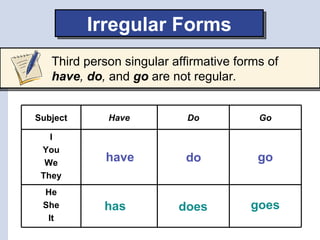
Irregular Forms
   Third person singular affirmative forms of
   have, do, and go are not regular.


Subject      Have           Do           Go

   I
 You
  We         have          do            go
 They
 He
 She        has           does         goes
  It
Complete the sentences with
  Practice 4                the correct form of have, do, or
                            go.


                goes
Example: She __________ shopping every Friday.


           does
1. Luis __________ his homework every night.

                         have
2. Leticia and Janet __________ backpacks.

                go
3. I always __________ to the movies on Thursdays.

             has
4. Shaun __________ a biology class on Mondays.

5. They always __________ the dishes after dinner.
                  do
References

Copyright © 2006 Pearson Education and
its licensors. All rights reserved.

The simple present

  • 1.
    The Simple Present: 3 Affirmative and Negative Statements Cultural Customs Focus on Grammar 2 Part III, Unit 8 By Ruth Luman, Gabriele Steiner, and BJ Wells Copyright © 2006. Pearson Education, Inc. All rights reserved.
  • 2.
    International Pen Pals Dear Ali, I am very happy at the English Language Institute. Every day, I meet so many interesting students with different customs. For example, my classmates from Thailand bow to the teacher. My roommate, Lia, doesn’t wear shoes inside our room. My classmates from Mexico don’t call the teacher by her first name. This is a great experience! Your friend, Kadesh
  • 3.
    The Simple Present1 Use the simple present to tell about things that happen again and again (habits, regular occurrences, customs, and routines). Ahmed drinks coffee every afternoon. Many American children wear costumes on Halloween.
  • 4.
    The Simple Present2 Use the simple present to tell facts. Peru is in South America. “I think we need sweaters.” Water freezes at 32° Fahrenheit.
  • 5.
    The Simple Present3 Use the simple present with non-action verbs. Marian and Cara know Arabic. Roberto likes bullfights.
  • 6.
    Practice 1 Match each statement to its use in the simple present. STATEMENT 2. “He goes Example: “They usually dancing “They usually celebrate Regular every Friday celebrate New New Year’s night.” Year’s Day with Occurrence Day with a a big party.” big party.” Fact 3. “Triangles have three 1. “They sides.” believe everything Non-Action she says.” Verb
  • 7.
    Affirmative Statements Use the base form of the verb for all persons except third person singular. Put –s or –es on the third person singular. Daniel dances in the Chinese New Year Parade each year. Ted dresses up like a lion.
  • 8.
    Use the verbsin the box to Practice 2 describe what these people do every day. make take watch play Example: He makes pizza. 1. 2. 3. She plays soccer. He watches soccer. They take a bath.
  • 9.
    Negative Statements 1 Use does not or do not before the base form of the verb. She does not takes off her shoes. take enjoy Some people do not enjoys sushi.
  • 10.
    Negative Statements 2 Use the contractions doesn’t and don’t for negative statements in speaking or in informal writing. Italians don’t use chopsticks. Luis doesn’t like bullfights.
  • 11.
    Change the affirmative Practice 3 statements to negative statements. Example: Many Chinese eat noodles. Many Chinese don’t eat noodles. 1. Sheila likes to eat spicy food. Sheila doesn’t like to eat spicy food. 2. Some nomadic people live in tents. Some nomadic people don’t live in tents. 3. Monica watches fireworks on the 4th of July. Monica doesn’t watch fireworks on the 4th of July.
  • 12.
    Irregular Forms Third person singular affirmative forms of have, do, and go are not regular. Subject Have Do Go I You We have do go They He She has does goes It
  • 13.
    Complete the sentenceswith Practice 4 the correct form of have, do, or go. goes Example: She __________ shopping every Friday. does 1. Luis __________ his homework every night. have 2. Leticia and Janet __________ backpacks. go 3. I always __________ to the movies on Thursdays. has 4. Shaun __________ a biology class on Mondays. 5. They always __________ the dishes after dinner. do
  • 14.
    References Copyright © 2006Pearson Education and its licensors. All rights reserved.

Editor's Notes

  • #9 Teachers could use this slide as an opportunity to discuss the differences in pronunciation of –s endings for makes, plays, & watches.