The Present Continuous
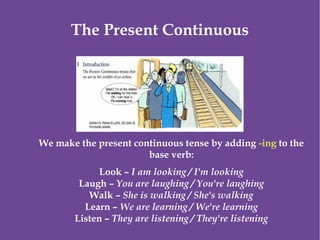
We make the present continuous tense by adding -ing to the
base verb:
Look – I am looking / I'm looking
Laugh – You are laughing / You're laughing
Walk – She is walking / She's walking
Learn – We are learning / We're learning
Listen – They are listening / They're listening
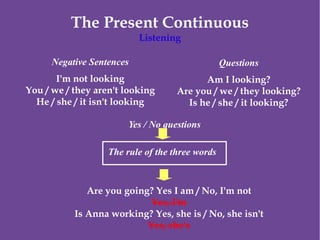
Negative Sentences
I'm not looking
You / we / they aren't looking
He / she / it isn't looking
The Present Continuous
Listening
Questions
Am I looking?
Are you / we / they looking?
Is he / she / it looking?
Yes / No questions
The rule of the three words
Are you going? Yes I am / No, I'm not
Yes, I'm
Is Anna working? Yes, she is / No, she isn't
Yes, she's
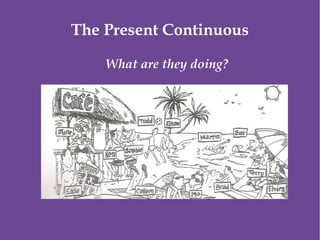
What are they doing?
The Present Continuous
● General rule: Just add -ing into the base verb:
go – going / visit - visiting
● Verbs that end in one -e lose the -e:
smoke – smoking / come – coming
But: - be – being
- Verbs that end in -ee, don't lose an -e:
agree – agreeing / see – seeing
- Verbs that end in -ie, change the ie to y:
lie – lying / die - dying
The Present Continuous
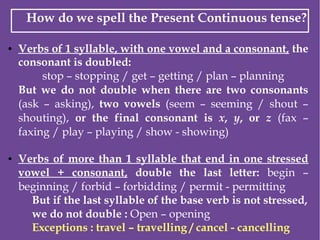
How do we spell the Present Continuous tense?
● Verbs of 1 syllable, with one vowel and a consonant, the
consonant is doubled:
stop – stopping / get – getting / plan – planning
But we do not double when there are two consonants
(ask – asking), two vowels (seem – seeming / shout –
shouting), or the final consonant is x, y, or z (fax –
faxing / play – playing / show - showing)
● Verbs of more than 1 syllable that end in one stressed
vowel + consonant, double the last letter: begin –
beginning / forbid – forbidding / permit - permitting
But if the last syllable of the base verb is not stressed,
we do not double : Open – opening
Exceptions : travel – travelling / cancel - cancelling
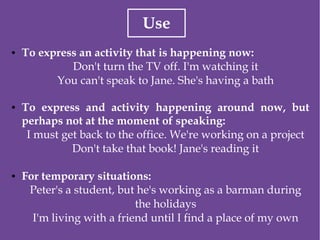
Use
● To express an activity that is happening now:
Don't turn the TV off. I'm watching it
You can't speak to Jane. She's having a bath
● To express and activity happening around now, but
perhaps not at the moment of speaking:
I must get back to the office. We're working on a project
Don't take that book! Jane's reading it
● For temporary situations:
Peter's a student, but he's working as a barman during
the holidays
I'm living with a friend until I find a place of my own
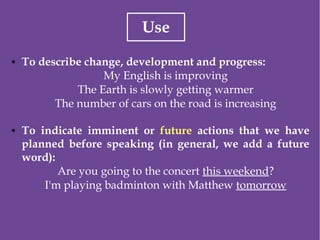
Use
● To describe change, development and progress:
My English is improving
The Earth is slowly getting warmer
The number of cars on the road is increasing
● To indicate imminent or future actions that we have
planned before speaking (in general, we add a future
word):
Are you going to the concert this weekend?
I'm playing badminton with Matthew tomorrow
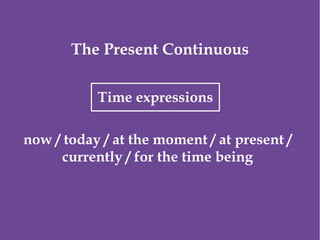
The Present Continuous
Time expressions
now / today / at the moment / at present /
currently / for the time being

Present continuous

  • 1.
    The Present Continuous Wemake the present continuous tense by adding -ing to the base verb: Look – I am looking / I'm looking Laugh – You are laughing / You're laughing Walk – She is walking / She's walking Learn – We are learning / We're learning Listen – They are listening / They're listening
  • 2.
    Negative Sentences I'm notlooking You / we / they aren't looking He / she / it isn't looking The Present Continuous Listening Questions Am I looking? Are you / we / they looking? Is he / she / it looking? Yes / No questions The rule of the three words Are you going? Yes I am / No, I'm not Yes, I'm Is Anna working? Yes, she is / No, she isn't Yes, she's
  • 3.
    What are theydoing? The Present Continuous
  • 4.
    ● General rule:Just add -ing into the base verb: go – going / visit - visiting ● Verbs that end in one -e lose the -e: smoke – smoking / come – coming But: - be – being - Verbs that end in -ee, don't lose an -e: agree – agreeing / see – seeing - Verbs that end in -ie, change the ie to y: lie – lying / die - dying The Present Continuous How do we spell the Present Continuous tense?
  • 5.
    How do wespell the Present Continuous tense? ● Verbs of 1 syllable, with one vowel and a consonant, the consonant is doubled: stop – stopping / get – getting / plan – planning But we do not double when there are two consonants (ask – asking), two vowels (seem – seeming / shout – shouting), or the final consonant is x, y, or z (fax – faxing / play – playing / show - showing) ● Verbs of more than 1 syllable that end in one stressed vowel + consonant, double the last letter: begin – beginning / forbid – forbidding / permit - permitting But if the last syllable of the base verb is not stressed, we do not double : Open – opening Exceptions : travel – travelling / cancel - cancelling
  • 6.
    Use ● To expressan activity that is happening now: Don't turn the TV off. I'm watching it You can't speak to Jane. She's having a bath ● To express and activity happening around now, but perhaps not at the moment of speaking: I must get back to the office. We're working on a project Don't take that book! Jane's reading it ● For temporary situations: Peter's a student, but he's working as a barman during the holidays I'm living with a friend until I find a place of my own
  • 7.
    Use ● To describechange, development and progress: My English is improving The Earth is slowly getting warmer The number of cars on the road is increasing ● To indicate imminent or future actions that we have planned before speaking (in general, we add a future word): Are you going to the concert this weekend? I'm playing badminton with Matthew tomorrow
  • 8.
    The Present Continuous Timeexpressions now / today / at the moment / at present / currently / for the time being