Adjective clauses   Grammar III ULACIT 13/03/10
What is a clause? It is a group of words containing a subject and a verb
What is adjective clause? An adjective clause uses pronouns to  connect the dependent clause to the  independent clause
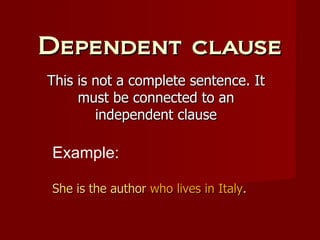
Dependent clause This is not a complete sentence. It must be connected to an independent clause Example:   She is the author  who lives in Italy .
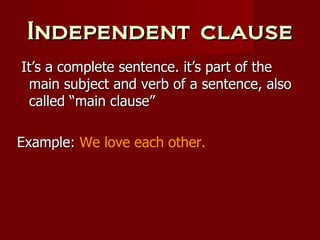
Independent clause It’s a complete sentence. it’s part of the main subject and verb of a sentence, also called “main clause” Example:  We love each other.
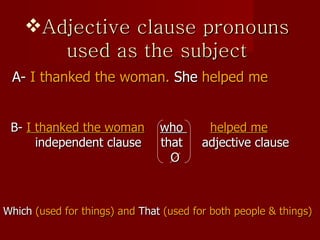
Adjective clause pronouns used as the subject A-  I thanked the woman.  She  helped me B-   I  thanked  the woman   who  helped me independent clause  that  adjective clause O Which  (used for things) and  That  (used for both people & things)
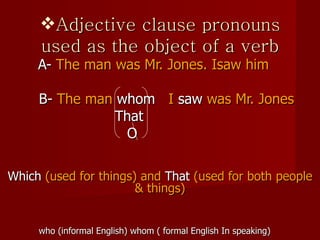
Adjective clause pronouns used as the object of a verb   A-  The man was Mr. Jones. Isaw him   B-  The man  whom   I  saw  was Mr. Jones   That O Which  (used for things) and  That  (used for both people & things) who (informal English) whom ( formal English In speaking)
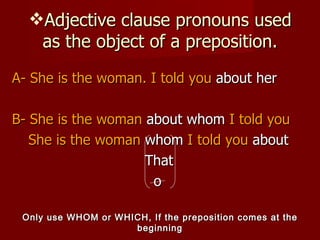
A- She is the woman. I told you  about her B-   She is the woman  about whom  I told you   She is the woman  whom  I told you  about That o Adjective clause pronouns used as the object of a preposition. Only use WHOM or WHICH, If the preposition comes at the beginning
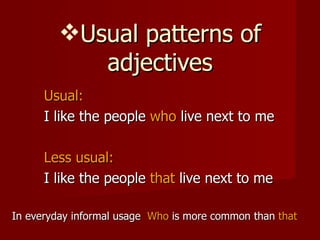
Usual patterns of adjectives Usual:   I like the people  who  live next to me Less usual: I like the people  that  live next to me  In everyday informal usage  Who  is more common than  that
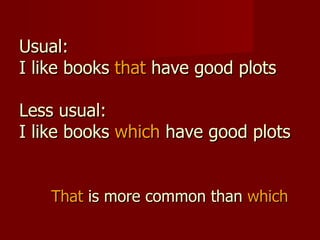
Usual:  I like books  that  have good plots Less usual: I like books  which  have good plots That  is more common than  which
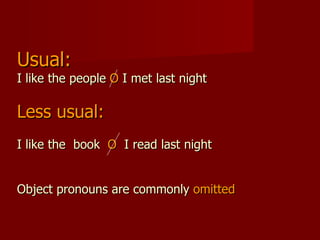
Usual: I like the people  O  I met last night Less usual: I like the  book  O   I read last night Object pronouns are commonly  omitted
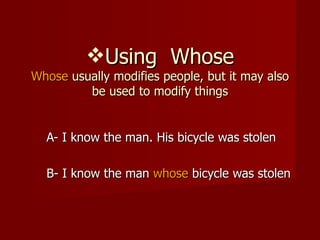
Using  Whose Whose  usually modifies people, but it may also be used to modify things A- I know the man. His bicycle was stolen  B- I know the man  whose  bicycle was stolen
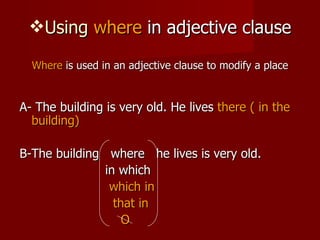
Using  where  in adjective clause Where  is used in an adjective clause to modify a place A- The building is very old. He lives  there ( in the building) B-The building  where  he lives is very old. in which which in that in O
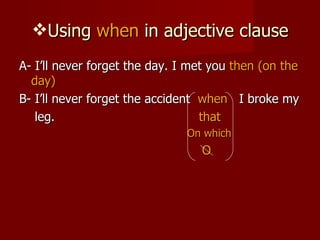
Using  when  in adjective clause A- I’ll never forget the day. I met you  then (on the day) B- I’ll never forget the accident  when   I broke my  leg.  that On which O
HAVE A NICE DAY

Adjective clauses

  • 1.
    Adjective clauses Grammar III ULACIT 13/03/10
  • 2.
    What is aclause? It is a group of words containing a subject and a verb
  • 3.
    What is adjectiveclause? An adjective clause uses pronouns to connect the dependent clause to the independent clause
  • 4.
    Dependent clause Thisis not a complete sentence. It must be connected to an independent clause Example: She is the author who lives in Italy .
  • 5.
    Independent clause It’sa complete sentence. it’s part of the main subject and verb of a sentence, also called “main clause” Example: We love each other.
  • 6.
    Adjective clause pronounsused as the subject A- I thanked the woman. She helped me B- I thanked the woman who helped me independent clause that adjective clause O Which (used for things) and That (used for both people & things)
  • 7.
    Adjective clause pronounsused as the object of a verb A- The man was Mr. Jones. Isaw him B- The man whom I saw was Mr. Jones That O Which (used for things) and That (used for both people & things) who (informal English) whom ( formal English In speaking)
  • 8.
    A- She isthe woman. I told you about her B- She is the woman about whom I told you She is the woman whom I told you about That o Adjective clause pronouns used as the object of a preposition. Only use WHOM or WHICH, If the preposition comes at the beginning
  • 9.
    Usual patterns ofadjectives Usual: I like the people who live next to me Less usual: I like the people that live next to me In everyday informal usage Who is more common than that
  • 10.
    Usual: Ilike books that have good plots Less usual: I like books which have good plots That is more common than which
  • 11.
    Usual: I likethe people O I met last night Less usual: I like the book O I read last night Object pronouns are commonly omitted
  • 12.
    Using WhoseWhose usually modifies people, but it may also be used to modify things A- I know the man. His bicycle was stolen B- I know the man whose bicycle was stolen
  • 13.
    Using where in adjective clause Where is used in an adjective clause to modify a place A- The building is very old. He lives there ( in the building) B-The building where he lives is very old. in which which in that in O
  • 14.
    Using when in adjective clause A- I’ll never forget the day. I met you then (on the day) B- I’ll never forget the accident when I broke my leg. that On which O
  • 15.