

FUTURE TENSES
To express action in certain time in the future.
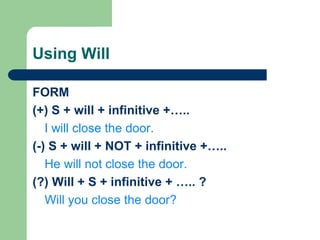
Using Will
FORM
(+) S + will + infinitive +…..
I will close the door.
(-) S + will + NOT + infinitive +…..
He will not close the door.
(?) Will + S + infinitive + ….. ?
Will you close the door?
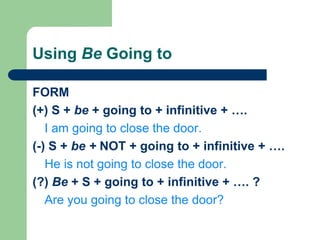
Using Be Going to
FORM
(+) S + be + going to + infinitive + ….
I am going to close the door.
(-) S + be + NOT + going to + infinitive + ….
He is not going to close the door.
(?) Be + S + going to + infinitive + …. ?
Are you going to close the door?
WILL vs BE GOING TO
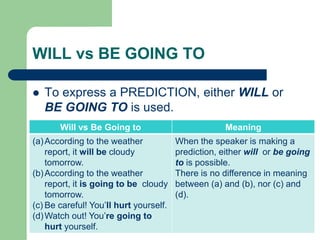
 To express a PREDICTION, either WILL or
BE GOING TO is used.
Will vs Be Going to Meaning
(a)According to the weather
report, it will be cloudy
tomorrow.
(b)According to the weather
report, it is going to be cloudy
tomorrow.
(c) Be careful! You’ll hurt yourself.
(d)Watch out! You’re going to
hurt yourself.
When the speaker is making a
prediction, either will or be going
to is possible.
There is no difference in meaning
between (a) and (b), nor (c) and
(d).
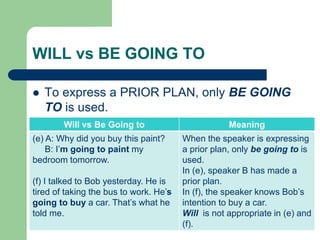
WILL vs BE GOING TO
Will vs Be Going to Meaning
(e) A: Why did you buy this paint?
B: I’m going to paint my
bedroom tomorrow.
(f) I talked to Bob yesterday. He is
tired of taking the bus to work. He’s
going to buy a car. That’s what he
told me.
When the speaker is expressing
a prior plan, only be going to is
used.
In (e), speaker B has made a
prior plan.
In (f), the speaker knows Bob’s
intention to buy a car.
Will is not appropriate in (e) and
(f).
 To express a PRIOR PLAN, only BE GOING
TO is used.
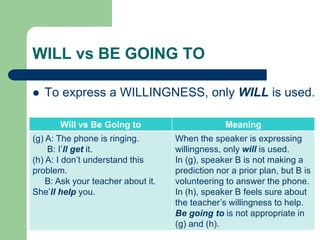
WILL vs BE GOING TO
Will vs Be Going to Meaning
(g) A: The phone is ringing.
B: I’ll get it.
(h) A: I don’t understand this
problem.
B: Ask your teacher about it.
She’ll help you.
When the speaker is expressing
willingness, only will is used.
In (g), speaker B is not making a
prediction nor a prior plan, but B is
volunteering to answer the phone.
In (h), speaker B feels sure about
the teacher’s willingness to help.
Be going to is not appropriate in
(g) and (h).
 To express a WILLINGNESS, only WILL is used.
Will versus Be Going To

Will versus Be Going To

  • 2.
    FUTURE TENSES To expressaction in certain time in the future.
  • 3.
    Using Will FORM (+) S+ will + infinitive +….. I will close the door. (-) S + will + NOT + infinitive +….. He will not close the door. (?) Will + S + infinitive + ….. ? Will you close the door?
  • 4.
    Using Be Goingto FORM (+) S + be + going to + infinitive + …. I am going to close the door. (-) S + be + NOT + going to + infinitive + …. He is not going to close the door. (?) Be + S + going to + infinitive + …. ? Are you going to close the door?
  • 5.
    WILL vs BEGOING TO  To express a PREDICTION, either WILL or BE GOING TO is used. Will vs Be Going to Meaning (a)According to the weather report, it will be cloudy tomorrow. (b)According to the weather report, it is going to be cloudy tomorrow. (c) Be careful! You’ll hurt yourself. (d)Watch out! You’re going to hurt yourself. When the speaker is making a prediction, either will or be going to is possible. There is no difference in meaning between (a) and (b), nor (c) and (d).
  • 6.
    WILL vs BEGOING TO Will vs Be Going to Meaning (e) A: Why did you buy this paint? B: I’m going to paint my bedroom tomorrow. (f) I talked to Bob yesterday. He is tired of taking the bus to work. He’s going to buy a car. That’s what he told me. When the speaker is expressing a prior plan, only be going to is used. In (e), speaker B has made a prior plan. In (f), the speaker knows Bob’s intention to buy a car. Will is not appropriate in (e) and (f).  To express a PRIOR PLAN, only BE GOING TO is used.
  • 7.
    WILL vs BEGOING TO Will vs Be Going to Meaning (g) A: The phone is ringing. B: I’ll get it. (h) A: I don’t understand this problem. B: Ask your teacher about it. She’ll help you. When the speaker is expressing willingness, only will is used. In (g), speaker B is not making a prediction nor a prior plan, but B is volunteering to answer the phone. In (h), speaker B feels sure about the teacher’s willingness to help. Be going to is not appropriate in (g) and (h).  To express a WILLINGNESS, only WILL is used.