Future Tense
Future tenses in English usually tell us about how 
the person speaking thinks about the future event. 
Is the event: ??? 
– an arrangement 
– a plan 
– a prediction
Arrangement 
Present continuous 
Something that involves someone else: 
i.e, appointments, bookings, dates, meetings 
“I’m sorry, I’m meeting a client at that time. Can we 
make it later?” 
“I’m watching that movie with my girlfriend tonight, 
so don’t tell me what happens.”
Plan 
going to 
A plan is something you have decided, e.g. a New 
Year’s resolution, a goal, a to-do list. 
“I’m going to give up smoking this year.” 
“I’m just going to chill this weekend.”
Prediction 
will 
A prediction is something you think you cannot 
change. Usually pertains to things about society, 
other people, trends. 
“There will be a final at the end of the semester.” 
“I’ll lose all my hair by the time I’m 50”
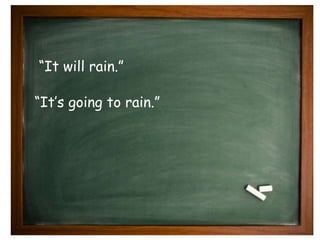
“It will rain.” 
“It’s going to rain.”
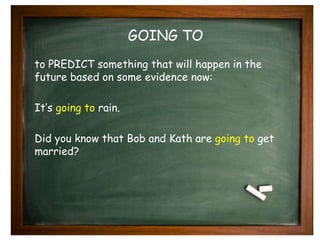
GOING TO 
to PREDICT something that will happen in the 
future based on some evidence now: 
It’s going to rain. 
Did you know that Bob and Kath are going to get 
married?
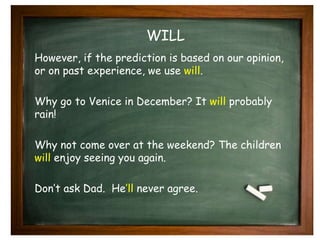
WILL 
However, if the prediction is based on our opinion, 
or on past experience, we use will. 
Why go to Venice in December? It will probably 
rain! 
Why not come over at the weekend? The children 
will enjoy seeing you again. 
Don’t ask Dad. He’ll never agree.
WILL 
often used with I expect, I hope, I imagine, I think , 
etc. 
I think I’ll go to the Christmas bazaar this 
afternoon. 
I bet the stores will be really crowded.
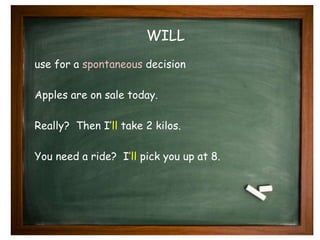
WILL 
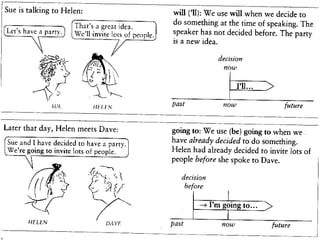
use for a spontaneous decision 
Apples are on sale today. 
Really? Then I’ll take 2 kilos. 
You need a ride? I’ll pick you up at 8.
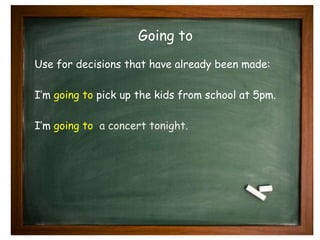
Going to 
Use for decisions that have already been made: 
I’m going to pick up the kids from school at 5pm. 
I’m going to a concert tonight.
“George phoned while you were out.” 
• O.K. I’ll phone him back. 
• Yes, I know. I’m going to phone him back. 
“Ann is in the hospital.” 
• Oh really? I didn’t know. I’ll go visit her. 
• Yes, I know. I’m going to go visit her.
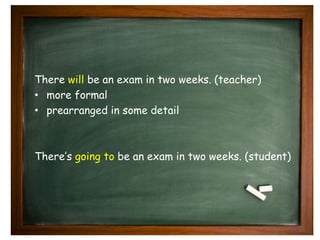
There will be an exam in two weeks. (teacher) 
• more formal 
• prearranged in some detail 
There’s going to be an exam in two weeks. (student)
Other Future Tenses
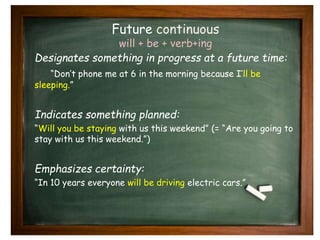
Future continuous 
will + be + verb+ing 
Designates something in progress at a future time: 
“Don’t phone me at 6 in the morning because I’ll be 
sleeping.” 
Indicates something planned: 
“Will you be staying with us this weekend” (= “Are you going to 
stay with us this weekend.”) 
Emphasizes certainty: 
“In 10 years everyone will be driving electric cars.”
Future Perfect 
Something ended or achieved in the future: 
“ By the time the semester is over, you will have 
covered everything in “Advanced Grammar in Use.”
Future Perfect Continuous 
Indicates an activity still in progress in the future: 
“By 2015, I will have been working 30 years for 
Siemens.”
The future seen from the past ..... 
..... as quoted in The New Yorker 
"When I began the Ponzi scheme, I 
believed it would end shortly and I would 
be able to extricate myself and my 
clients." 
Bernie Madoff 
quoted by Nancy Franklin in The New Yorker. See 
http://www.boston.com/bostonglobe/ideas/articles/2009/03/22/active_resistance/
SERIAL TAXI 
https://vimeo.com/63106783
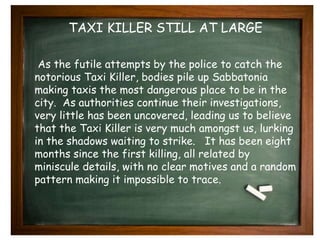
TAXI KILLER STILL AT LARGE 
As the futile attempts by the police to catch the 
notorious Taxi Killer, bodies pile up Sabbatonia 
making taxis the most dangerous place to be in the 
city. As authorities continue their investigations, 
very little has been uncovered, leading us to believe 
that the Taxi Killer is very much amongst us, lurking 
in the shadows waiting to strike. It has been eight 
months since the first killing, all related by 
miniscule details, with no clear motives and a random 
pattern making it impossible to trace.

Grammar 5 future tenses

  • 1.
  • 2.
    Future tenses inEnglish usually tell us about how the person speaking thinks about the future event. Is the event: ??? – an arrangement – a plan – a prediction
  • 3.
    Arrangement Present continuous Something that involves someone else: i.e, appointments, bookings, dates, meetings “I’m sorry, I’m meeting a client at that time. Can we make it later?” “I’m watching that movie with my girlfriend tonight, so don’t tell me what happens.”
  • 4.
    Plan going to A plan is something you have decided, e.g. a New Year’s resolution, a goal, a to-do list. “I’m going to give up smoking this year.” “I’m just going to chill this weekend.”
  • 5.
    Prediction will Aprediction is something you think you cannot change. Usually pertains to things about society, other people, trends. “There will be a final at the end of the semester.” “I’ll lose all my hair by the time I’m 50”
  • 6.
    “It will rain.” “It’s going to rain.”
  • 7.
    GOING TO toPREDICT something that will happen in the future based on some evidence now: It’s going to rain. Did you know that Bob and Kath are going to get married?
  • 8.
    WILL However, ifthe prediction is based on our opinion, or on past experience, we use will. Why go to Venice in December? It will probably rain! Why not come over at the weekend? The children will enjoy seeing you again. Don’t ask Dad. He’ll never agree.
  • 9.
    WILL often usedwith I expect, I hope, I imagine, I think , etc. I think I’ll go to the Christmas bazaar this afternoon. I bet the stores will be really crowded.
  • 10.
    WILL use fora spontaneous decision Apples are on sale today. Really? Then I’ll take 2 kilos. You need a ride? I’ll pick you up at 8.
  • 11.
    Going to Usefor decisions that have already been made: I’m going to pick up the kids from school at 5pm. I’m going to a concert tonight.
  • 13.
    “George phoned whileyou were out.” • O.K. I’ll phone him back. • Yes, I know. I’m going to phone him back. “Ann is in the hospital.” • Oh really? I didn’t know. I’ll go visit her. • Yes, I know. I’m going to go visit her.
  • 14.
    There will bean exam in two weeks. (teacher) • more formal • prearranged in some detail There’s going to be an exam in two weeks. (student)
  • 15.
  • 16.
    Future continuous will+ be + verb+ing Designates something in progress at a future time: “Don’t phone me at 6 in the morning because I’ll be sleeping.” Indicates something planned: “Will you be staying with us this weekend” (= “Are you going to stay with us this weekend.”) Emphasizes certainty: “In 10 years everyone will be driving electric cars.”
  • 17.
    Future Perfect Somethingended or achieved in the future: “ By the time the semester is over, you will have covered everything in “Advanced Grammar in Use.”
  • 18.
    Future Perfect Continuous Indicates an activity still in progress in the future: “By 2015, I will have been working 30 years for Siemens.”
  • 19.
    The future seenfrom the past ..... ..... as quoted in The New Yorker "When I began the Ponzi scheme, I believed it would end shortly and I would be able to extricate myself and my clients." Bernie Madoff quoted by Nancy Franklin in The New Yorker. See http://www.boston.com/bostonglobe/ideas/articles/2009/03/22/active_resistance/
  • 20.
  • 21.
    TAXI KILLER STILLAT LARGE As the futile attempts by the police to catch the notorious Taxi Killer, bodies pile up Sabbatonia making taxis the most dangerous place to be in the city. As authorities continue their investigations, very little has been uncovered, leading us to believe that the Taxi Killer is very much amongst us, lurking in the shadows waiting to strike. It has been eight months since the first killing, all related by miniscule details, with no clear motives and a random pattern making it impossible to trace.