1
Subject : Computer Networks
Topic : Addressing
Types of addresses
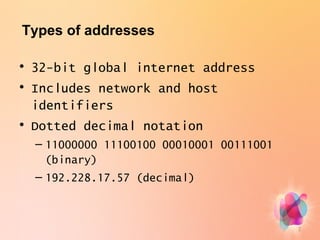
• 32-bit global internet address
• Includes network and host
identifiers
• Dotted decimal notation
– 11000000 11100100 00010001 00111001
(binary)
– 192.228.17.57 (decimal)
2
Types of addresses
3
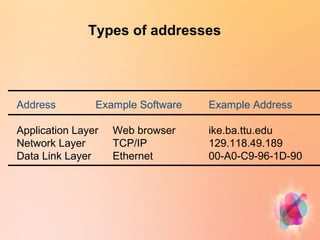
Address Example Software Example Address
Application Layer Web browser ike.ba.ttu.edu
Network Layer TCP/IP 129.118.49.189
Data Link Layer Ethernet 00-A0-C9-96-1D-90
Internet Addresses
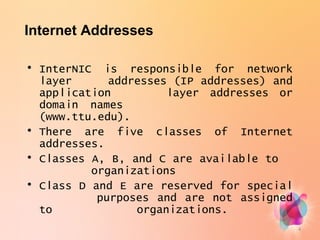
• InterNIC is responsible for network
layer addresses (IP addresses) and
application layer addresses or
domain names
(www.ttu.edu).
• There are five classes of Internet
addresses.
• Classes A, B, and C are available to
organizations
• Class D and E are reserved for special
purposes and are not assigned
to organizations.
4
Internet Address Classes
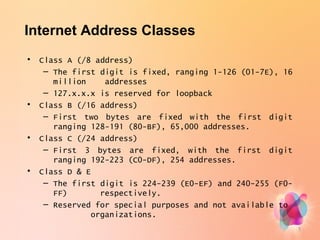
• Class A (/8 address)
– The first digit is fixed, ranging 1-126 (01-7E), 16
million addresses
– 127.x.x.x is reserved for loopback
• Class B (/16 address)
– First two bytes are fixed with the first digit
ranging 128-191 (80-BF), 65,000 addresses.
• Class C (/24 address)
– First 3 bytes are fixed, with the first digit
ranging 192-223 (C0-DF), 254 addresses.
• Class D & E
– The first digit is 224-239 (E0-EF) and 240-255 (F0-
FF) respectively.
– Reserved for special purposes and not available to
organizations.
5
Internet Address Classes
6
1/2
1 126
1/4
128 191
1/8
192 223
1/16 1/16
240 255
Class C Class D Class EClass BClass A
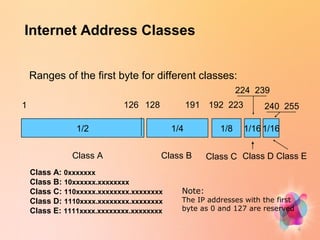
Ranges of the first byte for different classes:
Class A: 0xxxxxxx
Class B: 10xxxxxx.xxxxxxxx
Class C: 110xxxxx.xxxxxxxx.xxxxxxxx
Class D: 1110xxxx.xxxxxxxx.xxxxxxxx
Class E: 1111xxxx.xxxxxxxx.xxxxxxxx
224 239
Note:
The IP addresses with the first
byte as 0 and 127 are reserved
7
Thank You

Addressing in Computer Networks

  • 1.
    1 Subject : ComputerNetworks Topic : Addressing
  • 2.
    Types of addresses •32-bit global internet address • Includes network and host identifiers • Dotted decimal notation – 11000000 11100100 00010001 00111001 (binary) – 192.228.17.57 (decimal) 2
  • 3.
    Types of addresses 3 AddressExample Software Example Address Application Layer Web browser ike.ba.ttu.edu Network Layer TCP/IP 129.118.49.189 Data Link Layer Ethernet 00-A0-C9-96-1D-90
  • 4.
    Internet Addresses • InterNICis responsible for network layer addresses (IP addresses) and application layer addresses or domain names (www.ttu.edu). • There are five classes of Internet addresses. • Classes A, B, and C are available to organizations • Class D and E are reserved for special purposes and are not assigned to organizations. 4
  • 5.
    Internet Address Classes •Class A (/8 address) – The first digit is fixed, ranging 1-126 (01-7E), 16 million addresses – 127.x.x.x is reserved for loopback • Class B (/16 address) – First two bytes are fixed with the first digit ranging 128-191 (80-BF), 65,000 addresses. • Class C (/24 address) – First 3 bytes are fixed, with the first digit ranging 192-223 (C0-DF), 254 addresses. • Class D & E – The first digit is 224-239 (E0-EF) and 240-255 (F0- FF) respectively. – Reserved for special purposes and not available to organizations. 5
  • 6.
    Internet Address Classes 6 1/2 1126 1/4 128 191 1/8 192 223 1/16 1/16 240 255 Class C Class D Class EClass BClass A Ranges of the first byte for different classes: Class A: 0xxxxxxx Class B: 10xxxxxx.xxxxxxxx Class C: 110xxxxx.xxxxxxxx.xxxxxxxx Class D: 1110xxxx.xxxxxxxx.xxxxxxxx Class E: 1111xxxx.xxxxxxxx.xxxxxxxx 224 239 Note: The IP addresses with the first byte as 0 and 127 are reserved
  • 7.