MICROPROCESSOR
SYSTEMS
Week-7
INTERFACING
Memory Organization of 8086
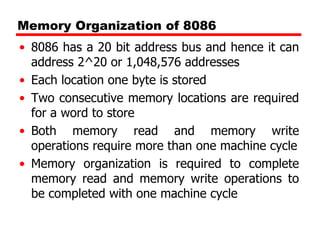
• 8086 has a 20 bit address bus and hence it can
address 2^20 or 1,048,576 addresses
• Each location one byte is stored
• Two consecutive memory locations are required
for a word to store
• Both memory read and memory write
operations require more than one machine cycle
• Memory organization is required to complete
memory read and memory write operations to
be completed with one machine cycle
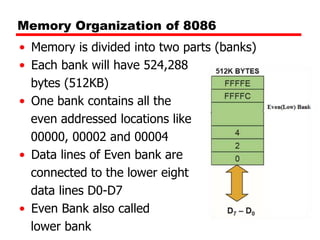
Memory Organization of 8086
• Memory is divided into two parts (banks)
• Each bank will have 524,288
bytes (512KB)
• One bank contains all the
even addressed locations like
00000, 00002 and 00004
• Data lines of Even bank are
connected to the lower eight
data lines D0-D7
• Even Bank also called
lower bank
Memory Organization of 8086
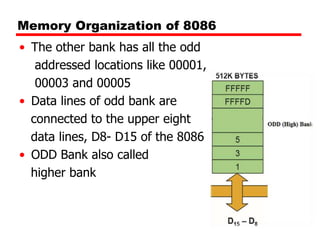
• The other bank has all the odd
addressed locations like 00001,
00003 and 00005
• Data lines of odd bank are
connected to the upper eight
data lines, D8- D15 of the 8086
• ODD Bank also called
higher bank
Memory Organization of 8086
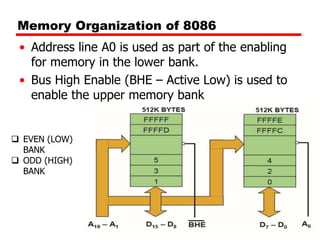
• Address line A0 is used as part of the enabling
for memory in the lower bank.
• Bus High Enable (BHE – Active Low) is used to
enable the upper memory bank
 EVEN (LOW)
BANK
 ODD (HIGH)
BANK
Memory Organization (Data Transfer)
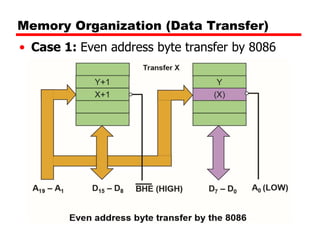
• Case 1: Even address byte transfer by 8086
• Read/Write a byte form/to an even address
• A0 will be low
• BHE (Active Low) will be high
• Byte is transferred to/from low bank through
D0-D7
• One Machine Cycle required
• Example
MOV AH,DS:BYTE PTR[0000]
Memory Organization (Data Transfer)
• Case 1: Even address byte transfer by 8086
Memory Organization (Data Transfer)
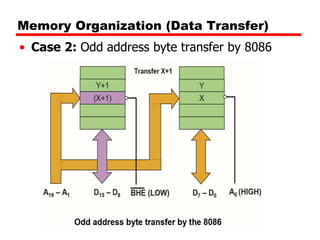
• Case 2: Odd address byte transfer by 8086
• Read/Write a byte from/to an odd address
• A0 will be high
• BHE (Active Low) will be asserted low
• Low bank is disabled and high bank is enabled
• Byte is transferred through D0-D7
• One Machine Cycle required
• Example
MOV AL,DS:BYTE PTR[0001]
Memory Organization (Data Transfer)
• Case 2: Odd address byte transfer by 8086
Memory Organization (Data Transfer)
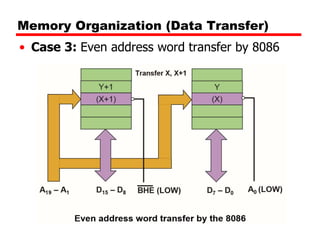
• Case 3: Even address word transfer by 8086
• A0 will be asserted low – Low byte of the word
through D0-D7
• BHE (Active Low) will be asserted low –high
byte of the word through D8-D15
• One Machine Cycle required
• Example
MOV AX,DS:WORD PTR[0000]
Memory Organization (Data Transfer)
• Case 3: Even address word transfer by 8086
Memory Organization (Data Transfer)
• Case 4: Odd address word transfer by 8086
• Read/Write a word from/to an odd address
• Two bus cycles are required
• During the first machine cycle assert BHE
(Active Low) as low and A0 as high
• First byte is transferred through D0-D7 and the
second byte is transferred through D8-D15
• Example
MOV AX,DS:WORD PTR[0001H]
Memory Organization (Data Transfer)
• Case 4: Odd address word transfer by 8086
Memory Organization (Data Transfer)
Comparison among different memory accesses
Memory
Type
Data
Type
BHE A0
BUS
Cycles
Data
Lines
Even BYTE 1 0 1 D0 – D7
Odd BYTE 0 1 1 D8 – D15
Even WORD 0 0 1 D0 – D15
Odd WORD
0 1 First D8 – D15
1 0 Second D0 – D7
Memory Organization (Data Transfer)
• Is the word at address 01231H in a 8086 based
system aligned or misaligned?
• How many memory cycles are required to read
the word?
Address Decoding Techniques
• The Different types of address decoding techniques in
8086 Microprocessor are,
1. Absolute decoding
2. Linear decoding
3. Block decoding
Address Decoding Techniques
1. Absolute decoding
• Memory chip is selected only for the specified logic level
on the address lines
• No other logic levels can select the chip
Address Decoding Techniques
1. Absolute decoding
• Figure shows the memory interface with
absolute decoding
• Two 8K EPROMs (2764) are used to provide
even and odd memory banks
• Control signals BHE and A0 are used to enable
outputs of odd and even memory banks
respectively
Address Decoding Techniques
1. Absolute decoding
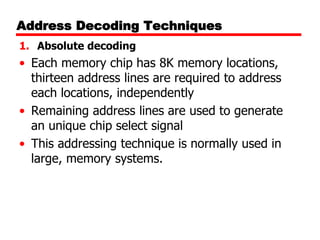
• Each memory chip has 8K memory locations,
thirteen address lines are required to address
each locations, independently
• Remaining address lines are used to generate
an unique chip select signal
• This addressing technique is normally used in
large, memory systems.
Address Decoding Techniques
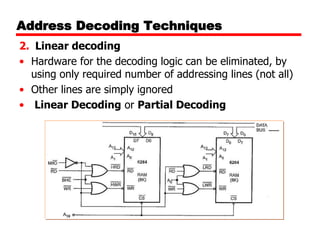
2. Linear decoding
• Hardware for the decoding logic can be eliminated, by
using only required number of addressing lines (not all)
• Other lines are simply ignored
• Linear Decoding or Partial Decoding
Address Decoding Techniques
2. Linear decoding
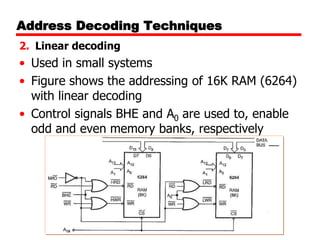
• Used in small systems
• Figure shows the addressing of 16K RAM (6264)
with linear decoding
• Control signals BHE and A0 are used to, enable
odd and even memory banks, respectively
Address Decoding Techniques
2. Linear decoding
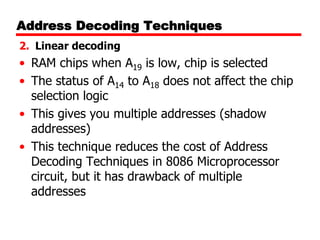
• RAM chips when A19 is low, chip is selected
• The status of A14 to A18 does not affect the chip
selection logic
• This gives you multiple addresses (shadow
addresses)
• This technique reduces the cost of Address
Decoding Techniques in 8086 Microprocessor
circuit, but it has drawback of multiple
addresses
Address Decoding Techniques
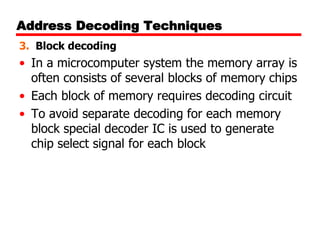
3. Block decoding
• In a microcomputer system the memory array is
often consists of several blocks of memory chips
• Each block of memory requires decoding circuit
• To avoid separate decoding for each memory
block special decoder IC is used to generate
chip select signal for each block
Address Decoding Techniques
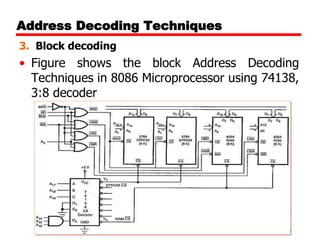
3. Block decoding
• Figure shows the block Address Decoding
Techniques in 8086 Microprocessor using 74138,
3:8 decoder
•
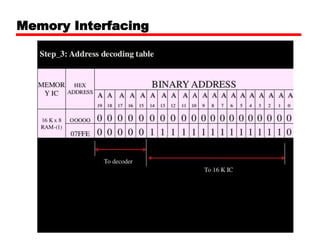
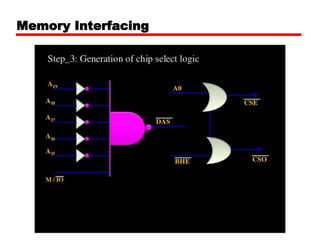
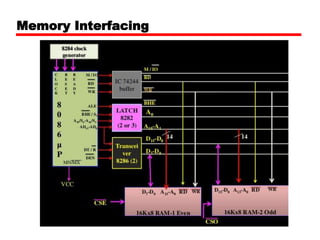
Memory Interfacing
Example 1: Interface 32KB of RAM to the 8086
microprocessor using absolute decoding with the suitable
address.
Memory Interfacing
Memory Interfacing
Memory Interfacing
REVIEW

Address decoding (1).pptx

  • 1.
  • 2.
    Memory Organization of8086 • 8086 has a 20 bit address bus and hence it can address 2^20 or 1,048,576 addresses • Each location one byte is stored • Two consecutive memory locations are required for a word to store • Both memory read and memory write operations require more than one machine cycle • Memory organization is required to complete memory read and memory write operations to be completed with one machine cycle
  • 3.
    Memory Organization of8086 • Memory is divided into two parts (banks) • Each bank will have 524,288 bytes (512KB) • One bank contains all the even addressed locations like 00000, 00002 and 00004 • Data lines of Even bank are connected to the lower eight data lines D0-D7 • Even Bank also called lower bank
  • 4.
    Memory Organization of8086 • The other bank has all the odd addressed locations like 00001, 00003 and 00005 • Data lines of odd bank are connected to the upper eight data lines, D8- D15 of the 8086 • ODD Bank also called higher bank
  • 5.
    Memory Organization of8086 • Address line A0 is used as part of the enabling for memory in the lower bank. • Bus High Enable (BHE – Active Low) is used to enable the upper memory bank  EVEN (LOW) BANK  ODD (HIGH) BANK
  • 6.
    Memory Organization (DataTransfer) • Case 1: Even address byte transfer by 8086 • Read/Write a byte form/to an even address • A0 will be low • BHE (Active Low) will be high • Byte is transferred to/from low bank through D0-D7 • One Machine Cycle required • Example MOV AH,DS:BYTE PTR[0000]
  • 7.
    Memory Organization (DataTransfer) • Case 1: Even address byte transfer by 8086
  • 8.
    Memory Organization (DataTransfer) • Case 2: Odd address byte transfer by 8086 • Read/Write a byte from/to an odd address • A0 will be high • BHE (Active Low) will be asserted low • Low bank is disabled and high bank is enabled • Byte is transferred through D0-D7 • One Machine Cycle required • Example MOV AL,DS:BYTE PTR[0001]
  • 9.
    Memory Organization (DataTransfer) • Case 2: Odd address byte transfer by 8086
  • 10.
    Memory Organization (DataTransfer) • Case 3: Even address word transfer by 8086 • A0 will be asserted low – Low byte of the word through D0-D7 • BHE (Active Low) will be asserted low –high byte of the word through D8-D15 • One Machine Cycle required • Example MOV AX,DS:WORD PTR[0000]
  • 11.
    Memory Organization (DataTransfer) • Case 3: Even address word transfer by 8086
  • 12.
    Memory Organization (DataTransfer) • Case 4: Odd address word transfer by 8086 • Read/Write a word from/to an odd address • Two bus cycles are required • During the first machine cycle assert BHE (Active Low) as low and A0 as high • First byte is transferred through D0-D7 and the second byte is transferred through D8-D15 • Example MOV AX,DS:WORD PTR[0001H]
  • 13.
    Memory Organization (DataTransfer) • Case 4: Odd address word transfer by 8086
  • 14.
    Memory Organization (DataTransfer) Comparison among different memory accesses Memory Type Data Type BHE A0 BUS Cycles Data Lines Even BYTE 1 0 1 D0 – D7 Odd BYTE 0 1 1 D8 – D15 Even WORD 0 0 1 D0 – D15 Odd WORD 0 1 First D8 – D15 1 0 Second D0 – D7
  • 15.
    Memory Organization (DataTransfer) • Is the word at address 01231H in a 8086 based system aligned or misaligned? • How many memory cycles are required to read the word?
  • 16.
    Address Decoding Techniques •The Different types of address decoding techniques in 8086 Microprocessor are, 1. Absolute decoding 2. Linear decoding 3. Block decoding
  • 17.
    Address Decoding Techniques 1.Absolute decoding • Memory chip is selected only for the specified logic level on the address lines • No other logic levels can select the chip
  • 18.
    Address Decoding Techniques 1.Absolute decoding • Figure shows the memory interface with absolute decoding • Two 8K EPROMs (2764) are used to provide even and odd memory banks • Control signals BHE and A0 are used to enable outputs of odd and even memory banks respectively
  • 19.
    Address Decoding Techniques 1.Absolute decoding • Each memory chip has 8K memory locations, thirteen address lines are required to address each locations, independently • Remaining address lines are used to generate an unique chip select signal • This addressing technique is normally used in large, memory systems.
  • 20.
    Address Decoding Techniques 2.Linear decoding • Hardware for the decoding logic can be eliminated, by using only required number of addressing lines (not all) • Other lines are simply ignored • Linear Decoding or Partial Decoding
  • 21.
    Address Decoding Techniques 2.Linear decoding • Used in small systems • Figure shows the addressing of 16K RAM (6264) with linear decoding • Control signals BHE and A0 are used to, enable odd and even memory banks, respectively
  • 22.
    Address Decoding Techniques 2.Linear decoding • RAM chips when A19 is low, chip is selected • The status of A14 to A18 does not affect the chip selection logic • This gives you multiple addresses (shadow addresses) • This technique reduces the cost of Address Decoding Techniques in 8086 Microprocessor circuit, but it has drawback of multiple addresses
  • 23.
    Address Decoding Techniques 3.Block decoding • In a microcomputer system the memory array is often consists of several blocks of memory chips • Each block of memory requires decoding circuit • To avoid separate decoding for each memory block special decoder IC is used to generate chip select signal for each block
  • 24.
    Address Decoding Techniques 3.Block decoding • Figure shows the block Address Decoding Techniques in 8086 Microprocessor using 74138, 3:8 decoder •
  • 25.
    Memory Interfacing Example 1:Interface 32KB of RAM to the 8086 microprocessor using absolute decoding with the suitable address.
  • 26.
  • 27.
  • 28.
  • 29.