İhsan Doğramacı Bilkent University / Faculty of Art, Design and Architecture
ADA 264- History of Built Environment II / Section 07
Spring 2017
Lecturer : Kumru Arapgirlioğlu
Students : Serra Koz
Assignment V
Bonus Homework: Late Ottoman and Early Republican Architecture
DOLMABAHÇE PALACE
by Garabed Balyan
Dolmabahçe Palace
a n a l y s i s
ID OF HOUSE: NAME, THE ARCHITECT, THE CLIENT, DATES OF THE PROJECT
Dolmabahçe Palace has a huge role in the history of Late Ottoman Architecture. The
name of Dolmabahçe comes from the ground of the building is stuffed with the soil.
(Ekşioğlu, A. pg. 146) The palace is one of the earliest examples of Baroque Architecture
and also it is the biggest monoblock palace of Turkey. Garabed Balyan is the designer
and main architecture of the Dolmabahçe Palace and as an assistant Ohannes
Serveryan, Nikoğos Balyan and James William Smith worked in the construction.
(Dolmabahçe Sarayı Brochure, pg. 2). The client of the Dolmabahçe Palace is the 31st
sultan of Ottoman Empire, Aldülmecid and The Palace started its construction on June
13, 1843 and its use was opened on 7 June 1856 with the completion of the surrounding
walls. (Dolmabahçe Sarayı) After 1856, palace is used by Sultan Abdülmecid (1839-1861),
Sultan Abdülaziz, Sultan V. Murad, Sultan II. Abdülhamid, Sultan V. Mehmed Reşad,
Sultab VI. Mehmed Vahideddin, Halife Abdülmecid, the first president of Republic of
Turkey and father of Turkish Republic: Mustafa Kemal Atatürk, İsmet İnönü
consecutively.
PLACE, CONTEXT, ARCHITECTURAL LANGUAGE, EXISTING CONDITIONS
Dolmabahçe Sarayı is located in İstanbul, next to Bosporus. The context of the palace is
urban and has huge gardens, stables, many kiosks and a mosque. However, most of the
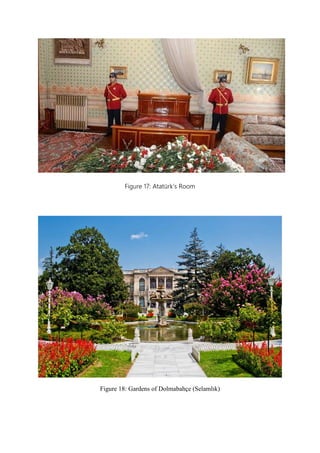
gardens, stables were destroyed or converted into a stadium or skyscrapers. As a kiosk,
Camlı Kiosk has been still using and it is the only place that understand from the
exterior of palace. The architectural language of the building is the combination of both
Traditional Ottoman Art and Western Architectural styles: Baroque, Rococo and Neo-
classicism. However, even though it is a combination of too many styles, it is not
eclectic; it is a well-designed example of 19th
century Ottoman Architecture. Today,
palace is used as museum-palace until 1984 and everyone is invited; however, for the
sake of paintings a separate exhibition building, Painting Museum next to Dolmabahçe
Palace, has been constructed in order to ensure that the paintings are not damaged
and in good condition. Also, Muayede Salonu is sometimes used for governmental
purpose.
SPATIAL QUALITIES, MATERIAL, STRUCTURE, CIRCULATION PATTERN, SOURCE OF
LIGHT
The palace is consisting of 3 different parts. The fisrt one is the Place where the
government's administration works “Mabeyn-I Hümayün” (Selamlık), private place of
sultan and his family “Harem-I Hümayün”(Harem), and finally a place of feast and
important government affairs “Muayede Salonu” (Tören Salonu). There are lots of
spaces such as Camlı Köşk, Saat Kulesi but they are not connected with the main
building. However, gardens are very important because the shape, form and details of
gardens stem from the Italian and France gardens. (Ekşioğlu, A. pg. 168)Each part has
unique shape, form and function. For the interior of the palace, Selamlık is the most
stony and glamorous, while Harem is simpler and suitable for everyday use. Also, the
shape of the Muayede Salonu is very important because dome is defined the space and
we can say that it is architectonic since we can understand the Muayede Salonu from
the outside. Both Selamlık and Harem consist of “daire” and each has its own main
space, subspace in it. In Harem, each “daire” belongs to someone such as Valide Sultan,
Sister of Sultan, Kalfa, Veliahd etc. Their circulation path is linear and connected to each
other with doors. They are 2 main corridors with opposite direction and each subspace,
(private rooms, hamams, restrooms) located around the corridor. The saloons are on
the middle of each “daire” and defined by 2 corridors. In Selamlık, the same rules are
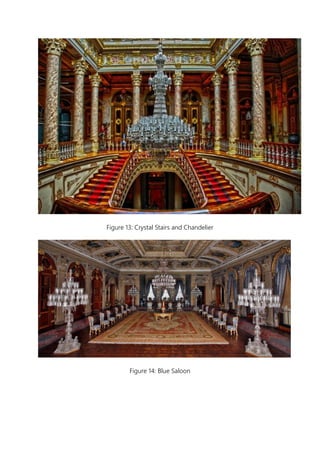
used; however, the decorations and ornamentations on wall are very well used. They
used crystal Baccarat and Bohemia chandeliers, Hereke carpets, Western Style paintings,
musical instruments, mostly piano, and sofas in the middle. The materials used in the
building are mostly marble and granite and the structure of the building is load-bearing
wall system. Also, the roof is covered with lead (Şehsüvaroğlu, H. Y.). The source of light
is well used in the building, whether it has very small windows. The palace does not
have any huge building around it and the material of marble has a property of
reflecting the sun-rays. Each main saloon and subspace has windows, even hamams.
SIMILARITIES AND DIFFERENCES TO MODERN WESTERN ARCHITECTURAL STYLE:
BAROQUE
In the Baroque Style, the exterior of the building become very crucial. The charactrstic of
Baroque architecture is belongs to monarchic, aristocratic and religious character. In
that sense, the idea of Dolmabahçe is similar to Baroque Style since the palace belongs
to sultan, and it was the center of the Ottoman Empire. The façade consist of lots of
Baroque elements and ornamentation but from the inside we can say that it is not
Baroque. Since thefurnitures and decorations belong to the France and Italy, we can say
that the interior is more like Neo-Classical but rather than Neo-Classical it is the typical
Turkish House. For the Baroque Style we can say that it is not only limit itself with the
façade and interiorthe gardens is become a part of design. For that reason the
landscape idea was based on a sense of movement. Actually, we can see the movement
in the Dolmabahçe Palace since the circulation path, form and elements used in the
landscape is a part of movement and directing people. Another important thing from
the garden design of the Baroque architecture is the elements in the center, like
obelisks. For example the Piazza del Popolo in Rome is one of the best examples of
Baroque styles in the sense of central element. Alhough the elements are very small in
the Dolmabahçe Palace, the idea of using a main element has to be considered,
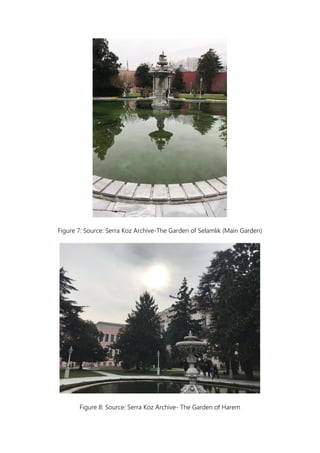
fountains in the middle of the Harem and Selamlık gardens. Other characteristic of
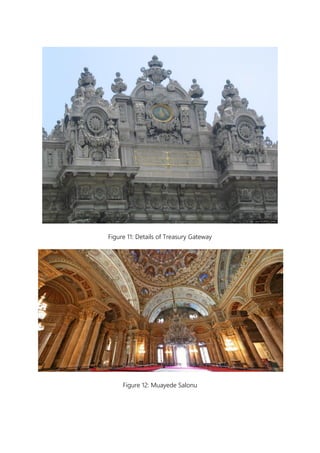
Baroque Style is the dome structures. Since they used domes to define spaces, we shoul
consider the dome of Muayede Salonu. The Muayede Salonu is the only place where
dome structure is used. Since the style of the Dolmabahçe Palace is taking reference
from the Baroque there is no huge difference between Baroque style and Dolmabahçe
Palace but we shoul consider the shape and from of the Harem and Selamlık. Since the
shape is more like cubical and solid, we can say that the difference of Broque Style and
Dolmabahçe might be the form of the structures.
WORK-CITED
Ekşioğlu, A. (2001). Rönesans ve Barok Bahçe Sanatı’nın İstanbul Saraylarındaki Etkileri:
Dolmabahçe ve Beylerbeyi Sarayı Örneği (Master Thesis). T.C. Yükseköğretim
Kurulu Dökümentasyon Merkezi. (101463).
Dolmabahçe Sarayı Brochure. TBMM Milli Saraylar, TBMM Basımevi-Ankara. (Attached)
Dolmabahçe Sarayı. (n.d. )TBMM Genel Sekreterliği (Milli Saraylar). Retrived from:
www.millisaraylar.gov.tr/portalmain/Palaces.aspx?SarayId=10
Şehsüvaroğlu, H. Y. (1950). Tarihten Sahifeler: Dolmabahçe Sarayı. Kişisel Arşivlerde
İstanbul Belleği Taha Toros Arşivi. (TT-581961)
APPENDIX
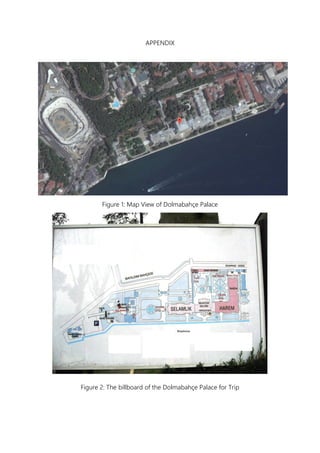
Figure 1: Map View of Dolmabahçe Palace
Figure 2: The billboard of the Dolmabahçe Palace for Trip
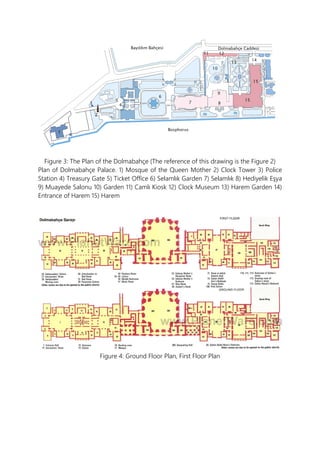
Figure 3: The Plan of the Dolmabahçe (The reference of this drawing is the Figure 2)
Plan of Dolmabahçe Palace. 1) Mosque of the Queen Mother 2) Clock Tower 3) Police
Station 4) Treasury Gate 5) Ticket Office 6) Selamlık Garden 7) Selamlık 8) Hediyelik Eşya
9) Muayede Salonu 10) Garden 11) Camlı Kiosk 12) Clock Museum 13) Harem Garden 14)
Entrance of Harem 15) Harem
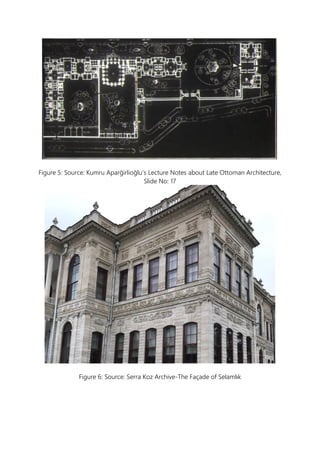
Figure 4: Ground Floor Plan, First Floor Plan
Figure 5: Source: Kumru Aparğirlioğlu’s Lecture Notes about Late Ottoman Architecture,
Slide No: 17
Figure 6: Source: Serra Koz Archive-The Façade of Selamlık
Figure 7: Source: Serra Koz Archive-The Garden of Selamlık (Main Garden)
Figure 8: Source: Serra Koz Archive- The Garden of Harem
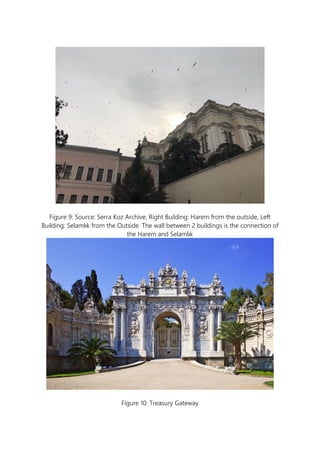
Figure 9: Source: Serra Koz Archive, Right Building: Harem from the outside, Left
Building: Selamlık from the Outside. The wall between 2 buildings is the connection of
the Harem and Selamlık
Figure 10: Treasury Gateway
Figure 11: Details of Treasury Gateway
Figure 12: Muayede Salonu
Figure 13: Crystal Stairs and Chandelier
Figure 14: Blue Saloon
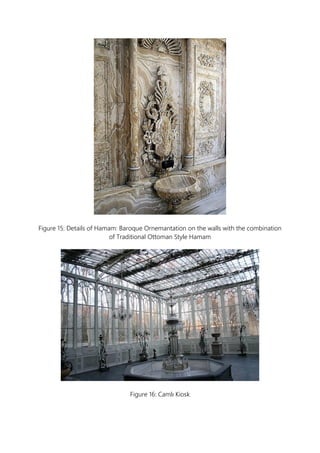
Figure 15: Details of Hamam: Baroque Ornemantation on the walls with the combination
of Traditional Ottoman Style Hamam
Figure 16: Camlı Kiosk
Figure 17: Atatürk’s Room
Figure 18: Gardens of Dolmabahçe (Selamlık)

ADA 264-Assignment 5

  • 1.
    İhsan Doğramacı BilkentUniversity / Faculty of Art, Design and Architecture ADA 264- History of Built Environment II / Section 07 Spring 2017 Lecturer : Kumru Arapgirlioğlu Students : Serra Koz Assignment V Bonus Homework: Late Ottoman and Early Republican Architecture DOLMABAHÇE PALACE by Garabed Balyan
  • 2.
    Dolmabahçe Palace a na l y s i s ID OF HOUSE: NAME, THE ARCHITECT, THE CLIENT, DATES OF THE PROJECT Dolmabahçe Palace has a huge role in the history of Late Ottoman Architecture. The name of Dolmabahçe comes from the ground of the building is stuffed with the soil. (Ekşioğlu, A. pg. 146) The palace is one of the earliest examples of Baroque Architecture and also it is the biggest monoblock palace of Turkey. Garabed Balyan is the designer and main architecture of the Dolmabahçe Palace and as an assistant Ohannes Serveryan, Nikoğos Balyan and James William Smith worked in the construction. (Dolmabahçe Sarayı Brochure, pg. 2). The client of the Dolmabahçe Palace is the 31st sultan of Ottoman Empire, Aldülmecid and The Palace started its construction on June 13, 1843 and its use was opened on 7 June 1856 with the completion of the surrounding walls. (Dolmabahçe Sarayı) After 1856, palace is used by Sultan Abdülmecid (1839-1861), Sultan Abdülaziz, Sultan V. Murad, Sultan II. Abdülhamid, Sultan V. Mehmed Reşad, Sultab VI. Mehmed Vahideddin, Halife Abdülmecid, the first president of Republic of Turkey and father of Turkish Republic: Mustafa Kemal Atatürk, İsmet İnönü consecutively. PLACE, CONTEXT, ARCHITECTURAL LANGUAGE, EXISTING CONDITIONS Dolmabahçe Sarayı is located in İstanbul, next to Bosporus. The context of the palace is urban and has huge gardens, stables, many kiosks and a mosque. However, most of the gardens, stables were destroyed or converted into a stadium or skyscrapers. As a kiosk, Camlı Kiosk has been still using and it is the only place that understand from the exterior of palace. The architectural language of the building is the combination of both Traditional Ottoman Art and Western Architectural styles: Baroque, Rococo and Neo- classicism. However, even though it is a combination of too many styles, it is not eclectic; it is a well-designed example of 19th century Ottoman Architecture. Today, palace is used as museum-palace until 1984 and everyone is invited; however, for the sake of paintings a separate exhibition building, Painting Museum next to Dolmabahçe Palace, has been constructed in order to ensure that the paintings are not damaged
  • 3.
    and in goodcondition. Also, Muayede Salonu is sometimes used for governmental purpose. SPATIAL QUALITIES, MATERIAL, STRUCTURE, CIRCULATION PATTERN, SOURCE OF LIGHT The palace is consisting of 3 different parts. The fisrt one is the Place where the government's administration works “Mabeyn-I Hümayün” (Selamlık), private place of sultan and his family “Harem-I Hümayün”(Harem), and finally a place of feast and important government affairs “Muayede Salonu” (Tören Salonu). There are lots of spaces such as Camlı Köşk, Saat Kulesi but they are not connected with the main building. However, gardens are very important because the shape, form and details of gardens stem from the Italian and France gardens. (Ekşioğlu, A. pg. 168)Each part has unique shape, form and function. For the interior of the palace, Selamlık is the most stony and glamorous, while Harem is simpler and suitable for everyday use. Also, the shape of the Muayede Salonu is very important because dome is defined the space and we can say that it is architectonic since we can understand the Muayede Salonu from the outside. Both Selamlık and Harem consist of “daire” and each has its own main space, subspace in it. In Harem, each “daire” belongs to someone such as Valide Sultan, Sister of Sultan, Kalfa, Veliahd etc. Their circulation path is linear and connected to each other with doors. They are 2 main corridors with opposite direction and each subspace, (private rooms, hamams, restrooms) located around the corridor. The saloons are on the middle of each “daire” and defined by 2 corridors. In Selamlık, the same rules are used; however, the decorations and ornamentations on wall are very well used. They used crystal Baccarat and Bohemia chandeliers, Hereke carpets, Western Style paintings, musical instruments, mostly piano, and sofas in the middle. The materials used in the building are mostly marble and granite and the structure of the building is load-bearing wall system. Also, the roof is covered with lead (Şehsüvaroğlu, H. Y.). The source of light is well used in the building, whether it has very small windows. The palace does not
  • 4.
    have any hugebuilding around it and the material of marble has a property of reflecting the sun-rays. Each main saloon and subspace has windows, even hamams. SIMILARITIES AND DIFFERENCES TO MODERN WESTERN ARCHITECTURAL STYLE: BAROQUE In the Baroque Style, the exterior of the building become very crucial. The charactrstic of Baroque architecture is belongs to monarchic, aristocratic and religious character. In that sense, the idea of Dolmabahçe is similar to Baroque Style since the palace belongs to sultan, and it was the center of the Ottoman Empire. The façade consist of lots of Baroque elements and ornamentation but from the inside we can say that it is not Baroque. Since thefurnitures and decorations belong to the France and Italy, we can say that the interior is more like Neo-Classical but rather than Neo-Classical it is the typical Turkish House. For the Baroque Style we can say that it is not only limit itself with the façade and interiorthe gardens is become a part of design. For that reason the landscape idea was based on a sense of movement. Actually, we can see the movement in the Dolmabahçe Palace since the circulation path, form and elements used in the landscape is a part of movement and directing people. Another important thing from the garden design of the Baroque architecture is the elements in the center, like obelisks. For example the Piazza del Popolo in Rome is one of the best examples of Baroque styles in the sense of central element. Alhough the elements are very small in the Dolmabahçe Palace, the idea of using a main element has to be considered, fountains in the middle of the Harem and Selamlık gardens. Other characteristic of Baroque Style is the dome structures. Since they used domes to define spaces, we shoul consider the dome of Muayede Salonu. The Muayede Salonu is the only place where dome structure is used. Since the style of the Dolmabahçe Palace is taking reference from the Baroque there is no huge difference between Baroque style and Dolmabahçe Palace but we shoul consider the shape and from of the Harem and Selamlık. Since the shape is more like cubical and solid, we can say that the difference of Broque Style and Dolmabahçe might be the form of the structures.
  • 5.
    WORK-CITED Ekşioğlu, A. (2001).Rönesans ve Barok Bahçe Sanatı’nın İstanbul Saraylarındaki Etkileri: Dolmabahçe ve Beylerbeyi Sarayı Örneği (Master Thesis). T.C. Yükseköğretim Kurulu Dökümentasyon Merkezi. (101463). Dolmabahçe Sarayı Brochure. TBMM Milli Saraylar, TBMM Basımevi-Ankara. (Attached) Dolmabahçe Sarayı. (n.d. )TBMM Genel Sekreterliği (Milli Saraylar). Retrived from: www.millisaraylar.gov.tr/portalmain/Palaces.aspx?SarayId=10 Şehsüvaroğlu, H. Y. (1950). Tarihten Sahifeler: Dolmabahçe Sarayı. Kişisel Arşivlerde İstanbul Belleği Taha Toros Arşivi. (TT-581961)
  • 6.
    APPENDIX Figure 1: MapView of Dolmabahçe Palace Figure 2: The billboard of the Dolmabahçe Palace for Trip
  • 7.
    Figure 3: ThePlan of the Dolmabahçe (The reference of this drawing is the Figure 2) Plan of Dolmabahçe Palace. 1) Mosque of the Queen Mother 2) Clock Tower 3) Police Station 4) Treasury Gate 5) Ticket Office 6) Selamlık Garden 7) Selamlık 8) Hediyelik Eşya 9) Muayede Salonu 10) Garden 11) Camlı Kiosk 12) Clock Museum 13) Harem Garden 14) Entrance of Harem 15) Harem Figure 4: Ground Floor Plan, First Floor Plan
  • 8.
    Figure 5: Source:Kumru Aparğirlioğlu’s Lecture Notes about Late Ottoman Architecture, Slide No: 17 Figure 6: Source: Serra Koz Archive-The Façade of Selamlık
  • 9.
    Figure 7: Source:Serra Koz Archive-The Garden of Selamlık (Main Garden) Figure 8: Source: Serra Koz Archive- The Garden of Harem
  • 10.
    Figure 9: Source:Serra Koz Archive, Right Building: Harem from the outside, Left Building: Selamlık from the Outside. The wall between 2 buildings is the connection of the Harem and Selamlık Figure 10: Treasury Gateway
  • 11.
    Figure 11: Detailsof Treasury Gateway Figure 12: Muayede Salonu
  • 12.
    Figure 13: CrystalStairs and Chandelier Figure 14: Blue Saloon
  • 13.
    Figure 15: Detailsof Hamam: Baroque Ornemantation on the walls with the combination of Traditional Ottoman Style Hamam Figure 16: Camlı Kiosk
  • 14.
    Figure 17: Atatürk’sRoom Figure 18: Gardens of Dolmabahçe (Selamlık)