REGENCY ARCHITECTURE
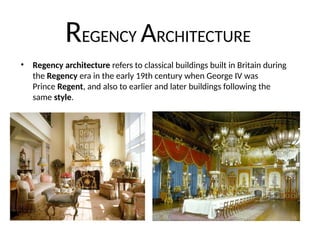
• Regency architecture refers to classical buildings built in Britain during
the Regency era in the early 19th century when George IV was
Prince Regent, and also to earlier and later buildings following the
same style.
REGENCY ARCHITECTURE
 Regency style, decorative arts produced during the regency of George,
prince of Wales, and during his entire reign as King George IV of England,
ending in 1830.
 The major source of inspiration for Regency taste was found in
Greek and Roman antiquity, from which designers borrowed both
structural and ornamental elements.
 The classical revival of Regency style, emphasizing purity of detail and
structure, adhered to a stricter archaeological interpretation of antique
modes
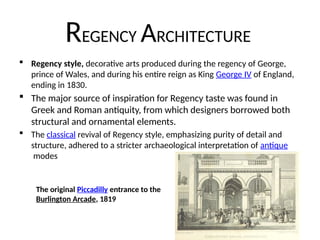
The original Piccadilly entrance to the
Burlington Arcade, 1819
REGENCY ARCHITECTURE
• CHARACTERISTICS
• The period of architecture we can loosely term Regency spans the first
thirty years of the 19th century
• There were two major streams of architectural styles popular in the
Regency period. The first, which lived on far into the Victorian period, was
one of medieval revival. This is often termed Victorian Gothic, or more
accurately,Gothic Revival.
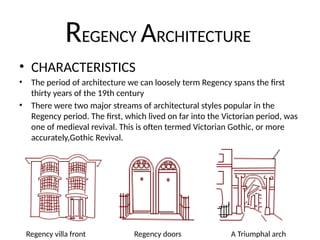
Regency villa front Regency doors A Triumphal arch
REGENCY ARCHITECTURE
• CHARACTERISTICS
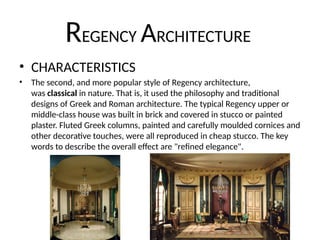
• The second, and more popular style of Regency architecture,
was classical in nature. That is, it used the philosophy and traditional
designs of Greek and Roman architecture. The typical Regency upper or
middle-class house was built in brick and covered in stucco or painted
plaster. Fluted Greek columns, painted and carefully moulded cornices and
other decorative touches, were all reproduced in cheap stucco. The key
words to describe the overall effect are "refined elegance".
REGENCY ARCHITECTURE
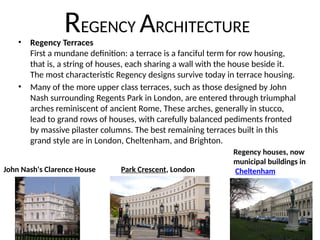
• Regency Terraces
First a mundane definition: a terrace is a fanciful term for row housing,
that is, a string of houses, each sharing a wall with the house beside it.
The most characteristic Regency designs survive today in terrace housing.
• Many of the more upper class terraces, such as those designed by John
Nash surrounding Regents Park in London, are entered through triumphal
arches reminiscent of ancient Rome, These arches, generally in stucco,
lead to grand rows of houses, with carefully balanced pediments fronted
by massive pilaster columns. The best remaining terraces built in this
grand style are in London, Cheltenham, and Brighton.
John Nash's Clarence House Park Crescent, London
Regency houses, now
municipal buildings in
Cheltenham
REGENCY ARCHITECTURE
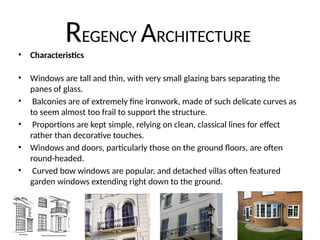
• Characteristics
• Windows are tall and thin, with very small glazing bars separating the
panes of glass.
• Balconies are of extremely fine ironwork, made of such delicate curves as
to seem almost too frail to support the structure.
• Proportions are kept simple, relying on clean, classical lines for effect
rather than decorative touches.
• Windows and doors, particularly those on the ground floors, are often
round-headed.
• Curved bow windows are popular, and detached villas often featured
garden windows extending right down to the ground.
REGENCY ARCHITECTURE
• FURNITURE DESIGN
• Prince George became Regent from 1811-1820 – this was a period
of classical furniture. It was then the fashion to copy actual
furniture of the classical Roman and Greek times.
• Winged Griffins, lions heads, animal legs, Roman Gods: anything
that was popular in ancient Rome, Egypt or Greece. Furniture had
moved from natural evolution to return to Classical form.
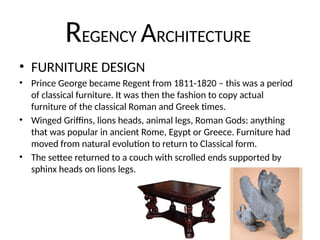
• The settee returned to a couch with scrolled ends supported by
sphinx heads on lions legs.
REGENCY ARCHITECTURE
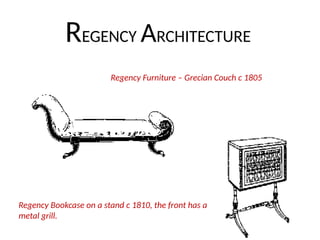
Regency Furniture – Grecian Couch c 1805
Regency Bookcase on a stand c 1810, the front has a
metal grill.
REGENCY ARCHITECTURE
• Features of Regency Furniture
• The addition of brass to wood. Brass inlays were longer lasting than marquetry and
this lead to the revival of French Boulle decorations.
• Sofa Table
• Sabre Leg
• Cable Twist
• Metal Grille
• Commode was replaced by the chiffionier – straight front low cupboard
• Cheaper pieces sometimes painted with black lacquer -revival of japanning
• The current fashion was for decorating walls with paintings which led to lower pieces.
• Tallboys disappeared and bookcases and cabinets became smaller.
• Wide use of metal mounts, lion paw feet, fretted brass grilles cover glass doors,
pierced galleries, supports for shelves.
• Ormolu – imitation gold.
REGENCY ARCHITECTURE
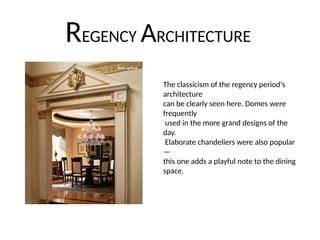
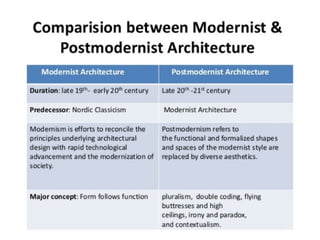
The classicism of the regency period's
architecture
can be clearly seen here. Domes were
frequently
used in the more grand designs of the
day.
Elaborate chandeliers were also popular
—
this one adds a playful note to the dining
space.
REGENCY ARCHITECTURE
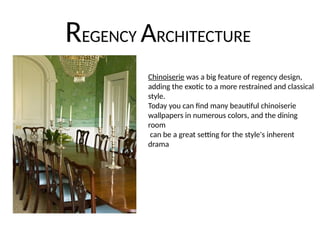
Chinoiserie was a big feature of regency design,
adding the exotic to a more restrained and classical
style.
Today you can find many beautiful chinoiserie
wallpapers in numerous colors, and the dining
room
can be a great setting for the style's inherent
drama
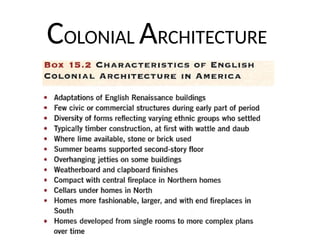
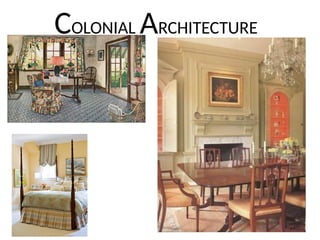
COLONIAL ARCHITECTURE
• Colonial architecture is an architectural style
from a mother country that has been
incorporated into the buildings of settlements
or colonies in distant locations. Colonists
frequently built settlements that synthesized
the architecture of their countries of origin
with the design characteristics of their new
lands, creating hybrid designs.
Colonial-Features 1700-1780
Styles of architecture during America's colonial period, i.e., before the Revolutionary War.
The most prominent style was Georgian because most the colonies were English owned.
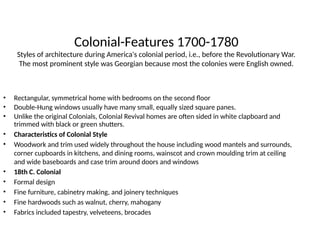
• Rectangular, symmetrical home with bedrooms on the second floor
• Double-Hung windows usually have many small, equally sized square panes.
• Unlike the original Colonials, Colonial Revival homes are often sided in white clapboard and
trimmed with black or green shutters.
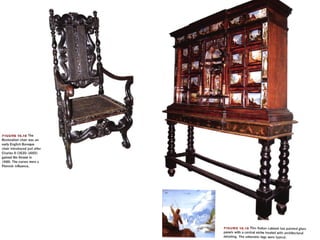
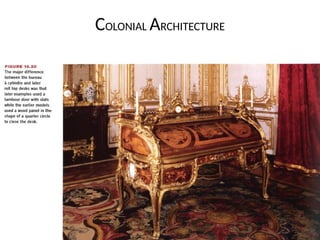
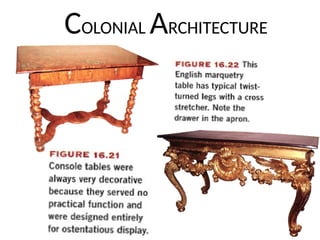
• Characteristics of Colonial Style
• Woodwork and trim used widely throughout the house including wood mantels and surrounds,
corner cupboards in kitchens, and dining rooms, wainscot and crown moulding trim at ceiling
and wide baseboards and case trim around doors and windows
• 18th C. Colonial
• Formal design
• Fine furniture, cabinetry making, and joinery techniques
• Fine hardwoods such as walnut, cherry, mahogany
• Fabrics included tapestry, velveteens, brocades
COLONIAL ARCHITECTURE
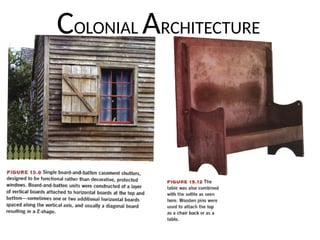
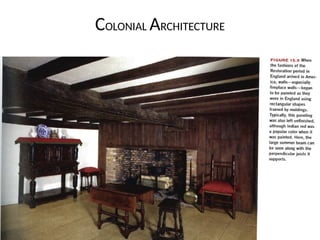
• Characteristics of Colonial Style
• Woodwork and trim used widely throughout the house including wood mantels
and surrounds, corner cupboards in kitchens, and dining rooms, wainscot and
crown moulding trim at ceiling and wide baseboards and case trim around doors
and windows
• 18th C. Colonial
• Formal design
• Fine furniture, cabinetry making, and joinery techniques
• Fine hardwoods such as walnut, cherry, mahogany
• Reinterpretation of classic 18th & early 19th C. artisans such as Chippendale,
Sheridan, and Hepplewhite. Duncan Phyfe was extremely popular.
• Fabrics included tapestry, velveteens, brocades
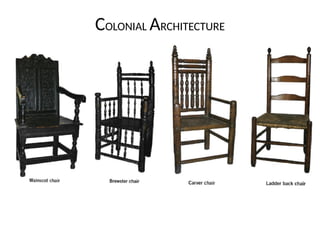
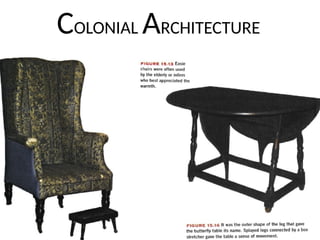
• Early American
• Rustic interpretations of early colonial furnishings
• Mixed woods including knotty pine, maple, hickory, chestnut, and poplar
• Rag, hooked, and braided rugs
• Fabrics were cotton, wool, and linen
• Iron and brass fixtures and lighting
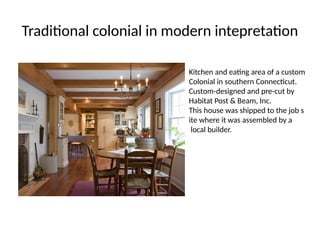
Traditional colonial in modern intepretation
Kitchen and eating area of a custom
Colonial in southern Connecticut.
Custom-designed and pre-cut by
Habitat Post & Beam, Inc.
This house was shipped to the job s
ite where it was assembled by a
local builder.
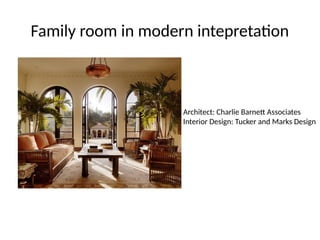
Family room in modern intepretation
Architect: Charlie Barnett Associates
Interior Design: Tucker and Marks Design
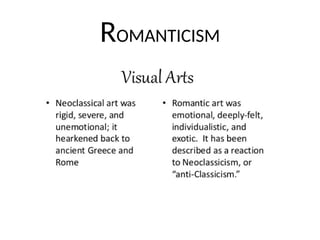
ROMANTICISM 1800 - 1810
• Romanticism is a movement in which the
artist of neo classical period sought to break
New ground in expression of emotion,both
subtle and stormy.it embraced a number of
Distinctive themes,such as longing for history,
Super – natural elements ,social justice and
nature
ROMANTICISM 1800 - 1810
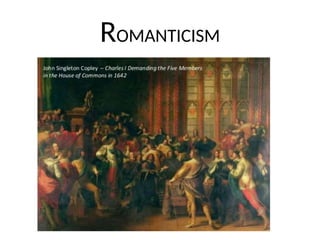
• Romanticism is a reaction to the classical Contemporary nature of neo
classical piece
• Characteristics
• Shows the height of action
• Emotional extremes
• Celebrated nature as out of control
• Dramatic compositions
• Heightened sensation [life and death moments]
ROMANTICISM
ROMANTICISM
ROMANTICISM
ROMANTICISM
ROMANTICISM
ROMANTICISM
ART NOUVEAU
BIRTH OF ART NOUVEAU
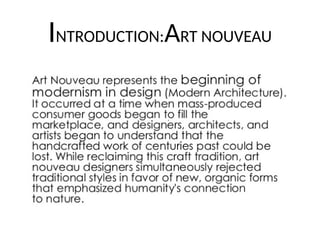
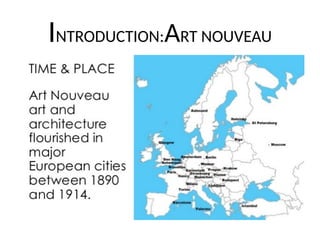
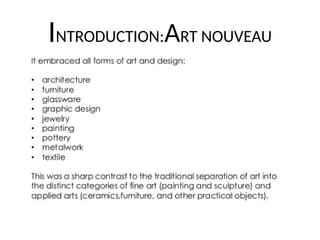
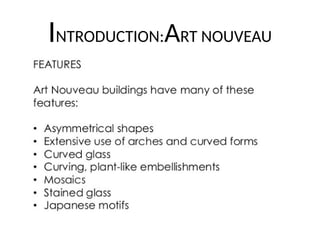
INTRODUCTION:ART NOUVEAU
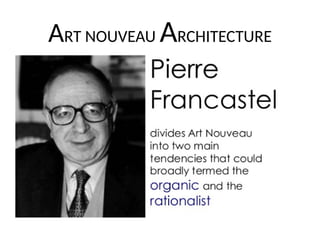
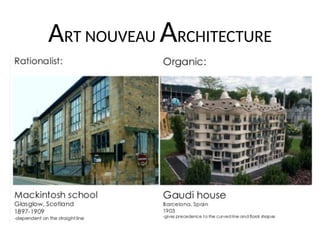
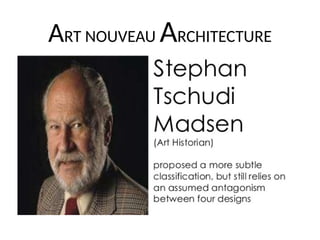
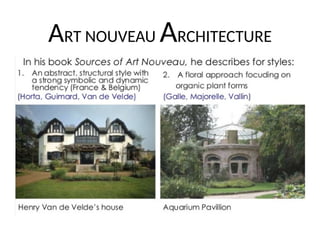
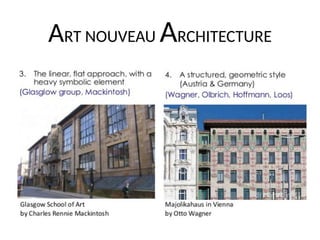
ART NOUVEAU ARCHITECTURE
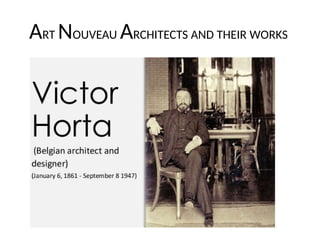
ART NOUVEAU ARCHITECTS AND THEIR WORKS
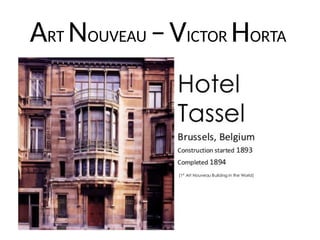
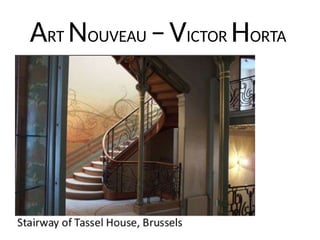
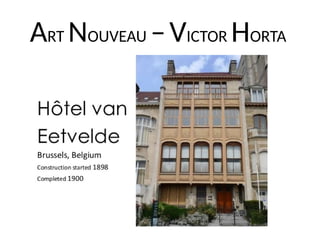
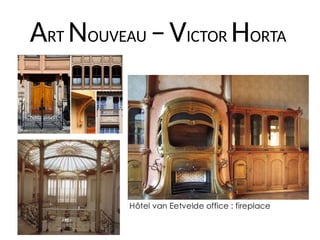
ART NOUVEAU –VICTOR HORTA
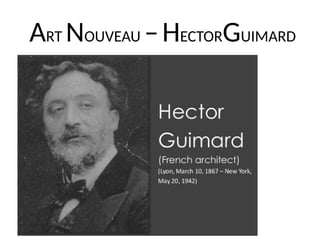
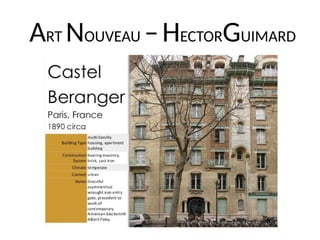
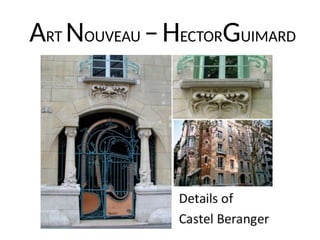
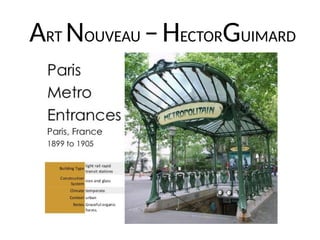
ART NOUVEAU –HECTORGUIMARD
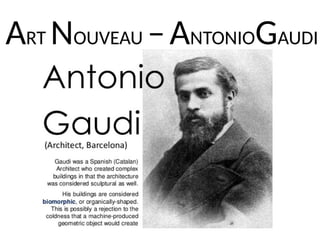
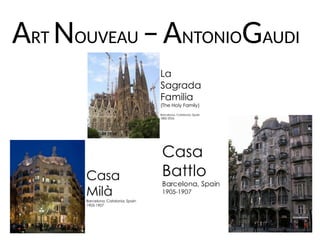
ART NOUVEAU –ANTONIOGAUDI
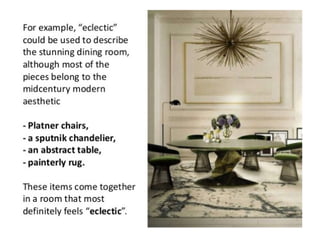
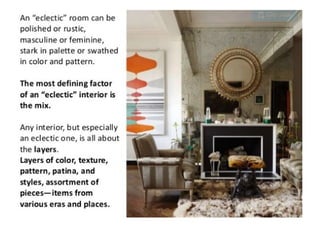
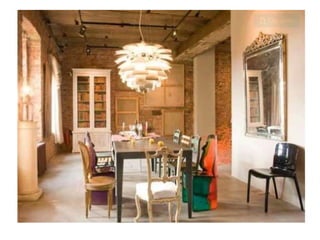
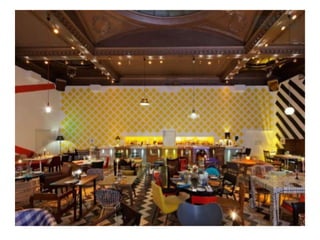
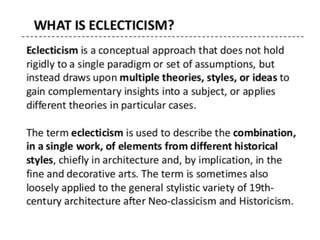
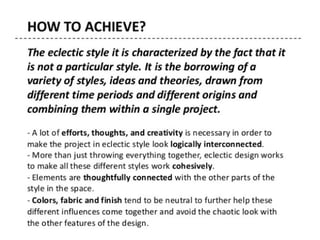
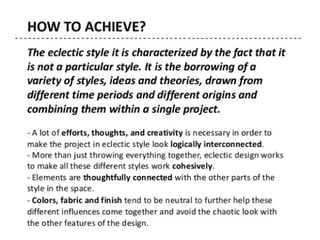
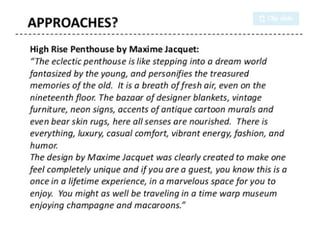
ECLECTICISM
• Eclecticism is a nineteenth and twentieth-
centuryarchitectural style in which a single
piece of work incorporates a mixture of
elements from previous historical styles to
create something that is new and original.
ECLECTICISM
ECLECTICISM
ART DÉCO
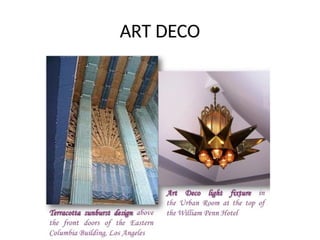
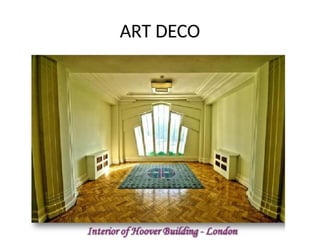
ART DECO
ART DECO
ART DECO
ART DECO
ART DECO
CUBISM
CUBISM
CUBISM
CUBISM
CUBISM
CUBISM
CUBISM
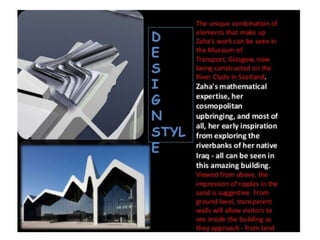
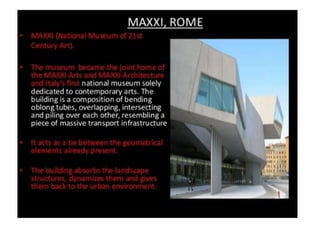
ZAHA HADID DESIGN STYLE
Interior Design Evolution Through History .pptx

Interior Design Evolution Through History .pptx

  • 1.
    REGENCY ARCHITECTURE • Regencyarchitecture refers to classical buildings built in Britain during the Regency era in the early 19th century when George IV was Prince Regent, and also to earlier and later buildings following the same style.
  • 2.
    REGENCY ARCHITECTURE  Regencystyle, decorative arts produced during the regency of George, prince of Wales, and during his entire reign as King George IV of England, ending in 1830.  The major source of inspiration for Regency taste was found in Greek and Roman antiquity, from which designers borrowed both structural and ornamental elements.  The classical revival of Regency style, emphasizing purity of detail and structure, adhered to a stricter archaeological interpretation of antique modes The original Piccadilly entrance to the Burlington Arcade, 1819
  • 3.
    REGENCY ARCHITECTURE • CHARACTERISTICS •The period of architecture we can loosely term Regency spans the first thirty years of the 19th century • There were two major streams of architectural styles popular in the Regency period. The first, which lived on far into the Victorian period, was one of medieval revival. This is often termed Victorian Gothic, or more accurately,Gothic Revival. Regency villa front Regency doors A Triumphal arch
  • 4.
    REGENCY ARCHITECTURE • CHARACTERISTICS •The second, and more popular style of Regency architecture, was classical in nature. That is, it used the philosophy and traditional designs of Greek and Roman architecture. The typical Regency upper or middle-class house was built in brick and covered in stucco or painted plaster. Fluted Greek columns, painted and carefully moulded cornices and other decorative touches, were all reproduced in cheap stucco. The key words to describe the overall effect are "refined elegance".
  • 5.
    REGENCY ARCHITECTURE • RegencyTerraces First a mundane definition: a terrace is a fanciful term for row housing, that is, a string of houses, each sharing a wall with the house beside it. The most characteristic Regency designs survive today in terrace housing. • Many of the more upper class terraces, such as those designed by John Nash surrounding Regents Park in London, are entered through triumphal arches reminiscent of ancient Rome, These arches, generally in stucco, lead to grand rows of houses, with carefully balanced pediments fronted by massive pilaster columns. The best remaining terraces built in this grand style are in London, Cheltenham, and Brighton. John Nash's Clarence House Park Crescent, London Regency houses, now municipal buildings in Cheltenham
  • 6.
    REGENCY ARCHITECTURE • Characteristics •Windows are tall and thin, with very small glazing bars separating the panes of glass. • Balconies are of extremely fine ironwork, made of such delicate curves as to seem almost too frail to support the structure. • Proportions are kept simple, relying on clean, classical lines for effect rather than decorative touches. • Windows and doors, particularly those on the ground floors, are often round-headed. • Curved bow windows are popular, and detached villas often featured garden windows extending right down to the ground.
  • 7.
    REGENCY ARCHITECTURE • FURNITUREDESIGN • Prince George became Regent from 1811-1820 – this was a period of classical furniture. It was then the fashion to copy actual furniture of the classical Roman and Greek times. • Winged Griffins, lions heads, animal legs, Roman Gods: anything that was popular in ancient Rome, Egypt or Greece. Furniture had moved from natural evolution to return to Classical form. • The settee returned to a couch with scrolled ends supported by sphinx heads on lions legs.
  • 8.
    REGENCY ARCHITECTURE Regency Furniture– Grecian Couch c 1805 Regency Bookcase on a stand c 1810, the front has a metal grill.
  • 9.
    REGENCY ARCHITECTURE • Featuresof Regency Furniture • The addition of brass to wood. Brass inlays were longer lasting than marquetry and this lead to the revival of French Boulle decorations. • Sofa Table • Sabre Leg • Cable Twist • Metal Grille • Commode was replaced by the chiffionier – straight front low cupboard • Cheaper pieces sometimes painted with black lacquer -revival of japanning • The current fashion was for decorating walls with paintings which led to lower pieces. • Tallboys disappeared and bookcases and cabinets became smaller. • Wide use of metal mounts, lion paw feet, fretted brass grilles cover glass doors, pierced galleries, supports for shelves. • Ormolu – imitation gold.
  • 10.
    REGENCY ARCHITECTURE The classicismof the regency period's architecture can be clearly seen here. Domes were frequently used in the more grand designs of the day. Elaborate chandeliers were also popular — this one adds a playful note to the dining space.
  • 11.
    REGENCY ARCHITECTURE Chinoiserie wasa big feature of regency design, adding the exotic to a more restrained and classical style. Today you can find many beautiful chinoiserie wallpapers in numerous colors, and the dining room can be a great setting for the style's inherent drama
  • 12.
    COLONIAL ARCHITECTURE • Colonialarchitecture is an architectural style from a mother country that has been incorporated into the buildings of settlements or colonies in distant locations. Colonists frequently built settlements that synthesized the architecture of their countries of origin with the design characteristics of their new lands, creating hybrid designs.
  • 13.
    Colonial-Features 1700-1780 Styles ofarchitecture during America's colonial period, i.e., before the Revolutionary War. The most prominent style was Georgian because most the colonies were English owned. • Rectangular, symmetrical home with bedrooms on the second floor • Double-Hung windows usually have many small, equally sized square panes. • Unlike the original Colonials, Colonial Revival homes are often sided in white clapboard and trimmed with black or green shutters. • Characteristics of Colonial Style • Woodwork and trim used widely throughout the house including wood mantels and surrounds, corner cupboards in kitchens, and dining rooms, wainscot and crown moulding trim at ceiling and wide baseboards and case trim around doors and windows • 18th C. Colonial • Formal design • Fine furniture, cabinetry making, and joinery techniques • Fine hardwoods such as walnut, cherry, mahogany • Fabrics included tapestry, velveteens, brocades
  • 14.
  • 15.
  • 16.
  • 17.
  • 18.
  • 19.
  • 22.
  • 23.
  • 24.
    COLONIAL ARCHITECTURE • Characteristicsof Colonial Style • Woodwork and trim used widely throughout the house including wood mantels and surrounds, corner cupboards in kitchens, and dining rooms, wainscot and crown moulding trim at ceiling and wide baseboards and case trim around doors and windows • 18th C. Colonial • Formal design • Fine furniture, cabinetry making, and joinery techniques • Fine hardwoods such as walnut, cherry, mahogany • Reinterpretation of classic 18th & early 19th C. artisans such as Chippendale, Sheridan, and Hepplewhite. Duncan Phyfe was extremely popular. • Fabrics included tapestry, velveteens, brocades • Early American • Rustic interpretations of early colonial furnishings • Mixed woods including knotty pine, maple, hickory, chestnut, and poplar • Rag, hooked, and braided rugs • Fabrics were cotton, wool, and linen • Iron and brass fixtures and lighting
  • 25.
    Traditional colonial inmodern intepretation Kitchen and eating area of a custom Colonial in southern Connecticut. Custom-designed and pre-cut by Habitat Post & Beam, Inc. This house was shipped to the job s ite where it was assembled by a local builder.
  • 26.
    Family room inmodern intepretation Architect: Charlie Barnett Associates Interior Design: Tucker and Marks Design
  • 27.
    ROMANTICISM 1800 -1810 • Romanticism is a movement in which the artist of neo classical period sought to break New ground in expression of emotion,both subtle and stormy.it embraced a number of Distinctive themes,such as longing for history, Super – natural elements ,social justice and nature
  • 28.
    ROMANTICISM 1800 -1810 • Romanticism is a reaction to the classical Contemporary nature of neo classical piece • Characteristics • Shows the height of action • Emotional extremes • Celebrated nature as out of control • Dramatic compositions • Heightened sensation [life and death moments]
  • 29.
  • 30.
  • 31.
  • 32.
  • 33.
  • 34.
  • 35.
  • 36.
    BIRTH OF ARTNOUVEAU
  • 37.
  • 38.
  • 39.
  • 40.
  • 41.
  • 42.
  • 43.
  • 44.
  • 45.
  • 46.
  • 47.
  • 48.
  • 49.
    ART NOUVEAU ARCHITECTSAND THEIR WORKS
  • 50.
  • 51.
  • 52.
  • 53.
  • 54.
  • 55.
  • 56.
  • 57.
  • 58.
  • 59.
  • 60.
    ECLECTICISM • Eclecticism isa nineteenth and twentieth- centuryarchitectural style in which a single piece of work incorporates a mixture of elements from previous historical styles to create something that is new and original.
  • 61.
  • 62.
  • 73.
  • 74.
  • 75.
  • 76.
  • 77.
  • 78.
  • 81.
  • 82.
  • 83.
  • 84.
  • 85.
  • 86.
  • 87.
  • 106.