Koz 1
INTERNATIONAL BACCALAUREATE
PHYSICS LAB REPORT
SPAGETTHIE BRIDGE
003067-0004
Candidate: Serra Koz
Supervisor: --
May 2014
Koz 2
BACKGROUND INFORMATION
Two basic ingredients of mechanics are the concepts of a mass and force. A force can deform,
stretch, rotate or compress a body and is intimately connected to the acceleration it can
produce on a body. (Tsokos, 2009)
An applied force is a force that is applied to an object by a person or another object. If a
person is pushing a desk across the room, then there is an applied force acting upon the object.
The applied force is the force exerted on the desk by the person. (Newton’s Laws-Lesson 2:
Types of Forces, no date)
The simplest experimental method for measuring the size of a force is to use the extension of
a spring. When a spring is in tension it increases in the length. The difference between the
natural length and stretched length is called the extension of a spring. (Kirk, 2007)
In this experiment the applied force measured by the dynamometer and it acts on the
spaghettis in the platform. The applied force measured by the length of the dynamometer and
it is change according to the amount of spaghettis.
AIM: The intent of this experiment is to investigate the relationship between number of
spaghettis and applied force for breaking on it.
RESEARCH QUESTION: How does the amount of spaghetti effect the applied force for
breaking at the room temperature, distance of the platform (20 cm), same type of spaghettis,
at the same diameter of the spaghettis and friction force of the platform?
HYPOTHESIS: If the number of spaghettis increase, then the strength of the spaghettis
increases. Thus, the applied force for breaking increases.
Koz 3
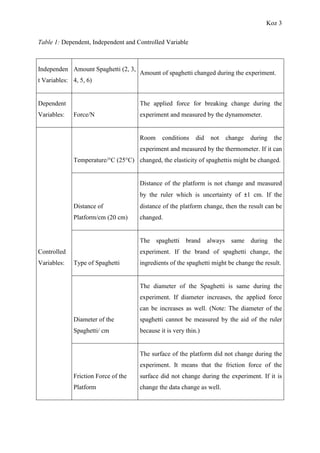
Table 1: Dependent, Independent and Controlled Variable
Independen
t Variables:
Amount Spaghetti (2, 3,
4, 5, 6)
Amount of spaghetti changed during the experiment.
Dependent
Variables: Force/N
The applied force for breaking change during the
experiment and measured by the dynamometer.
Temperature/°C (25°C)
Room conditions did not change during the
experiment and measured by the thermometer. If it can
changed, the elasticity of spaghettis might be changed.
Distance of
Platform/cm (20 cm)
Distance of the platform is not change and measured
by the ruler which is uncertainty of ±1 cm. If the
distance of the platform change, then the result can be
changed.
Controlled
Variables: Type of Spaghetti
The spaghetti brand always same during the
experiment. If the brand of spaghetti change, the
ingredients of the spaghetti might be change the result.
Diameter of the
Spaghetti/ cm
The diameter of the Spaghetti is same during the
experiment. If diameter increases, the applied force
can be increases as well. (Note: The diameter of the
spaghetti cannot be measured by the aid of the ruler
because it is very thin.)
Friction Force of the
Platform
The surface of the platform did not change during the
experiment. It means that the friction force of the
surface did not change during the experiment. If it is
change the data change as well.
Koz 4
MATERIALS
 Spaghetti (x20)
 Dynamometer (±0.1)
 Ruler (±0.05)
 Platform
 Band
 Chronometer (±0.1)
 Slow Motion Camera
PROCEDURE
i. The platform space was measured 20 cm.
ii. Groups that consist of 2, 3, 4, 5, and 6 of spaghettis were taken.
iii. 2 spaghettis in the platform were put.
iv. The dynamometer in the middle of the spaghettis was placed as shown in the Figure 2.
v. Camera was started to record and was pulled the dynamometer up.
vi. When the spaghettis were broken down, camera was stopped.
vii. Dynamometer breaking point was recorded.
viii. The process of iii, iv, v, vi, vii was repeated for the 3, 4, 5 and 6 spaghettis.
ix. Experiment was repeated for 4 more times.
Figure 2
Figure 1
Koz 5
PRESENTATION OF DATA METHOD
The data can be shown by the table and graph. Raw data include 5 of the trials and uncertainty
of the dynamometer (±0.1). According to the raw data table, take the avarage of the trials and
make a processing data table. Sketch a best fit line graph according to the processing data
table.
DATA COLLECTION & PROCESSING
Quantitative Data:
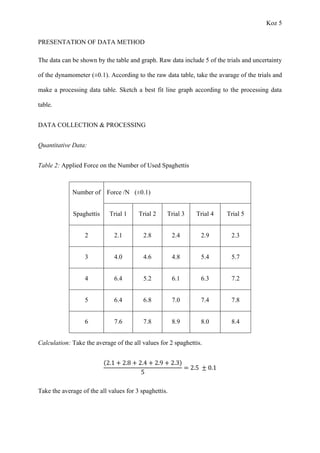
Table 2: Applied Force on the Number of Used Spaghettis
Number of Force /N (±0.1)
Spaghettis Trial 1 Trial 2 Trial 3 Trial 4 Trial 5
2 2.1 2.8 2.4 2.9 2.3
3 4.0 4.6 4.8 5.4 5.7
4 6.4 5.2 6.1 6.3 7.2
5 6.4 6.8 7.0 7.4 7.8
6 7.6 7.8 8.9 8.0 8.4
Calculation: Take the average of the all values for 2 spaghettis.
(2.1 + 2.8 + 2.4 + 2.9 + 2.3)
5
= 2.5 ± 0.1
Take the average of the all values for 3 spaghettis.
Koz 6
(4.0 + 4.6 + 4.8 + 5.4 + 5.7)
5
= 4.9 ± 0.1
Take the average of the all values for 4 spaghettis.
(6.4 + 5.2 + 6.1 + 6.3 + 7.2)
5
= 6.2 ± 0.1
Take the average of the all values for 5 spaghettis.
(6.4 + 6.8 + 7.0 + 7.4 + 7.8)
5
= 7.1 ± 0.1
Take the average of the all values for 6 spaghettis.
(7.6 + 7.8 + 8.9 + 8.0 + 8.4)
5
= 8.1 ± 0.1
Table 3: Average Applied Force on the Spaghettis
Number of Average
Percentage
Spaghettis Force/N (±0.1) Uncertainty
2 2.5 4.0 %
3 4.9 2.0 %
4 6.2 1.6 %
5 7.1 1.4 %
6 8.1 0.2 %
Koz 7
Uncertainty Calculation: For the 2 spaghettis:
𝑈𝑛𝑐𝑒𝑟𝑡𝑎𝑖𝑛𝑡𝑦
𝑀𝑒𝑎𝑛
× 100 =
0.1
2.5
× 100 = 4.0
Repeat the operation for all values.
Graph 1: Number of Spaghettis vs. Applied Force
The error bars in the vertical line is measured by the uncertainty of the dynamometer which is
0.1. The error bars in the horizontal line is percentage uncertainty but Graph 1 did not show
it.
y = 1,34x + 1,74
R² = 0,9535
0,0
1,0
2,0
3,0
4,0
5,0
6,0
7,0
8,0
9,0
0 1 2 3 4 5 6 7
AppliedForce/N(±0.1)
Number of Spaghetties
Koz 8
Qualitative Data:
1. There is no color change during the experiment.
2. There is no temperature change during the experiment.
3. There is no observation result, thus all data calculated by the quantitative data as
shown in the tables and graph below.
CONCLUSION
This experiment investigates the relationship between the number of spaghettis and applied
force for breaking. As hypothesis refers to if the amount of spaghettis increases, the applied
force for breaking will also increases.
The groups that has 2, 3, 4, 5 and 6 spaghettis placed the platform. The dynamometer placed
at the middle of the spaghettis and slow motion camera started to record. When the spaghettis
broke down, the dynamometer breaking point recorded. Consequently, the data is as follows:
According to Table 2, the applied force for breaking effected by the number of spaghettis. For
the number of 2 spaghettis, the applied force for breaking is 2.1, 2.8, 2.4, 2.9 and 2.3. For the
number of 3 spaghettis, the applied force for breaking is 4.0, 4.6, 4.8, 5.4 and 5.7. For the
number of 4 spaghettis, the applied force for breaking is 6.4, 5.2, 6.1, 6.3 and 7.2. For the
number of 5 spaghettis, the applied force for breaking is 6.4, 6.8, 7.0, 7.4 and 7.8. For the
number of 6 spaghettis, the applied force for breaking is 7.6, 7.8, 8.9, 8.0 and 8.4. The average
of the force is 2.5, 4.9, 6.2, 7.1 and 8.1 respectively and all data percentage uncertainties are
calculated as shown in the Table 3.
The anomalous data of this experiment are 4.0 where it is in the 1st
trial of the 3 spaghettis,
5.2 where it is in the 2nd
trial of the 4 spaghettis and 8.9 where it is in the 3rd
trial of the 6
spaghettis. Other data closed to each other.
Koz 9
According to the observations (qualitative data), Table 2, Table 3 and Graph 1 relationship
between applied force for the breaking and number of spaghettis is directly proportional with
each other. Thus, results support the hypothesis and the experiment results are reliable.
Table 4: Limitations and Improvements
LIMITATIONS IMPROVEMENTS
The weight of spaghettis is not same, thus it
effects the strength of the spaghettis.
If the experiment had seen further repetition,
more appropriate results would have been at
hand.
The radius of the spaghettis is not measured.
The type of spaghettis can be chose thick and
diameter can be measured by the ruler.
REFERANCES
Kirk, Tim. IB Study Guides Physics for the IB Diploma Standard and Higher Level. Great
Clarendon Street, Oxford University Press, 2007.
“Newton’s Laws-Lesson 2: Types of Forces” (15 December 2013) No city of Publication,
Retrieved from: <http://www.physicsclassroom.com/class/newtlaws/u2l2b.cfm#Top>
Tsokos, K. A. (2009) Physics for the IB Diploma. The Edinburgh Building, Cambridge
University Press.

Physics Lab Report 1

  • 1.
    Koz 1 INTERNATIONAL BACCALAUREATE PHYSICSLAB REPORT SPAGETTHIE BRIDGE 003067-0004 Candidate: Serra Koz Supervisor: -- May 2014
  • 2.
    Koz 2 BACKGROUND INFORMATION Twobasic ingredients of mechanics are the concepts of a mass and force. A force can deform, stretch, rotate or compress a body and is intimately connected to the acceleration it can produce on a body. (Tsokos, 2009) An applied force is a force that is applied to an object by a person or another object. If a person is pushing a desk across the room, then there is an applied force acting upon the object. The applied force is the force exerted on the desk by the person. (Newton’s Laws-Lesson 2: Types of Forces, no date) The simplest experimental method for measuring the size of a force is to use the extension of a spring. When a spring is in tension it increases in the length. The difference between the natural length and stretched length is called the extension of a spring. (Kirk, 2007) In this experiment the applied force measured by the dynamometer and it acts on the spaghettis in the platform. The applied force measured by the length of the dynamometer and it is change according to the amount of spaghettis. AIM: The intent of this experiment is to investigate the relationship between number of spaghettis and applied force for breaking on it. RESEARCH QUESTION: How does the amount of spaghetti effect the applied force for breaking at the room temperature, distance of the platform (20 cm), same type of spaghettis, at the same diameter of the spaghettis and friction force of the platform? HYPOTHESIS: If the number of spaghettis increase, then the strength of the spaghettis increases. Thus, the applied force for breaking increases.
  • 3.
    Koz 3 Table 1:Dependent, Independent and Controlled Variable Independen t Variables: Amount Spaghetti (2, 3, 4, 5, 6) Amount of spaghetti changed during the experiment. Dependent Variables: Force/N The applied force for breaking change during the experiment and measured by the dynamometer. Temperature/°C (25°C) Room conditions did not change during the experiment and measured by the thermometer. If it can changed, the elasticity of spaghettis might be changed. Distance of Platform/cm (20 cm) Distance of the platform is not change and measured by the ruler which is uncertainty of ±1 cm. If the distance of the platform change, then the result can be changed. Controlled Variables: Type of Spaghetti The spaghetti brand always same during the experiment. If the brand of spaghetti change, the ingredients of the spaghetti might be change the result. Diameter of the Spaghetti/ cm The diameter of the Spaghetti is same during the experiment. If diameter increases, the applied force can be increases as well. (Note: The diameter of the spaghetti cannot be measured by the aid of the ruler because it is very thin.) Friction Force of the Platform The surface of the platform did not change during the experiment. It means that the friction force of the surface did not change during the experiment. If it is change the data change as well.
  • 4.
    Koz 4 MATERIALS  Spaghetti(x20)  Dynamometer (±0.1)  Ruler (±0.05)  Platform  Band  Chronometer (±0.1)  Slow Motion Camera PROCEDURE i. The platform space was measured 20 cm. ii. Groups that consist of 2, 3, 4, 5, and 6 of spaghettis were taken. iii. 2 spaghettis in the platform were put. iv. The dynamometer in the middle of the spaghettis was placed as shown in the Figure 2. v. Camera was started to record and was pulled the dynamometer up. vi. When the spaghettis were broken down, camera was stopped. vii. Dynamometer breaking point was recorded. viii. The process of iii, iv, v, vi, vii was repeated for the 3, 4, 5 and 6 spaghettis. ix. Experiment was repeated for 4 more times. Figure 2 Figure 1
  • 5.
    Koz 5 PRESENTATION OFDATA METHOD The data can be shown by the table and graph. Raw data include 5 of the trials and uncertainty of the dynamometer (±0.1). According to the raw data table, take the avarage of the trials and make a processing data table. Sketch a best fit line graph according to the processing data table. DATA COLLECTION & PROCESSING Quantitative Data: Table 2: Applied Force on the Number of Used Spaghettis Number of Force /N (±0.1) Spaghettis Trial 1 Trial 2 Trial 3 Trial 4 Trial 5 2 2.1 2.8 2.4 2.9 2.3 3 4.0 4.6 4.8 5.4 5.7 4 6.4 5.2 6.1 6.3 7.2 5 6.4 6.8 7.0 7.4 7.8 6 7.6 7.8 8.9 8.0 8.4 Calculation: Take the average of the all values for 2 spaghettis. (2.1 + 2.8 + 2.4 + 2.9 + 2.3) 5 = 2.5 ± 0.1 Take the average of the all values for 3 spaghettis.
  • 6.
    Koz 6 (4.0 +4.6 + 4.8 + 5.4 + 5.7) 5 = 4.9 ± 0.1 Take the average of the all values for 4 spaghettis. (6.4 + 5.2 + 6.1 + 6.3 + 7.2) 5 = 6.2 ± 0.1 Take the average of the all values for 5 spaghettis. (6.4 + 6.8 + 7.0 + 7.4 + 7.8) 5 = 7.1 ± 0.1 Take the average of the all values for 6 spaghettis. (7.6 + 7.8 + 8.9 + 8.0 + 8.4) 5 = 8.1 ± 0.1 Table 3: Average Applied Force on the Spaghettis Number of Average Percentage Spaghettis Force/N (±0.1) Uncertainty 2 2.5 4.0 % 3 4.9 2.0 % 4 6.2 1.6 % 5 7.1 1.4 % 6 8.1 0.2 %
  • 7.
    Koz 7 Uncertainty Calculation:For the 2 spaghettis: 𝑈𝑛𝑐𝑒𝑟𝑡𝑎𝑖𝑛𝑡𝑦 𝑀𝑒𝑎𝑛 × 100 = 0.1 2.5 × 100 = 4.0 Repeat the operation for all values. Graph 1: Number of Spaghettis vs. Applied Force The error bars in the vertical line is measured by the uncertainty of the dynamometer which is 0.1. The error bars in the horizontal line is percentage uncertainty but Graph 1 did not show it. y = 1,34x + 1,74 R² = 0,9535 0,0 1,0 2,0 3,0 4,0 5,0 6,0 7,0 8,0 9,0 0 1 2 3 4 5 6 7 AppliedForce/N(±0.1) Number of Spaghetties
  • 8.
    Koz 8 Qualitative Data: 1.There is no color change during the experiment. 2. There is no temperature change during the experiment. 3. There is no observation result, thus all data calculated by the quantitative data as shown in the tables and graph below. CONCLUSION This experiment investigates the relationship between the number of spaghettis and applied force for breaking. As hypothesis refers to if the amount of spaghettis increases, the applied force for breaking will also increases. The groups that has 2, 3, 4, 5 and 6 spaghettis placed the platform. The dynamometer placed at the middle of the spaghettis and slow motion camera started to record. When the spaghettis broke down, the dynamometer breaking point recorded. Consequently, the data is as follows: According to Table 2, the applied force for breaking effected by the number of spaghettis. For the number of 2 spaghettis, the applied force for breaking is 2.1, 2.8, 2.4, 2.9 and 2.3. For the number of 3 spaghettis, the applied force for breaking is 4.0, 4.6, 4.8, 5.4 and 5.7. For the number of 4 spaghettis, the applied force for breaking is 6.4, 5.2, 6.1, 6.3 and 7.2. For the number of 5 spaghettis, the applied force for breaking is 6.4, 6.8, 7.0, 7.4 and 7.8. For the number of 6 spaghettis, the applied force for breaking is 7.6, 7.8, 8.9, 8.0 and 8.4. The average of the force is 2.5, 4.9, 6.2, 7.1 and 8.1 respectively and all data percentage uncertainties are calculated as shown in the Table 3. The anomalous data of this experiment are 4.0 where it is in the 1st trial of the 3 spaghettis, 5.2 where it is in the 2nd trial of the 4 spaghettis and 8.9 where it is in the 3rd trial of the 6 spaghettis. Other data closed to each other.
  • 9.
    Koz 9 According tothe observations (qualitative data), Table 2, Table 3 and Graph 1 relationship between applied force for the breaking and number of spaghettis is directly proportional with each other. Thus, results support the hypothesis and the experiment results are reliable. Table 4: Limitations and Improvements LIMITATIONS IMPROVEMENTS The weight of spaghettis is not same, thus it effects the strength of the spaghettis. If the experiment had seen further repetition, more appropriate results would have been at hand. The radius of the spaghettis is not measured. The type of spaghettis can be chose thick and diameter can be measured by the ruler. REFERANCES Kirk, Tim. IB Study Guides Physics for the IB Diploma Standard and Higher Level. Great Clarendon Street, Oxford University Press, 2007. “Newton’s Laws-Lesson 2: Types of Forces” (15 December 2013) No city of Publication, Retrieved from: <http://www.physicsclassroom.com/class/newtlaws/u2l2b.cfm#Top> Tsokos, K. A. (2009) Physics for the IB Diploma. The Edinburgh Building, Cambridge University Press.