Koz 1
INTERNATIONAL BACCALAUREATE
PHYSICS LAB REPORT
DOMINOES EFFECTS
Candidate: Serra Koz
Supervisor: ---
May 2014
Koz 2
BACKGROUND INFORMATION
Domino effect normally refers to how an action causes a similar action to occur. This second
reaction will trigger the next reaction and this will continue in a sequence until the last
possible action has been triggered.
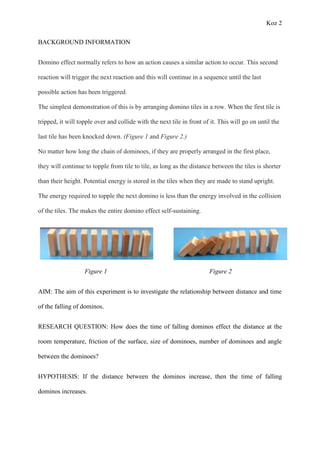
The simplest demonstration of this is by arranging domino tiles in a row. When the first tile is
tripped, it will topple over and collide with the next tile in front of it. This will go on until the
last tile has been knocked down. (Figure 1 and Figure 2.)
No matter how long the chain of dominoes, if they are properly arranged in the first place,
they will continue to topple from tile to tile, as long as the distance between the tiles is shorter
than their height. Potential energy is stored in the tiles when they are made to stand upright.
The energy required to topple the next domino is less than the energy involved in the collision
of the tiles. The makes the entire domino effect self-sustaining.
Figure 1 Figure 2
AIM: The aim of this experiment is to investigate the relationship between distance and time
of the falling of dominos.
RESEARCH QUESTION: How does the time of falling dominos effect the distance at the
room temperature, friction of the surface, size of dominoes, number of dominoes and angle
between the dominoes?
HYPOTHESIS: If the distance between the dominos increase, then the time of falling
dominos increases.
Koz 3
Table 1: Dependent, Independent and Control Variables
Independent
Variables: Time/s
Falling time of the dominoes changed according to
the distance between the dominoes measured by
the chronometer.
Dependent
Variables:
Distance between the
Dominoes/cm (2, 3, 4,5
and 6 cm)
Distance between dominos changed during the
experiment.
Room Temperature/°C
(25°C)
Room temperature is same during the experiment
and measured by the temperature.
Friction
Friction of the surface did not changed. The
friction of the surface affected by the time of the
reaction. Thus, the surface have to the same during
the experiment.
Controlled
Variables:
Size of the Dominoes/
cm
Dominoes are same during the experiment and did
not change. Each size of dominoes can be different
from each other and it is caused the time
difference.
Angle Between the
Dominoes/° (180°)
The angle between dominoes are 180° and
measured by the protractor. If the angle between
the dominos are different from each other, reaction
time can be change.
Number of Dominoes
Number of the dominoes for this experiment is 10
and did not change during the experiment. If the
number of dominoes that are used in the
experiment change, time of the reaction can be
increases or decreases.
MATERIALS
Koz 4
 Dominos (x10)
 Ruler (±0.5)
 Chronometer (±0.005)
 Camera
 Cartoon
PROCEDURE
i. The numbers on the dominos were written.
ii. Measure the wide of the dominos was measured and records are taken.
iii. Diagram on the cartoon was sketched according to the wide of the dominos and the
distance 1 cm was measured.
iv. The dominos onto the diagram was placed as shown in the Figure 3.
v. The video was started.
vi. The dominos was placed as shown in the Figure 4.
vii. The record of the time taken was observed and recorded.
viii. The experiment for the 2, 3, 4 and 5 cm was repeated.
ix. The experiment was repeated for 4 more times.
Figure 3
Figure 4
PRESENTATION OF DATA METHOD
Koz 5
The data can be shown by the table and graph. Raw data include 5 of the trials and uncertainty
of the ruler (±0.5) and uncertanity of chronometer (±0.005). According to the raw data table,
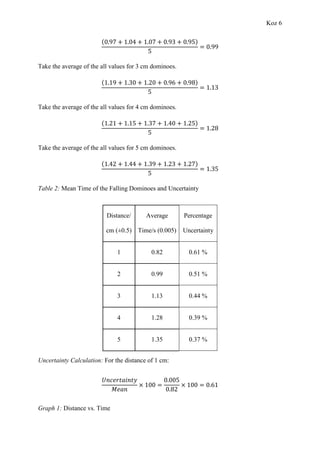
take the avarage of the trials and make a processing data table. Sketch a best fit line graph
according to the processing data table.
DATA COLLECTION & PROCESSING
Quantitative Data:
Table 2: Time Duration of Falling of Dominoes and Distance
Distance/ Time /s (±0.005)
cm (±0.5) Trial 1 Trial 2 Trial 3 Trial 4 Trial 5
1 0.70 0.96 0.82 0.79 0.84
2 0.97 1.04 1.07 0.93 0.95
3 1.19 1.30 1.20 0.96 0.98
4 1.21 1.15 1.37 1.40 1.25
5 1.42 1.44 1.39 1.23 1.27
Calculation: Take the average of the all values for 1 cm dominoes.
(0.70 + 0.96 + 0.82 + 0.79 + 0.84)
5
= 0.82
Take the average of the all values for 2 cm dominoes.
Koz 6
(0.97 + 1.04 + 1.07 + 0.93 + 0.95)
5
= 0.99
Take the average of the all values for 3 cm dominoes.
(1.19 + 1.30 + 1.20 + 0.96 + 0.98)
5
= 1.13
Take the average of the all values for 4 cm dominoes.
(1.21 + 1.15 + 1.37 + 1.40 + 1.25)
5
= 1.28
Take the average of the all values for 5 cm dominoes.
(1.42 + 1.44 + 1.39 + 1.23 + 1.27)
5
= 1.35
Table 2: Mean Time of the Falling Dominoes and Uncertainty
Distance/ Average Percentage
cm (±0.5) Time/s (0.005) Uncertainty
1 0.82 0.61 %
2 0.99 0.51 %
3 1.13 0.44 %
4 1.28 0.39 %
5 1.35 0.37 %
Uncertainty Calculation: For the distance of 1 cm:
𝑈𝑛𝑐𝑒𝑟𝑡𝑎𝑖𝑛𝑡𝑦
𝑀𝑒𝑎𝑛
× 100 =
0.005
0.82
× 100 = 0.61
Graph 1: Distance vs. Time
Koz 7
The error bars in the vertical line is measured by the uncertainty of the chronometer which is
0.005. The error bars in the horizontal line is measured by the uncertainty of ruler which is
0.5.
Qualitative Data:
1. There are no color change and temperature change during the experiment.
2. There is no observation result, thus all data calculated by the quantitative data as
shown in the tables and graph below.
CONCLUSION
y = 0,135x + 0,709
R² = 0,9834
0
0,2
0,4
0,6
0,8
1
1,2
1,4
1,6
0 1 2 3 4 5 6
Time/s(±0.005)
Distance/cm (±0.5)
Koz 8
This experiment investigates the relationship between distance and time of falling dominos.
As hypothesis refers to if the distance between the dominos increase, the time taken of falling
dominos increases.
10 dominos placed in the platform. Camera started to recording and dominoes pushed.
According to the recording of camera, time taken calculated. Consequently, the data is as
follows:
According to Table 2, the time taken effects the distance between each dominos. For the
distance of 1 cm the time taken is 0.70, 0.96, 0.82, 0.79 and 0.84. For the distance of 2 cm the
time taken is 0.97, 1.04, 1.07, 0.93 and 0.95. For the distance of 3 cm the time taken is 1.19,
1.30, 1.20, 0.96 and 0.98. For the distance of 4 cm the time taken is 1.21, 1.15, 1.37, 1.40 and
1.25. For the distance of 5 cm the time taken is 1.42, 1.44, 1.39, 1.23 and 1.27. The average of
the force is 0.82, 0.99, 1.13, 1.28 and 1.35 respectively and all data percentage uncertainties
are calculated as shown in the Table 3.
The anomalous data of this experiment are 0.70 where it is in 1st
trial of 1 cm, 1.30 where it is
in 2nd
trial of the 3 cm and 1.23 where it is in 4th
trial of 5cm. Other data closed to each other.
According to the observations (qualitative data), Table 2, Table 3 and Graph 1 relationship
between distance and time of falling dominos is directly proportional with each other. Thus,
results support the hypothesis and the experiment results are reliable.
The acting force on the dominos is applied by hand and the magnitude of this cannot be equal
to the each other. A pendulum can be prepared for the applying force on the dominoes. The
force that acting by the pendulum can be equal than the force that can acting by hand. If the
experiment had seen further repetition, more appropriate results would have been at hand.
REFERANCES
Koz 9
“Science Project Details: Domino Effect” (10th
December 2013). No city of Publication.
Retrieved from:
<www.all-science-fair-projects.com/print_project_1368_150>

Physics Lab Report 2

  • 1.
    Koz 1 INTERNATIONAL BACCALAUREATE PHYSICSLAB REPORT DOMINOES EFFECTS Candidate: Serra Koz Supervisor: --- May 2014
  • 2.
    Koz 2 BACKGROUND INFORMATION Dominoeffect normally refers to how an action causes a similar action to occur. This second reaction will trigger the next reaction and this will continue in a sequence until the last possible action has been triggered. The simplest demonstration of this is by arranging domino tiles in a row. When the first tile is tripped, it will topple over and collide with the next tile in front of it. This will go on until the last tile has been knocked down. (Figure 1 and Figure 2.) No matter how long the chain of dominoes, if they are properly arranged in the first place, they will continue to topple from tile to tile, as long as the distance between the tiles is shorter than their height. Potential energy is stored in the tiles when they are made to stand upright. The energy required to topple the next domino is less than the energy involved in the collision of the tiles. The makes the entire domino effect self-sustaining. Figure 1 Figure 2 AIM: The aim of this experiment is to investigate the relationship between distance and time of the falling of dominos. RESEARCH QUESTION: How does the time of falling dominos effect the distance at the room temperature, friction of the surface, size of dominoes, number of dominoes and angle between the dominoes? HYPOTHESIS: If the distance between the dominos increase, then the time of falling dominos increases.
  • 3.
    Koz 3 Table 1:Dependent, Independent and Control Variables Independent Variables: Time/s Falling time of the dominoes changed according to the distance between the dominoes measured by the chronometer. Dependent Variables: Distance between the Dominoes/cm (2, 3, 4,5 and 6 cm) Distance between dominos changed during the experiment. Room Temperature/°C (25°C) Room temperature is same during the experiment and measured by the temperature. Friction Friction of the surface did not changed. The friction of the surface affected by the time of the reaction. Thus, the surface have to the same during the experiment. Controlled Variables: Size of the Dominoes/ cm Dominoes are same during the experiment and did not change. Each size of dominoes can be different from each other and it is caused the time difference. Angle Between the Dominoes/° (180°) The angle between dominoes are 180° and measured by the protractor. If the angle between the dominos are different from each other, reaction time can be change. Number of Dominoes Number of the dominoes for this experiment is 10 and did not change during the experiment. If the number of dominoes that are used in the experiment change, time of the reaction can be increases or decreases. MATERIALS
  • 4.
    Koz 4  Dominos(x10)  Ruler (±0.5)  Chronometer (±0.005)  Camera  Cartoon PROCEDURE i. The numbers on the dominos were written. ii. Measure the wide of the dominos was measured and records are taken. iii. Diagram on the cartoon was sketched according to the wide of the dominos and the distance 1 cm was measured. iv. The dominos onto the diagram was placed as shown in the Figure 3. v. The video was started. vi. The dominos was placed as shown in the Figure 4. vii. The record of the time taken was observed and recorded. viii. The experiment for the 2, 3, 4 and 5 cm was repeated. ix. The experiment was repeated for 4 more times. Figure 3 Figure 4 PRESENTATION OF DATA METHOD
  • 5.
    Koz 5 The datacan be shown by the table and graph. Raw data include 5 of the trials and uncertainty of the ruler (±0.5) and uncertanity of chronometer (±0.005). According to the raw data table, take the avarage of the trials and make a processing data table. Sketch a best fit line graph according to the processing data table. DATA COLLECTION & PROCESSING Quantitative Data: Table 2: Time Duration of Falling of Dominoes and Distance Distance/ Time /s (±0.005) cm (±0.5) Trial 1 Trial 2 Trial 3 Trial 4 Trial 5 1 0.70 0.96 0.82 0.79 0.84 2 0.97 1.04 1.07 0.93 0.95 3 1.19 1.30 1.20 0.96 0.98 4 1.21 1.15 1.37 1.40 1.25 5 1.42 1.44 1.39 1.23 1.27 Calculation: Take the average of the all values for 1 cm dominoes. (0.70 + 0.96 + 0.82 + 0.79 + 0.84) 5 = 0.82 Take the average of the all values for 2 cm dominoes.
  • 6.
    Koz 6 (0.97 +1.04 + 1.07 + 0.93 + 0.95) 5 = 0.99 Take the average of the all values for 3 cm dominoes. (1.19 + 1.30 + 1.20 + 0.96 + 0.98) 5 = 1.13 Take the average of the all values for 4 cm dominoes. (1.21 + 1.15 + 1.37 + 1.40 + 1.25) 5 = 1.28 Take the average of the all values for 5 cm dominoes. (1.42 + 1.44 + 1.39 + 1.23 + 1.27) 5 = 1.35 Table 2: Mean Time of the Falling Dominoes and Uncertainty Distance/ Average Percentage cm (±0.5) Time/s (0.005) Uncertainty 1 0.82 0.61 % 2 0.99 0.51 % 3 1.13 0.44 % 4 1.28 0.39 % 5 1.35 0.37 % Uncertainty Calculation: For the distance of 1 cm: 𝑈𝑛𝑐𝑒𝑟𝑡𝑎𝑖𝑛𝑡𝑦 𝑀𝑒𝑎𝑛 × 100 = 0.005 0.82 × 100 = 0.61 Graph 1: Distance vs. Time
  • 7.
    Koz 7 The errorbars in the vertical line is measured by the uncertainty of the chronometer which is 0.005. The error bars in the horizontal line is measured by the uncertainty of ruler which is 0.5. Qualitative Data: 1. There are no color change and temperature change during the experiment. 2. There is no observation result, thus all data calculated by the quantitative data as shown in the tables and graph below. CONCLUSION y = 0,135x + 0,709 R² = 0,9834 0 0,2 0,4 0,6 0,8 1 1,2 1,4 1,6 0 1 2 3 4 5 6 Time/s(±0.005) Distance/cm (±0.5)
  • 8.
    Koz 8 This experimentinvestigates the relationship between distance and time of falling dominos. As hypothesis refers to if the distance between the dominos increase, the time taken of falling dominos increases. 10 dominos placed in the platform. Camera started to recording and dominoes pushed. According to the recording of camera, time taken calculated. Consequently, the data is as follows: According to Table 2, the time taken effects the distance between each dominos. For the distance of 1 cm the time taken is 0.70, 0.96, 0.82, 0.79 and 0.84. For the distance of 2 cm the time taken is 0.97, 1.04, 1.07, 0.93 and 0.95. For the distance of 3 cm the time taken is 1.19, 1.30, 1.20, 0.96 and 0.98. For the distance of 4 cm the time taken is 1.21, 1.15, 1.37, 1.40 and 1.25. For the distance of 5 cm the time taken is 1.42, 1.44, 1.39, 1.23 and 1.27. The average of the force is 0.82, 0.99, 1.13, 1.28 and 1.35 respectively and all data percentage uncertainties are calculated as shown in the Table 3. The anomalous data of this experiment are 0.70 where it is in 1st trial of 1 cm, 1.30 where it is in 2nd trial of the 3 cm and 1.23 where it is in 4th trial of 5cm. Other data closed to each other. According to the observations (qualitative data), Table 2, Table 3 and Graph 1 relationship between distance and time of falling dominos is directly proportional with each other. Thus, results support the hypothesis and the experiment results are reliable. The acting force on the dominos is applied by hand and the magnitude of this cannot be equal to the each other. A pendulum can be prepared for the applying force on the dominoes. The force that acting by the pendulum can be equal than the force that can acting by hand. If the experiment had seen further repetition, more appropriate results would have been at hand. REFERANCES
  • 9.
    Koz 9 “Science ProjectDetails: Domino Effect” (10th December 2013). No city of Publication. Retrieved from: <www.all-science-fair-projects.com/print_project_1368_150>