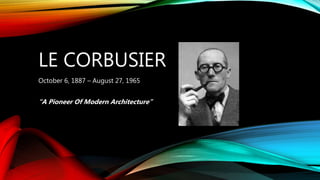
LE CORBUSIER
October 6, 1887 – August 27, 1965
“A Pioneer Of Modern Architecture”
BIOGRAPHY
(EARLY LIFE):
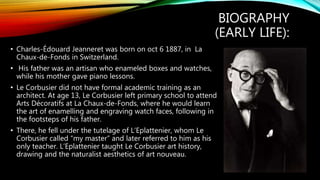
• Charles-Édouard Jeanneret was born on oct 6 1887, in La
Chaux-de-Fonds in Switzerland.
• His father was an artisan who enameled boxes and watches,
while his mother gave piano lessons.

• Le Corbusier did not have formal academic training as an
architect. At age 13, Le Corbusier left primary school to attend

Arts Décoratifs at La Chaux-de-Fonds, where he would learn
the art of enamelling and engraving watch faces, following in
the footsteps of his father.
• There, he fell under the tutelage of L’Eplattenier, whom Le
Corbusier called “my master” and later referred to him as his
only teacher. L’Eplattenier taught Le Corbusier art history,
drawing and the naturalist aesthetics of art nouveau.
EARLY CAREER
• After designing his first house, in 1907, at age 20, Le Corbusier took trips through
central Europe and the Mediterranean, including Italy, Vienna, Munich and Paris.
• He travelled to Paris, and between 1908 until 1910 he worked as a draftsman in the
office of the architect Auguste Perret, the pioneer of the use of reinforced concrete
in residential construction.
• In 1912, Le Corbusier returned to La Chaux-de-Fonds to teach alongside
L’Eplattenier and to open his own architectural practice.
• In 1917, Le Corbusier moved to Paris, where he worked as an architect on concrete
structures under government contracts.
• In 1918, Le Corbusier met Cubist painter Amédée Ozenfant, who encouraged Le
Corbusier to paint.
• Published the book Après le cubisme (After Cubism), an anti-cubism manifesto, and
established a new artistic movement called purism.
• In 1920, Charles-Edouard Jeanneret took on the pseudonym Le Corbusier, an alteration of
his grandfather’s last name, to reflect his belief that anyone could reinvent himself.
• In 1923, published another book, Vers une Architecture (Toward a New Architecture) in
which he declared ,“a house is a machine for living in”
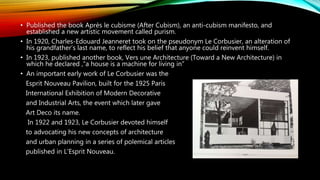
• An important early work of Le Corbusier was the
Esprit Nouveau Pavilion, built for the 1925 Paris
International Exhibition of Modern Decorative
and Industrial Arts, the event which later gave
Art Deco its name.
In 1922 and 1923, Le Corbusier devoted himself
to advocating his new concepts of architecture
and urban planning in a series of polemical articles
published in L'Esprit Nouveau.
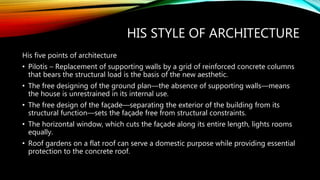
HIS STYLE OF ARCHITECTURE
His five points of architecture
• Pilotis – Replacement of supporting walls by a grid of reinforced concrete columns
that bears the structural load is the basis of the new aesthetic.
• The free designing of the ground plan—the absence of supporting walls—means
the house is unrestrained in its internal use.
• The free design of the façade—separating the exterior of the building from its
structural function—sets the façade free from structural constraints.
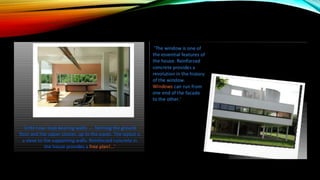
• The horizontal window, which cuts the façade along its entire length, lights rooms
equally.
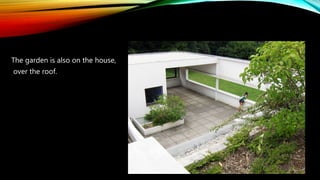
• Roof gardens on a flat roof can serve a domestic purpose while providing essential
protection to the concrete roof.
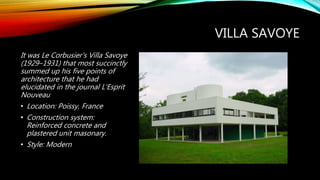
VILLA SAVOYE
It was Le Corbusier's Villa Savoye
(1929–1931) that most succinctly
summed up his five points of
architecture that he had
elucidated in the journal L'Esprit
Nouveau
• Location: Poissy, France
• Construction system:
Reinforced concrete and
plastered unit masonary.
• Style: Modern
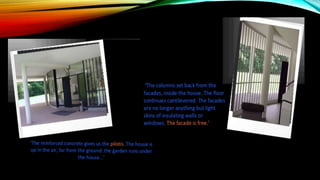
PILOTIS
• PILOTIS MEANS COLUMNS
• IT HELPED TO REDEFINE THE HOUSE AS A MATTER OF FORM AND FUNCTION
• REINFORCED CONCRETE GAVE US THE PILOTIS
• IT RAISED THE BUILDING IN THE AIR, FAR FROM THE SOIL, WITH GARDENS
STRETCHING BENEATH THE BUILDING
• FOR E.G VILLA SAVOYE,POISSY IN FRANCE IN 1929
• PILOTIS USUALLY SERVED AS AN ELEMENT OF DRAMATIZATION AND VISUAL
ISOLATI
ROOF TERRACE
• USUALLY KNOWN AS HANGING GARDEN
• FIRST REALIZATION OF THIS IDEA WAS IN THE SMALL HOUSE THAT THE
ARCHITECT BUILT FOR HIS PARENTS ON LAKE GENEVA IN 1923 IS DESCRIBED IN A
HYMNAL TONE
• REINFORCED CONCRETE MADE THE STRUCTURALLY HOMOGENOUS ROOF
POSSIBLE
• REASON OF TECHNIQUE, ECONOMY AND COMFORT LEAD TO THE ADOPTION OF
THE ROOF TERRACE AND THE ROOF GARDEN
• THE ROOF GARDEN OFTEN EQUIPPED FOR SPORTS, EMULATES THE ‘CONDITION
OF NATURE’ IN HUMAN HABITAT
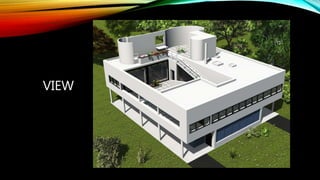
VIEW
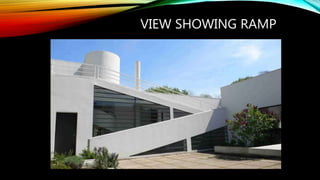
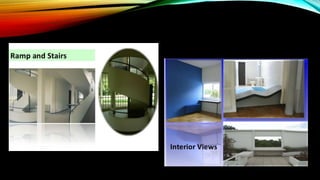
VIEW SHOWING RAMP
The garden is also on the house,
over the roof.
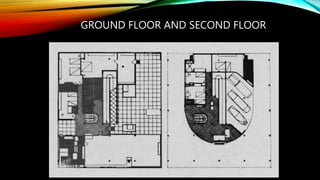
GROUND FLOOR AND SECOND FLOOR
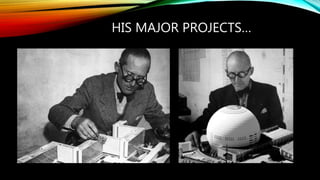
HIS MAJOR PROJECTS…
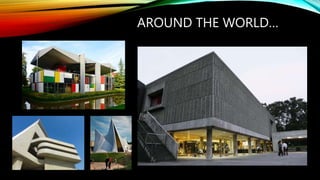
AROUND THE WORLD…
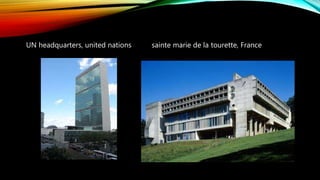
UN headquarters, united nations sainte marie de la tourette, France
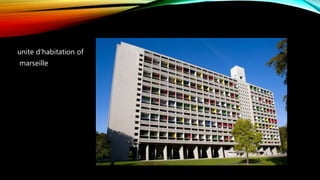
unite d'habitation of
marseille
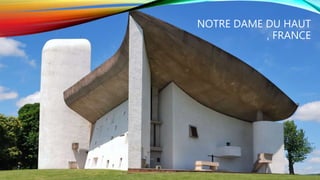
NOTRE DAME DU HAUT
, FRANCE
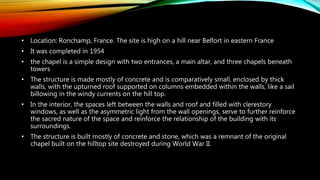
• Location: Ronchamp, France. The site is high on a hill near Belfort in eastern France
• It was completed in 1954
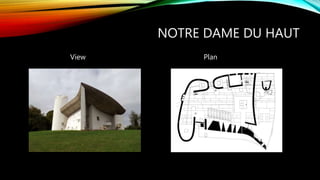
• the chapel is a simple design with two entrances, a main altar, and three chapels beneath
towers
• The structure is made mostly of concrete and is comparatively small, enclosed by thick
walls, with the upturned roof supported on columns embedded within the walls, like a sail
billowing in the windy currents on the hill top.
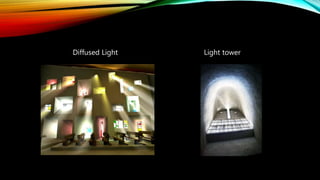
• In the interior, the spaces left between the walls and roof and filled with clerestory
windows, as well as the asymmetric light from the wall openings, serve to further reinforce
the sacred nature of the space and reinforce the relationship of the building with its
surroundings.
• The structure is built mostly of concrete and stone, which was a remnant of the original
chapel built on the hilltop site destroyed during World War II.
NOTRE DAME DU HAUT
View Plan
Diffused Light Light tower
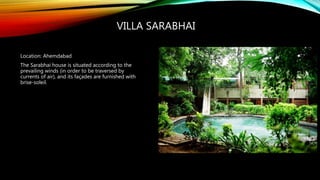
VILLA SARABHAI
Location: Ahemdabad
The Sarabhai house is situated according to the
prevailing winds (in order to be traversed by
currents of air), and its façades are furnished with
brise-soleil.
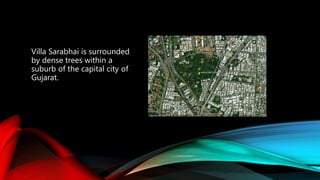
Villa Sarabhai is surrounded
by dense trees within a
suburb of the capital city of
Gujarat.
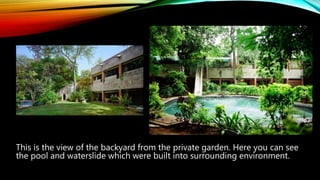
This is the view of the backyard from the private garden. Here you can see
the pool and waterslide which were built into surrounding environment.
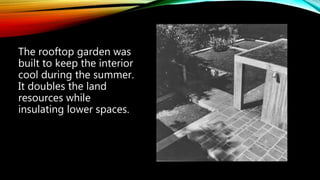
The rooftop garden was
built to keep the interior
cool during the summer.
It doubles the land
resources while
insulating lower spaces.
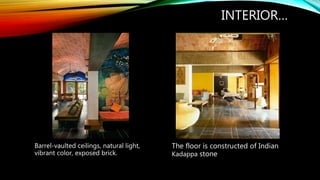
INTERIOR…
Barrel-vaulted ceilings, natural light,
vibrant color, exposed brick.
The floor is constructed of Indian
Kadappa stone
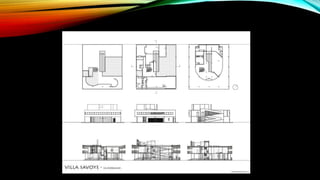
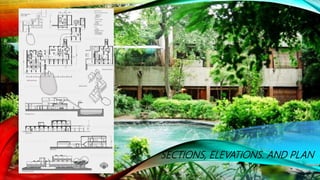
SECTIONS, ELEVATIONS. AND PLAN
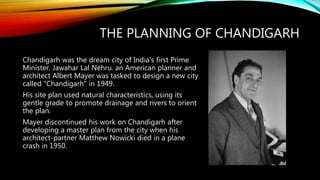
THE PLANNING OF CHANDIGARH
Chandigarh was the dream city of India's first Prime
Minister, Jawahar Lal Nehru. an American planner and
architect Albert Mayer was tasked to design a new city
called "Chandigarh" in 1949.
His site plan used natural characteristics, using its
gentle grade to promote drainage and rivers to orient
the plan.
Mayer discontinued his work on Chandigarh after
developing a master plan from the city when his
architect-partner Matthew Nowicki died in a plane
crash in 1950.
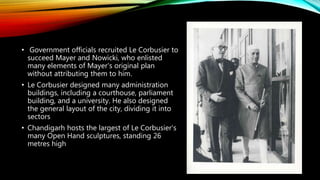
• Government officials recruited Le Corbusier to
succeed Mayer and Nowicki, who enlisted
many elements of Mayer's original plan
without attributing them to him.
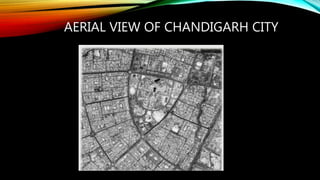
• Le Corbusier designed many administration
buildings, including a courthouse, parliament
building, and a university. He also designed
the general layout of the city, dividing it into
sectors
• Chandigarh hosts the largest of Le Corbusier's
many Open Hand sculptures, standing 26
metres high
AERIAL VIEW OF CHANDIGARH CITY
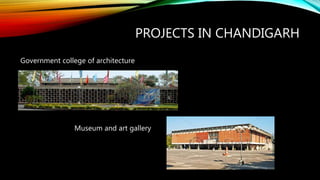
PROJECTS IN CHANDIGARH
Government college of architecture
Museum and art gallery
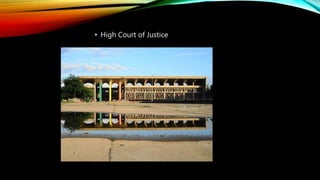
• High Court of Justice
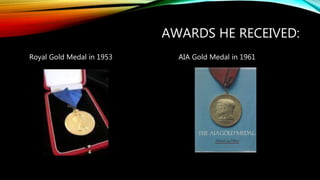
AWARDS HE RECEIVED:
Royal Gold Medal in 1953 AIA Gold Medal in 1961
BIBLIOGRAPHY
• Arch daily
• Wikipidea
• Dezeen.com
• https://www.youtube.com/watch?v=BsIO0gna0M8
• https://www.youtube.com/watch?v=uD-SFp_NvT8
THANKYOU… 
MADE BY:
SHIVANGI SHANKAR
2ND YEAR, 4TH SEM,
B.ARCH

Le corbusier

  • 1.
    LE CORBUSIER October 6,1887 – August 27, 1965 “A Pioneer Of Modern Architecture”
  • 2.
    BIOGRAPHY (EARLY LIFE): • Charles-ÉdouardJeanneret was born on oct 6 1887, in La Chaux-de-Fonds in Switzerland. • His father was an artisan who enameled boxes and watches, while his mother gave piano lessons. • Le Corbusier did not have formal academic training as an architect. At age 13, Le Corbusier left primary school to attend Arts Décoratifs at La Chaux-de-Fonds, where he would learn the art of enamelling and engraving watch faces, following in the footsteps of his father. • There, he fell under the tutelage of L’Eplattenier, whom Le Corbusier called “my master” and later referred to him as his only teacher. L’Eplattenier taught Le Corbusier art history, drawing and the naturalist aesthetics of art nouveau.
  • 3.
    EARLY CAREER • Afterdesigning his first house, in 1907, at age 20, Le Corbusier took trips through central Europe and the Mediterranean, including Italy, Vienna, Munich and Paris. • He travelled to Paris, and between 1908 until 1910 he worked as a draftsman in the office of the architect Auguste Perret, the pioneer of the use of reinforced concrete in residential construction. • In 1912, Le Corbusier returned to La Chaux-de-Fonds to teach alongside L’Eplattenier and to open his own architectural practice. • In 1917, Le Corbusier moved to Paris, where he worked as an architect on concrete structures under government contracts. • In 1918, Le Corbusier met Cubist painter Amédée Ozenfant, who encouraged Le Corbusier to paint.
  • 4.
    • Published thebook Après le cubisme (After Cubism), an anti-cubism manifesto, and established a new artistic movement called purism. • In 1920, Charles-Edouard Jeanneret took on the pseudonym Le Corbusier, an alteration of his grandfather’s last name, to reflect his belief that anyone could reinvent himself. • In 1923, published another book, Vers une Architecture (Toward a New Architecture) in which he declared ,“a house is a machine for living in” • An important early work of Le Corbusier was the Esprit Nouveau Pavilion, built for the 1925 Paris International Exhibition of Modern Decorative and Industrial Arts, the event which later gave Art Deco its name. In 1922 and 1923, Le Corbusier devoted himself to advocating his new concepts of architecture and urban planning in a series of polemical articles published in L'Esprit Nouveau.
  • 5.
    HIS STYLE OFARCHITECTURE His five points of architecture • Pilotis – Replacement of supporting walls by a grid of reinforced concrete columns that bears the structural load is the basis of the new aesthetic. • The free designing of the ground plan—the absence of supporting walls—means the house is unrestrained in its internal use. • The free design of the façade—separating the exterior of the building from its structural function—sets the façade free from structural constraints. • The horizontal window, which cuts the façade along its entire length, lights rooms equally. • Roof gardens on a flat roof can serve a domestic purpose while providing essential protection to the concrete roof.
  • 6.
    VILLA SAVOYE It wasLe Corbusier's Villa Savoye (1929–1931) that most succinctly summed up his five points of architecture that he had elucidated in the journal L'Esprit Nouveau • Location: Poissy, France • Construction system: Reinforced concrete and plastered unit masonary. • Style: Modern
  • 9.
    PILOTIS • PILOTIS MEANSCOLUMNS • IT HELPED TO REDEFINE THE HOUSE AS A MATTER OF FORM AND FUNCTION • REINFORCED CONCRETE GAVE US THE PILOTIS • IT RAISED THE BUILDING IN THE AIR, FAR FROM THE SOIL, WITH GARDENS STRETCHING BENEATH THE BUILDING • FOR E.G VILLA SAVOYE,POISSY IN FRANCE IN 1929 • PILOTIS USUALLY SERVED AS AN ELEMENT OF DRAMATIZATION AND VISUAL ISOLATI
  • 10.
    ROOF TERRACE • USUALLYKNOWN AS HANGING GARDEN • FIRST REALIZATION OF THIS IDEA WAS IN THE SMALL HOUSE THAT THE ARCHITECT BUILT FOR HIS PARENTS ON LAKE GENEVA IN 1923 IS DESCRIBED IN A HYMNAL TONE • REINFORCED CONCRETE MADE THE STRUCTURALLY HOMOGENOUS ROOF POSSIBLE • REASON OF TECHNIQUE, ECONOMY AND COMFORT LEAD TO THE ADOPTION OF THE ROOF TERRACE AND THE ROOF GARDEN • THE ROOF GARDEN OFTEN EQUIPPED FOR SPORTS, EMULATES THE ‘CONDITION OF NATURE’ IN HUMAN HABITAT
  • 11.
  • 12.
  • 13.
    The garden isalso on the house, over the roof.
  • 14.
    GROUND FLOOR ANDSECOND FLOOR
  • 18.
  • 19.
  • 20.
    UN headquarters, unitednations sainte marie de la tourette, France
  • 21.
  • 22.
    NOTRE DAME DUHAUT , FRANCE
  • 23.
    • Location: Ronchamp,France. The site is high on a hill near Belfort in eastern France • It was completed in 1954 • the chapel is a simple design with two entrances, a main altar, and three chapels beneath towers • The structure is made mostly of concrete and is comparatively small, enclosed by thick walls, with the upturned roof supported on columns embedded within the walls, like a sail billowing in the windy currents on the hill top. • In the interior, the spaces left between the walls and roof and filled with clerestory windows, as well as the asymmetric light from the wall openings, serve to further reinforce the sacred nature of the space and reinforce the relationship of the building with its surroundings. • The structure is built mostly of concrete and stone, which was a remnant of the original chapel built on the hilltop site destroyed during World War II.
  • 24.
    NOTRE DAME DUHAUT View Plan
  • 25.
  • 26.
    VILLA SARABHAI Location: Ahemdabad TheSarabhai house is situated according to the prevailing winds (in order to be traversed by currents of air), and its façades are furnished with brise-soleil.
  • 27.
    Villa Sarabhai issurrounded by dense trees within a suburb of the capital city of Gujarat.
  • 28.
    This is theview of the backyard from the private garden. Here you can see the pool and waterslide which were built into surrounding environment.
  • 29.
    The rooftop gardenwas built to keep the interior cool during the summer. It doubles the land resources while insulating lower spaces.
  • 30.
    INTERIOR… Barrel-vaulted ceilings, naturallight, vibrant color, exposed brick. The floor is constructed of Indian Kadappa stone
  • 31.
  • 32.
    THE PLANNING OFCHANDIGARH Chandigarh was the dream city of India's first Prime Minister, Jawahar Lal Nehru. an American planner and architect Albert Mayer was tasked to design a new city called "Chandigarh" in 1949. His site plan used natural characteristics, using its gentle grade to promote drainage and rivers to orient the plan. Mayer discontinued his work on Chandigarh after developing a master plan from the city when his architect-partner Matthew Nowicki died in a plane crash in 1950.
  • 33.
    • Government officialsrecruited Le Corbusier to succeed Mayer and Nowicki, who enlisted many elements of Mayer's original plan without attributing them to him. • Le Corbusier designed many administration buildings, including a courthouse, parliament building, and a university. He also designed the general layout of the city, dividing it into sectors • Chandigarh hosts the largest of Le Corbusier's many Open Hand sculptures, standing 26 metres high
  • 34.
    AERIAL VIEW OFCHANDIGARH CITY
  • 35.
    PROJECTS IN CHANDIGARH Governmentcollege of architecture Museum and art gallery
  • 36.
    • High Courtof Justice
  • 37.
    AWARDS HE RECEIVED: RoyalGold Medal in 1953 AIA Gold Medal in 1961
  • 38.
    BIBLIOGRAPHY • Arch daily •Wikipidea • Dezeen.com • https://www.youtube.com/watch?v=BsIO0gna0M8 • https://www.youtube.com/watch?v=uD-SFp_NvT8
  • 39.
    THANKYOU…  MADE BY: SHIVANGISHANKAR 2ND YEAR, 4TH SEM, B.ARCH