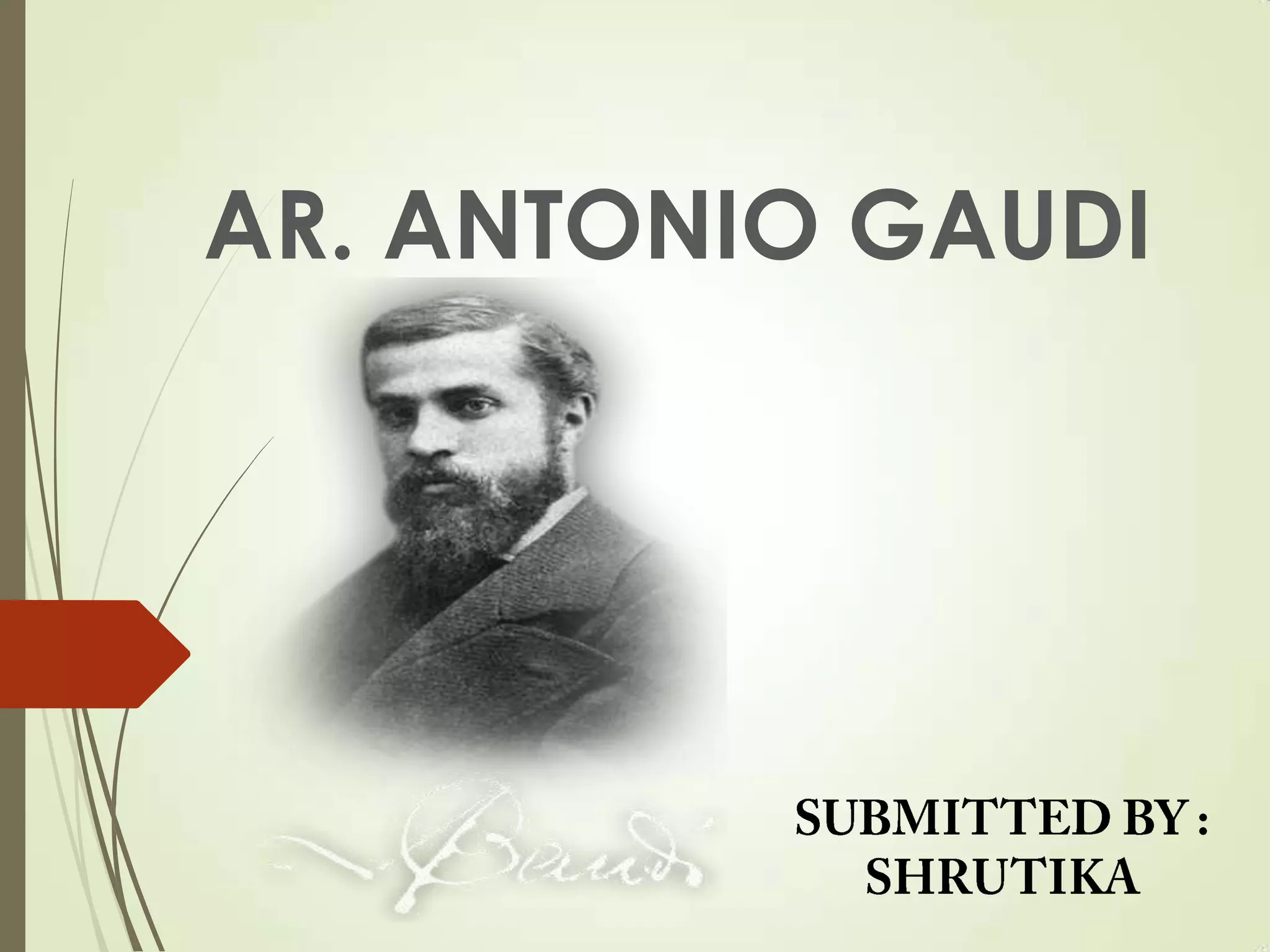
AR. ANTONIO GAUDI
WHY I CHOOSE AR. ANTONI GAUDI
 WAS UNIQUE, DEVELOPED HIS OWN UNIQUE STYLE
 NEVER MADE PLANS, ONLY 3D PLANS
 NEVER USED STRAIGHT LINES , BUT CURVED LINES.
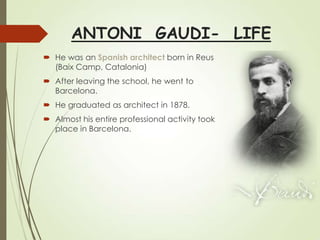
ANTONI GAUDI- LIFE
 He was an Spanish architect born in Reus
(Baix Camp, Catalonia)

 After leaving the school, he went to
Barcelona.
 He graduated as architect in 1878.
 Almost his entire professional activity took
place in Barcelona.
ABOUT ANTONI GAUDI
 Full name Antoni Placid Guillem Comet
 He became vegetarian at a young age.
 Spanish architect whose idiosyncratic work, characterized by
undulating curves and richly colored scrambled textures, won wide
international recognition only after the mid-20th century.
 develop his unique style—blending element`s of Gothic art, art
nouveau, known as modernismo in Catalonia, and functional structure.
 His favorite forms were inclined columns to add stress to ceilings,
paraboloid arches, thin edge-butted tile vaults, and the richest, most
colorful textures possible, often mosaics made of broken tile scraps.
 He didn't draw his buildings, but made 3D models/sculptures.
 His nickname was 'God's Architect' due to the religious images in his
work.
DEVELOPMENT AS A PROFESIONAL
ARCHITECT
 Upon graduation, Gaudí initially worked in the artistic vein of his Victorian
predecessors,


soon developed his own style, composing his works with juxtapositions
of geometric masses and animating the surfaces with patterned brick or
stone, bright ceramic tiles and floral or reptilian metalwork



During his early period, at the Paris World's Fair of 1878, Gaudí
displayed a showcase he had produced, which impressed one patron
enough to lead to Gaudí's working on the Güell Estate and Güell Palace,
among others.

 In 1883, Gaudí was charged with the construction of a Barcelona
cathedral called Basilica i Temple Expiatori de la Sagrada Familia
 The plans had been drawn up earlier, and construction had already
begun, but Gaudí completely changed the design, stamping it with his
own distinctive style.
 experimented with various permutations of historic styles- the Episcopal
Palace and the Casa de los Botines both Gothic, and the Casa Calvet
which was done in the Baroque style. Some of these commissions were
the result of the 1888 World's Fair, at which Gaudí once again staged an
impressive showcase.
THE MATURED ARTIST
 He created a type of structure known as EQUILIBRATED i.e., it could
stand on its own without internal bracing, external buttressing, etc.
 The primary functional elements of this system were columns that
tilted to employ diagonal thrusts and lightweight tile vaults.
 Notably, Gaudi used his equilibrated system to construct two
Barcelona apartment buildings: the casa ballot (1904–06) and the
casa milà (1905–10), whose floors were structured like clusters of tile
lily pads. Both projects are considered to be characteristic of
Gaudi's style.
ARCHI T ECT URAL
T E CHNOL OGI E S
•

Gaudí’s work employing organic or natural forms, curved or
undulating lines, reclaimed materials, ceramic bricks, trencadís
mosaics, etc.

•

He projects in such a way that the form does not become a mere
stylistic caprice, but rather finds its reason for being in the function
for which it was conceived. For examples: the schools at the
Sagrada Família and hyperbolic vaults.

•

He used steel inside of the building to reinforce his structure.
FACTS N THEORIES OF GAUDI
Those who look for the laws of
nature as a support for their new
works collaborate with the creator.
ANTONI GAUDI

Nothing is art if it doesn’t
come from nature
ANTONI GAUDI

The creation continues
incessantly through the
media of man
ANTONI GAUDI

Color in certain places has
the great value of making the
outlines and structural planes
seem more energetic
ANTONI GAUDI

There are no straight lines or
sharp corners in nature,
therefore buildings must have no
straight lines or straight corners.
ANTONI GAUDI
HIS
ARCHITECTURAL
WORKS...
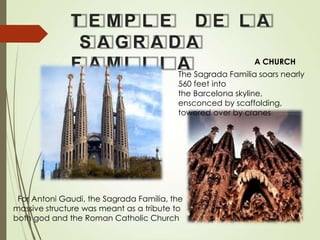
T E MP L E D E L A
S AGRADA
CHURCH
F A M I L I A Sagrada FamiliaAsoars nearly
The
560 feet into
the Barcelona skyline,
ensconced by scaffolding,
towered over by cranes

For Antoni Gaudi, the Sagrada Familia, the
massive structure was meant as a tribute to
both god and the Roman Catholic Church
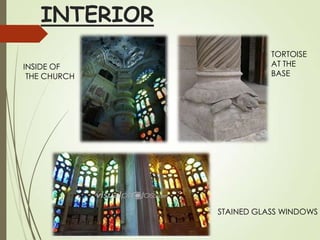
INTERIOR
INSIDE OF
THE CHURCH

TORTOISE
AT THE
BASE

STAINED GLASS WINDOWS
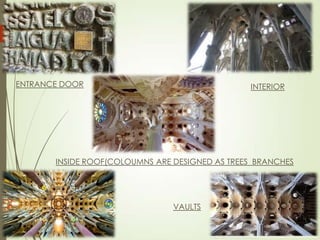
ENTRANCE DOOR

INTERIOR

INSIDE ROOF(COLOUMNS ARE DESIGNED AS TREES BRANCHES

VAULTS
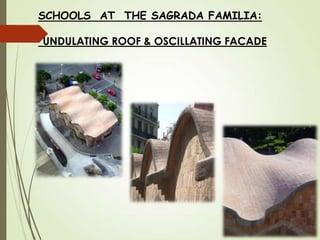
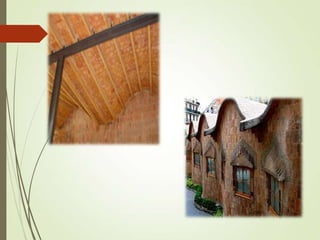
SCHOOLS AT THE SAGRADA FAMILIA:
UNDULATING ROOF & OSCILLATING FACADE
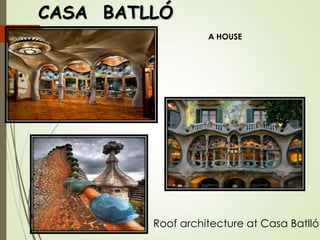
CASA BATLLÓ
A HOUSE

Roof architecture at Casa Batlló.
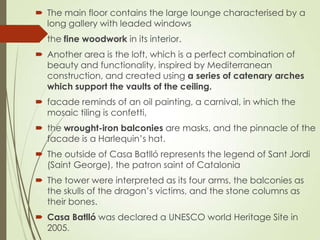
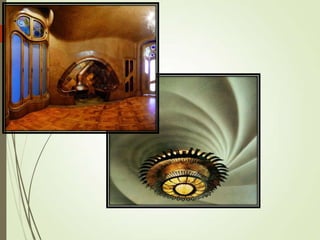
 The main floor contains the large lounge characterised by a
long gallery with leaded windows
 the fine woodwork in its interior.
 Another area is the loft, which is a perfect combination of
beauty and functionality, inspired by Mediterranean
construction, and created using a series of catenary arches
which support the vaults of the ceiling.
 facade reminds of an oil painting, a carnival, in which the
mosaic tiling is confetti,
 the wrought-iron balconies are masks, and the pinnacle of the
facade is a Harlequin’s hat.
 The outside of Casa Batlló represents the legend of Sant Jordi
(Saint George), the patron saint of Catalonia
 The tower were interpreted as its four arms, the balconies as
the skulls of the dragon’s victims, and the stone columns as
their bones.
 Casa Batlló was declared a UNESCO world Heritage Site in
2005.
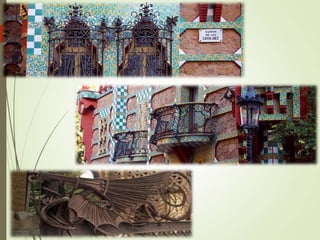
CASA

VI CENS

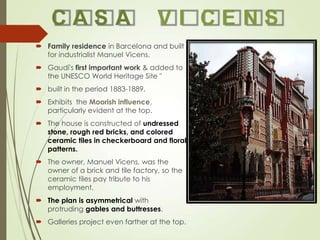
 Family residence in Barcelona and built
for industrialist Manuel Vicens.
 Gaudí's first important work & added to
the UNESCO World Heritage Site "

 built in the period 1883-1889.
 Exhibits the Moorish influence,
particularly evident at the top.
 The house is constructed of undressed
stone, rough red bricks, and colored
ceramic tiles in checkerboard and floral
patterns.
 The owner, Manuel Vicens, was the
owner of a brick and tile factory, so the
ceramic tiles pay tribute to his
employment.
 The plan is asymmetrical with
protruding gables and buttresses.
 Galleries project even farther at the top.
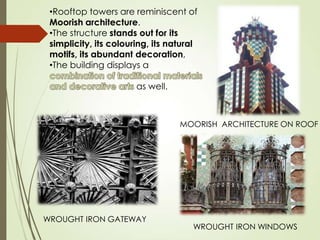
•Rooftop towers are reminiscent of
Moorish architecture.
•The structure stands out for its
simplicity, its colouring, its natural
motifs, its abundant decoration,
•The building displays a
as well.

MOORISH ARCHITECTURE ON ROOF

WROUGHT IRON GATEWAY

WROUGHT IRON WINDOWS
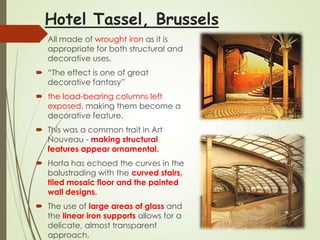
Hotel Tassel, Brussels
 All made of wrought iron as it is
appropriate for both structural and
decorative uses.
 ―The effect is one of great
decorative fantasy‖

 the load-bearing columns left
exposed, making them become a
decorative feature.
 This was a common trait in Art
Nouveau - making structural
features appear ornamental.
 Horta has echoed the curves in the
balustrading with the curved stairs,
tiled mosaic floor and the painted
wall designs.
 The use of large areas of glass and
the linear iron supports allows for a
delicate, almost transparent
approach.
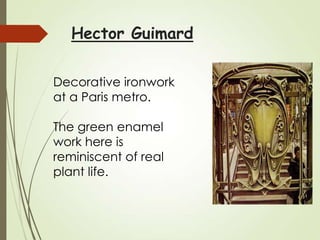
Hector Guimard
Decorative ironwork
at a Paris metro.
The green enamel
work here is
reminiscent of real
plant life.
DESIGN PRINCIPLE:
 Reaction against the styles that were developed by
machine-production.
 Objects were simple in form, without decoration.
 Emphasize the qualities of the materials used ("truth to
material").
 Used patterns inspired by British flora and fauna.
 Influenced by the Gothic Revival (1830–1880) & interested
in medieval styles, using bold forms and strong colors
based on medieval designs.
 believe in the moral purpose of art.
 To express the beauty of craft, some products were
deliberately left slightly unfinished, resulting in a certain
rustic and robust effect.
The Style
 A purely non-objective approach in the making of
artwork, without reference to the real world
 Essentially geometric, precise and almost
mathematical; in fact a number of Rodchenko drawings
were executed with compass and ruler
 Used squares, rectangles, circles and triangles as the
predominant shapes in carefully composed artworks,
whether drawing, painting, design or sculpture
 Emphasized the dominance of the world of machines
and structures over nature
Methods and Materials
 Dealt with such a wide range of materials that anything
was possible; wood, celluloid, nylon, Plexiglas, tin,
cardboard and early forms of plastic were used through
a variety of constructing methods from glue through to
welding
 Lacked the more engineered approach developed by
International Constructivism
 Employed new materials, construction, and joining
methods, including aluminum, electronic components
and chrome-plating
 Industrial materials such as glass, steel, and plastic in
clearly defined arrangements. Because of their
admiration for machines and technology, functionalism,
and modern mediums
THANK
YOU.....!!!

Antoni gaudi.....

  • 1.
  • 2.
    WHY I CHOOSEAR. ANTONI GAUDI  WAS UNIQUE, DEVELOPED HIS OWN UNIQUE STYLE  NEVER MADE PLANS, ONLY 3D PLANS  NEVER USED STRAIGHT LINES , BUT CURVED LINES.
  • 3.
    ANTONI GAUDI- LIFE He was an Spanish architect born in Reus (Baix Camp, Catalonia)  After leaving the school, he went to Barcelona.  He graduated as architect in 1878.  Almost his entire professional activity took place in Barcelona.
  • 4.
    ABOUT ANTONI GAUDI Full name Antoni Placid Guillem Comet  He became vegetarian at a young age.  Spanish architect whose idiosyncratic work, characterized by undulating curves and richly colored scrambled textures, won wide international recognition only after the mid-20th century.  develop his unique style—blending element`s of Gothic art, art nouveau, known as modernismo in Catalonia, and functional structure.  His favorite forms were inclined columns to add stress to ceilings, paraboloid arches, thin edge-butted tile vaults, and the richest, most colorful textures possible, often mosaics made of broken tile scraps.  He didn't draw his buildings, but made 3D models/sculptures.  His nickname was 'God's Architect' due to the religious images in his work.
  • 5.
    DEVELOPMENT AS APROFESIONAL ARCHITECT  Upon graduation, Gaudí initially worked in the artistic vein of his Victorian predecessors,  soon developed his own style, composing his works with juxtapositions of geometric masses and animating the surfaces with patterned brick or stone, bright ceramic tiles and floral or reptilian metalwork  During his early period, at the Paris World's Fair of 1878, Gaudí displayed a showcase he had produced, which impressed one patron enough to lead to Gaudí's working on the Güell Estate and Güell Palace, among others.  In 1883, Gaudí was charged with the construction of a Barcelona cathedral called Basilica i Temple Expiatori de la Sagrada Familia  The plans had been drawn up earlier, and construction had already begun, but Gaudí completely changed the design, stamping it with his own distinctive style.  experimented with various permutations of historic styles- the Episcopal Palace and the Casa de los Botines both Gothic, and the Casa Calvet which was done in the Baroque style. Some of these commissions were the result of the 1888 World's Fair, at which Gaudí once again staged an impressive showcase.
  • 6.
    THE MATURED ARTIST He created a type of structure known as EQUILIBRATED i.e., it could stand on its own without internal bracing, external buttressing, etc.  The primary functional elements of this system were columns that tilted to employ diagonal thrusts and lightweight tile vaults.  Notably, Gaudi used his equilibrated system to construct two Barcelona apartment buildings: the casa ballot (1904–06) and the casa milà (1905–10), whose floors were structured like clusters of tile lily pads. Both projects are considered to be characteristic of Gaudi's style.
  • 7.
    ARCHI T ECTURAL T E CHNOL OGI E S • Gaudí’s work employing organic or natural forms, curved or undulating lines, reclaimed materials, ceramic bricks, trencadís mosaics, etc. • He projects in such a way that the form does not become a mere stylistic caprice, but rather finds its reason for being in the function for which it was conceived. For examples: the schools at the Sagrada Família and hyperbolic vaults. • He used steel inside of the building to reinforce his structure.
  • 8.
    FACTS N THEORIESOF GAUDI Those who look for the laws of nature as a support for their new works collaborate with the creator. ANTONI GAUDI Nothing is art if it doesn’t come from nature ANTONI GAUDI The creation continues incessantly through the media of man ANTONI GAUDI Color in certain places has the great value of making the outlines and structural planes seem more energetic ANTONI GAUDI There are no straight lines or sharp corners in nature, therefore buildings must have no straight lines or straight corners. ANTONI GAUDI
  • 9.
  • 10.
    T E MPL E D E L A S AGRADA CHURCH F A M I L I A Sagrada FamiliaAsoars nearly The 560 feet into the Barcelona skyline, ensconced by scaffolding, towered over by cranes For Antoni Gaudi, the Sagrada Familia, the massive structure was meant as a tribute to both god and the Roman Catholic Church
  • 11.
    INTERIOR INSIDE OF THE CHURCH TORTOISE ATTHE BASE STAINED GLASS WINDOWS
  • 12.
    ENTRANCE DOOR INTERIOR INSIDE ROOF(COLOUMNSARE DESIGNED AS TREES BRANCHES VAULTS
  • 13.
    SCHOOLS AT THESAGRADA FAMILIA: UNDULATING ROOF & OSCILLATING FACADE
  • 15.
    CASA BATLLÓ A HOUSE Roofarchitecture at Casa Batlló.
  • 16.
     The mainfloor contains the large lounge characterised by a long gallery with leaded windows  the fine woodwork in its interior.  Another area is the loft, which is a perfect combination of beauty and functionality, inspired by Mediterranean construction, and created using a series of catenary arches which support the vaults of the ceiling.  facade reminds of an oil painting, a carnival, in which the mosaic tiling is confetti,  the wrought-iron balconies are masks, and the pinnacle of the facade is a Harlequin’s hat.  The outside of Casa Batlló represents the legend of Sant Jordi (Saint George), the patron saint of Catalonia  The tower were interpreted as its four arms, the balconies as the skulls of the dragon’s victims, and the stone columns as their bones.  Casa Batlló was declared a UNESCO world Heritage Site in 2005.
  • 18.
    CASA VI CENS  Familyresidence in Barcelona and built for industrialist Manuel Vicens.  Gaudí's first important work & added to the UNESCO World Heritage Site "  built in the period 1883-1889.  Exhibits the Moorish influence, particularly evident at the top.  The house is constructed of undressed stone, rough red bricks, and colored ceramic tiles in checkerboard and floral patterns.  The owner, Manuel Vicens, was the owner of a brick and tile factory, so the ceramic tiles pay tribute to his employment.  The plan is asymmetrical with protruding gables and buttresses.  Galleries project even farther at the top.
  • 19.
    •Rooftop towers arereminiscent of Moorish architecture. •The structure stands out for its simplicity, its colouring, its natural motifs, its abundant decoration, •The building displays a as well. MOORISH ARCHITECTURE ON ROOF WROUGHT IRON GATEWAY WROUGHT IRON WINDOWS
  • 21.
    Hotel Tassel, Brussels All made of wrought iron as it is appropriate for both structural and decorative uses.  ―The effect is one of great decorative fantasy‖  the load-bearing columns left exposed, making them become a decorative feature.  This was a common trait in Art Nouveau - making structural features appear ornamental.  Horta has echoed the curves in the balustrading with the curved stairs, tiled mosaic floor and the painted wall designs.  The use of large areas of glass and the linear iron supports allows for a delicate, almost transparent approach.
  • 22.
    Hector Guimard Decorative ironwork ata Paris metro. The green enamel work here is reminiscent of real plant life.
  • 23.
    DESIGN PRINCIPLE:  Reactionagainst the styles that were developed by machine-production.  Objects were simple in form, without decoration.  Emphasize the qualities of the materials used ("truth to material").  Used patterns inspired by British flora and fauna.  Influenced by the Gothic Revival (1830–1880) & interested in medieval styles, using bold forms and strong colors based on medieval designs.  believe in the moral purpose of art.  To express the beauty of craft, some products were deliberately left slightly unfinished, resulting in a certain rustic and robust effect.
  • 24.
    The Style  Apurely non-objective approach in the making of artwork, without reference to the real world  Essentially geometric, precise and almost mathematical; in fact a number of Rodchenko drawings were executed with compass and ruler  Used squares, rectangles, circles and triangles as the predominant shapes in carefully composed artworks, whether drawing, painting, design or sculpture  Emphasized the dominance of the world of machines and structures over nature
  • 25.
    Methods and Materials Dealt with such a wide range of materials that anything was possible; wood, celluloid, nylon, Plexiglas, tin, cardboard and early forms of plastic were used through a variety of constructing methods from glue through to welding  Lacked the more engineered approach developed by International Constructivism  Employed new materials, construction, and joining methods, including aluminum, electronic components and chrome-plating  Industrial materials such as glass, steel, and plastic in clearly defined arrangements. Because of their admiration for machines and technology, functionalism, and modern mediums
  • 26.