
CONTEMPRORY ARCHITECTURE : THEORY AND
TRENDS
BLOBITECTURE
SHUBHAM SISODIYA
FY M.ARCH
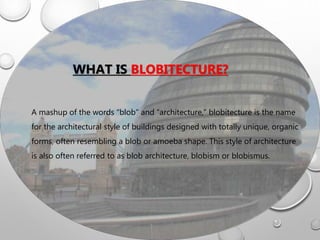
A mashup of the words “blob” and “architecture,” blobitecture is the name
for the architectural style of buildings designed with totally unique, organic
forms, often resembling a blob or amoeba shape. This style of architecture
is also often referred to as blob architecture, blobism or blobismus.
WHAT IS BLOBITECTURE?
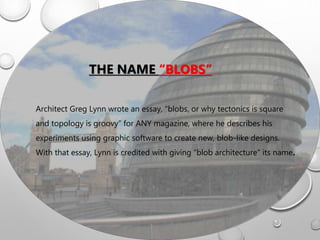
Architect Greg Lynn wrote an essay, “blobs, or why tectonics is square
and topology is groovy” for ANY magazine, where he describes his
experiments using graphic software to create new, blob-like designs.
With that essay, Lynn is credited with giving “blob architecture” its name.
THE NAME “BLOBS”
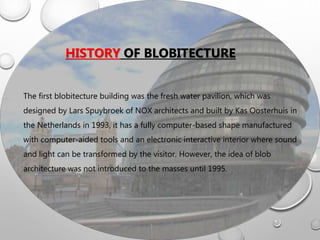
The first blobitecture building was the fresh water pavilion, which was
designed by Lars Spuybroek of NOX architects and built by Kas Oosterhuis in
the Netherlands in 1993, it has a fully computer-based shape manufactured
with computer-aided tools and an electronic interactive interior where sound
and light can be transformed by the visitor. However, the idea of blob
architecture was not introduced to the masses until 1995.
HISTORY OF BLOBITECTURE
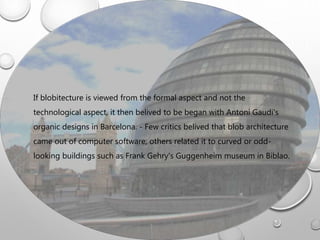
If blobitecture is viewed from the formal aspect and not the
technological aspect, it then belived to be began with Antoni Gaudi's
organic designs in Barcelona. - Few critics belived that blob architecture
came out of computer software; others related it to curved or odd-
looking buildings such as Frank Gehry's Guggenheim museum in Biblao.
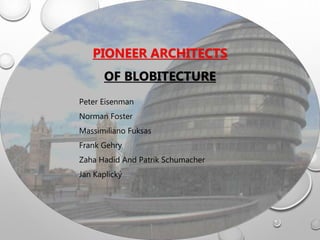
Peter Eisenman
Norman Foster
Massimiliano Fuksas
Frank Gehry
Zaha Hadid And Patrik Schumacher
Jan Kaplický
PIONEER ARCHITECTS
OF BLOBITECTURE
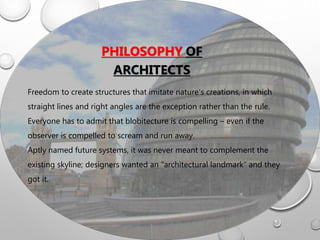
Freedom to create structures that imitate nature’s creations, in which
straight lines and right angles are the exception rather than the rule.
Everyone has to admit that blobitecture is compelling – even if the
observer is compelled to scream and run away.
Aptly named future systems, it was never meant to complement the
existing skyline; designers wanted an “architectural landmark” and they
got it.
PHILOSOPHY OF
ARCHITECTS
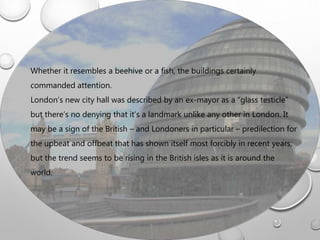
Whether it resembles a beehive or a fish, the buildings certainly
commanded attention.
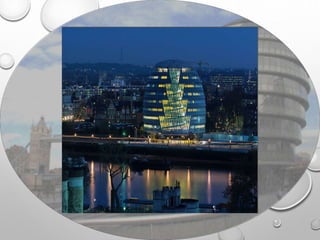
London’s new city hall was described by an ex-mayor as a “glass testicle”
but there’s no denying that it’s a landmark unlike any other in London. It
may be a sign of the British – and Londoners in particular – predilection for
the upbeat and offbeat that has shown itself most forcibly in recent years,
but the trend seems to be rising in the British isles as it is around the
world.
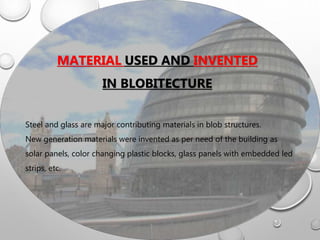
Steel and glass are major contributing materials in blob structures.
New generation materials were invented as per need of the building as
solar panels, color changing plastic blocks, glass panels with embedded led
strips, etc.
MATERIAL USED AND INVENTED
IN BLOBITECTURE
Water Pavilion (1993–1997) by
Lars Spuybroek and Kas Oosterhuis.
Experience Music Project, Seattle
(1999-2000) by Frank O Gehry.
FAMOUS EXAMPLES OF BLOBITECTURE
BLOB ARCHITECTURE “TODAY”
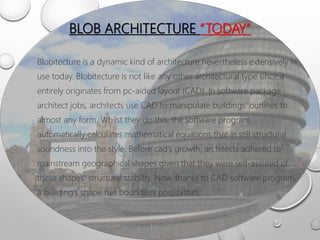
Blobitecture is a dynamic kind of architecture nevertheless extensively in
use today. Blobitecture is not like any other architectural type since it
entirely originates from pc-aided layout (CAD). In software package
architect jobs, architects use CAD to manipulate buildings' outlines to
almost any form. Whilst they do this, the software program
automatically calculates mathematical equations that in still structural
soundness into the style. Before cad's growth, architects adhered to
mainstream geographical shapes given that they were self-assured of
these shapes' structural stability. Now, thanks to CAD software program,
a building's shape has boundless possibilities.
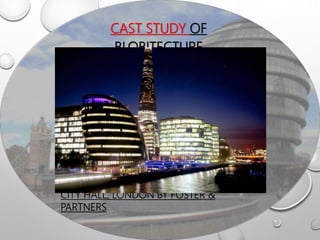
CITY HALL, LONDON BY FOSTER &
PARTNERS
CAST STUDY OF
BLOBITECTURE
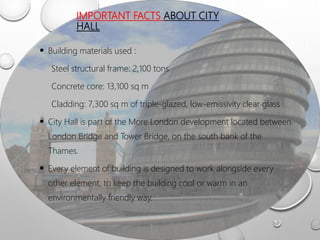
IMPORTANT FACTS ABOUT CITY
HALL
 Building materials used :
Steel structural frame: 2,100 tons
Concrete core: 13,100 sq m
Cladding: 7,300 sq m of triple-glazed, low-emissivity clear glass
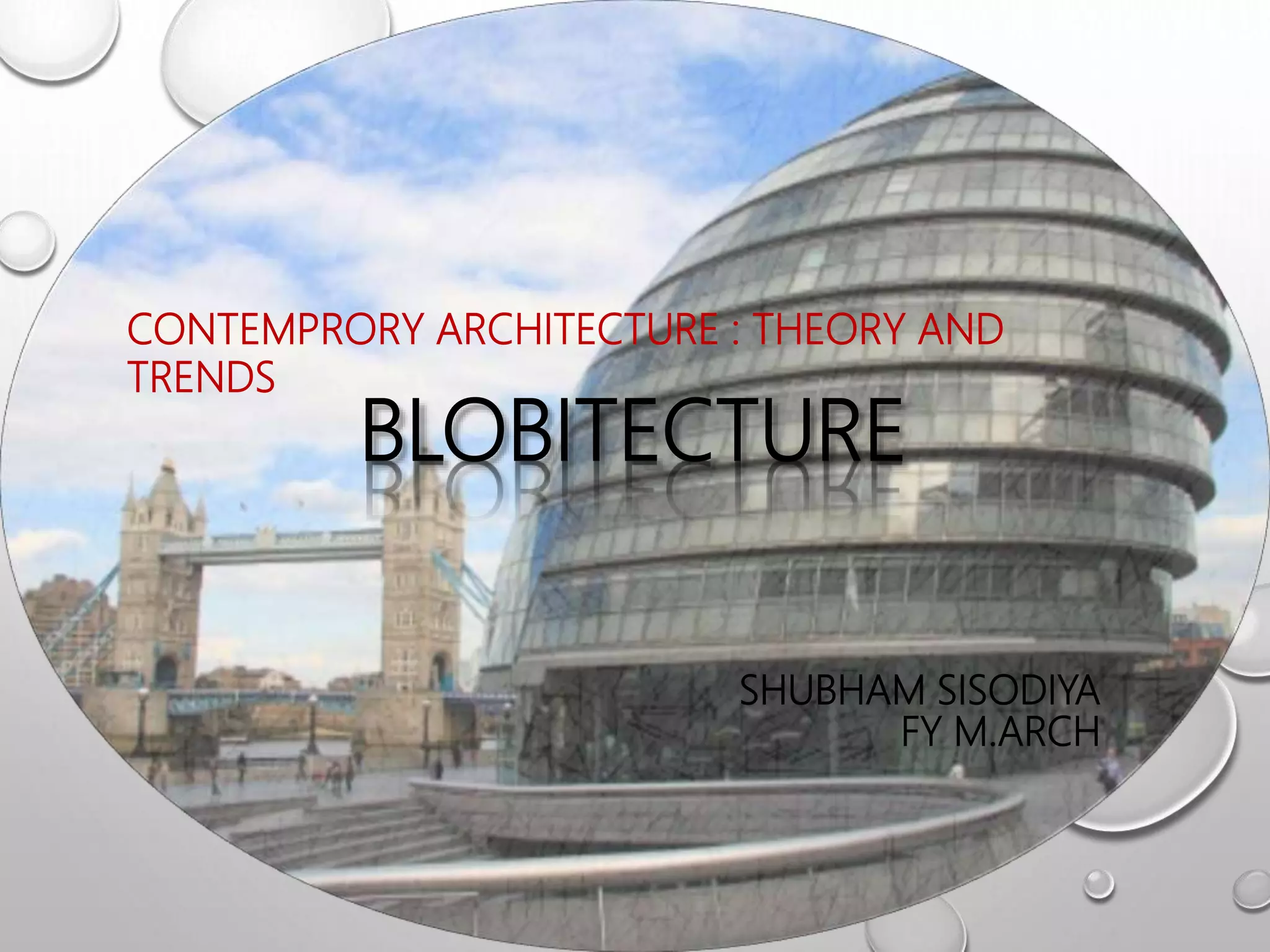
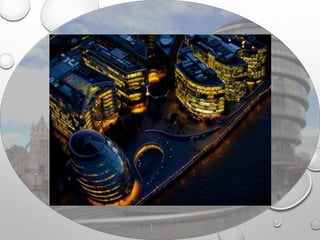
 City Hall is part of the More London development located between
London Bridge and Tower Bridge, on the south bank of the
Thames.
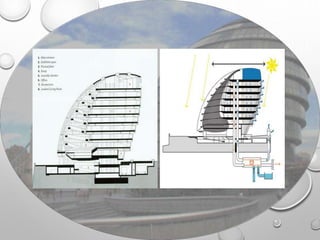
 Every element of building is designed to work alongside every
other element, to keep the building cool or warm in an
environmentally friendly way.
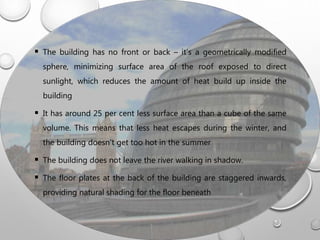
 The building has no front or back – it’s a geometrically modified
sphere, minimizing surface area of the roof exposed to direct
sunlight, which reduces the amount of heat build up inside the
building
 It has around 25 per cent less surface area than a cube of the same
volume. This means that less heat escapes during the winter, and
the building doesn't get too hot in the summer
 The building does not leave the river walking in shadow.
 The floor plates at the back of the building are staggered inwards,
providing natural shading for the floor beneath
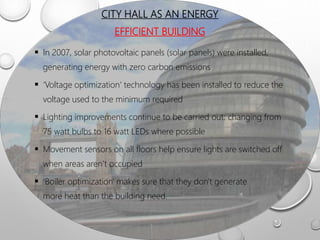
CITY HALL AS AN ENERGY
EFFICIENT BUILDING
 In 2007, solar photovoltaic panels (solar panels) were installed,
generating energy with zero carbon emissions
 ‘Voltage optimization’ technology has been installed to reduce the
voltage used to the minimum required
 Lighting improvements continue to be carried out: changing from
75 watt bulbs to 16 watt LEDs where possible
 Movement sensors on all floors help ensure lights are switched off
when areas aren’t occupied
 ‘Boiler optimization' makes sure that they don't generate
more heat than the building need.
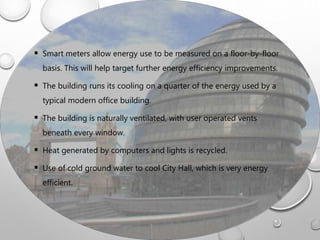
 Smart meters allow energy use to be measured on a floor-by-floor
basis. This will help target further energy efficiency improvements.
 The building runs its cooling on a quarter of the energy used by a
typical modern office building.
 The building is naturally ventilated, with user operated vents
beneath every window.
 Heat generated by computers and lights is recycled.
 Use of cold ground water to cool City Hall, which is very energy
efficient.
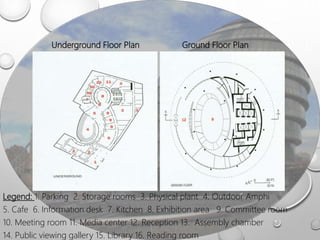
Underground Floor Plan Ground Floor Plan
Legend: 1. Parking 2. Storage rooms 3. Physical plant 4. Outdoor Amphi
5. Cafe 6. Information desk 7. Kitchen 8. Exhibition area 9. Committee room
10. Meeting room 11. Media center 12. Reception 13. Assembly chamber
14. Public viewing gallery 15. Library 16. Reading room
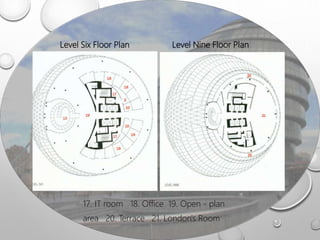
Level Six Floor Plan Level Nine Floor Plan
17. IT room 18. Office 19. Open - plan
area 20. Terrace 21. London's Room
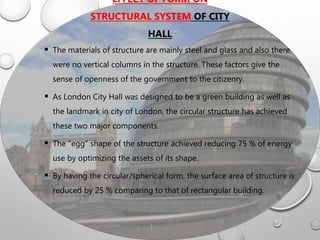
 The materials of structure are mainly steel and glass and also there
were no vertical columns in the structure. These factors give the
sense of openness of the government to the citizenry.
 As London City Hall was designed to be a green building as well as
the landmark in city of London, the circular structure has achieved
these two major components.
 The "egg" shape of the structure achieved reducing 75 % of energy
use by optimizing the assets of its shape.
 By having the circular/spherical form, the surface area of structure is
reduced by 25 % comparing to that of rectangular building.
EFFECT OF FORM ON
STRUCTURAL SYSTEM OF CITY
HALL
Blobitecture

Blobitecture

  • 1.
    CONTEMPRORY ARCHITECTURE :THEORY AND TRENDS BLOBITECTURE SHUBHAM SISODIYA FY M.ARCH
  • 2.
    A mashup ofthe words “blob” and “architecture,” blobitecture is the name for the architectural style of buildings designed with totally unique, organic forms, often resembling a blob or amoeba shape. This style of architecture is also often referred to as blob architecture, blobism or blobismus. WHAT IS BLOBITECTURE?
  • 3.
    Architect Greg Lynnwrote an essay, “blobs, or why tectonics is square and topology is groovy” for ANY magazine, where he describes his experiments using graphic software to create new, blob-like designs. With that essay, Lynn is credited with giving “blob architecture” its name. THE NAME “BLOBS”
  • 4.
    The first blobitecturebuilding was the fresh water pavilion, which was designed by Lars Spuybroek of NOX architects and built by Kas Oosterhuis in the Netherlands in 1993, it has a fully computer-based shape manufactured with computer-aided tools and an electronic interactive interior where sound and light can be transformed by the visitor. However, the idea of blob architecture was not introduced to the masses until 1995. HISTORY OF BLOBITECTURE
  • 5.
    If blobitecture isviewed from the formal aspect and not the technological aspect, it then belived to be began with Antoni Gaudi's organic designs in Barcelona. - Few critics belived that blob architecture came out of computer software; others related it to curved or odd- looking buildings such as Frank Gehry's Guggenheim museum in Biblao.
  • 6.
    Peter Eisenman Norman Foster MassimilianoFuksas Frank Gehry Zaha Hadid And Patrik Schumacher Jan Kaplický PIONEER ARCHITECTS OF BLOBITECTURE
  • 7.
    Freedom to createstructures that imitate nature’s creations, in which straight lines and right angles are the exception rather than the rule. Everyone has to admit that blobitecture is compelling – even if the observer is compelled to scream and run away. Aptly named future systems, it was never meant to complement the existing skyline; designers wanted an “architectural landmark” and they got it. PHILOSOPHY OF ARCHITECTS
  • 8.
    Whether it resemblesa beehive or a fish, the buildings certainly commanded attention. London’s new city hall was described by an ex-mayor as a “glass testicle” but there’s no denying that it’s a landmark unlike any other in London. It may be a sign of the British – and Londoners in particular – predilection for the upbeat and offbeat that has shown itself most forcibly in recent years, but the trend seems to be rising in the British isles as it is around the world.
  • 9.
    Steel and glassare major contributing materials in blob structures. New generation materials were invented as per need of the building as solar panels, color changing plastic blocks, glass panels with embedded led strips, etc. MATERIAL USED AND INVENTED IN BLOBITECTURE
  • 10.
    Water Pavilion (1993–1997)by Lars Spuybroek and Kas Oosterhuis. Experience Music Project, Seattle (1999-2000) by Frank O Gehry. FAMOUS EXAMPLES OF BLOBITECTURE
  • 11.
    BLOB ARCHITECTURE “TODAY” Blobitectureis a dynamic kind of architecture nevertheless extensively in use today. Blobitecture is not like any other architectural type since it entirely originates from pc-aided layout (CAD). In software package architect jobs, architects use CAD to manipulate buildings' outlines to almost any form. Whilst they do this, the software program automatically calculates mathematical equations that in still structural soundness into the style. Before cad's growth, architects adhered to mainstream geographical shapes given that they were self-assured of these shapes' structural stability. Now, thanks to CAD software program, a building's shape has boundless possibilities.
  • 12.
    CITY HALL, LONDONBY FOSTER & PARTNERS CAST STUDY OF BLOBITECTURE
  • 13.
    IMPORTANT FACTS ABOUTCITY HALL  Building materials used : Steel structural frame: 2,100 tons Concrete core: 13,100 sq m Cladding: 7,300 sq m of triple-glazed, low-emissivity clear glass  City Hall is part of the More London development located between London Bridge and Tower Bridge, on the south bank of the Thames.  Every element of building is designed to work alongside every other element, to keep the building cool or warm in an environmentally friendly way.
  • 14.
     The buildinghas no front or back – it’s a geometrically modified sphere, minimizing surface area of the roof exposed to direct sunlight, which reduces the amount of heat build up inside the building  It has around 25 per cent less surface area than a cube of the same volume. This means that less heat escapes during the winter, and the building doesn't get too hot in the summer  The building does not leave the river walking in shadow.  The floor plates at the back of the building are staggered inwards, providing natural shading for the floor beneath
  • 15.
    CITY HALL ASAN ENERGY EFFICIENT BUILDING  In 2007, solar photovoltaic panels (solar panels) were installed, generating energy with zero carbon emissions  ‘Voltage optimization’ technology has been installed to reduce the voltage used to the minimum required  Lighting improvements continue to be carried out: changing from 75 watt bulbs to 16 watt LEDs where possible  Movement sensors on all floors help ensure lights are switched off when areas aren’t occupied  ‘Boiler optimization' makes sure that they don't generate more heat than the building need.
  • 16.
     Smart metersallow energy use to be measured on a floor-by-floor basis. This will help target further energy efficiency improvements.  The building runs its cooling on a quarter of the energy used by a typical modern office building.  The building is naturally ventilated, with user operated vents beneath every window.  Heat generated by computers and lights is recycled.  Use of cold ground water to cool City Hall, which is very energy efficient.
  • 17.
    Underground Floor PlanGround Floor Plan Legend: 1. Parking 2. Storage rooms 3. Physical plant 4. Outdoor Amphi 5. Cafe 6. Information desk 7. Kitchen 8. Exhibition area 9. Committee room 10. Meeting room 11. Media center 12. Reception 13. Assembly chamber 14. Public viewing gallery 15. Library 16. Reading room
  • 18.
    Level Six FloorPlan Level Nine Floor Plan 17. IT room 18. Office 19. Open - plan area 20. Terrace 21. London's Room
  • 21.
     The materialsof structure are mainly steel and glass and also there were no vertical columns in the structure. These factors give the sense of openness of the government to the citizenry.  As London City Hall was designed to be a green building as well as the landmark in city of London, the circular structure has achieved these two major components.  The "egg" shape of the structure achieved reducing 75 % of energy use by optimizing the assets of its shape.  By having the circular/spherical form, the surface area of structure is reduced by 25 % comparing to that of rectangular building. EFFECT OF FORM ON STRUCTURAL SYSTEM OF CITY HALL