Acute Renal failure
Dr. Abhijeet Deshmukh
Dept. of Pediatrics
Pushpagiri Medical College & RC
Tiruvalla, Kerala
Definition
• A clinical syndrome in which a sudden
deterioration in renal function results in the
inability of the kidneys to maintain fluid and
electrolyte homeostasis.
• Also k/a Acute renal insufficiency
• 2-3% of children admitted to pediatric tertiary
care centres
• 8% of infants in neonatal ICU.
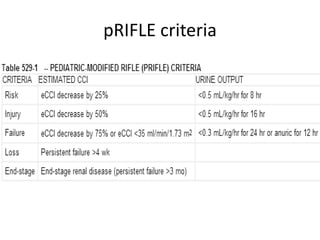
pRIFLE criteria
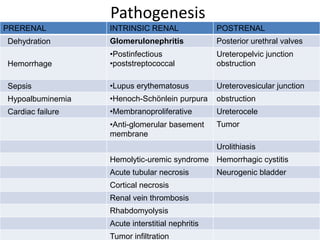
Pathogenesis
PRERENAL

INTRINSIC RENAL

POSTRENAL

Dehydration

Glomerulonephritis

Posterior urethral valves

Hemorrhage

•Postinfectious
•poststreptococcal

Ureteropelvic junction
obstruction

Sepsis

•Lupus erythematosus

Ureterovesicular junction

Hypoalbuminemia

•Henoch-Schönlein purpura

obstruction

Cardiac failure

•Membranoproliferative

Ureterocele

•Anti-glomerular basement
membrane

Tumor
Urolithiasis

Hemolytic-uremic syndrome Hemorrhagic cystitis

Acute tubular necrosis
Cortical necrosis
Renal vein thrombosis
Rhabdomyolysis

Acute interstitial nephritis
Tumor infiltration

Neurogenic bladder
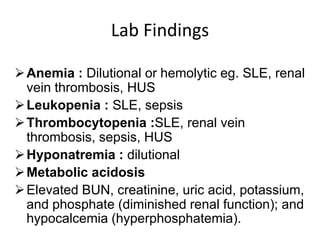
Lab Findings
 Anemia : Dilutional or hemolytic eg. SLE, renal
vein thrombosis, HUS
 Leukopenia : SLE, sepsis
 Thrombocytopenia :SLE, renal vein
thrombosis, sepsis, HUS
 Hyponatremia : dilutional
 Metabolic acidosis
 Elevated BUN, creatinine, uric acid, potassium,
and phosphate (diminished renal function); and
hypocalcemia (hyperphosphatemia).
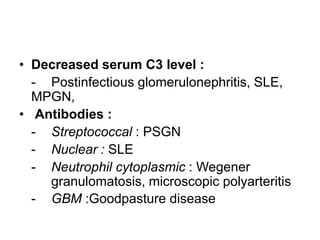
• Decreased serum C3 level :
- Postinfectious glomerulonephritis, SLE,
MPGN,
• Antibodies :
- Streptococcal : PSGN
- Nuclear : SLE
- Neutrophil cytoplasmic : Wegener
granulomatosis, microscopic polyarteritis
- GBM :Goodpasture disease
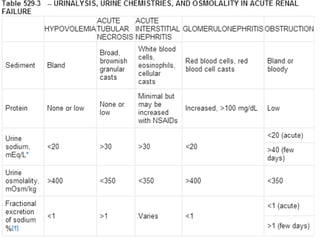
• Sensitivity and specificity of urine Na of <20
in differentiating prerenal azotemia from
acute tubular necrosis are 90% and 82%,
respectively.
• Fractional excretion of sodium
= urine:plasma (U/P) ratio of sodium divided
by U/P of creatinine × 100.
(sensitivity and specificity of fractional excretion of
sodium of <1% in differentiating prerenal
azotemia from acute tubular necrosis are 96%
and 95%, respectively)
• CXR : cardiomegaly, pulmonary
congestion (fluid overload) or pleural
effusions.
• Renal USG :
hydronephrosis /hydroureter,
Nephromegaly- s/o intrinsic renal disease.
• Renal biopsy : who do not have clearly
defined prerenal or postrenal ARF
• Other biomarkers:
- changes in plasma neutrophil
gelatinase-associated lipocalin (NGAL)
and cystatin C levels
- urinary changes in NGAL, interleukin18 (IL-18), and kidney injury molecule-1
(KIM-1).
Management
• Catheterization - in newborn with
suspected posterior ureteral valves &
nonambulatory older children.
If there is no evidence of volume
overload or cardiac failure, intravenous
administration of isotonic saline, 20 mL/kg
over 30 min.
hypovolemic patients generally void
within 2 hr after bolus; failure points to
intrinsic or postrenal ARF.
Hypotension due to sepsis - vigorous
fluid resuscitation f/b continuous infusion
of norepinephrine.
• Diuretic therapy :
 only after the adequate hydration.
 Mannitol (0.5 g/kg) and furosemide (2-4 mg/kg) - as a
single IV dose. [Mannitol - effective in pigment
(myoglobin, hemoglobin)-induced renal failure.]
 Bumetanide (0.1 mg/kg)- an alternative to furosemide.
If urine output is not improved - continuous diuretic
infusion may be considered.
 Consider Dopamine (2-3 µg/kg/min) in conjunction
with diuretic therapy.
 There is little evidence that diuretics or dopamine can
prevent ARF or hasten recovery.
• Hyperkalemia
• Sr K >6 mEq/L - cardiac arrhythmia, cardiac arrest, and death.
• Earliest ECG change - peaked T waves f/b widening of the QRS
intervals, ST segment depression, ventricular arrhythmias, and
cardiac arrest.
• Exogenous sources of K : dietary, intravenous fluids, total parenteral
nutrition) should be eliminated.
• Sodium polystyrene sulfonate resin (Kayexalate) : (1 g/kg) - orally or
by retention enema when Sr K>6 mEq/L
- exchanges sodium for potassium
- can take several hours to take effect. A single dose of 1 g/kg
can lower the sr K level by about 1 mEq/L.
- Resin therapy may be repeated every 2 hr, the frequency
being limited primarily by the risk of sodium overload.
• If Sr K >7 mEq/L : emergency measures in
addition to Kayexalate.
 Calcium gluconate 10% solution :
1.0 mL/kg IV, over 3-5 min
 Sodium bicarbonate :1-2 mEq/kg IV, over
5-10 min
 Regular insulin : 0.1 U/kg, with glucose
50% solution, 1 mL/kg, over 1 hr
• Mild metabolic acidosis:
common in ARF - rarely requires
treatment.
If severe (arterial pH < 7.15; serum
bicarbonate < 8 mEq/L) or contributes to
hyperkalemia it should be corrected.
• Hypocalcemia :
- Primarily treated by lowering the serum
phosphorus level.
- Calcium should not be given IV except
in cases of tetany, to avoid deposition of
calcium salts into tissues.
- Follow a low-phosphorus diet,
• Hyponatremia
- most commonly a dilutional
- must be corrected by fluid restriction.
- hypertonic (3%) saline - limited to
symptomatic hyponatremia
(seizures, lethargy) or those with a serum
sodium level <120 mEq/L.
• GI bleeding
 because of uremic platelet
dysfunction, increased stress, and heparin
exposure in hemodialysis.
 Oral or intravenous H2 blockerRanitidine.
• Hypertension

Common in ARF patients with acute
glomerulonephritis or HUS.
 Salt and water restriction, diuretics
 Isradipine (0.05-0.15 mg/kg/dose,
amlodipine, 0.1-0.6 mg/kg/24 hr qd or divided bid
propranolol, 0.5-8 mg/kg/24 hr divided bid or tid;
labetalol, 4-40 mg/kg/24 hr divided bid or tid
 severe symptomatic hypertension - continuous
infusions of sodium nitroprusside or esmolol
• Neurologic symptoms
 Headache, seizures, lethargy, and confusion
(encephalopathy).
 Potential etiologic factors - hyponatremia,
hypocalcemia, hypertension, cerebral
hemorrhage, cerebral vasculitis, and the
uremic state.
 Diazepam - most effective in controlling
seizures,
 Treat the underlying cause.
• Anemia of ARF
 generally mild
packed red blood cells if Hb < 7 g/dL
Slow (4-6 hr) transfusion with packed red
blood cells (10 mL/kg) diminishes the risk
of hypervolemia.
• Nutrition
 In most cases, sodium, potassium, and
phosphorus should be restricted.
Protein – restricted & caloric intake
maximised to minimize the accumulation
of nitrogenous wastes.
Critically ill patients with ARF - parenteral
essential amino acids given
• Protein :
 enough protein for growth - limiting high protein intake.
 Protein needs increase on dialysis.
 Foods with protein include
eggs
milk
cheese
chicken
fish
red meats
beans
yogurt
cottage cheese
• Sodium.
 Depend on stage of their kidney disease, their
age, and sometimes other factors.
 Foods high in sodium include
• canned foods
• some frozen foods
• most processed foods
• some snack foods, such as chips
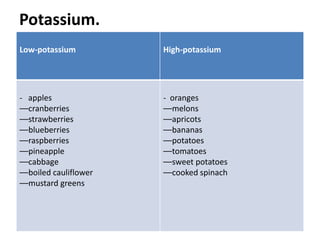
Potassium.
Low-potassium

High-potassium

- apples
––cranberries
––strawberries
––blueberries
––raspberries
––pineapple
––cabbage
––boiled cauliflower
––mustard greens

- oranges
––melons
––apricots
––bananas
––potatoes
––tomatoes
––sweet potatoes
––cooked spinach
Health care team
•
•
•
•
•
•
•
•

pediatrician
nephrologist
dialysis nurse
transplant coordinator
transplant surgeon
social worker
financial counselor
dietitian
Dialysis
• Indications
 Volume overload with evidence of hypertension
and/or pulmonary edema refractory to diuretic therapy
 Persistent hyperkalemia
 Severe metabolic acidosis unresponsive to medical
management
 Neurologic symptoms (altered mental status, seizures)
 Blood urea nitrogen >100-150 mg/dL (or lower if
rapidly rising)
 Calcium:phosphorus imbalance, with hypocalcemic
tetany
Thank You !
Referances
• Nelson Textbook of pediatrics 19 th edition
• Treatment Methods for Kidney Failure in
Children (National instt. of Diabetes & Kidney
disease)
Acute renal failure in children

Acute renal failure in children

  • 1.
    Acute Renal failure Dr.Abhijeet Deshmukh Dept. of Pediatrics Pushpagiri Medical College & RC Tiruvalla, Kerala
  • 2.
    Definition • A clinicalsyndrome in which a sudden deterioration in renal function results in the inability of the kidneys to maintain fluid and electrolyte homeostasis. • Also k/a Acute renal insufficiency • 2-3% of children admitted to pediatric tertiary care centres • 8% of infants in neonatal ICU.
  • 3.
  • 4.
    Pathogenesis PRERENAL INTRINSIC RENAL POSTRENAL Dehydration Glomerulonephritis Posterior urethralvalves Hemorrhage •Postinfectious •poststreptococcal Ureteropelvic junction obstruction Sepsis •Lupus erythematosus Ureterovesicular junction Hypoalbuminemia •Henoch-Schönlein purpura obstruction Cardiac failure •Membranoproliferative Ureterocele •Anti-glomerular basement membrane Tumor Urolithiasis Hemolytic-uremic syndrome Hemorrhagic cystitis Acute tubular necrosis Cortical necrosis Renal vein thrombosis Rhabdomyolysis Acute interstitial nephritis Tumor infiltration Neurogenic bladder
  • 5.
    Lab Findings  Anemia: Dilutional or hemolytic eg. SLE, renal vein thrombosis, HUS  Leukopenia : SLE, sepsis  Thrombocytopenia :SLE, renal vein thrombosis, sepsis, HUS  Hyponatremia : dilutional  Metabolic acidosis  Elevated BUN, creatinine, uric acid, potassium, and phosphate (diminished renal function); and hypocalcemia (hyperphosphatemia).
  • 6.
    • Decreased serumC3 level : - Postinfectious glomerulonephritis, SLE, MPGN, • Antibodies : - Streptococcal : PSGN - Nuclear : SLE - Neutrophil cytoplasmic : Wegener granulomatosis, microscopic polyarteritis - GBM :Goodpasture disease
  • 8.
    • Sensitivity andspecificity of urine Na of <20 in differentiating prerenal azotemia from acute tubular necrosis are 90% and 82%, respectively. • Fractional excretion of sodium = urine:plasma (U/P) ratio of sodium divided by U/P of creatinine × 100. (sensitivity and specificity of fractional excretion of sodium of <1% in differentiating prerenal azotemia from acute tubular necrosis are 96% and 95%, respectively)
  • 9.
    • CXR :cardiomegaly, pulmonary congestion (fluid overload) or pleural effusions. • Renal USG : hydronephrosis /hydroureter, Nephromegaly- s/o intrinsic renal disease. • Renal biopsy : who do not have clearly defined prerenal or postrenal ARF
  • 10.
    • Other biomarkers: -changes in plasma neutrophil gelatinase-associated lipocalin (NGAL) and cystatin C levels - urinary changes in NGAL, interleukin18 (IL-18), and kidney injury molecule-1 (KIM-1).
  • 11.
    Management • Catheterization -in newborn with suspected posterior ureteral valves & nonambulatory older children.
  • 12.
    If there isno evidence of volume overload or cardiac failure, intravenous administration of isotonic saline, 20 mL/kg over 30 min.
  • 13.
    hypovolemic patients generallyvoid within 2 hr after bolus; failure points to intrinsic or postrenal ARF. Hypotension due to sepsis - vigorous fluid resuscitation f/b continuous infusion of norepinephrine.
  • 14.
    • Diuretic therapy:  only after the adequate hydration.  Mannitol (0.5 g/kg) and furosemide (2-4 mg/kg) - as a single IV dose. [Mannitol - effective in pigment (myoglobin, hemoglobin)-induced renal failure.]  Bumetanide (0.1 mg/kg)- an alternative to furosemide. If urine output is not improved - continuous diuretic infusion may be considered.  Consider Dopamine (2-3 µg/kg/min) in conjunction with diuretic therapy.  There is little evidence that diuretics or dopamine can prevent ARF or hasten recovery.
  • 15.
    • Hyperkalemia • SrK >6 mEq/L - cardiac arrhythmia, cardiac arrest, and death. • Earliest ECG change - peaked T waves f/b widening of the QRS intervals, ST segment depression, ventricular arrhythmias, and cardiac arrest. • Exogenous sources of K : dietary, intravenous fluids, total parenteral nutrition) should be eliminated. • Sodium polystyrene sulfonate resin (Kayexalate) : (1 g/kg) - orally or by retention enema when Sr K>6 mEq/L - exchanges sodium for potassium - can take several hours to take effect. A single dose of 1 g/kg can lower the sr K level by about 1 mEq/L. - Resin therapy may be repeated every 2 hr, the frequency being limited primarily by the risk of sodium overload.
  • 16.
    • If SrK >7 mEq/L : emergency measures in addition to Kayexalate.  Calcium gluconate 10% solution : 1.0 mL/kg IV, over 3-5 min  Sodium bicarbonate :1-2 mEq/kg IV, over 5-10 min  Regular insulin : 0.1 U/kg, with glucose 50% solution, 1 mL/kg, over 1 hr
  • 17.
    • Mild metabolicacidosis: common in ARF - rarely requires treatment. If severe (arterial pH < 7.15; serum bicarbonate < 8 mEq/L) or contributes to hyperkalemia it should be corrected.
  • 18.
    • Hypocalcemia : -Primarily treated by lowering the serum phosphorus level. - Calcium should not be given IV except in cases of tetany, to avoid deposition of calcium salts into tissues. - Follow a low-phosphorus diet,
  • 19.
    • Hyponatremia - mostcommonly a dilutional - must be corrected by fluid restriction. - hypertonic (3%) saline - limited to symptomatic hyponatremia (seizures, lethargy) or those with a serum sodium level <120 mEq/L.
  • 20.
    • GI bleeding because of uremic platelet dysfunction, increased stress, and heparin exposure in hemodialysis.  Oral or intravenous H2 blockerRanitidine.
  • 21.
    • Hypertension  Common inARF patients with acute glomerulonephritis or HUS.  Salt and water restriction, diuretics  Isradipine (0.05-0.15 mg/kg/dose, amlodipine, 0.1-0.6 mg/kg/24 hr qd or divided bid propranolol, 0.5-8 mg/kg/24 hr divided bid or tid; labetalol, 4-40 mg/kg/24 hr divided bid or tid  severe symptomatic hypertension - continuous infusions of sodium nitroprusside or esmolol
  • 22.
    • Neurologic symptoms Headache, seizures, lethargy, and confusion (encephalopathy).  Potential etiologic factors - hyponatremia, hypocalcemia, hypertension, cerebral hemorrhage, cerebral vasculitis, and the uremic state.  Diazepam - most effective in controlling seizures,  Treat the underlying cause.
  • 23.
    • Anemia ofARF  generally mild packed red blood cells if Hb < 7 g/dL Slow (4-6 hr) transfusion with packed red blood cells (10 mL/kg) diminishes the risk of hypervolemia.
  • 24.
    • Nutrition  Inmost cases, sodium, potassium, and phosphorus should be restricted. Protein – restricted & caloric intake maximised to minimize the accumulation of nitrogenous wastes. Critically ill patients with ARF - parenteral essential amino acids given
  • 25.
    • Protein : enough protein for growth - limiting high protein intake.  Protein needs increase on dialysis.  Foods with protein include eggs milk cheese chicken fish red meats beans yogurt cottage cheese
  • 26.
    • Sodium.  Dependon stage of their kidney disease, their age, and sometimes other factors.  Foods high in sodium include • canned foods • some frozen foods • most processed foods • some snack foods, such as chips
  • 27.
    Potassium. Low-potassium High-potassium - apples ––cranberries ––strawberries ––blueberries ––raspberries ––pineapple ––cabbage ––boiled cauliflower ––mustardgreens - oranges ––melons ––apricots ––bananas ––potatoes ––tomatoes ––sweet potatoes ––cooked spinach
  • 28.
    Health care team • • • • • • • • pediatrician nephrologist dialysisnurse transplant coordinator transplant surgeon social worker financial counselor dietitian
  • 29.
    Dialysis • Indications  Volumeoverload with evidence of hypertension and/or pulmonary edema refractory to diuretic therapy  Persistent hyperkalemia  Severe metabolic acidosis unresponsive to medical management  Neurologic symptoms (altered mental status, seizures)  Blood urea nitrogen >100-150 mg/dL (or lower if rapidly rising)  Calcium:phosphorus imbalance, with hypocalcemic tetany
  • 30.
  • 31.
    Referances • Nelson Textbookof pediatrics 19 th edition • Treatment Methods for Kidney Failure in Children (National instt. of Diabetes & Kidney disease)