Childhood Asthma
Classification, Epidemiology, Etiology, Pathogenesis,
Clinical Features, Complications, Management
Prognosis and Prevention
Prof. Imran Iqbal
Fellowship in Pediatric Neurology (Australia)
Prof of Paediatrics (2003-2018)
Prof of Pediatrics Emeritus, CHICH
Prof of Pediatrics, CIMS
Multan, Pakistan
(God speaking to Prophet Muhammad (PBUH)
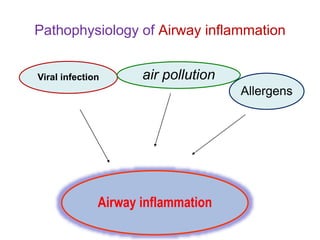
They ask you what they should spend. Say: whatever you spend for
good must be for parents and relatives and orphans and poor and
travelers; and whatever you do of good deeds, Allah knows it well
Al Quran surah Al-Baqara 2:215
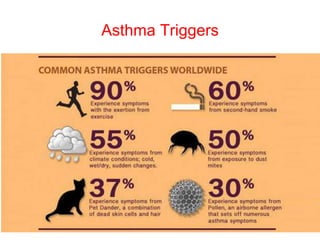
Case scenario 1
• Ten months old baby
• Runny nose – 5 days
• Cough and noisy breathing - 1 day
• History of two similar episodes in last two months
• Grandmother has bronchial asthma
• Examination
• Temperature 98 F
• Respiratory rate 60 / min, chest indrawing present
• Bilateral expiratory rhonchi
• What is your diagnosis ?
Case scenario 1
• 10 months old baby
• runny nose – 5 days
• cough and noisy breathing - 1 day
• History of one similar episode one month before
• Examination
• Temperature is 98 F.
• prolonged expiration
• Bilateral expiratory rhonchi.
• What is your diagnosis ?
• ASTHMA
• (Early onset)
• Likely to resolve in 2-4 years
Case scenario 2
• Six years old child
• Cough often since start of winter season
• Cough usually at night and in the morning
• Cough and shortness of breath starts when the child runs in school
• Examination,
• Temperature 98 F.
• Watery discharge in nose
• Expiratory rhonchi audible in chest
• What is your diagnosis ?
Case scenario 2
• 6 years old child
• Cough since start of winter season.
• Cough usually at night and in the morning
• Cough and shortness of breath starts when the child runs in school
• Examination,
• Temperature 98 F.
• Watery discharge in nose
• Expiratory rhonchi audible in chest
• What is your diagnosis ?
• ASTHMA (childhood onset)
• May resolve at puberty
ASTHMA - epidemiology
• Commonest respiratory disease of children
• Can start at any age
• Prevalence of asthma is increasing in children
• Prevalence of asthma in children in Pakistan = 20 %
ASTHMA
is a
chronic inflammatory condition
of lung airways
resulting in
episodic airway obstruction
Airway inflammation
produces
Hyper-reactivity of airways
to a variety of stimuli
resulting in
diffuse airway obstruction
which is reversible
spontaneously
or
as a result of treatment
Mechanism of Development of Asthma
Chronic inflammation
causes
Hyper-reactivity of airways
Viral infection air pollution
Allergens
Airway inflammation
Pathophysiology of Airway inflammation
Antigens incite Inflammatory Reaction and
Cytokines produce Airway inflammation
Etiology of Asthma
Genetic
factors
(predisposing
factors)
Allergy to
different
antigens
(genetic+
exposure)
Environmental
factors
(infection/air
pollution)
How is Bronchoconstriction produced in Asthma ?
Air way Inflammation
Bronchial hyper-responsiveness
Trigger stimulus
Airway narrowing
Precipitating stimuli (triggers of asthma)
• Infection
• Viral infections
• Allergens
• House dust
• Plant pollen
• Animal dander
• Wheat hay
• Foods
• Air temperature
• Cold air
• Air Pollution
• Dust
• Cigarettes
• Smoke
• Perfumes
• Physiological
• Exercise
• Stress
Asthma Triggers
How are the airways obstructed ?
Pathology
Air - Flow Obstruction in Asthma
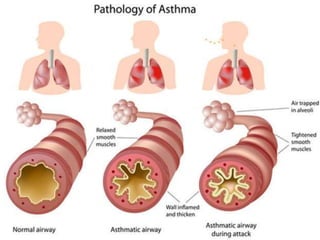
PATHOLOGY of Asthma
• Contraction of bronchial smooth muscle
• Mucosal edema
• Viscid mucus secretion
Contraction
of bronchial
smooth
muscle
Mucosal
edema
Viscid
mucus
secretion
Bronchial Airway
constriction
PATHOLOGY of Asthma
Clinical Features
SYMPTOMS
• COUGH
• WHEEZE
• BREATHLESSNESS
Differential Diagnosis
• COUGH can be due to many causes
• All that wheezes is not asthma
Causes of Cough
• Infections – viral / bacterial / mixed
• Allergy – asthma
• Environment – smoking / pollution
Causes of Recurrent / Persistent Cough
• Asthma
• Chronic irritation / Air pollution
• Postnasal discharge
• Repeated Viral Infection
• Recurrent Bacterial infection
• Whooping Cough
• Tuberculosis
Chronic Cough - Rare causes
• Foreign body
• GERD
• Cystic fibrosis
• Interstitial lung disease
• Hypersensitivity Pneumonitis
• Immunodeficiency
• Ciliary dyskinesia
• Habit cough
Causes of Wheezing
• Asthma
• Bronchiolitis
• Viral infections
• Foreign body
• GERD
• Heart failure
Diagnosis
DIAGNOSIS
• Diagnosis is Clinical on History and Examination
• RECURRENT / INTERMITTENT symptoms
• Signs of BRONCHIAL obstruction
• There may be NO signs at the time of examination
ASTHMA – symptom variability
Suggestive clinical features of Asthma
• Late night or early morning cough / breathlessness
• Breathlessness on Exercise
• Symptoms precipitated by viral colds
• Response to bronchodilators
• Family history of asthma / allergy
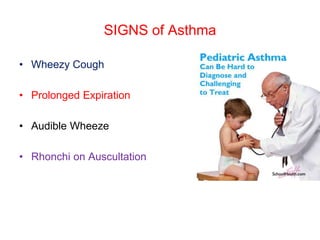
SIGNS of Asthma
• Wheezy Cough
• Prolonged Expiration
• Audible Wheeze
• Rhonchi on Auscultation
INVESTIGATIONS
• Asthma is Clinical diagnosis
• X-ray Chest – may show hyperinflation
• CBC – may show eosinophilia
• Serum IgE level – increased in allergy
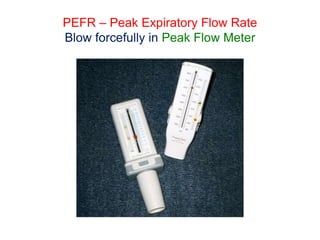
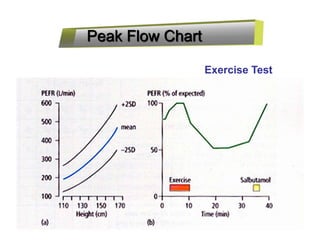
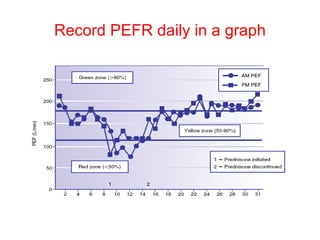
• PEFR (Peak Expiratory Flow Rate) – low in exacerbation
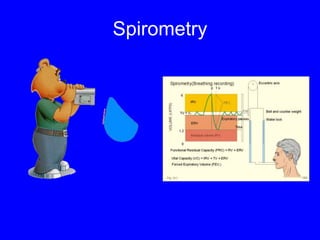
• Spirometry – Lung Function tests – low FEV1/FVC
PEFR – Peak Expiratory Flow Rate
Blow forcefully in Peak Flow Meter
Peak Flow Chart
Exercise Test
Spirometry
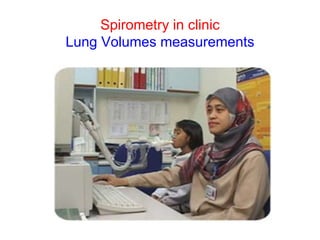
Spirometry in clinic
Lung Volumes measurements
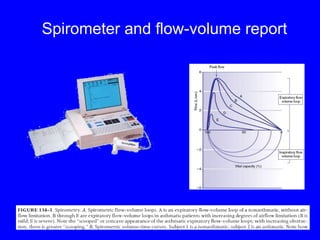
Spirometer and flow-volume report
FEV1 / FVC ratio
Complications of Asthma
• Bacterial bronchitis
• Pneumonia
• Respiratory failure
• Re-modelling of Airways
• Chest deformity
• Growth retardation
MANAGEMENT of ASTHMA
Asthma
is
underdiagnosed
and
undertreated
Assess the child with ASTHMA
• Onset of symptoms (duration)
• Acute exacerbations (frequency and severity of attacks)
• Daily symptoms (day / night – cough / wheeze / breathless)
• Physical Examination (Chest, Growth)
• PEFR (in clinic)
• Environment (allergens / pollution in house)
Asthma Management
• Educate the parents about the disease
• Avoid allergens and irritants
• Prevent infections
• Monitor daily symptoms
• Relieve symptoms (Quick-Reliever medication)
• Prevent exacerbations (Controller / Preventer medication)
EDUCATE THE PARENTS
• Asthma is a chronic disease
• Many children get better as they get older
• Regular treatment and prevention increases cure rate
• Asthma triggers should be avoided
• Treatment will need to be increased or decreased with
severity of symptoms
• Signs of worsening of Asthma must be recognized and
appropriate treatment started
Avoid Allergens in House
• Dust in house
• Smoke / smoking of cigarettes
• Carpets in house
• Birds (pigeons, parrots)
• Animals (cats)
• Cold air
• Ice-cream
• Cold drinks
• Any foods known to start symptoms
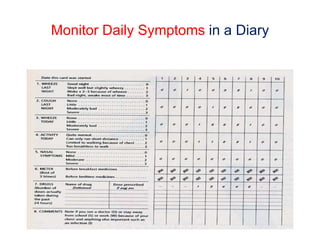
Monitor Daily Symptoms in a Diary
Record PEFR daily in a graph
Asthma Medications
• Bronchodilator
– Beta – stimulants – Short-acting (Salbutamol), SABA
-- Long-acting (LABA)
– Theophylline
• Anti – inflammatory
– LTRA (Leukotriene Receptor Antagonist) - Monteleukast
– Inhaled steroids (beclomethasone, budesonide)
– Oral steroids
 Bronchodilator and Anti – inflammatory, both are needed for
control of Asthma
 Bronchodilator and Anti-inflammatory medications should be
started together in all children with Asthma
Asthma Medications
• Quick-Reliever medication – for relief of symptoms
(bronchodilator)
– Salbutamol / Short – acting Beta – stimulants (SABA)
– Theophylline
– Oral steroids
• Controller / Preventer medication – to Control
inflammation and Prevent exacerbations
– Monteleukast / LTRA (Leukotriene Receptor Antagonist)
– Inhaled steroids (beclomethasone, budesonide)
– LABA (long acting beta agonists)
Assess and Manage Acute Asthma
Asthma Exacerbations - (non-severe)
• Assess severity of problem
• Give nebulized salbutamol
• Oral doxophylline
• Monteleukast
• Start oral prednisolone – if no persistent relief by nebulization
Asthma Exacerbations - (severe)
• Monitor severity of illness
• Oxygen
• Frequent salbutamol nebulization
• IM hydrocortisone
• Oral Prednisolone
• Monteleukast
• Antibiotics if needed
Asthma Exacerbations - (life-threatening)
Status Asthmaticus
• Admit in hospital / PICU
• Oxygen
• IV fluids
• Frequent salbutamol nebulization
• Nebulize Ipratropium bromide
• IV hydrocortisone
• IV methylprednisolone
• IV Aminophylline
• IV magnesium Sulphate
• Antibiotics
Long-term Asthma Management
• Classify severity of symptoms –
-- intermittent, persistent (mild, moderate, severe)
• Give Monteleukast / Inhaled steroids / LABA as needed
• Step up or step down treatment as needed
• Treat exacerbations: salbutamol / SABA
oral steroids
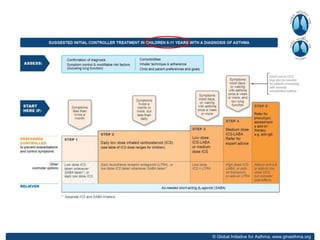
Classification of Long-term Asthma Symptoms
Severity of
Asthma
Day Symptoms
Night time
symptoms
TREATMENT
Step 4
Severe
Persistent
Asthma
Continuous symptoms:
Limited physical activity
Frequent
Beta agonists
Monteleukast
Inhaled steroids
Oral steroids
Step 3
Moderate
Persistent
Asthma
Daily symptoms:
Attacks daily affect
activity
More than 1 time
a week
LABA
Monteleukast
Inhaled steroids
Step 2
Mild
Persistent
Asthma
Symptoms more than
once a week but less
than once a day.
More than 3
times a month
Monteleukast
or
Inhaled steroids
Step 1
Mild
Intermittent
Asthma
Symptoms less than
once a week.
Asymptomatic and
normal between attacks
Less than 3
times a month.
BRONCHODILATORS
and Montelukast
as needed
© Global Initiative for Asthma, www.ginasthma.org
GINA 2020, Box 3-4C
Evaluate Asthma Control
Prevention of Asthma
• Breastfeeding
• Control smoking, air pollution
• Avoid dust, carpets, perfumes
• No birds, pets in house
• Avoid exposure to cold air
• Avoid Foods guided by individual experience
?

Childhood asthma 2021

  • 1.
    Childhood Asthma Classification, Epidemiology,Etiology, Pathogenesis, Clinical Features, Complications, Management Prognosis and Prevention Prof. Imran Iqbal Fellowship in Pediatric Neurology (Australia) Prof of Paediatrics (2003-2018) Prof of Pediatrics Emeritus, CHICH Prof of Pediatrics, CIMS Multan, Pakistan
  • 2.
    (God speaking toProphet Muhammad (PBUH) They ask you what they should spend. Say: whatever you spend for good must be for parents and relatives and orphans and poor and travelers; and whatever you do of good deeds, Allah knows it well Al Quran surah Al-Baqara 2:215
  • 3.
    Case scenario 1 •Ten months old baby • Runny nose – 5 days • Cough and noisy breathing - 1 day • History of two similar episodes in last two months • Grandmother has bronchial asthma • Examination • Temperature 98 F • Respiratory rate 60 / min, chest indrawing present • Bilateral expiratory rhonchi • What is your diagnosis ?
  • 4.
    Case scenario 1 •10 months old baby • runny nose – 5 days • cough and noisy breathing - 1 day • History of one similar episode one month before • Examination • Temperature is 98 F. • prolonged expiration • Bilateral expiratory rhonchi. • What is your diagnosis ? • ASTHMA • (Early onset) • Likely to resolve in 2-4 years
  • 5.
    Case scenario 2 •Six years old child • Cough often since start of winter season • Cough usually at night and in the morning • Cough and shortness of breath starts when the child runs in school • Examination, • Temperature 98 F. • Watery discharge in nose • Expiratory rhonchi audible in chest • What is your diagnosis ?
  • 6.
    Case scenario 2 •6 years old child • Cough since start of winter season. • Cough usually at night and in the morning • Cough and shortness of breath starts when the child runs in school • Examination, • Temperature 98 F. • Watery discharge in nose • Expiratory rhonchi audible in chest • What is your diagnosis ? • ASTHMA (childhood onset) • May resolve at puberty
  • 7.
    ASTHMA - epidemiology •Commonest respiratory disease of children • Can start at any age • Prevalence of asthma is increasing in children • Prevalence of asthma in children in Pakistan = 20 %
  • 8.
    ASTHMA is a chronic inflammatorycondition of lung airways resulting in episodic airway obstruction
  • 9.
    Airway inflammation produces Hyper-reactivity ofairways to a variety of stimuli resulting in diffuse airway obstruction which is reversible spontaneously or as a result of treatment
  • 10.
    Mechanism of Developmentof Asthma Chronic inflammation causes Hyper-reactivity of airways
  • 11.
    Viral infection airpollution Allergens Airway inflammation Pathophysiology of Airway inflammation
  • 12.
    Antigens incite InflammatoryReaction and Cytokines produce Airway inflammation
  • 13.
    Etiology of Asthma Genetic factors (predisposing factors) Allergyto different antigens (genetic+ exposure) Environmental factors (infection/air pollution)
  • 14.
    How is Bronchoconstrictionproduced in Asthma ? Air way Inflammation Bronchial hyper-responsiveness Trigger stimulus Airway narrowing
  • 15.
    Precipitating stimuli (triggersof asthma) • Infection • Viral infections • Allergens • House dust • Plant pollen • Animal dander • Wheat hay • Foods • Air temperature • Cold air • Air Pollution • Dust • Cigarettes • Smoke • Perfumes • Physiological • Exercise • Stress
  • 17.
  • 18.
    How are theairways obstructed ? Pathology
  • 19.
    Air - FlowObstruction in Asthma
  • 20.
    PATHOLOGY of Asthma •Contraction of bronchial smooth muscle • Mucosal edema • Viscid mucus secretion
  • 21.
  • 23.
  • 24.
  • 25.
    Differential Diagnosis • COUGHcan be due to many causes • All that wheezes is not asthma
  • 26.
    Causes of Cough •Infections – viral / bacterial / mixed • Allergy – asthma • Environment – smoking / pollution
  • 27.
    Causes of Recurrent/ Persistent Cough • Asthma • Chronic irritation / Air pollution • Postnasal discharge • Repeated Viral Infection • Recurrent Bacterial infection • Whooping Cough • Tuberculosis
  • 28.
    Chronic Cough -Rare causes • Foreign body • GERD • Cystic fibrosis • Interstitial lung disease • Hypersensitivity Pneumonitis • Immunodeficiency • Ciliary dyskinesia • Habit cough
  • 29.
    Causes of Wheezing •Asthma • Bronchiolitis • Viral infections • Foreign body • GERD • Heart failure
  • 30.
  • 31.
    DIAGNOSIS • Diagnosis isClinical on History and Examination • RECURRENT / INTERMITTENT symptoms • Signs of BRONCHIAL obstruction • There may be NO signs at the time of examination
  • 32.
    ASTHMA – symptomvariability
  • 33.
    Suggestive clinical featuresof Asthma • Late night or early morning cough / breathlessness • Breathlessness on Exercise • Symptoms precipitated by viral colds • Response to bronchodilators • Family history of asthma / allergy
  • 34.
    SIGNS of Asthma •Wheezy Cough • Prolonged Expiration • Audible Wheeze • Rhonchi on Auscultation
  • 35.
    INVESTIGATIONS • Asthma isClinical diagnosis • X-ray Chest – may show hyperinflation • CBC – may show eosinophilia • Serum IgE level – increased in allergy • PEFR (Peak Expiratory Flow Rate) – low in exacerbation • Spirometry – Lung Function tests – low FEV1/FVC
  • 36.
    PEFR – PeakExpiratory Flow Rate Blow forcefully in Peak Flow Meter
  • 37.
  • 38.
  • 39.
    Spirometry in clinic LungVolumes measurements
  • 40.
  • 41.
  • 42.
    Complications of Asthma •Bacterial bronchitis • Pneumonia • Respiratory failure • Re-modelling of Airways • Chest deformity • Growth retardation
  • 43.
  • 44.
  • 45.
    Assess the childwith ASTHMA • Onset of symptoms (duration) • Acute exacerbations (frequency and severity of attacks) • Daily symptoms (day / night – cough / wheeze / breathless) • Physical Examination (Chest, Growth) • PEFR (in clinic) • Environment (allergens / pollution in house)
  • 46.
    Asthma Management • Educatethe parents about the disease • Avoid allergens and irritants • Prevent infections • Monitor daily symptoms • Relieve symptoms (Quick-Reliever medication) • Prevent exacerbations (Controller / Preventer medication)
  • 47.
    EDUCATE THE PARENTS •Asthma is a chronic disease • Many children get better as they get older • Regular treatment and prevention increases cure rate • Asthma triggers should be avoided • Treatment will need to be increased or decreased with severity of symptoms • Signs of worsening of Asthma must be recognized and appropriate treatment started
  • 48.
    Avoid Allergens inHouse • Dust in house • Smoke / smoking of cigarettes • Carpets in house • Birds (pigeons, parrots) • Animals (cats) • Cold air • Ice-cream • Cold drinks • Any foods known to start symptoms
  • 49.
  • 50.
  • 51.
    Asthma Medications • Bronchodilator –Beta – stimulants – Short-acting (Salbutamol), SABA -- Long-acting (LABA) – Theophylline • Anti – inflammatory – LTRA (Leukotriene Receptor Antagonist) - Monteleukast – Inhaled steroids (beclomethasone, budesonide) – Oral steroids  Bronchodilator and Anti – inflammatory, both are needed for control of Asthma  Bronchodilator and Anti-inflammatory medications should be started together in all children with Asthma
  • 52.
    Asthma Medications • Quick-Relievermedication – for relief of symptoms (bronchodilator) – Salbutamol / Short – acting Beta – stimulants (SABA) – Theophylline – Oral steroids • Controller / Preventer medication – to Control inflammation and Prevent exacerbations – Monteleukast / LTRA (Leukotriene Receptor Antagonist) – Inhaled steroids (beclomethasone, budesonide) – LABA (long acting beta agonists)
  • 53.
    Assess and ManageAcute Asthma
  • 54.
    Asthma Exacerbations -(non-severe) • Assess severity of problem • Give nebulized salbutamol • Oral doxophylline • Monteleukast • Start oral prednisolone – if no persistent relief by nebulization
  • 55.
    Asthma Exacerbations -(severe) • Monitor severity of illness • Oxygen • Frequent salbutamol nebulization • IM hydrocortisone • Oral Prednisolone • Monteleukast • Antibiotics if needed
  • 56.
    Asthma Exacerbations -(life-threatening) Status Asthmaticus • Admit in hospital / PICU • Oxygen • IV fluids • Frequent salbutamol nebulization • Nebulize Ipratropium bromide • IV hydrocortisone • IV methylprednisolone • IV Aminophylline • IV magnesium Sulphate • Antibiotics
  • 57.
    Long-term Asthma Management •Classify severity of symptoms – -- intermittent, persistent (mild, moderate, severe) • Give Monteleukast / Inhaled steroids / LABA as needed • Step up or step down treatment as needed • Treat exacerbations: salbutamol / SABA oral steroids
  • 58.
    Classification of Long-termAsthma Symptoms Severity of Asthma Day Symptoms Night time symptoms TREATMENT Step 4 Severe Persistent Asthma Continuous symptoms: Limited physical activity Frequent Beta agonists Monteleukast Inhaled steroids Oral steroids Step 3 Moderate Persistent Asthma Daily symptoms: Attacks daily affect activity More than 1 time a week LABA Monteleukast Inhaled steroids Step 2 Mild Persistent Asthma Symptoms more than once a week but less than once a day. More than 3 times a month Monteleukast or Inhaled steroids Step 1 Mild Intermittent Asthma Symptoms less than once a week. Asymptomatic and normal between attacks Less than 3 times a month. BRONCHODILATORS and Montelukast as needed
  • 59.
    © Global Initiativefor Asthma, www.ginasthma.org GINA 2020, Box 3-4C
  • 60.
  • 61.
  • 62.
    Prevention of Asthma •Breastfeeding • Control smoking, air pollution • Avoid dust, carpets, perfumes • No birds, pets in house • Avoid exposure to cold air • Avoid Foods guided by individual experience
  • 63.

Editor's Notes

  • #41 40
  • #60 Explain that, once initial treatment is started, it is important to revert to the main treatment figure for the prompts in the arrowed circle (Assess, Adjust, Review response). Treatment is not just about pharmacotherapy