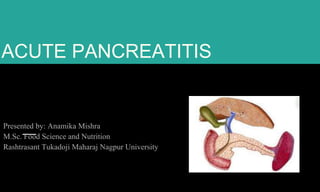
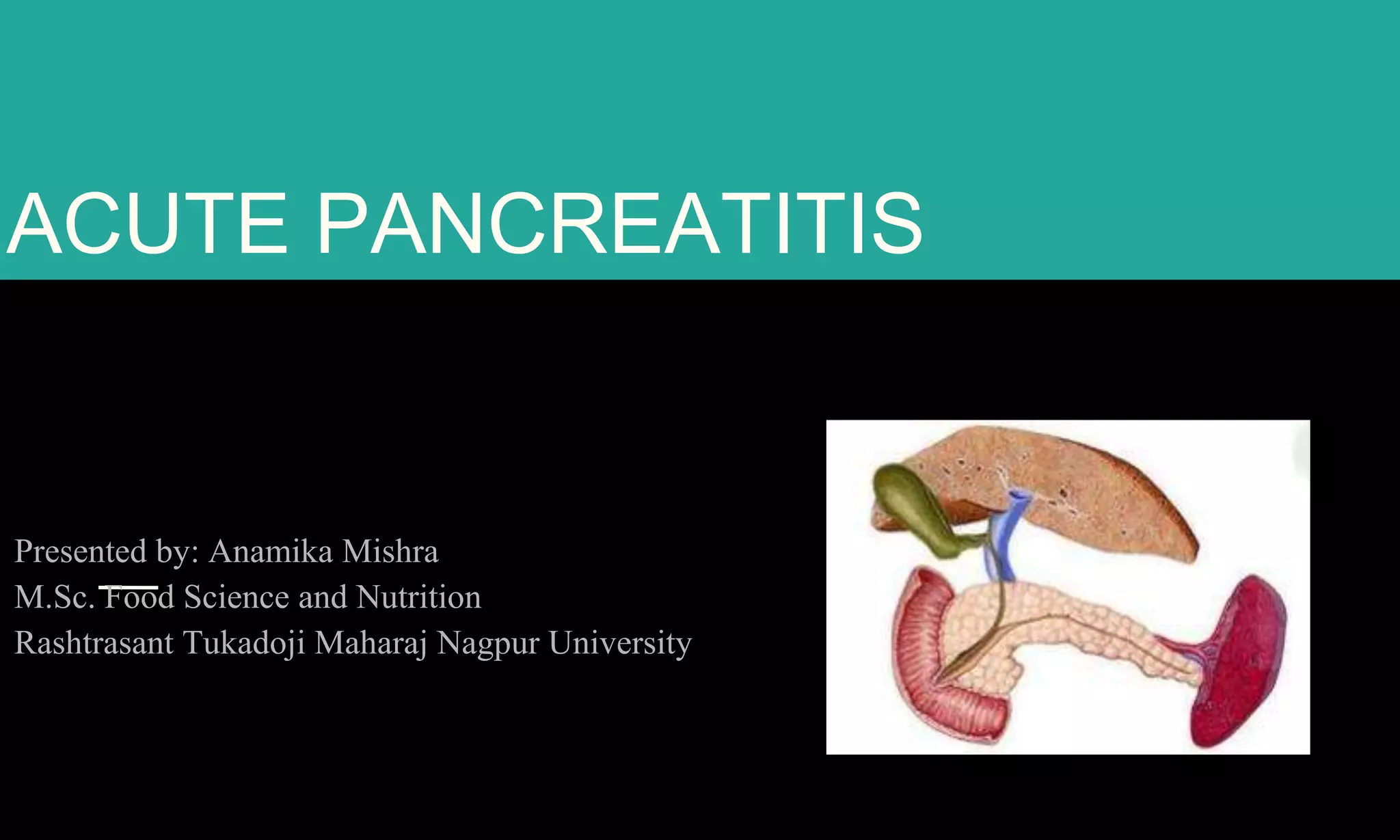
ACUTE PANCREATITIS
Presented by: Anamika Mishra
M.Sc. Food Science and Nutrition
Rashtrasant Tukadoji Maharaj Nagpur University
Pancreatitis
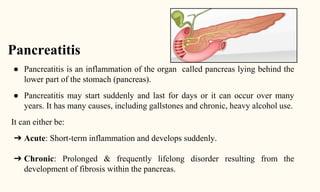
● Pancreatitis is an inflammation of the organ called pancreas lying behind the
lower part of the stomach (pancreas).
● Pancreatitis may start suddenly and last for days or it can occur over many
years. It has many causes, including gallstones and chronic, heavy alcohol use.
It can either be:
➔ Acute: Short-term inflammation and develops suddenly.
➔ Chronic: Prolonged & frequently lifelong disorder resulting from the
development of fibrosis within the pancreas.
Pancreas
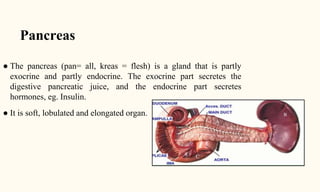
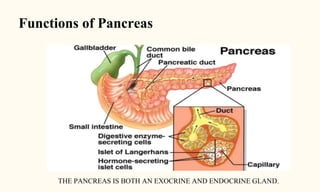
● The pancreas (pan= all, kreas = flesh) is a gland that is partly
exocrine and partly endocrine. The exocrine part secretes the
digestive pancreatic juice, and the endocrine part secretes
hormones, eg. Insulin.
● It is soft, lobulated and elongated organ.
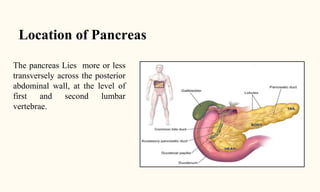
Location of Pancreas
The pancreas Lies more or less
transversely across the posterior
abdominal wall, at the level of
first and second lumbar
vertebrae.
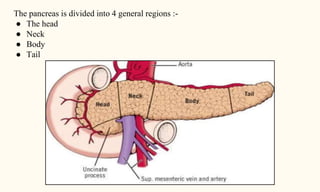
The pancreas is divided into 4 general regions :-
● The head
● Neck
● Body
● Tail
Functions of Pancreas
THE PANCREAS IS BOTH AN EXOCRINE AND ENDOCRINE GLAND.
Exocrine Secretion
● Exocrine activities consist of the production of enzymes that are part of the
alkaline pancreatic juice and support the digestion of food in the intestine.
● The composition of pancreatic juice includes enzymes that digest proteins, fats,
CHO and nucleic acid as well as electrolytes, small amount of mucus.
● Digestion of protein: proteolytic enzymes (trypsin, chymotrypsin,
carboxypeptidase and elastase).
● Digestion of Fats: Lipase, Phospholipase and esterase.
● Digestion of CHO: Lactase and Amylase.
Regulation of Pancreas
Stimulated by the parasympathetic system and inhibited by the sympathetic
system.
● Stimulation occurs when we see, smell or taste food, or when the stomach wall
is stretched.
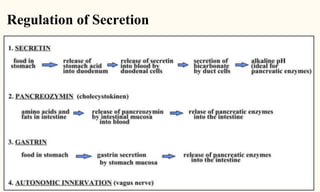
● Gastric acid is the stimulus for the release of secretin from the duodenum,
which stimulates the secretion of water and electrolytes from pancreatic ductal
cells.
● Release of cholecystokinin (CCK) from the duodenum and proximal jejunum
is triggered by Long chain fatty acid (LCFA), certain essential amino acids and
gastric acid itself.
● CCK evokes an enzyme-rich secretion from acinar cells in the pancreas.
Regulation of Secretion
Endocrine Secretions
● Distributed throughout the gland are groups of specialised cells called the
pancreatic islets (islets of langerhans).
● The islets have no ducts so the hormones diffuse directly into the blood.
● Pancreatic endocrine cells regulate carbohydrate, fat, protein metabolism:
● Alpha cells - glucagon
Beta cells - insulin
Delta cells - gastrin and somatostatin
F cells - pancreatic polypeptide
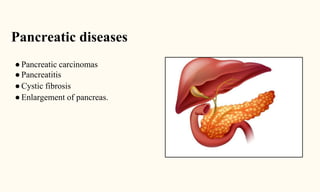
Pancreatic diseases
● Pancreatic carcinomas
● Pancreatitis
● Cystic fibrosis
● Enlargement of pancreas.
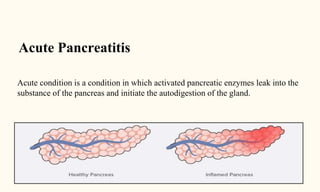
Acute Pancreatitis
Acute condition is a condition in which activated pancreatic enzymes leak into the
substance of the pancreas and initiate the autodigestion of the gland.
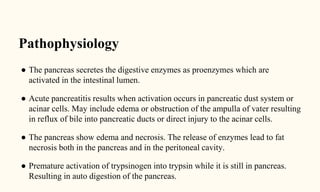
Pathophysiology
● The pancreas secretes the digestive enzymes as proenzymes which are
activated in the intestinal lumen.
● Acute pancreatitis results when activation occurs in pancreatic dust system or
acinar cells. May include edema or obstruction of the ampulla of vater resulting
in reflux of bile into pancreatic ducts or direct injury to the acinar cells.
● The pancreas show edema and necrosis. The release of enzymes lead to fat
necrosis both in the pancreas and in the peritoneal cavity.
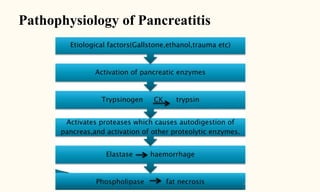
● Premature activation of trypsinogen into trypsin while it is still in pancreas.
Resulting in auto digestion of the pancreas.
Pathophysiology of Pancreatitis
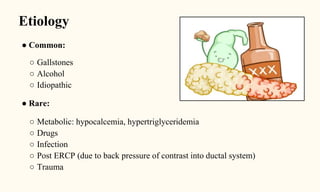
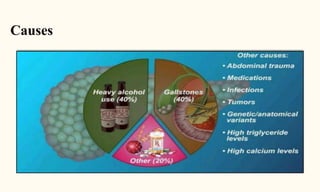
Etiology
● Common:
○ Gallstones
○ Alcohol
○ Idiopathic
● Rare:
○ Metabolic: hypocalcemia, hypertriglyceridemia
○ Drugs
○ Infection
○ Post ERCP (due to back pressure of contrast into ductal system)
○ Trauma
Causes
Patient Profile
● Name: XYZ
● Age: 30Yrs.
● Sex: Male
● Weight: 82Kgs.
● Height: 170 cms
● Occupation: Bank Service
● Type of Work: Sedentary
● Patient was habitual with drinking alcohol since 1-2yrs. & Consumption of
outside food.
Clinical Symptoms
● Pain in abdomen over epigastric region.
● 4-6 episodes of vomiting.
● Irregular bowel movements.
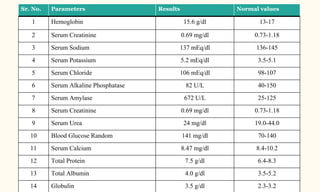
Laboratory Reports contd.
Sr. No. Parameters Results Normal values
1 Hemoglobin 15.6 g/dl 13-17
2 Serum Creatinine 0.69 mg/dl 0.73-1.18
3 Serum Sodium 137 mEq/dl 136-145
4 Serum Potassium 5.2 mEq/dl 3.5-5.1
5 Serum Chloride 106 mEq/dl 98-107
6 Serum Alkaline Phosphatase 82 U/L 40-150
7 Serum Amylase 672 U/L 25-125
8 Serum Creatinine 0.69 mg/dl 0.73-1.18
9 Serum Urea 24 mg/dl 19.0-44.0
10 Blood Glucose Random 141 mg/dl 70-140
11 Serum Calcium 8.47 mg/dl 8.4-10.2
12 Total Protein 7.5 g/dl 6.4-8.3
13 Total Albumin 4.0 g/dl 3.5-5.2
14 Globulin 3.5 g/dl 2.3-3.2
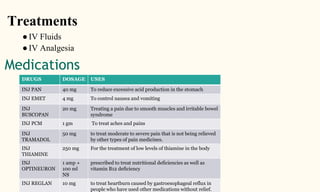
Treatments
● IV Fluids
● IV Analgesia
Medications
DRUGS DOSAGE USES
INJ PAN 40 mg To reduce excessive acid production in the stomach
INJ EMET 4 mg To control nausea and vomiting
INJ
BUSCOPAN
20 mg Treating a pain due to smooth muscles and irritable bowel
syndrome
INJ PCM 1 gm To treat aches and pains
INJ
TRAMADOL
50 mg to treat moderate to severe pain that is not being relieved
by other types of pain medicines.
INJ
THIAMINE
250 mg For the treatment of low levels of thiamine in the body
INJ
OPTINEURON
1 amp +
100 ml
NS
prescribed to treat nutritional deficiencies as well as
vitamin B12 deficiency
INJ REGLAN 10 mg to treat heartburn caused by gastroesophageal reflux in
people who have used other medications without relief.
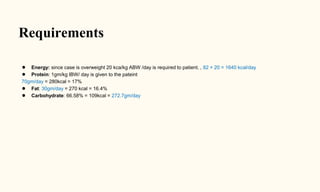
Requirements
● Energy: since case is overweight 20 kca/kg ABW /day is required to patient. , 82 × 20 = 1640 kcal/day
● Protein: 1gm/kg IBW/ day is given to the pateint
70gm/day = 280kcal = 17%
● Fat: 30gm/day = 270 kcal = 16.4%
● Carbohydrate: 66.58% = 109kcal = 272.7gm/day
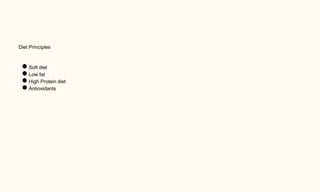
Diet Principles
●Soft diet
●Low fat
●High Protein diet
●Antioxidants
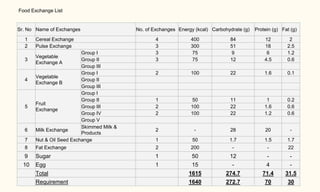
Food Exchange List
Sr. No Name of Exchanges No. of Exchanges Energy (kcal) Carbohydrate (g) Protein (g) Fat (g)
1 Cereal Exchange 4 400 84 12 2
2 Pulse Exchange 3 300 51 18 2.5
3
Vegetable
Exchange A
Group I 3 75 9 6 1.2
Group II 3 75 12 4.5 0.6
Group III
4
Vegetable
Exchange B
Group I 2 100 22 1.6 0.1
Group II
Group III
5
Fruit
Exchange
Group I
Group II 1 50 11 1 0.2
Group III 2 100 22 1.6 0.6
Group IV 2 100 22 1.2 0.6
Group V
6 Milk Exchange
Skimmed Milk &
Products
2 - 28 20 -
7 Nut & Oil Seed Exchange 1 50 1.7 1.5 1.7
8 Fat Exchange 2 200 - - 22
9 Sugar 1 50 12 - -
10 Egg 1 15 - 4 -
Total 1615 274.7 71.4 31.5
Requirement 1640 272.7 70 30
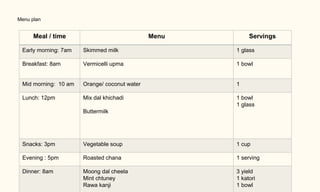
Menu plan
Meal / time Menu Servings
Early morning: 7am Skimmed milk 1 glass
Breakfast: 8am Vermicelli upma 1 bowl
Mid morning: 10 am Orange/ coconut water 1
Lunch: 12pm Mix dal khichadi
Buttermilk
1 bowl
1 glass
Snacks: 3pm Vegetable soup 1 cup
Evening : 5pm Roasted chana 1 serving
Dinner: 8am Moong dal cheela
Mint chtuney
Rawa kanji
3 yield
1 katori
1 bowl
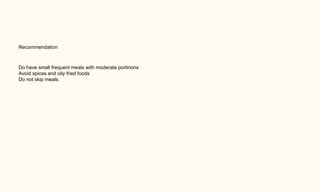
Recommendation
Do have small frequent meals with moderate portinons
Avoid spices and oily fried foods
Do not skip meals.

Acute pancreatitis.pptx

  • 1.
    ACUTE PANCREATITIS Presented by:Anamika Mishra M.Sc. Food Science and Nutrition Rashtrasant Tukadoji Maharaj Nagpur University
  • 2.
    Pancreatitis ● Pancreatitis isan inflammation of the organ called pancreas lying behind the lower part of the stomach (pancreas). ● Pancreatitis may start suddenly and last for days or it can occur over many years. It has many causes, including gallstones and chronic, heavy alcohol use. It can either be: ➔ Acute: Short-term inflammation and develops suddenly. ➔ Chronic: Prolonged & frequently lifelong disorder resulting from the development of fibrosis within the pancreas.
  • 3.
    Pancreas ● The pancreas(pan= all, kreas = flesh) is a gland that is partly exocrine and partly endocrine. The exocrine part secretes the digestive pancreatic juice, and the endocrine part secretes hormones, eg. Insulin. ● It is soft, lobulated and elongated organ.
  • 4.
    Location of Pancreas Thepancreas Lies more or less transversely across the posterior abdominal wall, at the level of first and second lumbar vertebrae.
  • 5.
    The pancreas isdivided into 4 general regions :- ● The head ● Neck ● Body ● Tail
  • 6.
    Functions of Pancreas THEPANCREAS IS BOTH AN EXOCRINE AND ENDOCRINE GLAND.
  • 7.
    Exocrine Secretion ● Exocrineactivities consist of the production of enzymes that are part of the alkaline pancreatic juice and support the digestion of food in the intestine. ● The composition of pancreatic juice includes enzymes that digest proteins, fats, CHO and nucleic acid as well as electrolytes, small amount of mucus. ● Digestion of protein: proteolytic enzymes (trypsin, chymotrypsin, carboxypeptidase and elastase). ● Digestion of Fats: Lipase, Phospholipase and esterase. ● Digestion of CHO: Lactase and Amylase.
  • 8.
    Regulation of Pancreas Stimulatedby the parasympathetic system and inhibited by the sympathetic system. ● Stimulation occurs when we see, smell or taste food, or when the stomach wall is stretched. ● Gastric acid is the stimulus for the release of secretin from the duodenum, which stimulates the secretion of water and electrolytes from pancreatic ductal cells. ● Release of cholecystokinin (CCK) from the duodenum and proximal jejunum is triggered by Long chain fatty acid (LCFA), certain essential amino acids and gastric acid itself. ● CCK evokes an enzyme-rich secretion from acinar cells in the pancreas.
  • 9.
  • 10.
    Endocrine Secretions ● Distributedthroughout the gland are groups of specialised cells called the pancreatic islets (islets of langerhans). ● The islets have no ducts so the hormones diffuse directly into the blood. ● Pancreatic endocrine cells regulate carbohydrate, fat, protein metabolism: ● Alpha cells - glucagon Beta cells - insulin Delta cells - gastrin and somatostatin F cells - pancreatic polypeptide
  • 11.
    Pancreatic diseases ● Pancreaticcarcinomas ● Pancreatitis ● Cystic fibrosis ● Enlargement of pancreas.
  • 12.
    Acute Pancreatitis Acute conditionis a condition in which activated pancreatic enzymes leak into the substance of the pancreas and initiate the autodigestion of the gland.
  • 13.
    Pathophysiology ● The pancreassecretes the digestive enzymes as proenzymes which are activated in the intestinal lumen. ● Acute pancreatitis results when activation occurs in pancreatic dust system or acinar cells. May include edema or obstruction of the ampulla of vater resulting in reflux of bile into pancreatic ducts or direct injury to the acinar cells. ● The pancreas show edema and necrosis. The release of enzymes lead to fat necrosis both in the pancreas and in the peritoneal cavity. ● Premature activation of trypsinogen into trypsin while it is still in pancreas. Resulting in auto digestion of the pancreas.
  • 14.
  • 15.
    Etiology ● Common: ○ Gallstones ○Alcohol ○ Idiopathic ● Rare: ○ Metabolic: hypocalcemia, hypertriglyceridemia ○ Drugs ○ Infection ○ Post ERCP (due to back pressure of contrast into ductal system) ○ Trauma
  • 16.
  • 17.
    Patient Profile ● Name:XYZ ● Age: 30Yrs. ● Sex: Male ● Weight: 82Kgs. ● Height: 170 cms ● Occupation: Bank Service ● Type of Work: Sedentary ● Patient was habitual with drinking alcohol since 1-2yrs. & Consumption of outside food.
  • 18.
    Clinical Symptoms ● Painin abdomen over epigastric region. ● 4-6 episodes of vomiting. ● Irregular bowel movements. Laboratory Reports contd.
  • 19.
    Sr. No. ParametersResults Normal values 1 Hemoglobin 15.6 g/dl 13-17 2 Serum Creatinine 0.69 mg/dl 0.73-1.18 3 Serum Sodium 137 mEq/dl 136-145 4 Serum Potassium 5.2 mEq/dl 3.5-5.1 5 Serum Chloride 106 mEq/dl 98-107 6 Serum Alkaline Phosphatase 82 U/L 40-150 7 Serum Amylase 672 U/L 25-125 8 Serum Creatinine 0.69 mg/dl 0.73-1.18 9 Serum Urea 24 mg/dl 19.0-44.0 10 Blood Glucose Random 141 mg/dl 70-140 11 Serum Calcium 8.47 mg/dl 8.4-10.2 12 Total Protein 7.5 g/dl 6.4-8.3 13 Total Albumin 4.0 g/dl 3.5-5.2 14 Globulin 3.5 g/dl 2.3-3.2
  • 20.
    Treatments ● IV Fluids ●IV Analgesia Medications DRUGS DOSAGE USES INJ PAN 40 mg To reduce excessive acid production in the stomach INJ EMET 4 mg To control nausea and vomiting INJ BUSCOPAN 20 mg Treating a pain due to smooth muscles and irritable bowel syndrome INJ PCM 1 gm To treat aches and pains INJ TRAMADOL 50 mg to treat moderate to severe pain that is not being relieved by other types of pain medicines. INJ THIAMINE 250 mg For the treatment of low levels of thiamine in the body INJ OPTINEURON 1 amp + 100 ml NS prescribed to treat nutritional deficiencies as well as vitamin B12 deficiency INJ REGLAN 10 mg to treat heartburn caused by gastroesophageal reflux in people who have used other medications without relief.
  • 21.
    Requirements ● Energy: sincecase is overweight 20 kca/kg ABW /day is required to patient. , 82 × 20 = 1640 kcal/day ● Protein: 1gm/kg IBW/ day is given to the pateint 70gm/day = 280kcal = 17% ● Fat: 30gm/day = 270 kcal = 16.4% ● Carbohydrate: 66.58% = 109kcal = 272.7gm/day
  • 22.
    Diet Principles ●Soft diet ●Lowfat ●High Protein diet ●Antioxidants
  • 23.
    Food Exchange List Sr.No Name of Exchanges No. of Exchanges Energy (kcal) Carbohydrate (g) Protein (g) Fat (g) 1 Cereal Exchange 4 400 84 12 2 2 Pulse Exchange 3 300 51 18 2.5 3 Vegetable Exchange A Group I 3 75 9 6 1.2 Group II 3 75 12 4.5 0.6 Group III 4 Vegetable Exchange B Group I 2 100 22 1.6 0.1 Group II Group III 5 Fruit Exchange Group I Group II 1 50 11 1 0.2 Group III 2 100 22 1.6 0.6 Group IV 2 100 22 1.2 0.6 Group V 6 Milk Exchange Skimmed Milk & Products 2 - 28 20 - 7 Nut & Oil Seed Exchange 1 50 1.7 1.5 1.7 8 Fat Exchange 2 200 - - 22 9 Sugar 1 50 12 - - 10 Egg 1 15 - 4 - Total 1615 274.7 71.4 31.5 Requirement 1640 272.7 70 30
  • 24.
    Menu plan Meal /time Menu Servings Early morning: 7am Skimmed milk 1 glass Breakfast: 8am Vermicelli upma 1 bowl Mid morning: 10 am Orange/ coconut water 1 Lunch: 12pm Mix dal khichadi Buttermilk 1 bowl 1 glass Snacks: 3pm Vegetable soup 1 cup Evening : 5pm Roasted chana 1 serving Dinner: 8am Moong dal cheela Mint chtuney Rawa kanji 3 yield 1 katori 1 bowl
  • 25.
    Recommendation Do have smallfrequent meals with moderate portinons Avoid spices and oily fried foods Do not skip meals.