Medical case presentation
on
SUBMITTED TO :
SUBMITTED BY:
MRS. NIDHI JOSEPH MA’AM
(TUTOR)
MS. SHRUTI SHARMA
(Bsc.HONORS NURSING 2ND
YEAR)
Pancreas is a retroperitoneal gland 12-20cm long
and 2.5cm thick, lies to posterior to greater
curvature of stomach .The pancreas consists of
a head, a body and a tail is usually connected to
duodenum by two duct. The head is the
expanded portion of the organ near duodenum
,superior to and to the left of the head are the
control body and tapering tail.
ANATOMY OF
PANCREAS
Pancreatic juices secreted by the
exocrine into small ducts, that form two
larger duct i.e, pancreatic duct and
accessory duct where turn into small
intestine .Pancreatic duct is larger of the
two duct .Pancreatic duct join to the
common bile duct from liver and gall
bladder and enters duodenum as dilated
common duct called hepatopancreatic
ampulla.
The pancreas is both an endocrine
and an exocrine gland.
 ENDOCRINE PANCREAS
 EXOCRINE PANCREAS
Physiology of pancreas
ENDOCRINE PANCREAS
Distributed throughout
gland group of cells
called islets of
langerhans .The
pancreatic cells have no
duct so hormone diffuse
directly into blood. It
secrets hormone insulin
and glucagon which
control blood glucose
level.
EXOCRINE PANCREAS
Consists large number of
lobules made of small
alveoli, wall of which
consists of number of
secretory cells. Lobules
drained by tiny duct and
unit to form pancreatic
duct ,which extend whole
land of gland and open into
duodenum before enter
duodenum pancreatic duct
join common bile duct to
form hepatopancreatic
ampulla . Function of
exocrine pancreas is to
pancreatic juices
containing enzymes for the
digestion of
carbohydrates,protein ,fats
etc.
ENDOCRINEPANCREAS
EXOCRINEPANCREAS
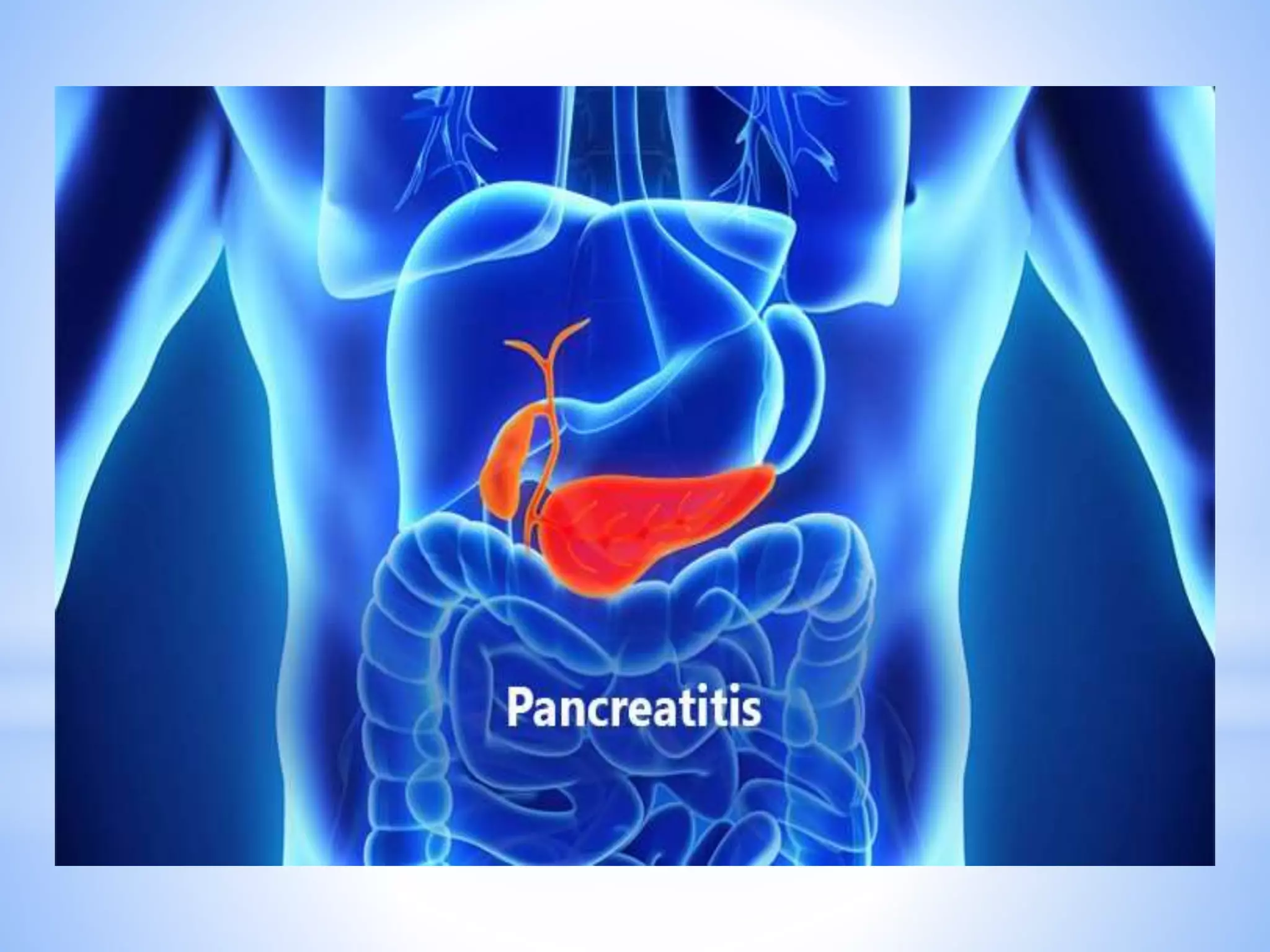
Pancreatitis is a serious disorder. It is a condition
characterized by inflammation of the pancreas .The
pancreas is a pale grey gland behind the stomach and is
situated in epigastric and left hypochondriac region of the
abdominal cavity .Although the mechanism causing
pancreatic inflammation are unknown, pancreatitis is
commonly described as auto digestion of the pancreas. It is
believed that the pancreatic duct becomes temporarily
obstructed ,accompanied by hypersecretion of the exocrine
enzymes of the pancreas .These enzymes enter the bile duct
,where they are activated and together with bile ,back up
into the pancreatic duct, causing pancreatitis.
ACUTE PANCREATITIS
Protolytic enzymes produced by
pancreas are secreted in inactive
form ,which are not activated until
they reach the intestine ;this
protect the pancreas from digestion
by its own enzymes .If there
pancreatic enzymes are activate
while still in pancreas ,pancreatitis
results .It is of two types:
ACUTE PANCREATITIS
CHRONIC PANCREATITIS
SEVERE ACUTE
PANCREATITIS
Termed as necrotizing and
hemorrhagic pancreatitis.
In this the tissue become
necrotic and damage
extend into retroperitoneal
tissues.
MILD ACUTE PANCREATITIS
Characterized by edema
and inflammation confined
to pancreas with minimal
organ dysfunction
It occurs after acute pancreatitis .It is an inflammatory
condition or disorder characterized by progressive
anatomic and functional dysfunction of pancreas. The
inflammation of pancreas does not heal in this condition
and leads to permanent damage.
CHRONIC PANCREATITIS
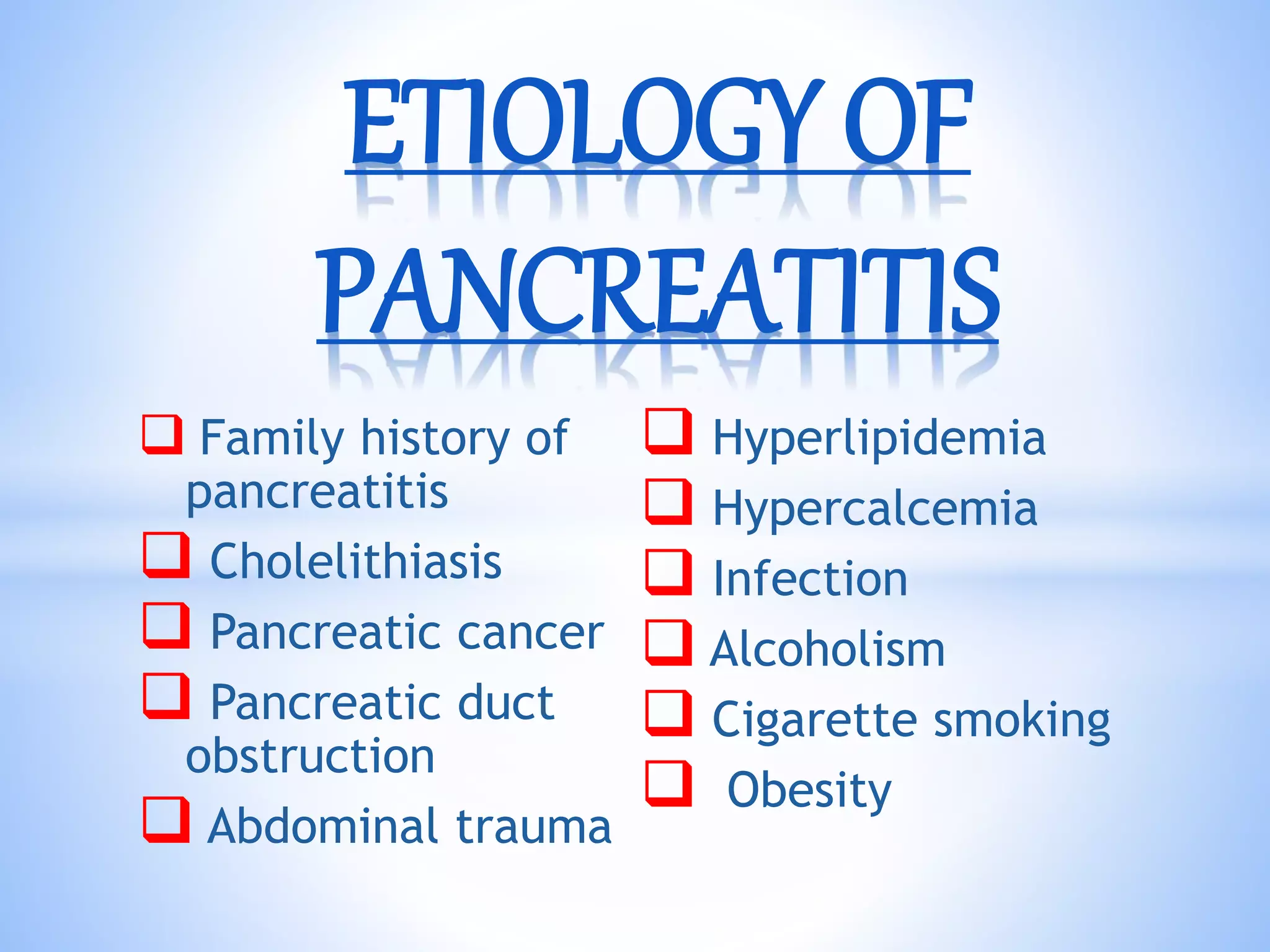
 Family history of
pancreatitis
 Cholelithiasis
 Pancreatic cancer
 Pancreatic duct
obstruction
 Abdominal trauma
 Hyperlipidemia
 Hypercalcemia
 Infection
 Alcoholism
 Cigarette smoking
 Obesity
ETIOLOGY OF
PANCREATITIS
PATHOPHYSIOLOGY
Surgical trauma ,tumour head of pancreas
Autoimmune process
Sphincter of oddi dysfunction
Obstruction to secretory pancreatic duct
Gall
stones
Alcoho-
lism
Premature activation of
enzymes in the pancreas
and release of trypsin
Inactivation of auto
digestion of pancreatic
cell
Release of
chymotrypsin, elastase
,phospholipase
Destruction of blood
vessels
Destruction of blood
wall
Release of inflammatory
marker into systemic
circulation
Severe
hemmorhagic
shock
Multiorgan
dysfunction
CLINICAL
MANIFESTATIONS
 Abdominal pain
 Vomiting
 Fever
 Discoloration of
abdominal wall
 Sign of shock
 Abdominal
distention
 Hypotension
 Hypovolemia
 Constipation
 Jaundice
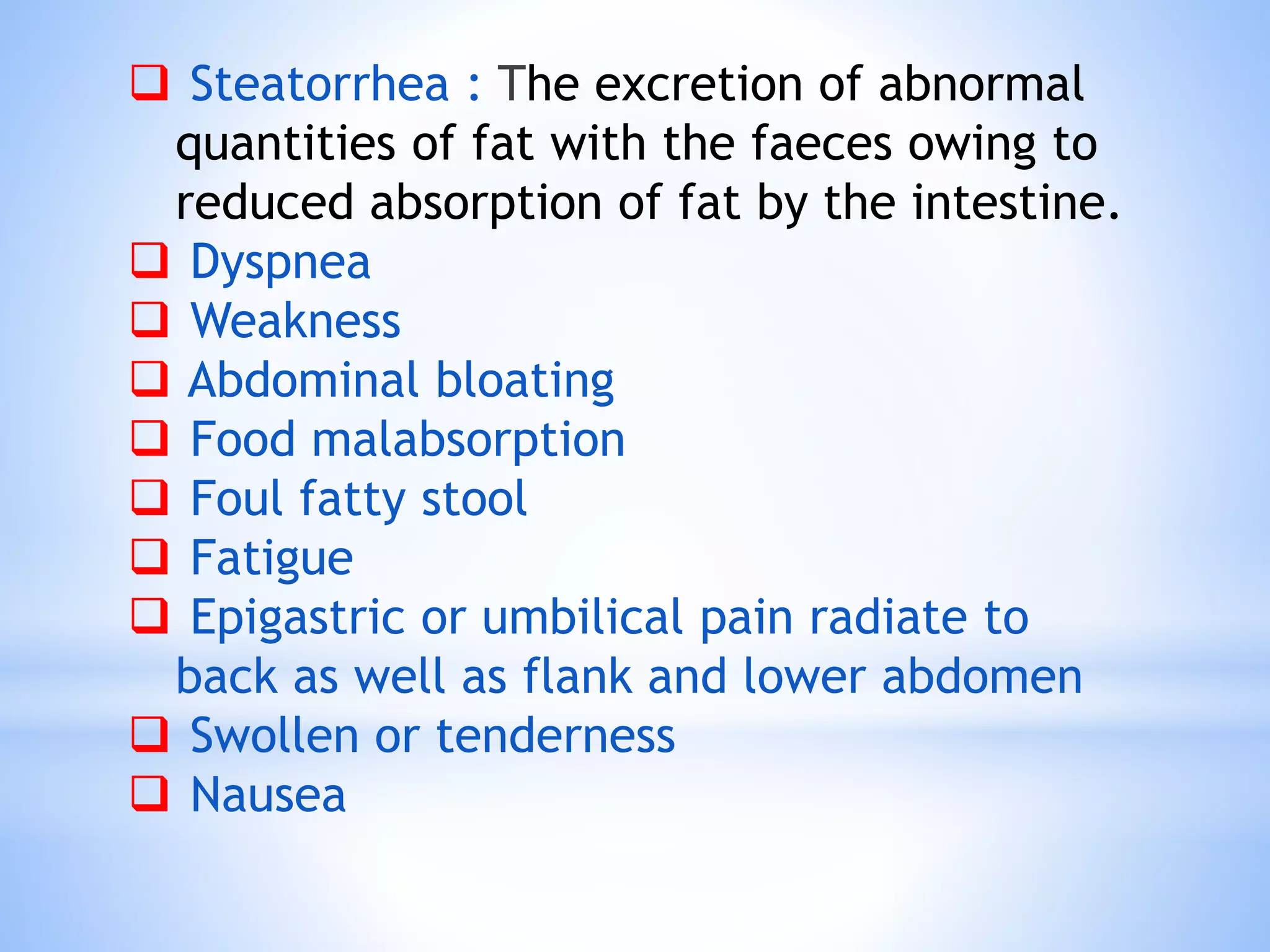
 Steatorrhea : The excretion of abnormal
quantities of fat with the faeces owing to
reduced absorption of fat by the intestine.
 Dyspnea
 Weakness
 Abdominal bloating
 Food malabsorption
 Foul fatty stool
 Fatigue
 Epigastric or umbilical pain radiate to
back as well as flank and lower abdomen
 Swollen or tenderness
 Nausea
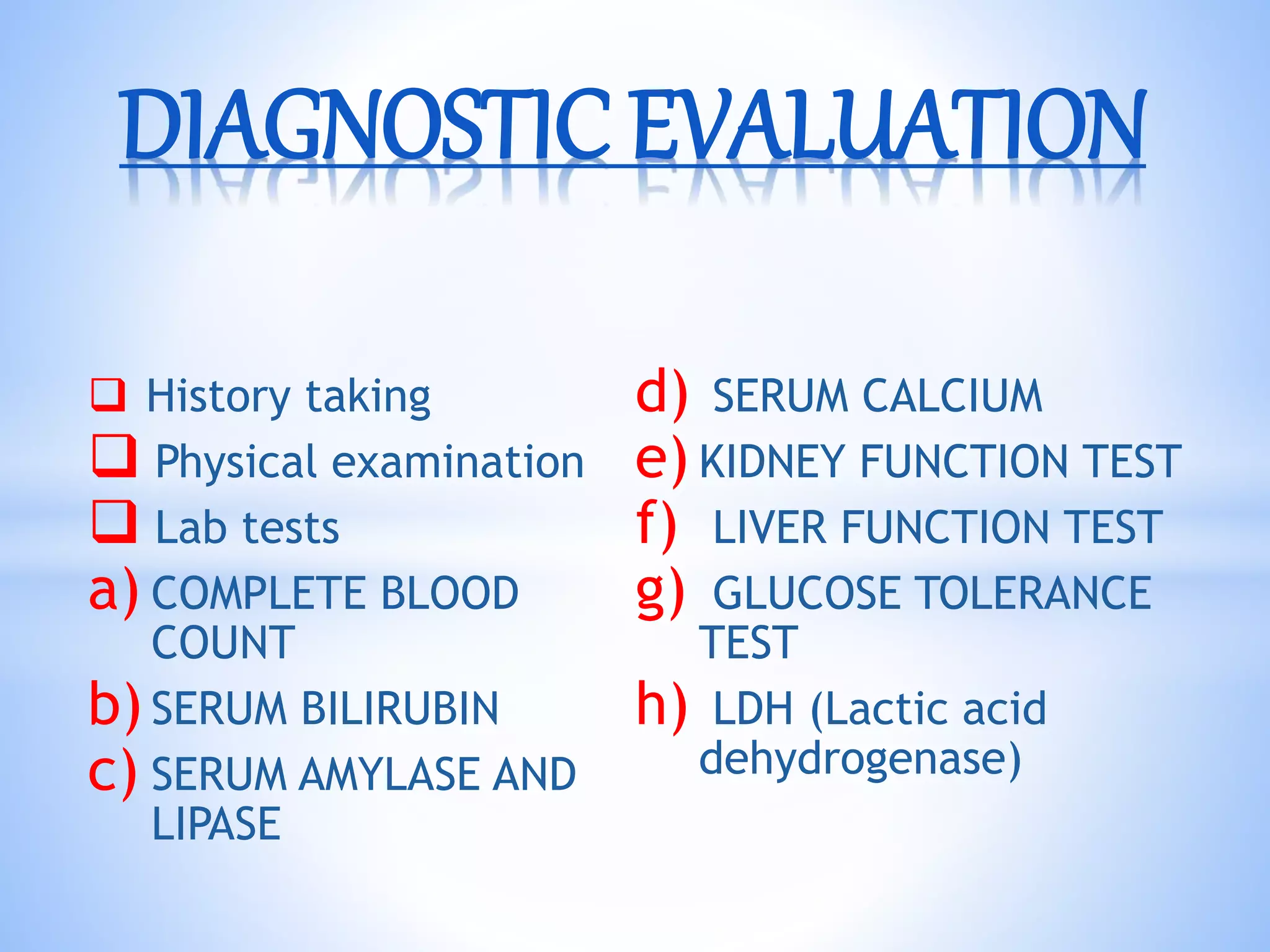
 History taking
 Physical examination
 Lab tests
a) COMPLETE BLOOD
COUNT
b)SERUM BILIRUBIN
c) SERUM AMYLASE AND
LIPASE
d) SERUM CALCIUM
e) KIDNEY FUNCTION TEST
f) LIVER FUNCTION TEST
g) GLUCOSE TOLERANCE
TEST
h) LDH (Lactic acid
dehydrogenase)
DIAGNOSTIC EVALUATION
Imaging tests
a)X-RAY
b)CT SCAN
c)ULTRASONOGRAPHY
d)MRI (MAGNETIC RESONANCE IMAGING)
 Other important procedures
a)ERCP (Endoscopic retrograde
colangiopancreatography)
b) MRCP (Magnetic resonance
colangiopancreatography)
 Analgesics
 Antibiotics
 Maintain volume status, electrolyte balance and
nutritional status
 Vitals signs should be checked properly
 Maintain pancreatic rest
 Treat complications: like pancreatic abscess, infection
and necrosis
 Give oral rehydration solution to keep hydrated and to
maintain electrolyte balance
MEDICAL MANAGEMENT
 Laparotomy
 Pancreaticojejunostomy
 Subtotal pancreatectomy
 Frey’s procedure
 Cholecystectomy
SURGICAL MANAGEMENT
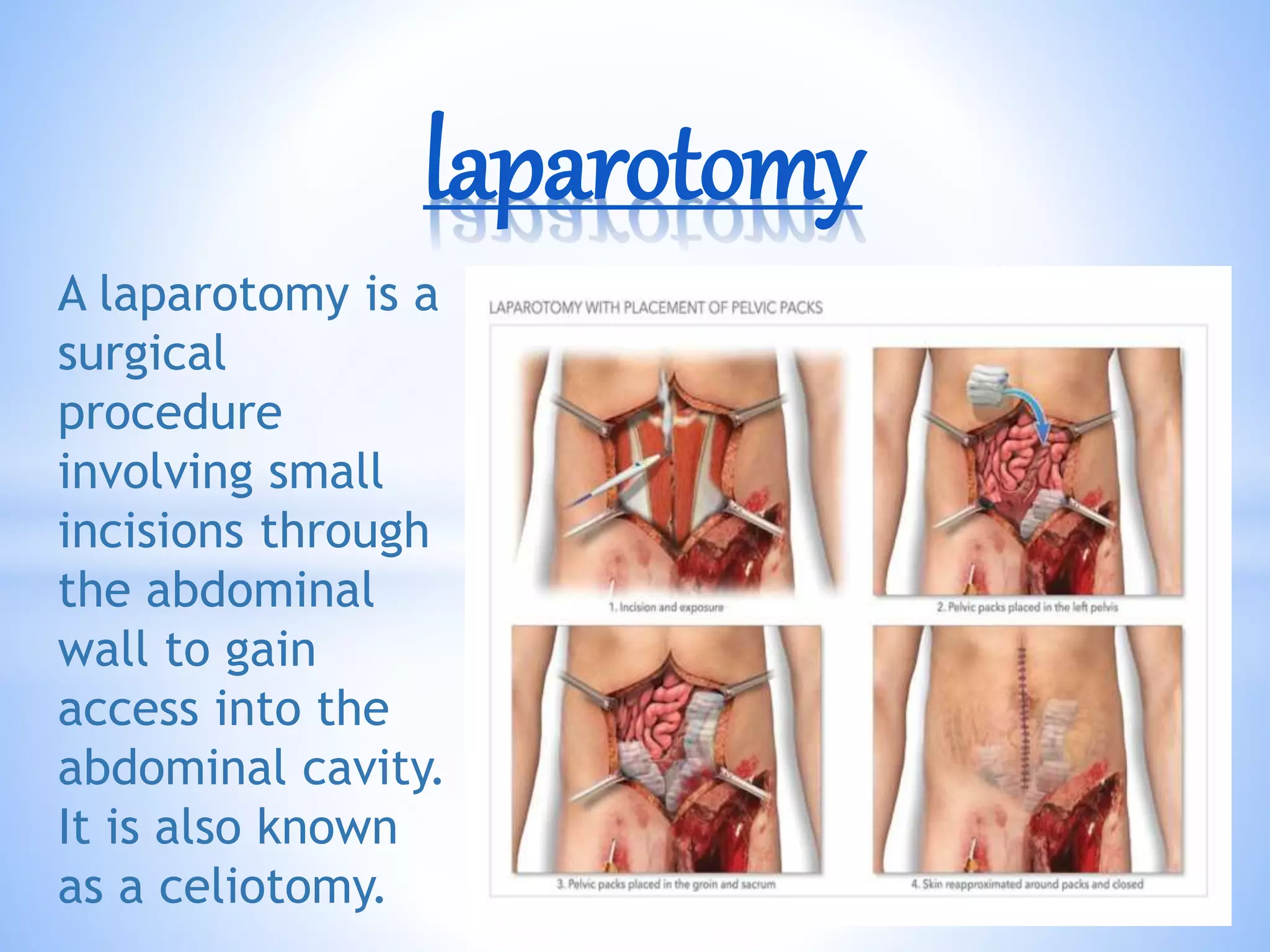
A laparotomy is a
surgical
procedure
involving small
incisions through
the abdominal
wall to gain
access into the
abdominal cavity.
It is also known
as a celiotomy.
laparotomy
The Puestow
procedure is a
surgical
technique used
in the treatment
of chronic
pancreatitis. It
involves a side-
to-side
anastomosis of
the pancreatic
duct and the
jejunum.
Pancreaticojejunostomy
Subtotal
pancreatectomy
is the surgical
removal of all or
part of
the pancreas.
Subtotal pancreatectomy
Frey’s procedure
Cholecystectomy
is the surgical
removal of the
gallbladder.
Cholecystectomy
is a common
treatment of
symptomatic
gallstones and
other gallbladder
conditions.
Cholecystectomy
Relieve pain and discomfort :The current recommendation for pain
management in this population is parenteral opioids including
morphine or fentanyl via patient-controlled analgesia or bolus.
Improve breathing pattern: The nurse maintains the patient in a
semi-Fowler’s position and encourages frequent position changes.
Improve nutritional status: The patient receives a diet high in
carbohydrates and low in fats and proteins between acute attacks.
Maintain skin integrity : The nurse carries out wound care as
prescribed and takes precautions to protect intact skin from contact
with drainage.
NURSING MANAGEMENT
Pancreatitis can cause serious complications, including:
Pseudocyst. Acute pancreatitis can cause fluid and debris
to collect in cystlike pockets in your pancreas. ...
Infection. ...
Kidney failure. ...
Breathing problems. ...
Diabetes. ...
Malnutrition. ...
Pancreatic cancer
COMPLICATIONS
 Dietary changes
 Maintain healthy weight
 Stop alcohol intake
 Smoking cessation
HEALTH EDUCATION
Presentation on pancreatitis

Presentation on pancreatitis

  • 1.
    Medical case presentation on SUBMITTEDTO : SUBMITTED BY: MRS. NIDHI JOSEPH MA’AM (TUTOR) MS. SHRUTI SHARMA (Bsc.HONORS NURSING 2ND YEAR)
  • 3.
    Pancreas is aretroperitoneal gland 12-20cm long and 2.5cm thick, lies to posterior to greater curvature of stomach .The pancreas consists of a head, a body and a tail is usually connected to duodenum by two duct. The head is the expanded portion of the organ near duodenum ,superior to and to the left of the head are the control body and tapering tail. ANATOMY OF PANCREAS
  • 4.
    Pancreatic juices secretedby the exocrine into small ducts, that form two larger duct i.e, pancreatic duct and accessory duct where turn into small intestine .Pancreatic duct is larger of the two duct .Pancreatic duct join to the common bile duct from liver and gall bladder and enters duodenum as dilated common duct called hepatopancreatic ampulla.
  • 5.
    The pancreas isboth an endocrine and an exocrine gland.  ENDOCRINE PANCREAS  EXOCRINE PANCREAS Physiology of pancreas
  • 6.
    ENDOCRINE PANCREAS Distributed throughout glandgroup of cells called islets of langerhans .The pancreatic cells have no duct so hormone diffuse directly into blood. It secrets hormone insulin and glucagon which control blood glucose level. EXOCRINE PANCREAS Consists large number of lobules made of small alveoli, wall of which consists of number of secretory cells. Lobules drained by tiny duct and unit to form pancreatic duct ,which extend whole land of gland and open into duodenum before enter duodenum pancreatic duct join common bile duct to form hepatopancreatic ampulla . Function of exocrine pancreas is to pancreatic juices containing enzymes for the digestion of carbohydrates,protein ,fats etc. ENDOCRINEPANCREAS EXOCRINEPANCREAS
  • 8.
    Pancreatitis is aserious disorder. It is a condition characterized by inflammation of the pancreas .The pancreas is a pale grey gland behind the stomach and is situated in epigastric and left hypochondriac region of the abdominal cavity .Although the mechanism causing pancreatic inflammation are unknown, pancreatitis is commonly described as auto digestion of the pancreas. It is believed that the pancreatic duct becomes temporarily obstructed ,accompanied by hypersecretion of the exocrine enzymes of the pancreas .These enzymes enter the bile duct ,where they are activated and together with bile ,back up into the pancreatic duct, causing pancreatitis.
  • 9.
    ACUTE PANCREATITIS Protolytic enzymesproduced by pancreas are secreted in inactive form ,which are not activated until they reach the intestine ;this protect the pancreas from digestion by its own enzymes .If there pancreatic enzymes are activate while still in pancreas ,pancreatitis results .It is of two types: ACUTE PANCREATITIS CHRONIC PANCREATITIS
  • 10.
    SEVERE ACUTE PANCREATITIS Termed asnecrotizing and hemorrhagic pancreatitis. In this the tissue become necrotic and damage extend into retroperitoneal tissues. MILD ACUTE PANCREATITIS Characterized by edema and inflammation confined to pancreas with minimal organ dysfunction
  • 11.
    It occurs afteracute pancreatitis .It is an inflammatory condition or disorder characterized by progressive anatomic and functional dysfunction of pancreas. The inflammation of pancreas does not heal in this condition and leads to permanent damage. CHRONIC PANCREATITIS
  • 12.
     Family historyof pancreatitis  Cholelithiasis  Pancreatic cancer  Pancreatic duct obstruction  Abdominal trauma  Hyperlipidemia  Hypercalcemia  Infection  Alcoholism  Cigarette smoking  Obesity ETIOLOGY OF PANCREATITIS
  • 13.
    PATHOPHYSIOLOGY Surgical trauma ,tumourhead of pancreas Autoimmune process Sphincter of oddi dysfunction Obstruction to secretory pancreatic duct Gall stones Alcoho- lism
  • 14.
    Premature activation of enzymesin the pancreas and release of trypsin Inactivation of auto digestion of pancreatic cell Release of chymotrypsin, elastase ,phospholipase
  • 15.
    Destruction of blood vessels Destructionof blood wall Release of inflammatory marker into systemic circulation Severe hemmorhagic shock
  • 16.
  • 17.
    CLINICAL MANIFESTATIONS  Abdominal pain Vomiting  Fever  Discoloration of abdominal wall  Sign of shock  Abdominal distention  Hypotension  Hypovolemia  Constipation  Jaundice
  • 18.
     Steatorrhea :The excretion of abnormal quantities of fat with the faeces owing to reduced absorption of fat by the intestine.  Dyspnea  Weakness  Abdominal bloating  Food malabsorption  Foul fatty stool  Fatigue  Epigastric or umbilical pain radiate to back as well as flank and lower abdomen  Swollen or tenderness  Nausea
  • 19.
     History taking Physical examination  Lab tests a) COMPLETE BLOOD COUNT b)SERUM BILIRUBIN c) SERUM AMYLASE AND LIPASE d) SERUM CALCIUM e) KIDNEY FUNCTION TEST f) LIVER FUNCTION TEST g) GLUCOSE TOLERANCE TEST h) LDH (Lactic acid dehydrogenase) DIAGNOSTIC EVALUATION
  • 20.
    Imaging tests a)X-RAY b)CT SCAN c)ULTRASONOGRAPHY d)MRI(MAGNETIC RESONANCE IMAGING)  Other important procedures a)ERCP (Endoscopic retrograde colangiopancreatography) b) MRCP (Magnetic resonance colangiopancreatography)
  • 21.
     Analgesics  Antibiotics Maintain volume status, electrolyte balance and nutritional status  Vitals signs should be checked properly  Maintain pancreatic rest  Treat complications: like pancreatic abscess, infection and necrosis  Give oral rehydration solution to keep hydrated and to maintain electrolyte balance MEDICAL MANAGEMENT
  • 22.
     Laparotomy  Pancreaticojejunostomy Subtotal pancreatectomy  Frey’s procedure  Cholecystectomy SURGICAL MANAGEMENT
  • 23.
    A laparotomy isa surgical procedure involving small incisions through the abdominal wall to gain access into the abdominal cavity. It is also known as a celiotomy. laparotomy
  • 24.
    The Puestow procedure isa surgical technique used in the treatment of chronic pancreatitis. It involves a side- to-side anastomosis of the pancreatic duct and the jejunum. Pancreaticojejunostomy
  • 25.
    Subtotal pancreatectomy is the surgical removalof all or part of the pancreas. Subtotal pancreatectomy
  • 26.
  • 27.
    Cholecystectomy is the surgical removalof the gallbladder. Cholecystectomy is a common treatment of symptomatic gallstones and other gallbladder conditions. Cholecystectomy
  • 28.
    Relieve pain anddiscomfort :The current recommendation for pain management in this population is parenteral opioids including morphine or fentanyl via patient-controlled analgesia or bolus. Improve breathing pattern: The nurse maintains the patient in a semi-Fowler’s position and encourages frequent position changes. Improve nutritional status: The patient receives a diet high in carbohydrates and low in fats and proteins between acute attacks. Maintain skin integrity : The nurse carries out wound care as prescribed and takes precautions to protect intact skin from contact with drainage. NURSING MANAGEMENT
  • 29.
    Pancreatitis can causeserious complications, including: Pseudocyst. Acute pancreatitis can cause fluid and debris to collect in cystlike pockets in your pancreas. ... Infection. ... Kidney failure. ... Breathing problems. ... Diabetes. ... Malnutrition. ... Pancreatic cancer COMPLICATIONS
  • 30.
     Dietary changes Maintain healthy weight  Stop alcohol intake  Smoking cessation HEALTH EDUCATION