Introduction
Present by:
Sajjad Moradi-Ms student
Department of Community Nutrition, School of Nutritional Sciences and

Dietetics, Tehran University of Medical Sciences (TUMS), Tehran, Iran
The Exchange List System
What is the Exchange System
The exchange system is the
basis of your meal plan.
 Diabetes diet
 Weight loss, CVD, Renal, HTN,
hyperlipidemia, atherosclerosis
Introduction
Introduction
Excellent tool for:
1. Meal planning
2. Calorie control
3. Meeting AMDRs and DRIs
Application of Exchange List System
Advantages

variety of healthful food choices
 According to different age groups
allows individuals to be accountable for what they eat
Introduction
.
More than one energy source gives us
Disadvantages
Introduction
Possibility of measurement error
 Absorption rates vary in different individuals
Portion sizes are based on:
Grams of protein
Grams of carbohydrate
Grams of fat
Total number of Calories
Introduction
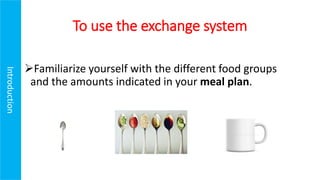
To use the exchange system
Familiarize yourself with the different food groups
and the amounts indicated in your meal plan.
Introduction
Standard measurement used in this present:
 1 cup = 236 ml
 1 tbsp = 14.8ml
 1tsp = 4.2 ml
 1 oz = 29.57 ml
Introduction
Introduction
Introduction
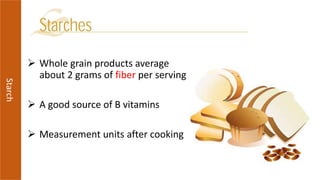
 Whole grain products average
about 2 grams of fiber per serving
 A good source of B vitamins
 Measurement units after cooking
Starch
Starch
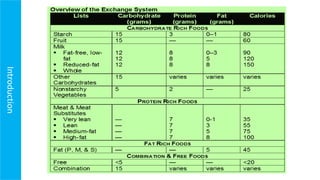
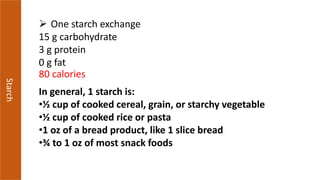
 One starch exchange
15 g carbohydrate
3 g protein
0 g fat
80 calories
In general, 1 starch is:
•½ cup of cooked cereal, grain, or starchy vegetable
•½ cup of cooked rice or pasta
•1 oz of a bread product, like 1 slice bread
•¾ to 1 oz of most snack foods
Starch
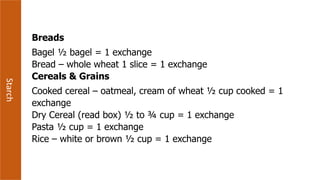
Breads
Bagel ½ bagel = 1 exchange
Bread – whole wheat 1 slice = 1 exchange
Cereals & Grains
Cooked cereal – oatmeal, cream of wheat ½ cup cooked = 1
exchange
Dry Cereal (read box) ½ to ¾ cup = 1 exchange
Pasta ½ cup = 1 exchange
Rice – white or brown ½ cup = 1 exchange
Starch
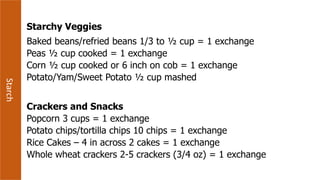
Starchy Veggies
Baked beans/refried beans 1/3 to ½ cup = 1 exchange
Peas ½ cup cooked = 1 exchange
Corn ½ cup cooked or 6 inch on cob = 1 exchange
Potato/Yam/Sweet Potato ½ cup mashed
Crackers and Snacks
Popcorn 3 cups = 1 exchange
Potato chips/tortilla chips 10 chips = 1 exchange
Rice Cakes – 4 in across 2 cakes = 1 exchange
Whole wheat crackers 2-5 crackers (3/4 oz) = 1 exchange
Starch
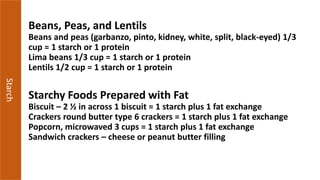
Beans, Peas, and Lentils
Beans and peas (garbanzo, pinto, kidney, white, split, black-eyed) 1/3
cup = 1 starch or 1 protein
Lima beans 1/3 cup = 1 starch or 1 protein
Lentils 1/2 cup = 1 starch or 1 protein
Starchy Foods Prepared with Fat
Biscuit – 2 ½ in across 1 biscuit = 1 starch plus 1 fat exchange
Crackers round butter type 6 crackers = 1 starch plus 1 fat exchange
Popcorn, microwaved 3 cups = 1 starch plus 1 fat exchange
Sandwich crackers – cheese or peanut butter filling
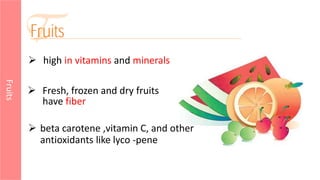
 Fresh, frozen and dry fruits
have fiber
Fruits
 high in vitamins and minerals
 beta carotene ,vitamin C, and other
antioxidants like lyco -pene
Fruits
Typically, 1 fruit exchange is:
•1 small (4 oz) fresh fruit
•½ cup of fresh fruit or canned
•½ cup unsweetened fruit juice
•¼ cup of dried fruit
One fruit exchange =
15 g carbohydrate
0 g protein
0 g fat
60 calories
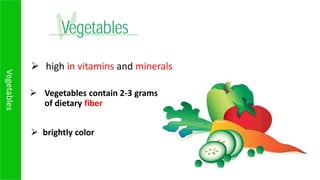
 Vegetables contain 2-3 grams
of dietary fiber
Vegetables
 high in vitamins and minerals
 brightly color
Vegetables
½ C Cooked vegetables (carrots, broccoli, zucchini,
cabbage, etc.)
1 C Raw vegetables or salad greens
½ C Vegetable juice
If you’re hungry, eat more fresh or steamed vegetables.
• 1 vegetable exchange =
• 5 g carbohydrate
• 2 g protein
• 0 g fat
• 25 calories
Dairy
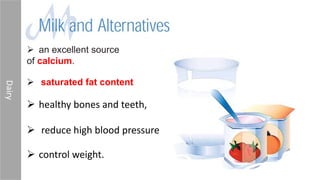
 an excellent source
of calcium.
 saturated fat content
 healthy bones and teeth,
 reduce high blood pressure
 control weight.
Dairy
1 Milk and Alternatives exchange =
12 carbohydrate
8 g protein
0 to 8 g fat
90 to 150 calories
 Milk- skim or 1% 1 cup (8 oz) = 1 exchange
Soy milk – low fat or fat free 1 cup = 1 exchange
Yogurt – fat free or light 2/3 cup (6 oz) = 1
exchange
Dairy
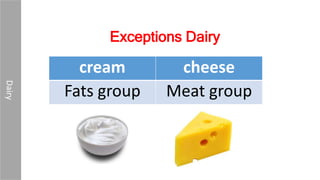
Exceptions Dairy
cream cheese
Fats group Meat group
Meat
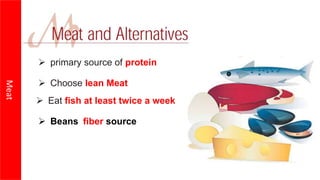
 primary source of protein
 Choose lean Meat
 Eat fish at least twice a week
 Beans fiber source
Meat
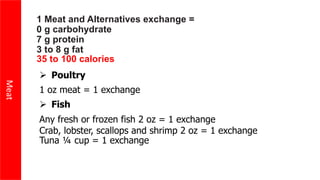
1 Meat and Alternatives exchange =
0 g carbohydrate
7 g protein
3 to 8 g fat
35 to 100 calories
 Poultry
1 oz meat = 1 exchange
 Fish
Any fresh or frozen fish 2 oz = 1 exchange
Crab, lobster, scallops and shrimp 2 oz = 1 exchange
Tuna ¼ cup = 1 exchange
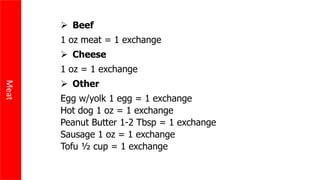
Meat
 Beef
1 oz meat = 1 exchange
 Cheese
1 oz = 1 exchange
 Other
Egg w/yolk 1 egg = 1 exchange
Hot dog 1 oz = 1 exchange
Peanut Butter 1-2 Tbsp = 1 exchange
Sausage 1 oz = 1 exchange
Tofu ½ cup = 1 exchange
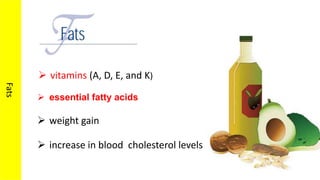
Fats
 vitamins (A, D, E, and K)
 essential fatty acids
 weight gain
 increase in blood cholesterol levels
Fats
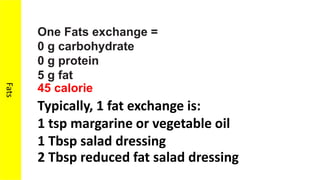
One Fats exchange =
0 g carbohydrate
0 g protein
5 g fat
45 calorie
Typically, 1 fat exchange is:
1 tsp margarine or vegetable oil
1 Tbsp salad dressing
2 Tbsp reduced fat salad dressing
Fats
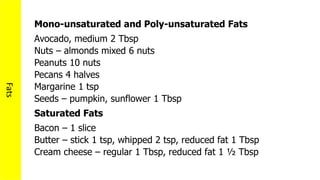
Mono-unsaturated and Poly-unsaturated Fats
Avocado, medium 2 Tbsp
Nuts – almonds mixed 6 nuts
Peanuts 10 nuts
Pecans 4 halves
Margarine 1 tsp
Seeds – pumpkin, sunflower 1 Tbsp
Saturated Fats
Bacon – 1 slice
Butter – stick 1 tsp, whipped 2 tsp, reduced fat 1 Tbsp
Cream cheese – regular 1 Tbsp, reduced fat 1 ½ Tbsp
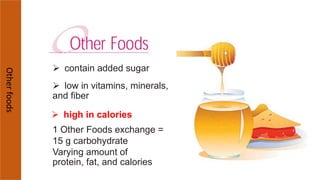
containaddedsugar
Otherfoods
 contain added sugar
 low in vitamins, minerals,
and fiber
 high in calories
1 Other Foods exchange =
15 g carbohydrate
Varying amount of
protein, fat, and calories
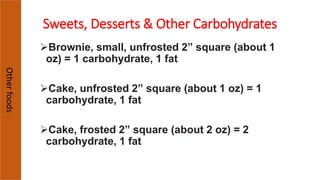
Otherfoods
Brownie, small, unfrosted 2” square (about 1
oz) = 1 carbohydrate, 1 fat
Cake, unfrosted 2” square (about 1 oz) = 1
carbohydrate, 1 fat
Cake, frosted 2” square (about 2 oz) = 2
carbohydrate, 1 fat
Sweets, Desserts & Other Carbohydrates
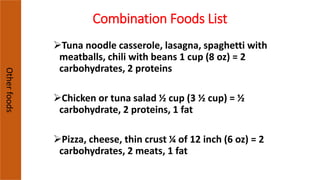
Combination Foods List
Tuna noodle casserole, lasagna, spaghetti with
meatballs, chili with beans 1 cup (8 oz) = 2
carbohydrates, 2 proteins
Chicken or tuna salad ½ cup (3 ½ cup) = ½
carbohydrate, 2 proteins, 1 fat
Pizza, cheese, thin crust ¼ of 12 inch (6 oz) = 2
carbohydrates, 2 meats, 1 fat
Otherfoods
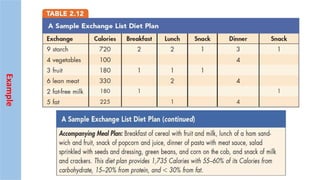
Example
Example list
Example
Example
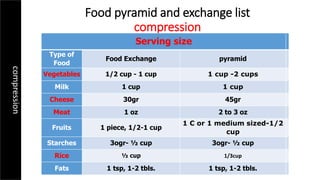
Food pyramid and exchange list
compression
Serving size
Type of
Food
Food Exchange pyramid
Vegetables 1/2 cup - 1 cup 1 cup -2 cups
Milk 1 cup 1 cup
Cheese 30gr 45gr
Meat 1 oz 2 to 3 oz
Fruits 1 piece, 1/2-1 cup
1 C or 1 medium sized-1/2
cup
Starches 3ogr- ½ cup 3ogr- ½ cup
Rice ½ cup 1/3cup
Fats 1 tsp, 1-2 tbls. 1 tsp, 1-2 tbls.
compression
compression Structural differences
foods Food exchange pyramid
fats Separated group ---------
Nuts fats meat
Beans Meat & starch meat
Cheese Meat Dairy
Corn, green peas and
potatoes
starch vegetable
Olives and avocados fats vegetable
Bacon fats Meat
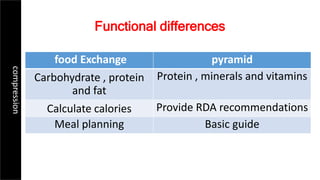
food Exchange pyramid
Carbohydrate , protein
and fat
Protein , minerals and vitamins
Calculate calories Provide RDA recommendations
Meal planning Basic guide
compression
Functional differences
Combining Food Guide Pyramid Plan with the
Exchange Lists
Helps choose foods that provide all
nutrients Promotes adequacy,
balance and variety Exchange
system uses calorie control and
moderation
compression
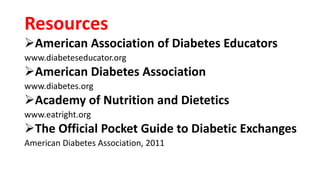
Resources
American Association of Diabetes Educators
www.diabeteseducator.org
American Diabetes Association
www.diabetes.org
Academy of Nutrition and Dietetics
www.eatright.org
The Official Pocket Guide to Diabetic Exchanges
American Diabetes Association, 2011
Resources
http://www.lillydiabetes.com/documents/pdf/LD90772_DailyMeal
PlanGuide.pdf
 http://www.diet.com/g/exchange-system
http://fnic.nal.usda.gov/diet-and-disease/diabetes/carbohydrate-
counting-and-exchange-lists
http://www.nhlbi.nih.gov/health/educational/lose_wt/eat/fd_exch
.htm
http://www.pamf.org/southasian/healthy/nutrition/pyramidservin
gcharts.html

Exchange list

  • 1.
    Introduction Present by: Sajjad Moradi-Msstudent Department of Community Nutrition, School of Nutritional Sciences and Dietetics, Tehran University of Medical Sciences (TUMS), Tehran, Iran The Exchange List System
  • 2.
    What is theExchange System The exchange system is the basis of your meal plan.  Diabetes diet  Weight loss, CVD, Renal, HTN, hyperlipidemia, atherosclerosis Introduction
  • 3.
    Introduction Excellent tool for: 1.Meal planning 2. Calorie control 3. Meeting AMDRs and DRIs Application of Exchange List System
  • 4.
    Advantages  variety of healthfulfood choices  According to different age groups allows individuals to be accountable for what they eat Introduction . More than one energy source gives us
  • 5.
    Disadvantages Introduction Possibility of measurementerror  Absorption rates vary in different individuals
  • 6.
    Portion sizes arebased on: Grams of protein Grams of carbohydrate Grams of fat Total number of Calories Introduction
  • 7.
    To use theexchange system Familiarize yourself with the different food groups and the amounts indicated in your meal plan. Introduction
  • 8.
    Standard measurement usedin this present:  1 cup = 236 ml  1 tbsp = 14.8ml  1tsp = 4.2 ml  1 oz = 29.57 ml Introduction
  • 9.
  • 10.
  • 11.
     Whole grainproducts average about 2 grams of fiber per serving  A good source of B vitamins  Measurement units after cooking Starch
  • 12.
    Starch  One starchexchange 15 g carbohydrate 3 g protein 0 g fat 80 calories In general, 1 starch is: •½ cup of cooked cereal, grain, or starchy vegetable •½ cup of cooked rice or pasta •1 oz of a bread product, like 1 slice bread •¾ to 1 oz of most snack foods
  • 13.
    Starch Breads Bagel ½ bagel= 1 exchange Bread – whole wheat 1 slice = 1 exchange Cereals & Grains Cooked cereal – oatmeal, cream of wheat ½ cup cooked = 1 exchange Dry Cereal (read box) ½ to ¾ cup = 1 exchange Pasta ½ cup = 1 exchange Rice – white or brown ½ cup = 1 exchange
  • 14.
    Starch Starchy Veggies Baked beans/refriedbeans 1/3 to ½ cup = 1 exchange Peas ½ cup cooked = 1 exchange Corn ½ cup cooked or 6 inch on cob = 1 exchange Potato/Yam/Sweet Potato ½ cup mashed Crackers and Snacks Popcorn 3 cups = 1 exchange Potato chips/tortilla chips 10 chips = 1 exchange Rice Cakes – 4 in across 2 cakes = 1 exchange Whole wheat crackers 2-5 crackers (3/4 oz) = 1 exchange
  • 15.
    Starch Beans, Peas, andLentils Beans and peas (garbanzo, pinto, kidney, white, split, black-eyed) 1/3 cup = 1 starch or 1 protein Lima beans 1/3 cup = 1 starch or 1 protein Lentils 1/2 cup = 1 starch or 1 protein Starchy Foods Prepared with Fat Biscuit – 2 ½ in across 1 biscuit = 1 starch plus 1 fat exchange Crackers round butter type 6 crackers = 1 starch plus 1 fat exchange Popcorn, microwaved 3 cups = 1 starch plus 1 fat exchange Sandwich crackers – cheese or peanut butter filling
  • 16.
     Fresh, frozenand dry fruits have fiber Fruits  high in vitamins and minerals  beta carotene ,vitamin C, and other antioxidants like lyco -pene
  • 17.
    Fruits Typically, 1 fruitexchange is: •1 small (4 oz) fresh fruit •½ cup of fresh fruit or canned •½ cup unsweetened fruit juice •¼ cup of dried fruit One fruit exchange = 15 g carbohydrate 0 g protein 0 g fat 60 calories
  • 18.
     Vegetables contain2-3 grams of dietary fiber Vegetables  high in vitamins and minerals  brightly color
  • 19.
    Vegetables ½ C Cookedvegetables (carrots, broccoli, zucchini, cabbage, etc.) 1 C Raw vegetables or salad greens ½ C Vegetable juice If you’re hungry, eat more fresh or steamed vegetables. • 1 vegetable exchange = • 5 g carbohydrate • 2 g protein • 0 g fat • 25 calories
  • 20.
    Dairy  an excellentsource of calcium.  saturated fat content  healthy bones and teeth,  reduce high blood pressure  control weight.
  • 21.
    Dairy 1 Milk andAlternatives exchange = 12 carbohydrate 8 g protein 0 to 8 g fat 90 to 150 calories  Milk- skim or 1% 1 cup (8 oz) = 1 exchange Soy milk – low fat or fat free 1 cup = 1 exchange Yogurt – fat free or light 2/3 cup (6 oz) = 1 exchange
  • 22.
  • 23.
    Meat  primary sourceof protein  Choose lean Meat  Eat fish at least twice a week  Beans fiber source
  • 24.
    Meat 1 Meat andAlternatives exchange = 0 g carbohydrate 7 g protein 3 to 8 g fat 35 to 100 calories  Poultry 1 oz meat = 1 exchange  Fish Any fresh or frozen fish 2 oz = 1 exchange Crab, lobster, scallops and shrimp 2 oz = 1 exchange Tuna ¼ cup = 1 exchange
  • 25.
    Meat  Beef 1 ozmeat = 1 exchange  Cheese 1 oz = 1 exchange  Other Egg w/yolk 1 egg = 1 exchange Hot dog 1 oz = 1 exchange Peanut Butter 1-2 Tbsp = 1 exchange Sausage 1 oz = 1 exchange Tofu ½ cup = 1 exchange
  • 26.
    Fats  vitamins (A,D, E, and K)  essential fatty acids  weight gain  increase in blood cholesterol levels
  • 27.
    Fats One Fats exchange= 0 g carbohydrate 0 g protein 5 g fat 45 calorie Typically, 1 fat exchange is: 1 tsp margarine or vegetable oil 1 Tbsp salad dressing 2 Tbsp reduced fat salad dressing
  • 28.
    Fats Mono-unsaturated and Poly-unsaturatedFats Avocado, medium 2 Tbsp Nuts – almonds mixed 6 nuts Peanuts 10 nuts Pecans 4 halves Margarine 1 tsp Seeds – pumpkin, sunflower 1 Tbsp Saturated Fats Bacon – 1 slice Butter – stick 1 tsp, whipped 2 tsp, reduced fat 1 Tbsp Cream cheese – regular 1 Tbsp, reduced fat 1 ½ Tbsp
  • 29.
    containaddedsugar Otherfoods  contain addedsugar  low in vitamins, minerals, and fiber  high in calories 1 Other Foods exchange = 15 g carbohydrate Varying amount of protein, fat, and calories
  • 30.
    Otherfoods Brownie, small, unfrosted2” square (about 1 oz) = 1 carbohydrate, 1 fat Cake, unfrosted 2” square (about 1 oz) = 1 carbohydrate, 1 fat Cake, frosted 2” square (about 2 oz) = 2 carbohydrate, 1 fat Sweets, Desserts & Other Carbohydrates
  • 31.
    Combination Foods List Tunanoodle casserole, lasagna, spaghetti with meatballs, chili with beans 1 cup (8 oz) = 2 carbohydrates, 2 proteins Chicken or tuna salad ½ cup (3 ½ cup) = ½ carbohydrate, 2 proteins, 1 fat Pizza, cheese, thin crust ¼ of 12 inch (6 oz) = 2 carbohydrates, 2 meats, 1 fat Otherfoods
  • 32.
  • 33.
  • 34.
  • 35.
    Food pyramid andexchange list compression Serving size Type of Food Food Exchange pyramid Vegetables 1/2 cup - 1 cup 1 cup -2 cups Milk 1 cup 1 cup Cheese 30gr 45gr Meat 1 oz 2 to 3 oz Fruits 1 piece, 1/2-1 cup 1 C or 1 medium sized-1/2 cup Starches 3ogr- ½ cup 3ogr- ½ cup Rice ½ cup 1/3cup Fats 1 tsp, 1-2 tbls. 1 tsp, 1-2 tbls. compression
  • 36.
    compression Structural differences foodsFood exchange pyramid fats Separated group --------- Nuts fats meat Beans Meat & starch meat Cheese Meat Dairy Corn, green peas and potatoes starch vegetable Olives and avocados fats vegetable Bacon fats Meat
  • 37.
    food Exchange pyramid Carbohydrate, protein and fat Protein , minerals and vitamins Calculate calories Provide RDA recommendations Meal planning Basic guide compression Functional differences
  • 38.
    Combining Food GuidePyramid Plan with the Exchange Lists Helps choose foods that provide all nutrients Promotes adequacy, balance and variety Exchange system uses calorie control and moderation compression
  • 40.
    Resources American Association ofDiabetes Educators www.diabeteseducator.org American Diabetes Association www.diabetes.org Academy of Nutrition and Dietetics www.eatright.org The Official Pocket Guide to Diabetic Exchanges American Diabetes Association, 2011
  • 41.