Approach to Headache
Dr. Faisal Al Hadad
Consultant of Family Medicine
& Occupational Health
PSMMC
Introduction


Headache is defined as diffuse pain in various parts of
the head, with the pain not confined to the area of
distribution of a nerve.



Headache is among the most common pain problems
encountered in family practice.
Classification
1. Primary headaches (benign, recurrent, no organic
disease):
 Migraine
 Tension-type headache and
 Cluster headache
2. Secondary headaches are caused by underlying

organic diseases.
Acute Secondary Headache Disorders
1. Headache associated with head trauma
2. Headache associated with vascular disorders
 SAH
 Acute ischemic cerebrovascular disorder
 Unruptured vascular malformation
 Arteritis (e.g. temporal arteritis)
 Arterial HTN
3. Headache associated with nonvascular intracranial disorder
 Benign intracranial HTN (pseudotumor cerebri)
 Intracranial infection
 Low CSF pressure (e.g., headache subsequent to LP)
;Contd
4. Headache associated with substance use or withdrawal
5. Headache associated with noncephalic infection (viral infection,
bacterial infection)
6. Headache associated with metabolic disorder (hypoxia,
hypercapnia, hypoglycemia, dialysis)
7. Headache or facial pain associated with disorder of cranium,
neck, eyes, ears, nose, sinuses, teeth or mouth
8. Cranial neuralgias pain
History
FIRST OR WORST HEADACHE


Primary headaches can occur at any age but most often begin
during childhood or between 20 and 50 years of age.



Onset of headache after 50 years of age is a red flag for
consideration of a secondary headache disorder such as temporal
arteritis or a mass lesion.



If the patient routinely has headaches, it is important to determine
whether the current episode is typical. Is this headache like the
ones you usually have?
History
SYMPTOMS
? What symptoms do you have before the headache starts
? What symptoms do you have during the headache
?What symptoms do you have right now


Primary headache disorder such as cluster headache (ipsilateral
lacrimation and/or nasal congestion) or migraine with aura (e.g.,
scotomata, photophobia, phonophobia, nausea).



Secondary headache disorder (stiff neck, disorientation, rash,
fever, eye pain, diplopia, unilateral paresthesias, unilateral
weakness, balance change).
History
ONSET
?Whether start gradually or suddenly
: Headache of sudden and severe onset can be due to
 SAH
 Vascular malformations
 Acute ischemic CVA
 Posterior fossa mass lesions.
History
LOCATION AND RADIATION OF PAIN


Cluster headaches are strictly unilateral.



Tension-type headaches are usually band-like and bilateral.



Migraines generally begin unilaterally but may progress to involve
the entire head.



Pain along the distribution of the temporal artery may suggest
temporal arteritis, and pain along the distribution of the trigeminal
nerve may be a sign of trigeminal neuralgia



Eye pain may suggest acute glaucoma.
History
SEVERITY AND QUALITY OF PAIN


Tension-type headache: Mild or moderate, pressing or
tightening pain.



Cluster headache : Severe, stabbing pain



Migraine headache: Moderate or severe, pulsating, throbbing
or dull aching pain.
History
CONCURRENT MEDICAL CONDITIONS







Meningitis
CNS lymphoma
Toxoplasmosis
Metastases
Intracranial vascular disorder
Acute viral syndrome or acute bacterial infection
History
MEDICATIONS


Prescription and over-the-counter medications (especially
caffeine-containing analgesics) have been implicated as
triggers for drug-rebound and nonspecific headaches.



Thus, it is important to review any medication that a patient is
taking for its potential to cause headache.
History
RECENT TRAUMA OR PROCEDURES


Headache subsequent to trauma may signify a postconcussive
disorder, although ICH should always be suspected.



Migraine and cluster headaches may be triggered by head
trauma.



Headache has also been associated with common medical
procedures (e.g. LP, rhinoscopy) and dental procedures (e.g.,
tooth extraction).
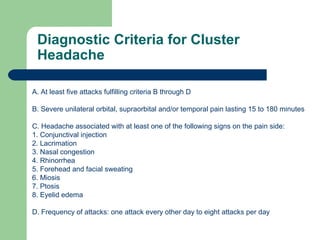
Diagnostic Criteria for Cluster
Headache
A. At least five attacks fulfilling criteria B through D
B. Severe unilateral orbital, supraorbital and/or temporal pain lasting 15 to 180 minutes
C. Headache associated with at least one of the following signs on the pain side:
1. Conjunctival injection
2. Lacrimation
3. Nasal congestion
4. Rhinorrhea
5. Forehead and facial sweating
6. Miosis
7. Ptosis
8. Eyelid edema
D. Frequency of attacks: one attack every other day to eight attacks per day
Diagnostic Criteria for Episodic
Tension-Type Headache
A. At least 10 previous headache episodes fulfilling criteria B through D;
number of days with such headaches: less than 180 days per year
B. Headache lasting from 30 minutes to 7 days
C. At least two of the following pain characteristics:
1. Pressing or tightening quality
2. Mild or moderate intensity
3. Bilateral location
4. No aggravation by walking stairs or similar routine physical activity
D. Both of the following:
1. No nausea or vomiting
2. Photophobia and phonophobia are absent, or one but not the other is
present.
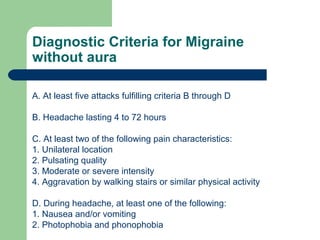
Diagnostic Criteria for Migraine
without aura
A. At least five attacks fulfilling criteria B through D
B. Headache lasting 4 to 72 hours
C. At least two of the following pain characteristics:
1. Unilateral location
2. Pulsating quality
3. Moderate or severe intensity
4. Aggravation by walking stairs or similar physical activity
D. During headache, at least one of the following:
1. Nausea and/or vomiting
2. Photophobia and phonophobia
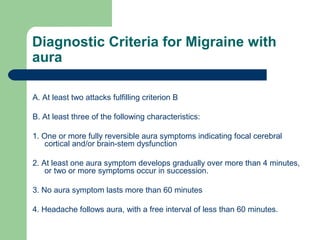
Diagnostic Criteria for Migraine with
aura
A. At least two attacks fulfilling criterion B
B. At least three of the following characteristics:
1. One or more fully reversible aura symptoms indicating focal cerebral
cortical and/or brain-stem dysfunction
2. At least one aura symptom develops gradually over more than 4 minutes,
or two or more symptoms occur in succession.
3. No aura symptom lasts more than 60 minutes
4. Headache follows aura, with a free interval of less than 60 minutes.
Physical Examination


The primary purpose of the physical examination is to identify
causes of secondary headaches.



General physical examination:
- VS (BP, temperature)
- Funduscopic examination (papilledema)
- CV assessment (assess risk of CVA)
- Palpation of the head and face (R/O sinusitis)



Complete neurologic examination (focal neurologic signs)
Neurological examination











Mental status
Level of consciousness
Cranial nerve testing
Motor strength testing
Deep tendon reflexes
Pathologic reflexes (e.g. Babinski’s sign)
Sensation
Cerebellar function
Gait testing
Signs of meningeal irritation (Kernig’s and Brudzinski’s signs).
Red Flags


Headache beginning after 50 years of age (temporal arteritis,
mass lesion)



Sudden onset of headache (SAH, hemorrhage into a mass
lesion or vascular malformation, mass lesion especially
posterior fossa mass)



Headaches increasing in frequency and severity (mass lesion,
subdural hematoma, medication overuse)



New-onset headache in patient with risk factors for HIV
infection or cancer (brain abscess, meningitis, metastasis)
Red Flags


Headache with signs of systemic illness (e.g. fever, stiff neck,
rash indicating meningitis)



Focal neurologic signs (mass lesion, vascular malformation,
stroke, collagen vascular disease evaluation)



Papilledema (mass lesion, pseudotumor cerebri, meningitis)



Headache subsequent head trauma (ICH, subdural hematoma,
epidural hematoma, post traumatic headache)
Investigations
Laboratory
 Random use of laboratory testing in the evaluation of acute
headache is not warranted.
 CBC when systemic or intracranial infection is suspected
 ESR when temporal arteritis is a possibility.
Neuroimaging
 Neuroimaging is not usually warranted in patients with primary
headaches .
 CT scanning is recommended to identify acute hemorrhage.
 MRI studies are recommended to evaluate the posterior fossa.
Investigations
Lumbar Puncture


CT scanning without contrast medium, followed by LP if the
scan is negative, is preferred to rule out SAH within the first 48
hours.



LP is useful for assessing the CSF for blood, infection and
cellular abnormalities.



Headaches are associated with low CSF pressure (e.g. posttraumatic leakage of CSF) and elevated CSF pressure (e.g.
idiopathic intracranial HTN and CNS space-occupying lesions)
Indications of referral to Neurologist









Physician has inadequate level of comfort in diagnosing or
treating patient’s headache.
Patient requests a referral.
Patient does not respond to treatment.
Patient’s condition or disability continues or worsens.
Physician is unable to classify patient’s headache according to
diagnostic criteria for primary or secondary headache
disorders.
Habituation or rebound headaches limit outpatient
management.
Patient has intractable or daily headaches.
Thank you
Level of consciousness
Eye opening
 Spontaneous
 To speech
 To pain
 None
Verbal response
 Oriented
 Confused
 Words
 Sounds
 None
Level of consciousness
Motor response
 Obey commands
 Localising pain
 Flexing to pain
 Extending to pain
 None
Higher cerebral function
Congnitive skills
 Dysphasia (expressive/receptive/nominal)
 Dyslexia
 Dysgraphia
 Dyscalculia
 Agnosia
Memory test
 Immediate
 Recent
 Remote
 Verbal
 Visual
Higher cerebral function
Reasoning and problem solving
 Two-step calculation
 Reverse 3/4 random numbers
 Explain proverb
Emotional state
 Anxiety
 Depression
 Personality disorder
Cranial nerves examination
1. Olfactory (I)
2. Optic nerve (II)
 Visual acuity
 Visual fields
 Optic fundus
 Pupils (equality, RX to light, RX to accomodation
and convergence)
Cranial nerves examination
Oculomotor (III)
 Ptosis
 Pupil
 Ocular movement
Trochlear (IV) and Abducens (VI)
 LR6
 SO4
Cranial nerves examination
Trigeminal (V)
 Sensation
 Corneal reflex
 Motor examination
Facial (VII)
 Asymmetry
 Frontalis
 Orbicularis oculi
 Buccinator
 Orbicularis oris
 Taste
Cranial nerves examination
Auditory (VIII)
 Weber’s test
 Rinne’s test
Glossopharyngeal (IX)
 Swallowing
 Uvula
 Gag reflex
Cranial nerves examination
Accessory (XI)
 Sternomastoid
 Trapezius
Hypoglossal (XII)
 Tongue atrophy
 Tongue fibrillation
 Tongue deviation
Motor, Sensation and Reflexes
Motor
 Muscle wasting
 Tone
 Power
Sensation
 Pain
 Touch
 Temperature
 Joint position
 Vibration
Reflexes (deep tendon, pathologic)
Cerebellar function and meningeal
irritation signs
Cerebellar function
 Finger-nose testing
 Supination and pronation of the forearms
 Romberg’s test
 Gait
Signs of meningeal irritation
 Kernig’s sign
 Brudzinski’s sign
Thank you

Approach to headache

  • 1.
    Approach to Headache Dr.Faisal Al Hadad Consultant of Family Medicine & Occupational Health PSMMC
  • 2.
    Introduction  Headache is definedas diffuse pain in various parts of the head, with the pain not confined to the area of distribution of a nerve.  Headache is among the most common pain problems encountered in family practice.
  • 3.
    Classification 1. Primary headaches(benign, recurrent, no organic disease):  Migraine  Tension-type headache and  Cluster headache 2. Secondary headaches are caused by underlying organic diseases.
  • 4.
    Acute Secondary HeadacheDisorders 1. Headache associated with head trauma 2. Headache associated with vascular disorders  SAH  Acute ischemic cerebrovascular disorder  Unruptured vascular malformation  Arteritis (e.g. temporal arteritis)  Arterial HTN 3. Headache associated with nonvascular intracranial disorder  Benign intracranial HTN (pseudotumor cerebri)  Intracranial infection  Low CSF pressure (e.g., headache subsequent to LP)
  • 5.
    ;Contd 4. Headache associatedwith substance use or withdrawal 5. Headache associated with noncephalic infection (viral infection, bacterial infection) 6. Headache associated with metabolic disorder (hypoxia, hypercapnia, hypoglycemia, dialysis) 7. Headache or facial pain associated with disorder of cranium, neck, eyes, ears, nose, sinuses, teeth or mouth 8. Cranial neuralgias pain
  • 6.
    History FIRST OR WORSTHEADACHE  Primary headaches can occur at any age but most often begin during childhood or between 20 and 50 years of age.  Onset of headache after 50 years of age is a red flag for consideration of a secondary headache disorder such as temporal arteritis or a mass lesion.  If the patient routinely has headaches, it is important to determine whether the current episode is typical. Is this headache like the ones you usually have?
  • 7.
    History SYMPTOMS ? What symptomsdo you have before the headache starts ? What symptoms do you have during the headache ?What symptoms do you have right now  Primary headache disorder such as cluster headache (ipsilateral lacrimation and/or nasal congestion) or migraine with aura (e.g., scotomata, photophobia, phonophobia, nausea).  Secondary headache disorder (stiff neck, disorientation, rash, fever, eye pain, diplopia, unilateral paresthesias, unilateral weakness, balance change).
  • 8.
    History ONSET ?Whether start graduallyor suddenly : Headache of sudden and severe onset can be due to  SAH  Vascular malformations  Acute ischemic CVA  Posterior fossa mass lesions.
  • 9.
    History LOCATION AND RADIATIONOF PAIN  Cluster headaches are strictly unilateral.  Tension-type headaches are usually band-like and bilateral.  Migraines generally begin unilaterally but may progress to involve the entire head.  Pain along the distribution of the temporal artery may suggest temporal arteritis, and pain along the distribution of the trigeminal nerve may be a sign of trigeminal neuralgia  Eye pain may suggest acute glaucoma.
  • 10.
    History SEVERITY AND QUALITYOF PAIN  Tension-type headache: Mild or moderate, pressing or tightening pain.  Cluster headache : Severe, stabbing pain  Migraine headache: Moderate or severe, pulsating, throbbing or dull aching pain.
  • 11.
    History CONCURRENT MEDICAL CONDITIONS       Meningitis CNSlymphoma Toxoplasmosis Metastases Intracranial vascular disorder Acute viral syndrome or acute bacterial infection
  • 12.
    History MEDICATIONS  Prescription and over-the-countermedications (especially caffeine-containing analgesics) have been implicated as triggers for drug-rebound and nonspecific headaches.  Thus, it is important to review any medication that a patient is taking for its potential to cause headache.
  • 13.
    History RECENT TRAUMA ORPROCEDURES  Headache subsequent to trauma may signify a postconcussive disorder, although ICH should always be suspected.  Migraine and cluster headaches may be triggered by head trauma.  Headache has also been associated with common medical procedures (e.g. LP, rhinoscopy) and dental procedures (e.g., tooth extraction).
  • 14.
    Diagnostic Criteria forCluster Headache A. At least five attacks fulfilling criteria B through D B. Severe unilateral orbital, supraorbital and/or temporal pain lasting 15 to 180 minutes C. Headache associated with at least one of the following signs on the pain side: 1. Conjunctival injection 2. Lacrimation 3. Nasal congestion 4. Rhinorrhea 5. Forehead and facial sweating 6. Miosis 7. Ptosis 8. Eyelid edema D. Frequency of attacks: one attack every other day to eight attacks per day
  • 15.
    Diagnostic Criteria forEpisodic Tension-Type Headache A. At least 10 previous headache episodes fulfilling criteria B through D; number of days with such headaches: less than 180 days per year B. Headache lasting from 30 minutes to 7 days C. At least two of the following pain characteristics: 1. Pressing or tightening quality 2. Mild or moderate intensity 3. Bilateral location 4. No aggravation by walking stairs or similar routine physical activity D. Both of the following: 1. No nausea or vomiting 2. Photophobia and phonophobia are absent, or one but not the other is present.
  • 16.
    Diagnostic Criteria forMigraine without aura A. At least five attacks fulfilling criteria B through D B. Headache lasting 4 to 72 hours C. At least two of the following pain characteristics: 1. Unilateral location 2. Pulsating quality 3. Moderate or severe intensity 4. Aggravation by walking stairs or similar physical activity D. During headache, at least one of the following: 1. Nausea and/or vomiting 2. Photophobia and phonophobia
  • 17.
    Diagnostic Criteria forMigraine with aura A. At least two attacks fulfilling criterion B B. At least three of the following characteristics: 1. One or more fully reversible aura symptoms indicating focal cerebral cortical and/or brain-stem dysfunction 2. At least one aura symptom develops gradually over more than 4 minutes, or two or more symptoms occur in succession. 3. No aura symptom lasts more than 60 minutes 4. Headache follows aura, with a free interval of less than 60 minutes.
  • 19.
    Physical Examination  The primarypurpose of the physical examination is to identify causes of secondary headaches.  General physical examination: - VS (BP, temperature) - Funduscopic examination (papilledema) - CV assessment (assess risk of CVA) - Palpation of the head and face (R/O sinusitis)  Complete neurologic examination (focal neurologic signs)
  • 20.
    Neurological examination           Mental status Levelof consciousness Cranial nerve testing Motor strength testing Deep tendon reflexes Pathologic reflexes (e.g. Babinski’s sign) Sensation Cerebellar function Gait testing Signs of meningeal irritation (Kernig’s and Brudzinski’s signs).
  • 21.
    Red Flags  Headache beginningafter 50 years of age (temporal arteritis, mass lesion)  Sudden onset of headache (SAH, hemorrhage into a mass lesion or vascular malformation, mass lesion especially posterior fossa mass)  Headaches increasing in frequency and severity (mass lesion, subdural hematoma, medication overuse)  New-onset headache in patient with risk factors for HIV infection or cancer (brain abscess, meningitis, metastasis)
  • 22.
    Red Flags  Headache withsigns of systemic illness (e.g. fever, stiff neck, rash indicating meningitis)  Focal neurologic signs (mass lesion, vascular malformation, stroke, collagen vascular disease evaluation)  Papilledema (mass lesion, pseudotumor cerebri, meningitis)  Headache subsequent head trauma (ICH, subdural hematoma, epidural hematoma, post traumatic headache)
  • 23.
    Investigations Laboratory  Random useof laboratory testing in the evaluation of acute headache is not warranted.  CBC when systemic or intracranial infection is suspected  ESR when temporal arteritis is a possibility. Neuroimaging  Neuroimaging is not usually warranted in patients with primary headaches .  CT scanning is recommended to identify acute hemorrhage.  MRI studies are recommended to evaluate the posterior fossa.
  • 24.
    Investigations Lumbar Puncture  CT scanningwithout contrast medium, followed by LP if the scan is negative, is preferred to rule out SAH within the first 48 hours.  LP is useful for assessing the CSF for blood, infection and cellular abnormalities.  Headaches are associated with low CSF pressure (e.g. posttraumatic leakage of CSF) and elevated CSF pressure (e.g. idiopathic intracranial HTN and CNS space-occupying lesions)
  • 25.
    Indications of referralto Neurologist        Physician has inadequate level of comfort in diagnosing or treating patient’s headache. Patient requests a referral. Patient does not respond to treatment. Patient’s condition or disability continues or worsens. Physician is unable to classify patient’s headache according to diagnostic criteria for primary or secondary headache disorders. Habituation or rebound headaches limit outpatient management. Patient has intractable or daily headaches.
  • 26.
  • 27.
    Level of consciousness Eyeopening  Spontaneous  To speech  To pain  None Verbal response  Oriented  Confused  Words  Sounds  None
  • 28.
    Level of consciousness Motorresponse  Obey commands  Localising pain  Flexing to pain  Extending to pain  None
  • 29.
    Higher cerebral function Congnitiveskills  Dysphasia (expressive/receptive/nominal)  Dyslexia  Dysgraphia  Dyscalculia  Agnosia Memory test  Immediate  Recent  Remote  Verbal  Visual
  • 30.
    Higher cerebral function Reasoningand problem solving  Two-step calculation  Reverse 3/4 random numbers  Explain proverb Emotional state  Anxiety  Depression  Personality disorder
  • 31.
    Cranial nerves examination 1.Olfactory (I) 2. Optic nerve (II)  Visual acuity  Visual fields  Optic fundus  Pupils (equality, RX to light, RX to accomodation and convergence)
  • 32.
    Cranial nerves examination Oculomotor(III)  Ptosis  Pupil  Ocular movement Trochlear (IV) and Abducens (VI)  LR6  SO4
  • 33.
    Cranial nerves examination Trigeminal(V)  Sensation  Corneal reflex  Motor examination Facial (VII)  Asymmetry  Frontalis  Orbicularis oculi  Buccinator  Orbicularis oris  Taste
  • 34.
    Cranial nerves examination Auditory(VIII)  Weber’s test  Rinne’s test Glossopharyngeal (IX)  Swallowing  Uvula  Gag reflex
  • 35.
    Cranial nerves examination Accessory(XI)  Sternomastoid  Trapezius Hypoglossal (XII)  Tongue atrophy  Tongue fibrillation  Tongue deviation
  • 36.
    Motor, Sensation andReflexes Motor  Muscle wasting  Tone  Power Sensation  Pain  Touch  Temperature  Joint position  Vibration Reflexes (deep tendon, pathologic)
  • 37.
    Cerebellar function andmeningeal irritation signs Cerebellar function  Finger-nose testing  Supination and pronation of the forearms  Romberg’s test  Gait Signs of meningeal irritation  Kernig’s sign  Brudzinski’s sign
  • 38.