HEADACHE
Post Basic Neurosciences Course 2015
Dr Ahmad Shahir bin Mawardi
Specialist Registrar,
Neurology Department
Hospital Kuala Lumpur
1st
October 2015
Myth about Headache
Headache = Migraine
Headache = CT scan
Outlines
1.Introduction
2.Classification of headache
3.Diagnosis of headache
• History, Examination, Ix
1.Red flag for headche
2.Common causes of headache
• Migraine, TTH, CH,MOH
1.Management of headache
Introduction
• Headache affects nearly everyone at least
occasionally.
• Most frequent causes of consultation in GP and
neurological clinics.
• Migraine occurs in 15% of the UK adult
population
– women more than men in a ratio of 3:1
• >100,000 people are absent from work or school
because of migraine every working day.
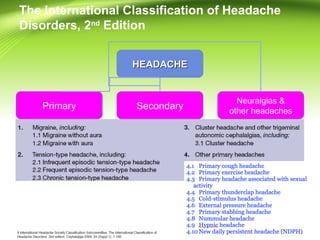
The International Classification of Headache
Disorders, 2nd
Edition
HEADACHEHEADACHE
Primary Secondary
Neuralgias &
other headaches
The International Classification of Headache
Disorders, 2nd
Edition
HEADACHEHEADACHE
Primary Secondary
Neuralgias &
other headaches
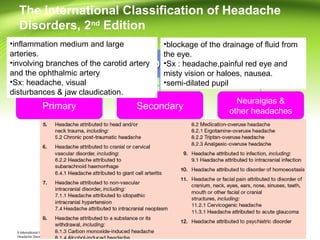
•inflammation medium and large
arteries.
•involving branches of the carotid artery
and the ophthalmic artery
•Sx: headache, visual
disturbances & jaw claudication.
•blockage of the drainage of fluid from
the eye.
•Sx : headache,painful red eye and
misty vision or haloes, nausea.
•semi-dilated pupil
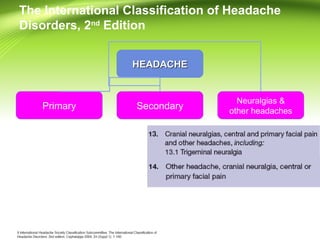
The International Classification of Headache
Disorders, 2nd
Edition
HEADACHEHEADACHE
Primary Secondary
Neuralgias &
other headaches
Diagnosis of headache
1)History
2)Physical examination
3)Investigations
1) History of headache
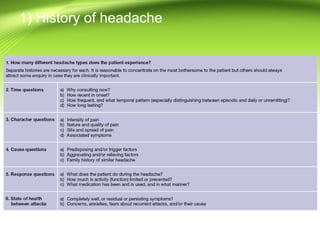
• The history is all-important
• Headache diary- pattern of headache
• Excludes sinister causes of headcahe
– Intracranial tumor
– Meningitis
– Sudarachoid Haemorrhages
– Giant Cell Arteritis
– Primary angle-glaucoma
– Idiopathic Intracranial Hypertension
– Carbon Monoxide posioning
1) History of headache
Differential diagnoses
• Posterior headache- functional or structural
derangement of the neck (cervicogenic
headache)
• Acute exacerbation of chronic sinusitis
• Refraction Errors - mild, frontal, absent on
waking & confined to eyes only
• Diseases of ears, temporomandibular joints or
teeth
2) Examination of headache
• Normal most of time
• BP
• Fundoscopy- papiloedema
• Head and neck - muscle tenderness, stiffness, limitation
in range of movement and crepitation
3) Investigations
• Neuroimaging (CT/MRI brain)
– not required for diagnosis of migraine or tension-type headache.
– history or examination suggest secondary headache
– therapeutic value of convincing a patient
• Cervical spine x-rays
• Eye tests
Red Flag of Headache (I)
1. Headache that is new or unexpected in an individual
patient
2. Thunderclap headache (intense headache with abrupt or
“explosive” onset)
3. Headache with atypical aura (duration >1 hour, or
including motor weakness)
4. Aura occurring for the first time in a patient during use of
combined oral contraceptives
5. New onset headache in a patient older than 50 years
Red Flag of Headache (II)
6. New onset headache in a patient younger than 10 years
7. Persistent morning headache with nausea
8. Progressive headache, worsening over weeks or longer
9. Headache associated with postural change
10. New onset headache in a patient with a history of
cancer
11. New onset headache
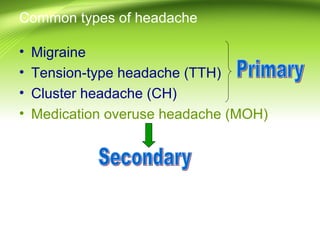
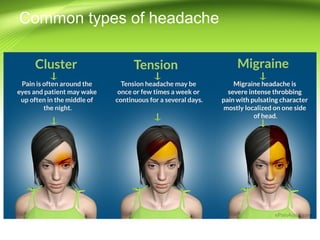
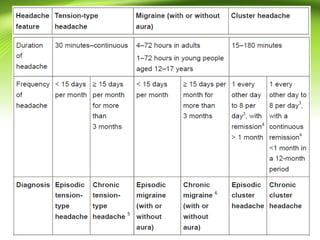
Common types of headache
• Migraine
• Tension-type headache (TTH)
• Cluster headache (CH)
• Medication overuse headache (MOH)
Common types of headache
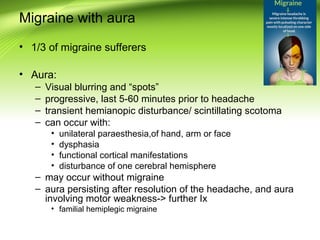
Migraine with aura
• 1/3 of migraine sufferers
• Aura:
– Visual blurring and “spots”
– progressive, last 5-60 minutes prior to headache
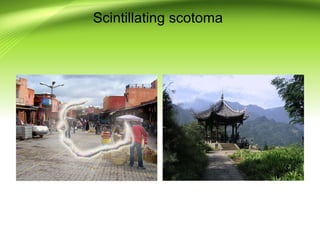
– transient hemianopic disturbance/ scintillating scotoma
– can occur with:
• unilateral paraesthesia,of hand, arm or face
• dysphasia
• functional cortical manifestations
• disturbance of one cerebral hemisphere
– may occur without migraine
– aura persisting after resolution of the headache, and aura
involving motor weakness-> further Ix
• familial hemiplegic migraine
Scintillating scotoma
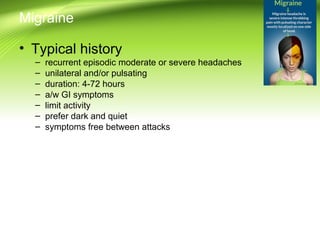
Migraine
• Typical history
– recurrent episodic moderate or severe headaches
– unilateral and/or pulsating
– duration: 4-72 hours
– a/w GI symptoms
– limit activity
– prefer dark and quiet
– symptoms free between attacks
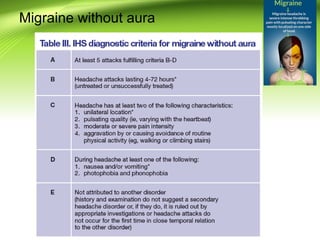
Migraine without aura
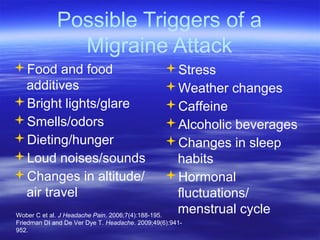
Possible Triggers of a
Migraine Attack
Food and food
additives
Bright lights/glare
Smells/odors
Dieting/hunger
Loud noises/sounds
Changes in altitude/
air travel
Stress
Weather changes
Caffeine
Alcoholic beverages
Changes in sleep
habits
Hormonal
fluctuations/
menstrual cycleWober C et al. J Headache Pain. 2006;7(4):188-195.
Friedman DI and De Ver Dye T. Headache. 2009;49(6):941-
952.
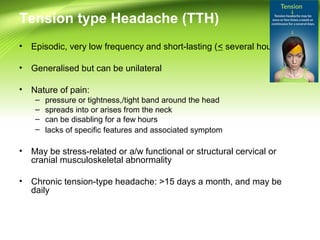
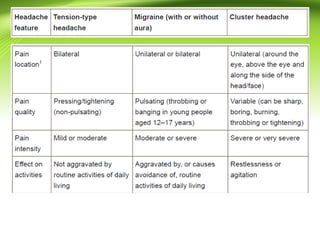
Tension type Headache (TTH)
• Episodic, very low frequency and short-lasting (< several hours)
• Generalised but can be unilateral
• Nature of pain:
– pressure or tightness,/tight band around the head
– spreads into or arises from the neck
– can be disabling for a few hours
– lacks of specific features and associated symptom
• May be stress-related or a/w functional or structural cervical or
cranial musculoskeletal abnormality
• Chronic tension-type headache: >15 days a month, and may be
daily
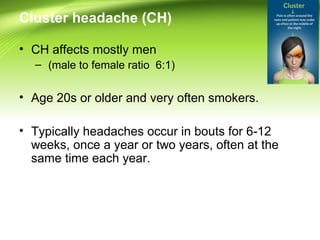
Cluster headache (CH)
• CH affects mostly men
– (male to female ratio 6:1)
• Age 20s or older and very often smokers.
• Typically headaches occur in bouts for 6-12
weeks, once a year or two years, often at the
same time each year.
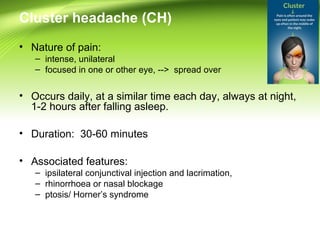
Cluster headache (CH)
• Nature of pain:
– intense, unilateral
– focused in one or other eye, --> spread over
• Occurs daily, at a similar time each day, always at night,
1-2 hours after falling asleep.
• Duration: 30-60 minutes
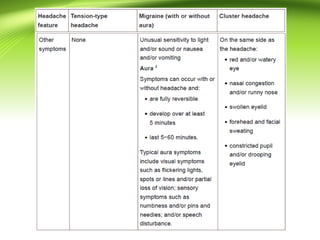
• Associated features:
– ipsilateral conjunctival injection and lacrimation,
– rhinorrhoea or nasal blockage
– ptosis/ Horner’s syndrome
Medication overuse headache (MOH)
• Headache caused by overuse of medication
– phenacetin, ergotamine, triptan
– analgesics containing barbiturates, caffeine, and codeine
– aspirin and paracetamol
• Mechanisms: not clear
– probably as a results in down-regulation of 5-HT1B/1D
receptors
– addictive properties
– changes in neural pain pathways
• may take weeks to months for the headache to resolve
after withdrawal.
Medication overuse headache (MOH)
• Small amounts are sufficient to induce MOH
– >15 days a month or of codeine-containing analgesics,
– >10 or more days a month of ergot or triptans
• Frequency is important:
– low doses daily carry greater risk than larger doses weekly.
• Nature of pain
– worst on awakening in the morning
– increases after physical exertion
– In the end-stage, headache persists all day, fluctuating with
medication use repeated every few hours.
Medication overuse headache (MOH)
• Prophylactic medication aggravate the condition
• Headache diary
• The (presumptive) diagnosis made based on symptoms
and drug used.
• Confirmed when symptoms improve after medication is
withdrawn.
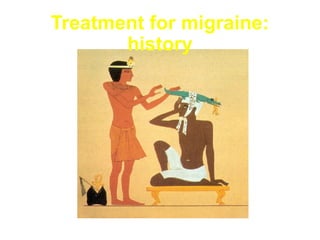
Treatment for migraine:
history
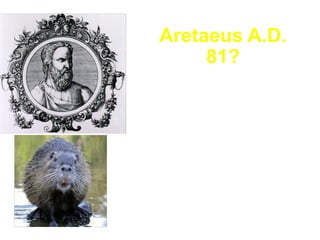
Aretaeus A.D.
81?
For the treatment of
headache, Aretaeus
recommended
inducing sneezing
by placing testicle of
beaver powder
intranasally to “bring
off phlegm”
Management- General
During consultation:
1. Explanation of the diagnosis and reassurance that
other pathology has been excluded
2. the options for management
3. recognition that headache is a valid medical disorder
with significant psychosocial impact
Management- General
Headache diary (minimum of 8/52):
• frequency, duration and severity of headaches
• any associated symptoms
• all prescribed and over the counter medications taken to
relieve headaches
• possible precipitants
• relationship of headaches to menstruation
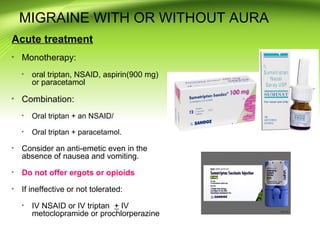
MIGRAINE WITH OR WITHOUT AURA
Acute treatment
Monotherapy:
oral triptan, NSAID, aspirin(900 mg)
or paracetamol
Combination:
Oral triptan + an NSAID/
Oral triptan + paracetamol.
Consider an anti-emetic even in the
absence of nausea and vomiting.
Do not offer ergots or opioids
If ineffective or not tolerated:
IV NSAID or IV triptan + IV
metoclopramide or prochlorperazine
MIGRAINE WITH OR WITHOUT AURA
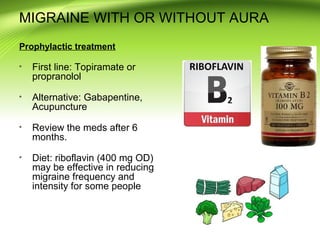
Prophylactic treatment
First line: Topiramate or
propranolol
Alternative: Gabapentine,
Acupuncture
Review the meds after 6
months.
Diet: riboflavin (400 mg OD)
may be effective in reducing
migraine frequency and
intensity for some people
MIGRAINE WITH OR WITHOUT AURA
Other meds
Amitriptyline is widely used, off-label, to treat chronic painful
disorders, including migraine. Inadequate evidence. If effective-->
continue the current treatment
Pizotifen is a popular treatment for migraine prevention, been in use
since the 1970s and appears to be well tolerated. Inadequate
evidence.
Treatment of migraine during pregnancy: PCM
TENSION-TYPE HEADACHE
• Acute treatment
– Aspirin, paracetamol or an NSAID
– Do not offer opioids
• Prophylactic treatment
– Acupuncture (10 sessions over 5–8 weeks)
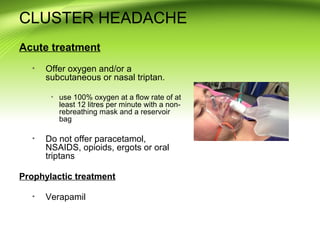
CLUSTER HEADACHE
Acute treatment
Offer oxygen and/or a
subcutaneous or nasal triptan.
use 100% oxygen at a flow rate of at
least 12 litres per minute with a non-
rebreathing mask and a reservoir
bag
Do not offer paracetamol,
NSAIDS, opioids, ergots or oral
triptans
Prophylactic treatment
Verapamil
Medication overuse headache
• Treated by withdrawing overused medication--> Explain, explain,
explain!!!
• Advise:
– to stop all overused meds abruptly rather than gradually for < 1 month
– headache symptoms are likely to get worse in the short term before they
improve
– + withdrawal symptoms
• Consider prophylactic treatment for the underlying primary
headache disorder
• Consider specialist referral for people who are using strong opioids
withdrawal (Addiction team)
• Review the diagnosis & mx 4–8 weeks after the start of withdrawal
of overused medic
References
Thank you

Headache for post basic neuroscience course 2015

  • 1.
    HEADACHE Post Basic NeurosciencesCourse 2015 Dr Ahmad Shahir bin Mawardi Specialist Registrar, Neurology Department Hospital Kuala Lumpur 1st October 2015
  • 2.
    Myth about Headache Headache= Migraine Headache = CT scan
  • 3.
    Outlines 1.Introduction 2.Classification of headache 3.Diagnosisof headache • History, Examination, Ix 1.Red flag for headche 2.Common causes of headache • Migraine, TTH, CH,MOH 1.Management of headache
  • 4.
    Introduction • Headache affectsnearly everyone at least occasionally. • Most frequent causes of consultation in GP and neurological clinics. • Migraine occurs in 15% of the UK adult population – women more than men in a ratio of 3:1 • >100,000 people are absent from work or school because of migraine every working day.
  • 5.
    The International Classificationof Headache Disorders, 2nd Edition HEADACHEHEADACHE Primary Secondary Neuralgias & other headaches
  • 6.
    The International Classificationof Headache Disorders, 2nd Edition HEADACHEHEADACHE Primary Secondary Neuralgias & other headaches •inflammation medium and large arteries. •involving branches of the carotid artery and the ophthalmic artery •Sx: headache, visual disturbances & jaw claudication. •blockage of the drainage of fluid from the eye. •Sx : headache,painful red eye and misty vision or haloes, nausea. •semi-dilated pupil
  • 7.
    The International Classificationof Headache Disorders, 2nd Edition HEADACHEHEADACHE Primary Secondary Neuralgias & other headaches
  • 8.
    Diagnosis of headache 1)History 2)Physicalexamination 3)Investigations
  • 9.
    1) History ofheadache • The history is all-important • Headache diary- pattern of headache • Excludes sinister causes of headcahe – Intracranial tumor – Meningitis – Sudarachoid Haemorrhages – Giant Cell Arteritis – Primary angle-glaucoma – Idiopathic Intracranial Hypertension – Carbon Monoxide posioning
  • 10.
    1) History ofheadache
  • 11.
    Differential diagnoses • Posteriorheadache- functional or structural derangement of the neck (cervicogenic headache) • Acute exacerbation of chronic sinusitis • Refraction Errors - mild, frontal, absent on waking & confined to eyes only • Diseases of ears, temporomandibular joints or teeth
  • 12.
    2) Examination ofheadache • Normal most of time • BP • Fundoscopy- papiloedema • Head and neck - muscle tenderness, stiffness, limitation in range of movement and crepitation
  • 13.
    3) Investigations • Neuroimaging(CT/MRI brain) – not required for diagnosis of migraine or tension-type headache. – history or examination suggest secondary headache – therapeutic value of convincing a patient • Cervical spine x-rays • Eye tests
  • 14.
    Red Flag ofHeadache (I) 1. Headache that is new or unexpected in an individual patient 2. Thunderclap headache (intense headache with abrupt or “explosive” onset) 3. Headache with atypical aura (duration >1 hour, or including motor weakness) 4. Aura occurring for the first time in a patient during use of combined oral contraceptives 5. New onset headache in a patient older than 50 years
  • 15.
    Red Flag ofHeadache (II) 6. New onset headache in a patient younger than 10 years 7. Persistent morning headache with nausea 8. Progressive headache, worsening over weeks or longer 9. Headache associated with postural change 10. New onset headache in a patient with a history of cancer 11. New onset headache
  • 16.
    Common types ofheadache • Migraine • Tension-type headache (TTH) • Cluster headache (CH) • Medication overuse headache (MOH)
  • 17.
  • 18.
    Migraine with aura •1/3 of migraine sufferers • Aura: – Visual blurring and “spots” – progressive, last 5-60 minutes prior to headache – transient hemianopic disturbance/ scintillating scotoma – can occur with: • unilateral paraesthesia,of hand, arm or face • dysphasia • functional cortical manifestations • disturbance of one cerebral hemisphere – may occur without migraine – aura persisting after resolution of the headache, and aura involving motor weakness-> further Ix • familial hemiplegic migraine
  • 19.
  • 20.
    Migraine • Typical history –recurrent episodic moderate or severe headaches – unilateral and/or pulsating – duration: 4-72 hours – a/w GI symptoms – limit activity – prefer dark and quiet – symptoms free between attacks
  • 21.
  • 22.
    Possible Triggers ofa Migraine Attack Food and food additives Bright lights/glare Smells/odors Dieting/hunger Loud noises/sounds Changes in altitude/ air travel Stress Weather changes Caffeine Alcoholic beverages Changes in sleep habits Hormonal fluctuations/ menstrual cycleWober C et al. J Headache Pain. 2006;7(4):188-195. Friedman DI and De Ver Dye T. Headache. 2009;49(6):941- 952.
  • 23.
    Tension type Headache(TTH) • Episodic, very low frequency and short-lasting (< several hours) • Generalised but can be unilateral • Nature of pain: – pressure or tightness,/tight band around the head – spreads into or arises from the neck – can be disabling for a few hours – lacks of specific features and associated symptom • May be stress-related or a/w functional or structural cervical or cranial musculoskeletal abnormality • Chronic tension-type headache: >15 days a month, and may be daily
  • 24.
    Cluster headache (CH) •CH affects mostly men – (male to female ratio 6:1) • Age 20s or older and very often smokers. • Typically headaches occur in bouts for 6-12 weeks, once a year or two years, often at the same time each year.
  • 25.
    Cluster headache (CH) •Nature of pain: – intense, unilateral – focused in one or other eye, --> spread over • Occurs daily, at a similar time each day, always at night, 1-2 hours after falling asleep. • Duration: 30-60 minutes • Associated features: – ipsilateral conjunctival injection and lacrimation, – rhinorrhoea or nasal blockage – ptosis/ Horner’s syndrome
  • 29.
    Medication overuse headache(MOH) • Headache caused by overuse of medication – phenacetin, ergotamine, triptan – analgesics containing barbiturates, caffeine, and codeine – aspirin and paracetamol • Mechanisms: not clear – probably as a results in down-regulation of 5-HT1B/1D receptors – addictive properties – changes in neural pain pathways • may take weeks to months for the headache to resolve after withdrawal.
  • 30.
    Medication overuse headache(MOH) • Small amounts are sufficient to induce MOH – >15 days a month or of codeine-containing analgesics, – >10 or more days a month of ergot or triptans • Frequency is important: – low doses daily carry greater risk than larger doses weekly. • Nature of pain – worst on awakening in the morning – increases after physical exertion – In the end-stage, headache persists all day, fluctuating with medication use repeated every few hours.
  • 31.
    Medication overuse headache(MOH) • Prophylactic medication aggravate the condition • Headache diary • The (presumptive) diagnosis made based on symptoms and drug used. • Confirmed when symptoms improve after medication is withdrawn.
  • 32.
  • 33.
    Aretaeus A.D. 81? For thetreatment of headache, Aretaeus recommended inducing sneezing by placing testicle of beaver powder intranasally to “bring off phlegm”
  • 34.
    Management- General During consultation: 1.Explanation of the diagnosis and reassurance that other pathology has been excluded 2. the options for management 3. recognition that headache is a valid medical disorder with significant psychosocial impact
  • 35.
    Management- General Headache diary(minimum of 8/52): • frequency, duration and severity of headaches • any associated symptoms • all prescribed and over the counter medications taken to relieve headaches • possible precipitants • relationship of headaches to menstruation
  • 36.
    MIGRAINE WITH ORWITHOUT AURA Acute treatment Monotherapy: oral triptan, NSAID, aspirin(900 mg) or paracetamol Combination: Oral triptan + an NSAID/ Oral triptan + paracetamol. Consider an anti-emetic even in the absence of nausea and vomiting. Do not offer ergots or opioids If ineffective or not tolerated: IV NSAID or IV triptan + IV metoclopramide or prochlorperazine
  • 37.
    MIGRAINE WITH ORWITHOUT AURA Prophylactic treatment First line: Topiramate or propranolol Alternative: Gabapentine, Acupuncture Review the meds after 6 months. Diet: riboflavin (400 mg OD) may be effective in reducing migraine frequency and intensity for some people
  • 38.
    MIGRAINE WITH ORWITHOUT AURA Other meds Amitriptyline is widely used, off-label, to treat chronic painful disorders, including migraine. Inadequate evidence. If effective--> continue the current treatment Pizotifen is a popular treatment for migraine prevention, been in use since the 1970s and appears to be well tolerated. Inadequate evidence. Treatment of migraine during pregnancy: PCM
  • 39.
    TENSION-TYPE HEADACHE • Acutetreatment – Aspirin, paracetamol or an NSAID – Do not offer opioids • Prophylactic treatment – Acupuncture (10 sessions over 5–8 weeks)
  • 40.
    CLUSTER HEADACHE Acute treatment Offeroxygen and/or a subcutaneous or nasal triptan. use 100% oxygen at a flow rate of at least 12 litres per minute with a non- rebreathing mask and a reservoir bag Do not offer paracetamol, NSAIDS, opioids, ergots or oral triptans Prophylactic treatment Verapamil
  • 41.
    Medication overuse headache •Treated by withdrawing overused medication--> Explain, explain, explain!!! • Advise: – to stop all overused meds abruptly rather than gradually for < 1 month – headache symptoms are likely to get worse in the short term before they improve – + withdrawal symptoms • Consider prophylactic treatment for the underlying primary headache disorder • Consider specialist referral for people who are using strong opioids withdrawal (Addiction team) • Review the diagnosis & mx 4–8 weeks after the start of withdrawal of overused medic
  • 42.
  • 43.