Approach To Headache
A Presentation By:
Dr. SHIVAOM CHAURASIA
MD INTERNAL MEDICINE, KUSMS
FIRST YEAR RESIDENT
INTRODUCTION:
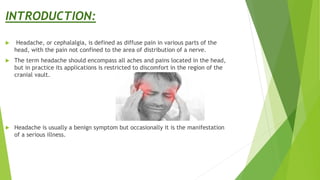
 Headache, or cephalalgia, is defined as diffuse pain in various parts of the
head, with the pain not confined to the area of distribution of a nerve.
 The term headache should encompass all aches and pains located in the head,
but in practice its applications is restricted to discomfort in the region of the
cranial vault.
 Headache is usually a benign symptom but occasionally it is the manifestation
of a serious illness.
Common causes of headache:
There are mainly two causes of headache:
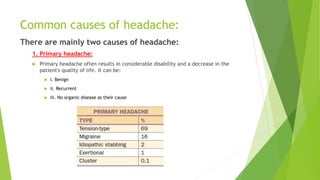
1. Primary headache:
 Primary headache often results in considerable disability and a decrease in the
patient's quality of life. It can be:
 i. Benign
 ii. Recurrent
 iii. No organic disease as their cause
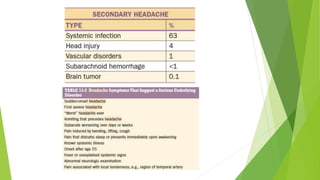
2. Secondary Headache:
i. Underlying organic disease.
ii. Headache associated with head trauma.
iii. Headache associated with vascular disorders.
 Acute ischemic cerebrovascular disorder
 SAH
 Un-ruptured vascular malformation
 Arterial HTN
 Arteritis (e.g. temporal arteritis, sinusitis )
iv. Headache associated with nonvascular intracranial disorder:
 Benign intracranial HTN ( pseudotumor cerebri –presence with headache papilledma,
diplopia and elevated CSF pressure > 20 cm of H2O in relaxed lateral decupitus position).
 Low CSF pressure (e.g., headache subsequent to LP)
 Intracranial infection
Classification:
 Primary headache syndromes include migraines with (classic) or without
(common) aura, the hemicranias and indomethacin-responsive headaches,
tension headaches, chronic daily headaches, and cluster headaches.
 Secondary headaches have specific etiologies, and symptomatic features
vary depending on the underlying pathology (i.e., SAH, tumor, hypertension,
posterior reversible encephalopathy syndrome [PRES], analgesic overuse,
iatrogenic).
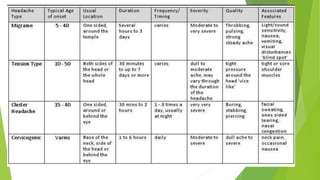
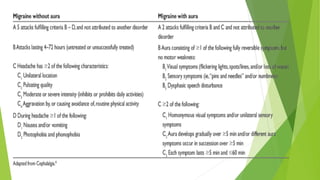
 Migraine without aura (common): At least five attacks that last 4 to 72
hours.Symptomsshouldincludeatleasttwoofthefollowing:unilaterallocation,puls
atingorthrobbing,moderatetosevereinintensity,aggravatedbyactivity,andatleas
tone of these associated features: nausea/vomiting, photophobia, and/or
phonophobia.
 Migraine with aura (classic): Same as the aforementioned, except at least
two attacks with an associated aura that lasts from 4 minutes to 1 hour
(longer than 60 minutes is a red flag). The aura should have a gradual onset,
be fully reversible, and can occur before, with, or after headache onset
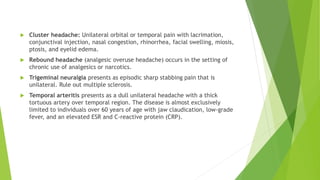
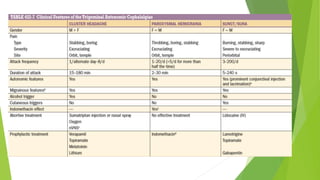
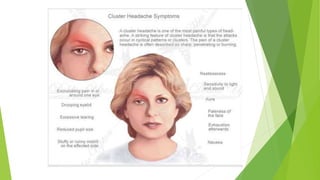
 Cluster headache: Unilateral orbital or temporal pain with lacrimation,
conjunctival injection, nasal congestion, rhinorrhea, facial swelling, miosis,
ptosis, and eyelid edema.
 Rebound headache (analgesic overuse headache) occurs in the setting of
chronic use of analgesics or narcotics.
 Trigeminal neuralgia presents as episodic sharp stabbing pain that is
unilateral. Rule out multiple sclerosis.
 Temporal arteritis presents as a dull unilateral headache with a thick
tortuous artery over temporal region. The disease is almost exclusively
limited to individuals over 60 years of age with jaw claudication, low-grade
fever, and an elevated ESR and C-reactive protein (CRP).
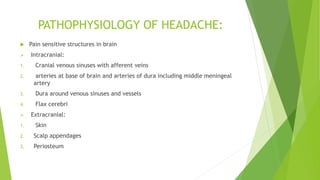
PATHOPHYSIOLOGY OF HEADACHE:
 Pain sensitive structures in brain
 Intracranial:
1. Cranial venous sinuses with afferent veins
2. arteries at base of brain and arteries of dura including middle meningeal
artery
3. Dura around venous sinuses and vessels
4. Flax cerebri
 Extracranial:
1. Skin
2. Scalp appendages
3. Periosteum
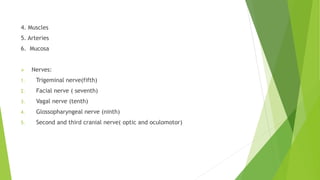
4. Muscles
5. Arteries
6. Mucosa
 Nerves:
1. Trigeminal nerve(fifth)
2. Facial nerve ( seventh)
3. Vagal nerve (tenth)
4. Glossopharyngeal nerve (ninth)
5. Second and third cranial nerve( optic and oculomotor)
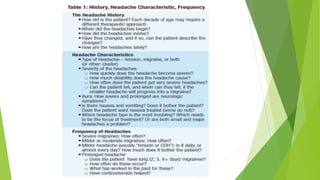
HISTORY:
FIRST OR WORST HEADACHE:
1.Age, Sex, Occupation:
 Migraine headache – more frequent in teenagers & young adults, higher
occurrence in female.
 Cluster headache – almost exclusively in males.
 Cranial arteritis – more frequently in late middle age & in elderly.
2. Duration:
 Tension headache -often has long duration.
 Headache due to expanding of intracranial disease – usually short duration.
 Headache due to meningeal cause – acute in onset.
 Migraine headache – recur over a long period of time, with symptoms free
interval between attacks
3. Location:
 As a general rule localized headache is of greater significance than diffuse
headache.
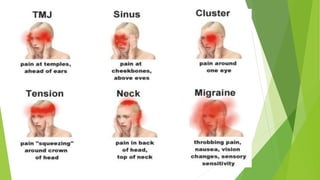
 Tension headache – typically generalized, band like or bi-occipital.
 Migraine with aura – often unilateral & frequently more prominent interiorly.
 Migraine without aura – frequently bilateral.
 Cluster headache – invariably limited to the same side of the head in any
given attacks & usually periorbital.
4. Prodromal symptoms:
 Migraine headache – commonly precede by systemic complaints as
euphoria, anorexia, nausea.
 Migraine headache – often precede by neurological symptoms as
scintillating scotoma, transient hemianopia, hemi-motor or hemi-sensory
disturbance & dysphasia.
5. Associated symptoms:
 Tension headache – often associated with other psycho-physiologic
disturbances.
 Cluster headache – typically associated with ipsilateral lacrimation,
Conjunctival injection, Rhinorrhea, & Facial Flushing.
6. Quality of pain:
 Tension headache – Pressing, Squeezing, Tight or Heavy.
 Migraine headache – Throbbing or Pounding.
 Headache due to intracranial lesion – Relatively Mild.
 Acute SAH- Pain tends to be explosive & intense.
8. Frequency, duration & diurnal variation:
 Tension headache– often persist & may worsen as the day progress.
 Migraine headache – the frequency is variable & unpredictable. Although usual
variation is from 4 - 72 hrs, they may persist for days.
 Cluster headache – occur repetitively over a period of weeks or months. Often
there are 1 or 2 attacks daily. The headache typically nocturnal & of brief
duration (30 min to a few hours).
9. Family History:
 Migraine headache – strong family history.
 Cluster headache – are not familial.
10. Intracranial Mass Lesion:
 Associated symptoms are more prominent than headache.
 Some intra-cerebral lesion may exhibit seizure or vomiting.
11. Cranial arteritis:
 Systemic symptoms as fever, anorexia & rheumatic symptoms.
12.Tension headache & Vascular Headache:
 Induced or aggravated by emotional factors.
 Intraventricular & posterior fossa tumor – may be accentuated by change in
the head position, coughing & Valsalva maneuver
Approach to Headache
1. PHYSICAL EXAMINTAION:
 The primary purpose of the physical examination is to identify causes of
secondary headaches.
 General physical examination:
 VS (BP, temperature)
 Fundoscopic examination (papilledema)
 CV assessment (assess risk of CVA)
 Palpation of the head and face (R/O sinusitis).
 Systemic sign (fever, weight loss, anemia) – infectious disease, specific
infection of CNS, metastatic disease of brain &/or meninges
Complete Neurologic Examination:
 focal neurologic signs
 Mental status
 Level of consciousness
 Cranial nerve testing
 Motor strength testing
 Deep tendon reflexes
 Pathologic reflexes (e.g. Babinski’s sign)
 Cerebellar function
 Gait testing
 Signs of meningeal irritation ( Kernig’s and Brudzinski’s signs).
2. Neurological examination:
 No neurological abnormality – tension headache.
 Evidence of cerebral ischemia – small percentage of migraine (permanent residual
damage).
 Horner’s syndrome – sometimes during migraine headache(rarely permanent).
Localizing sign – expanding ICSOL.
 Papilledema - ICP due to ICSOL.
 Bruits over the eyes/cranium – vascular malformation.
 Sign of meningeal irritation – lesion affecting the meninges.
INVESTIGATION:
Laboratory:
 Random use of laboratory testing in the evaluation of acute headache is not
warranted.
 CBC when systemic or intracranial infection is suspected
 ESR when temporal arteritis is a possibility.
Neuroimaging:
 Neuroimaging is not usually warranted in patients with primary headaches.
 CT scanning is recommended to identify acute hemorrhage.
 MRI studies are recommended to evaluate the posterior fossa.
Lumbar Puncture:
 CT scanning without contrast medium, followed by LP if the scan is negative,
is preferred to rule out SAH within the first 48 hours.
 LP is useful for assessing the CSF for blood, infection and cellular
abnormalities.
 Headaches are associated with low CSF pressure (e.g. posttraumatic leakage
of CSF) and elevated CSF pressure (e.g. idiopathic intracranial HTN and CNS
space-occupying lesions)
Indication For Scan:
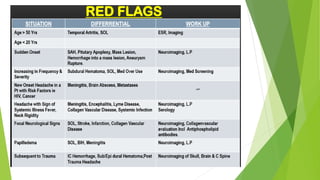
 First or worst headache, particularly if of sudden onset.
 Headache of increasing frequency or severity.
 Increased frequency of vomiting and headache on waking.
 Headache triggered by coughing, straining or postural changes.
 Persistent physical symptoms or signs after attack (neurological or endocrine)
When to refer to a neurologist????
 Physician has inadequate level of comfort in diagnosing or treating patient’s
headache.
 Patient requests a referral.
 Patient does not respond to treatment.
 Patient’s condition or disability continues or worsens.
 Physician is unable to classify patient’s headache according to diagnostic
criteria for primary or secondary headache disorders.
 Habituation or rebound headaches limit outpatient management.
 Patient has intractable or daily headaches.
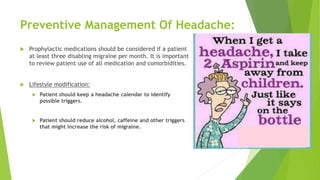
Preventive Management Of Headache:
 Prophylactic medications should be considered if a patient
at least three disabling migraine per month. It is important
to review patient use of all medication and comorbidities.
 Lifestyle modification:
 Patient should keep a headache calendar to identify
possible triggers.
 Patient should reduce alcohol, caffeine and other triggers
that might increase the risk of migraine.
1. Migraine Headache:
1. Abortive Therapy:
 Moderate : NSAIDs, Sumitriptans, Dopamine Antagonists
 Severe: Naratriptan, Sumitriptan (s.c./ n.s.)
 Extreme: Opiods
 Intravenous Metoclopromide is recognized as effective
therapy for acute migraine.
 I.V. Ketorolac an effective alternative in ED
 2. Prophylaxis:
 High efficacy: Beta blockers, TCAs, Antiepileptics like
Valproic
 Low efficacy: Verapamil, Flunarizine
2. Tension-Type Headache:
 The pain of TTH can generally be managed with simple analgesics such as
acetaminophen, aspirin, or NSAIDs.
 Behavioral approaches including relaxation can also be effective.
 TRIPTANS in pure TTH are NOT HELPFUL, although triptans are effective in TTH when
the patient also has migraine.
 For chronic TTH , AMITRIPTYLINE is the only proven treatment Other TCA, SSRI and the
benzodiazepines have not been shown to be effective.
3. Cluster Headache:
 Abortive agents:
 Oxygen (8L/min for 10 mins or 100% by mask)
 Triptans (sumitriptan)
 Prophylactic:
 CCBs – MOST effective for CH prophylaxis. Most used Verapamil others: Nimodipine
and diltiazem
 Corticosteroids to terminate the CH cyle and in preventing immediate recurrence
 High dose prednisolone is first prescribed and gradually tapered
 Beta blockers are not used as it may precipitate bradycardia occuring during CH
Secondary Headache:
 Treatment of Secondary Headaches includes identifying the disease and
treating it
References:
 Harrison’s_Principles_of_Internal_Medicine,_Twentieth_Edition_(Vol.1_&_Vol.
2
 Davidson’s Principles and Practice of the Medicine- 23rd Edition.
 The Washington Manual Of Medical Therapeutics- 34th Edition
THANK YOU!!!

Approach to headache final shivaom

  • 1.
    Approach To Headache APresentation By: Dr. SHIVAOM CHAURASIA MD INTERNAL MEDICINE, KUSMS FIRST YEAR RESIDENT
  • 2.
    INTRODUCTION:  Headache, orcephalalgia, is defined as diffuse pain in various parts of the head, with the pain not confined to the area of distribution of a nerve.  The term headache should encompass all aches and pains located in the head, but in practice its applications is restricted to discomfort in the region of the cranial vault.  Headache is usually a benign symptom but occasionally it is the manifestation of a serious illness.
  • 3.
    Common causes ofheadache: There are mainly two causes of headache: 1. Primary headache:  Primary headache often results in considerable disability and a decrease in the patient's quality of life. It can be:  i. Benign  ii. Recurrent  iii. No organic disease as their cause
  • 4.
    2. Secondary Headache: i.Underlying organic disease. ii. Headache associated with head trauma. iii. Headache associated with vascular disorders.  Acute ischemic cerebrovascular disorder  SAH  Un-ruptured vascular malformation  Arterial HTN  Arteritis (e.g. temporal arteritis, sinusitis ) iv. Headache associated with nonvascular intracranial disorder:  Benign intracranial HTN ( pseudotumor cerebri –presence with headache papilledma, diplopia and elevated CSF pressure > 20 cm of H2O in relaxed lateral decupitus position).  Low CSF pressure (e.g., headache subsequent to LP)  Intracranial infection
  • 6.
    Classification:  Primary headachesyndromes include migraines with (classic) or without (common) aura, the hemicranias and indomethacin-responsive headaches, tension headaches, chronic daily headaches, and cluster headaches.  Secondary headaches have specific etiologies, and symptomatic features vary depending on the underlying pathology (i.e., SAH, tumor, hypertension, posterior reversible encephalopathy syndrome [PRES], analgesic overuse, iatrogenic).  Migraine without aura (common): At least five attacks that last 4 to 72 hours.Symptomsshouldincludeatleasttwoofthefollowing:unilaterallocation,puls atingorthrobbing,moderatetosevereinintensity,aggravatedbyactivity,andatleas tone of these associated features: nausea/vomiting, photophobia, and/or phonophobia.  Migraine with aura (classic): Same as the aforementioned, except at least two attacks with an associated aura that lasts from 4 minutes to 1 hour (longer than 60 minutes is a red flag). The aura should have a gradual onset, be fully reversible, and can occur before, with, or after headache onset
  • 7.
     Cluster headache:Unilateral orbital or temporal pain with lacrimation, conjunctival injection, nasal congestion, rhinorrhea, facial swelling, miosis, ptosis, and eyelid edema.  Rebound headache (analgesic overuse headache) occurs in the setting of chronic use of analgesics or narcotics.  Trigeminal neuralgia presents as episodic sharp stabbing pain that is unilateral. Rule out multiple sclerosis.  Temporal arteritis presents as a dull unilateral headache with a thick tortuous artery over temporal region. The disease is almost exclusively limited to individuals over 60 years of age with jaw claudication, low-grade fever, and an elevated ESR and C-reactive protein (CRP).
  • 13.
    PATHOPHYSIOLOGY OF HEADACHE: Pain sensitive structures in brain  Intracranial: 1. Cranial venous sinuses with afferent veins 2. arteries at base of brain and arteries of dura including middle meningeal artery 3. Dura around venous sinuses and vessels 4. Flax cerebri  Extracranial: 1. Skin 2. Scalp appendages 3. Periosteum
  • 14.
    4. Muscles 5. Arteries 6.Mucosa  Nerves: 1. Trigeminal nerve(fifth) 2. Facial nerve ( seventh) 3. Vagal nerve (tenth) 4. Glossopharyngeal nerve (ninth) 5. Second and third cranial nerve( optic and oculomotor)
  • 15.
    HISTORY: FIRST OR WORSTHEADACHE: 1.Age, Sex, Occupation:  Migraine headache – more frequent in teenagers & young adults, higher occurrence in female.  Cluster headache – almost exclusively in males.  Cranial arteritis – more frequently in late middle age & in elderly. 2. Duration:  Tension headache -often has long duration.  Headache due to expanding of intracranial disease – usually short duration.  Headache due to meningeal cause – acute in onset.  Migraine headache – recur over a long period of time, with symptoms free interval between attacks
  • 16.
    3. Location:  Asa general rule localized headache is of greater significance than diffuse headache.  Tension headache – typically generalized, band like or bi-occipital.  Migraine with aura – often unilateral & frequently more prominent interiorly.  Migraine without aura – frequently bilateral.  Cluster headache – invariably limited to the same side of the head in any given attacks & usually periorbital. 4. Prodromal symptoms:  Migraine headache – commonly precede by systemic complaints as euphoria, anorexia, nausea.  Migraine headache – often precede by neurological symptoms as scintillating scotoma, transient hemianopia, hemi-motor or hemi-sensory disturbance & dysphasia.
  • 17.
    5. Associated symptoms: Tension headache – often associated with other psycho-physiologic disturbances.  Cluster headache – typically associated with ipsilateral lacrimation, Conjunctival injection, Rhinorrhea, & Facial Flushing. 6. Quality of pain:  Tension headache – Pressing, Squeezing, Tight or Heavy.  Migraine headache – Throbbing or Pounding.  Headache due to intracranial lesion – Relatively Mild.  Acute SAH- Pain tends to be explosive & intense.
  • 18.
    8. Frequency, duration& diurnal variation:  Tension headache– often persist & may worsen as the day progress.  Migraine headache – the frequency is variable & unpredictable. Although usual variation is from 4 - 72 hrs, they may persist for days.  Cluster headache – occur repetitively over a period of weeks or months. Often there are 1 or 2 attacks daily. The headache typically nocturnal & of brief duration (30 min to a few hours). 9. Family History:  Migraine headache – strong family history.  Cluster headache – are not familial. 10. Intracranial Mass Lesion:  Associated symptoms are more prominent than headache.  Some intra-cerebral lesion may exhibit seizure or vomiting.
  • 19.
    11. Cranial arteritis: Systemic symptoms as fever, anorexia & rheumatic symptoms. 12.Tension headache & Vascular Headache:  Induced or aggravated by emotional factors.  Intraventricular & posterior fossa tumor – may be accentuated by change in the head position, coughing & Valsalva maneuver
  • 21.
    Approach to Headache 1.PHYSICAL EXAMINTAION:  The primary purpose of the physical examination is to identify causes of secondary headaches.  General physical examination:  VS (BP, temperature)  Fundoscopic examination (papilledema)  CV assessment (assess risk of CVA)  Palpation of the head and face (R/O sinusitis).  Systemic sign (fever, weight loss, anemia) – infectious disease, specific infection of CNS, metastatic disease of brain &/or meninges
  • 22.
    Complete Neurologic Examination: focal neurologic signs  Mental status  Level of consciousness  Cranial nerve testing  Motor strength testing  Deep tendon reflexes  Pathologic reflexes (e.g. Babinski’s sign)  Cerebellar function  Gait testing  Signs of meningeal irritation ( Kernig’s and Brudzinski’s signs).
  • 23.
    2. Neurological examination: No neurological abnormality – tension headache.  Evidence of cerebral ischemia – small percentage of migraine (permanent residual damage).  Horner’s syndrome – sometimes during migraine headache(rarely permanent). Localizing sign – expanding ICSOL.  Papilledema - ICP due to ICSOL.  Bruits over the eyes/cranium – vascular malformation.  Sign of meningeal irritation – lesion affecting the meninges.
  • 25.
    INVESTIGATION: Laboratory:  Random useof laboratory testing in the evaluation of acute headache is not warranted.  CBC when systemic or intracranial infection is suspected  ESR when temporal arteritis is a possibility.
  • 26.
    Neuroimaging:  Neuroimaging isnot usually warranted in patients with primary headaches.  CT scanning is recommended to identify acute hemorrhage.  MRI studies are recommended to evaluate the posterior fossa.
  • 27.
    Lumbar Puncture:  CTscanning without contrast medium, followed by LP if the scan is negative, is preferred to rule out SAH within the first 48 hours.  LP is useful for assessing the CSF for blood, infection and cellular abnormalities.  Headaches are associated with low CSF pressure (e.g. posttraumatic leakage of CSF) and elevated CSF pressure (e.g. idiopathic intracranial HTN and CNS space-occupying lesions)
  • 28.
    Indication For Scan: First or worst headache, particularly if of sudden onset.  Headache of increasing frequency or severity.  Increased frequency of vomiting and headache on waking.  Headache triggered by coughing, straining or postural changes.  Persistent physical symptoms or signs after attack (neurological or endocrine)
  • 29.
    When to referto a neurologist????  Physician has inadequate level of comfort in diagnosing or treating patient’s headache.  Patient requests a referral.  Patient does not respond to treatment.  Patient’s condition or disability continues or worsens.  Physician is unable to classify patient’s headache according to diagnostic criteria for primary or secondary headache disorders.  Habituation or rebound headaches limit outpatient management.  Patient has intractable or daily headaches.
  • 30.
    Preventive Management OfHeadache:  Prophylactic medications should be considered if a patient at least three disabling migraine per month. It is important to review patient use of all medication and comorbidities.  Lifestyle modification:  Patient should keep a headache calendar to identify possible triggers.  Patient should reduce alcohol, caffeine and other triggers that might increase the risk of migraine.
  • 31.
    1. Migraine Headache: 1.Abortive Therapy:  Moderate : NSAIDs, Sumitriptans, Dopamine Antagonists  Severe: Naratriptan, Sumitriptan (s.c./ n.s.)  Extreme: Opiods  Intravenous Metoclopromide is recognized as effective therapy for acute migraine.  I.V. Ketorolac an effective alternative in ED  2. Prophylaxis:  High efficacy: Beta blockers, TCAs, Antiepileptics like Valproic  Low efficacy: Verapamil, Flunarizine
  • 32.
    2. Tension-Type Headache: The pain of TTH can generally be managed with simple analgesics such as acetaminophen, aspirin, or NSAIDs.  Behavioral approaches including relaxation can also be effective.  TRIPTANS in pure TTH are NOT HELPFUL, although triptans are effective in TTH when the patient also has migraine.  For chronic TTH , AMITRIPTYLINE is the only proven treatment Other TCA, SSRI and the benzodiazepines have not been shown to be effective.
  • 33.
    3. Cluster Headache: Abortive agents:  Oxygen (8L/min for 10 mins or 100% by mask)  Triptans (sumitriptan)  Prophylactic:  CCBs – MOST effective for CH prophylaxis. Most used Verapamil others: Nimodipine and diltiazem  Corticosteroids to terminate the CH cyle and in preventing immediate recurrence  High dose prednisolone is first prescribed and gradually tapered  Beta blockers are not used as it may precipitate bradycardia occuring during CH
  • 34.
    Secondary Headache:  Treatmentof Secondary Headaches includes identifying the disease and treating it
  • 35.
    References:  Harrison’s_Principles_of_Internal_Medicine,_Twentieth_Edition_(Vol.1_&_Vol. 2  Davidson’sPrinciples and Practice of the Medicine- 23rd Edition.  The Washington Manual Of Medical Therapeutics- 34th Edition
  • 36.