G l o m e r u l o n e p h r I t I
s
HELLO
K I D N E Y
ANATOMY OF MR KIDNEY
LET’S
CHECK
IT
OUT!!!
GLOMERULUS
Functions of ME (MR.KIDNEY)
 Without me, YOU will UNABLE
to:
 Remove wastes and water from the
blood
 Balanced chemicals in your body
 Release hormones
 Help to control blood pressure
 Help to produce red blood cells
 Produce vitamin D, which keeps
the bones strong and healthy
DEFINITION
What is glomerulonephristis?
Glomerulonephritis is
is a kidney condition
that involves damage
/inflammation to the
glomeruli.
Types of glomerulonephritis
 Acute glomerulonephritis
- begins suddenly
Chronic glomerulonephritis
-develops gradually over
several years.
Approach to patient with
glomerular disease
ACUTE
GLOMERULONEPHRITIS
(AGN)
Acute Glomerulonephritis
Acute glomerulonephritis (AGN) is an
abrupt onset of one or more features of an
Acute Nephritic Syndrome :
• Oedema e.g. facial puffiness
• Microscopic / macroscopic haematuria
• Decreased urine output (oliguria)
• Hypertension
• Azotemia
Presenting features of AGN
Acute nephritic syndrome (most common)
Nephrotic syndrome
Rapidly progressive glomerulonepritis
Hypertensive encephalopathy
Pulmonary oedema
Subclinical (detected on routine
examination)
Causes of Acute Nephritis
Post streptococcal AGN
Post-infectious acute glomerulonephritis (other
than Grp A B-Haemolytic Stretococci)
Subacute bacterial endocarditis
Henoch- Schoelein Purpura
IgA nephropathy
Hereditary nephritis
SLE
Systemic vasculitis
ACUTE
POST-STREPTOCOCCAL
GLOMERULONEPHRITIS
In children, the commonest cause of acute
nephritic syndrome is post-infectious
AGN, mainly due to post-streptococcal
infection of the pharynx or skin.
Post streptococcal AGN is commonest at
6-10 years age.
Definition
AGN that follows an infection with a
nephritogenic strain of group A beta
hemolytic streptococci.
The classic example of the acute nephritic
syndrome.
Nelson Textbook of Pediatrics, 7th
Edition
Streptococcal infection of the throat
( strep throat) or skin ( impetigo)
epiDemiology
 Most commonly – sporadic.
 Peak incidence - age 2-14 y/o, uncommon <3y/o.
 Males are commonly affected than females.
etiology anD
pathogenesis
 M types of streptococci (nephritogenic strains)
 M types 47, 49, 55, 2, 60, and 57 - following impetigo
M types 1, 2, 4, 3, 25, 49, and 12 – pharyngitis
 Incubation period:
2–6 weeks after skin infection
1–3 weeks after streptococcal pharyngitis.
etiology anD
pathogenesis
 Antibodies to streptoccocus (eg antistreptolysin O) are
formed in the circulation
 Antigen-antibody circulating immune complexes are
subsequently deposited along the glomerular basement
membrane (GBM).
Streptococcal infection
immune complex formation + deposited in GBM
complement system activated
immune injuries
cellular proliferation GBM fracture
capillary lumen narrowed hematuria
glomerular blood flow decreased proteinuria
oliguria GFR↓ distal sodium reabsorption
retention of water & sodium
blood volume ↑
edema
hypertension
Low serum
complement
light microscope
not specific for post streptococcal nephritis
•Glomeruli appear enlarged and hypercellular.
•Diffuse mesangial cell proliferation with an increase in mesangial
matrix.
•Polymorphonuclear leukocytes are common in glomeruli during
the early stage of the disease.
Deposits localize in the mesangium and along the capillary wall in a
subepithelial pattern and stain dominantly for C3 and to a lesser extent
for IgG
typical manifestation
1. Edema
75% of the patients
Face, periorbital area  lower extremities  generalized
(ascites, pleural effusions)
2. Proteinuria – usually normalize after 4 weeks
3. Oliguria
Sign and symptoms
Kidney pain normally happens in the
“flank” region, which is just below the
bottom of rib cage.
Sign and symptoms
Cola-colored or diluted, iced-
tea-colored urine from red blood
cells in your urine (hematuria)
Foamy urine due to excess
protein (proteinuria)
Sign and symptoms
 High blood pressure
(hypertension)
 Fluid retention (edema)
with swelling evident in
your face, hands, feet and
abdomen
 Fatigue/SOB from
anemia or kidney failure.
 Less frequent urination
than usual.
Clinical course
Spontaneous improvement typically begins within 1 wk
with resolution of edema in 5-10 days and hypertension
in 2-3 wk, but urinalysis may be abnormal (persistent
microscopic hematuria) for a year.
InvestIgatIons
Urinalysis and culture
• Haematuria – present in all patients.
• Proteinuria (trace to 2+, but may be in the
nephrotic range; usually associated with more
severe disease.)
• Red blood cell casts (pathognomonic of acute
glomerulonephritis).
• Other cellular casts.
• Pyuria may also be present.
InvestIgatIons
Urinalysis and culture
• Red blood cell casts
(pathognomonic of acute
glomerulonephritis)
• Other cellular casts
• Pyuria may also be
present
InvestIgatIons
 Bacteriological and serological evidence of antecedent
streptococcal infection:
• Raised ASOT ( > 200 IU/ml ).
• Increased anti-DNAse B (if available) – a
better serological marker of preceding
streptococcal skin infection.
• Throat swab or skin swab.
InvestIgatIons
 Renal function test
• The BUN - elevated in 75% of patients,
• serum creatinine level is increased in one half of the
patients
• Hyperkalemia, hypocalcaemia, hyponatremia, and
metabolic acidosis are seen only in severe patients.
 Full blood count
• A mild normochromic anemia may be present from
hemodilution and low-grade hemolysis.
• Leucocytosis may be present.
InvestIgatIons
 Complement levels
• C3 level – low at onset of symptoms, normalizes by 6wks
• C4 is usually within normal limits in post-streptococcal
AGN.
 Ultrasound of the kidneys
• Not necessary if patient has clear cut acute nephritic
syndrome.
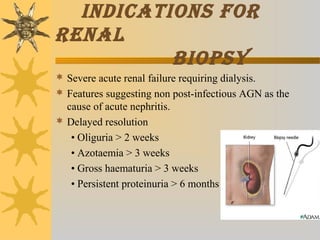
IndIcatIons for
renal
BIopsy
 Severe acute renal failure requiring dialysis.
 Features suggesting non post-infectious AGN as the
cause of acute nephritis.
 Delayed resolution
• Oliguria > 2 weeks
• Azotaemia > 3 weeks
• Gross haematuria > 3 weeks
• Persistent proteinuria > 6 months
dIagnosIs
Acute onset
Symptoms: edema, oliguria, dark urine,
hypertension
Urinalysis: RBCs, protein, casts
Evidences of streptococcal infection:
– Elevated serum titers of Abs to
streptozymes(ASO)
Serum C3 - Reduced
Lupus
dIfferentIal
dIagnosIs
dIfferentIal dIagnosIs
ManageMent
Strict monitoring - fluid intake, urine output,
daily weight, BP (Nephrotic chart)
Penicillin V for 10 days (give erythromycin if
penicillin is contraindicated)
Fluid restriction
MANAGEMENT
Diuretic (e.g. Frusemide) should be given in
children with pulmonary oedema.
Diet – no added salt to diet.
COMPLICATIONS
Look out for complications of post-
streptococcal AGN:
• Hypertensive encephalopathy usually
presenting with seizures
• Pulmonary oedema (acute left ventricular
failure)
• Acute renal failure
MANAGEMENT fOr
COMPLICATIONS
Significant asymptomatic
hypertension
symptomatic, severe hypertension or hypertensive emergency /
encephalopathy
Prehypertension is defined as a blood pressure
in at least the 90th percentile, but less than the
95th percentile, for age, sex, and height, or a
measurement of 120/80 mm Hg or greater.
Hypertension is defined as blood pressure in
the 95th percentile or greater.
Acute pulmonary edema
MANAGEMENT fOr
COMPLICATIONS
MANAGEMENT fOr
COMPLICATIONS
Acute Renal Failure
fOLLOw-uP
 For at least 1 year.
Monitor BP at every visit
Do urinalysis and renal function to
evaluate recovery.
Repeat C3 levels 6 weeks later if not
already normalised by the time of
discharge.
OuTCOME
 Short term outcome: Excellent, mortality
<0.5%.
 Long term outcome: 1.8% of children
develop chronic kidney disease following
post streptococcal AGN.
 These children should be referred to the
paediatric nephrologists for further
evaluation and management.
KIDNEY SAY !!!!
Thanks for watching

Acute glomerular disease

  • 1.
    G l om e r u l o n e p h r I t I s HELLO K I D N E Y
  • 2.
    ANATOMY OF MRKIDNEY LET’S CHECK IT OUT!!!
  • 4.
  • 5.
    Functions of ME(MR.KIDNEY)  Without me, YOU will UNABLE to:  Remove wastes and water from the blood  Balanced chemicals in your body  Release hormones  Help to control blood pressure  Help to produce red blood cells  Produce vitamin D, which keeps the bones strong and healthy
  • 6.
  • 7.
    What is glomerulonephristis? Glomerulonephritisis is a kidney condition that involves damage /inflammation to the glomeruli.
  • 8.
    Types of glomerulonephritis Acute glomerulonephritis - begins suddenly Chronic glomerulonephritis -develops gradually over several years.
  • 9.
    Approach to patientwith glomerular disease
  • 10.
  • 12.
    Acute Glomerulonephritis Acute glomerulonephritis(AGN) is an abrupt onset of one or more features of an Acute Nephritic Syndrome : • Oedema e.g. facial puffiness • Microscopic / macroscopic haematuria • Decreased urine output (oliguria) • Hypertension • Azotemia
  • 13.
    Presenting features ofAGN Acute nephritic syndrome (most common) Nephrotic syndrome Rapidly progressive glomerulonepritis Hypertensive encephalopathy Pulmonary oedema Subclinical (detected on routine examination)
  • 14.
    Causes of AcuteNephritis Post streptococcal AGN Post-infectious acute glomerulonephritis (other than Grp A B-Haemolytic Stretococci) Subacute bacterial endocarditis Henoch- Schoelein Purpura IgA nephropathy Hereditary nephritis SLE Systemic vasculitis
  • 15.
  • 16.
    In children, thecommonest cause of acute nephritic syndrome is post-infectious AGN, mainly due to post-streptococcal infection of the pharynx or skin. Post streptococcal AGN is commonest at 6-10 years age.
  • 17.
    Definition AGN that followsan infection with a nephritogenic strain of group A beta hemolytic streptococci. The classic example of the acute nephritic syndrome. Nelson Textbook of Pediatrics, 7th Edition
  • 18.
    Streptococcal infection ofthe throat ( strep throat) or skin ( impetigo)
  • 19.
    epiDemiology  Most commonly– sporadic.  Peak incidence - age 2-14 y/o, uncommon <3y/o.  Males are commonly affected than females.
  • 20.
    etiology anD pathogenesis  Mtypes of streptococci (nephritogenic strains)  M types 47, 49, 55, 2, 60, and 57 - following impetigo M types 1, 2, 4, 3, 25, 49, and 12 – pharyngitis  Incubation period: 2–6 weeks after skin infection 1–3 weeks after streptococcal pharyngitis.
  • 21.
    etiology anD pathogenesis  Antibodiesto streptoccocus (eg antistreptolysin O) are formed in the circulation  Antigen-antibody circulating immune complexes are subsequently deposited along the glomerular basement membrane (GBM).
  • 22.
    Streptococcal infection immune complexformation + deposited in GBM complement system activated immune injuries cellular proliferation GBM fracture capillary lumen narrowed hematuria glomerular blood flow decreased proteinuria oliguria GFR↓ distal sodium reabsorption retention of water & sodium blood volume ↑ edema hypertension Low serum complement
  • 25.
    light microscope not specificfor post streptococcal nephritis •Glomeruli appear enlarged and hypercellular. •Diffuse mesangial cell proliferation with an increase in mesangial matrix. •Polymorphonuclear leukocytes are common in glomeruli during the early stage of the disease.
  • 26.
    Deposits localize inthe mesangium and along the capillary wall in a subepithelial pattern and stain dominantly for C3 and to a lesser extent for IgG
  • 27.
    typical manifestation 1. Edema 75%of the patients Face, periorbital area  lower extremities  generalized (ascites, pleural effusions) 2. Proteinuria – usually normalize after 4 weeks 3. Oliguria
  • 28.
    Sign and symptoms Kidneypain normally happens in the “flank” region, which is just below the bottom of rib cage.
  • 29.
    Sign and symptoms Cola-coloredor diluted, iced- tea-colored urine from red blood cells in your urine (hematuria) Foamy urine due to excess protein (proteinuria)
  • 30.
    Sign and symptoms High blood pressure (hypertension)  Fluid retention (edema) with swelling evident in your face, hands, feet and abdomen  Fatigue/SOB from anemia or kidney failure.  Less frequent urination than usual.
  • 31.
    Clinical course Spontaneous improvementtypically begins within 1 wk with resolution of edema in 5-10 days and hypertension in 2-3 wk, but urinalysis may be abnormal (persistent microscopic hematuria) for a year.
  • 32.
    InvestIgatIons Urinalysis and culture •Haematuria – present in all patients. • Proteinuria (trace to 2+, but may be in the nephrotic range; usually associated with more severe disease.) • Red blood cell casts (pathognomonic of acute glomerulonephritis). • Other cellular casts. • Pyuria may also be present.
  • 33.
    InvestIgatIons Urinalysis and culture •Red blood cell casts (pathognomonic of acute glomerulonephritis) • Other cellular casts • Pyuria may also be present
  • 34.
    InvestIgatIons  Bacteriological andserological evidence of antecedent streptococcal infection: • Raised ASOT ( > 200 IU/ml ). • Increased anti-DNAse B (if available) – a better serological marker of preceding streptococcal skin infection. • Throat swab or skin swab.
  • 35.
    InvestIgatIons  Renal functiontest • The BUN - elevated in 75% of patients, • serum creatinine level is increased in one half of the patients • Hyperkalemia, hypocalcaemia, hyponatremia, and metabolic acidosis are seen only in severe patients.  Full blood count • A mild normochromic anemia may be present from hemodilution and low-grade hemolysis. • Leucocytosis may be present.
  • 36.
    InvestIgatIons  Complement levels •C3 level – low at onset of symptoms, normalizes by 6wks • C4 is usually within normal limits in post-streptococcal AGN.  Ultrasound of the kidneys • Not necessary if patient has clear cut acute nephritic syndrome.
  • 37.
    IndIcatIons for renal BIopsy  Severeacute renal failure requiring dialysis.  Features suggesting non post-infectious AGN as the cause of acute nephritis.  Delayed resolution • Oliguria > 2 weeks • Azotaemia > 3 weeks • Gross haematuria > 3 weeks • Persistent proteinuria > 6 months
  • 38.
    dIagnosIs Acute onset Symptoms: edema,oliguria, dark urine, hypertension Urinalysis: RBCs, protein, casts Evidences of streptococcal infection: – Elevated serum titers of Abs to streptozymes(ASO) Serum C3 - Reduced
  • 39.
  • 40.
  • 41.
  • 42.
    ManageMent Strict monitoring -fluid intake, urine output, daily weight, BP (Nephrotic chart) Penicillin V for 10 days (give erythromycin if penicillin is contraindicated) Fluid restriction
  • 43.
    MANAGEMENT Diuretic (e.g. Frusemide)should be given in children with pulmonary oedema. Diet – no added salt to diet.
  • 44.
    COMPLICATIONS Look out forcomplications of post- streptococcal AGN: • Hypertensive encephalopathy usually presenting with seizures • Pulmonary oedema (acute left ventricular failure) • Acute renal failure
  • 45.
    MANAGEMENT fOr COMPLICATIONS Significant asymptomatic hypertension symptomatic,severe hypertension or hypertensive emergency / encephalopathy
  • 47.
    Prehypertension is definedas a blood pressure in at least the 90th percentile, but less than the 95th percentile, for age, sex, and height, or a measurement of 120/80 mm Hg or greater. Hypertension is defined as blood pressure in the 95th percentile or greater.
  • 49.
  • 50.
  • 51.
    fOLLOw-uP  For atleast 1 year. Monitor BP at every visit Do urinalysis and renal function to evaluate recovery. Repeat C3 levels 6 weeks later if not already normalised by the time of discharge.
  • 52.
    OuTCOME  Short termoutcome: Excellent, mortality <0.5%.  Long term outcome: 1.8% of children develop chronic kidney disease following post streptococcal AGN.  These children should be referred to the paediatric nephrologists for further evaluation and management.
  • 53.

Editor's Notes

  • #5 Normal histological structure of a glomerulus. On the right, is a 3-D illustration of a glomerulus. Left one shows AA = affrent arteriole, EA= Efferent arteriole, BC= Bowman’s capsule, US= Urinary space