
Verbs and Voice

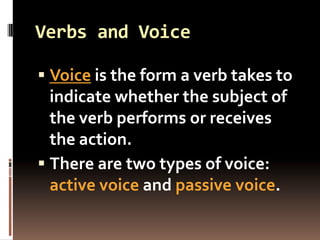
 Voice is the form a verb takes to
  indicate whether the subject of
  the verb performs or receives
  the action.
 There are two types of voice:
 active voice and passive voice.
Active Voice

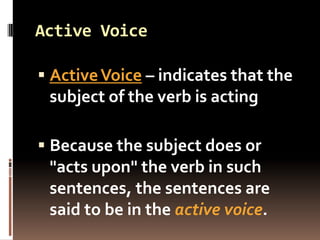
 Active Voice – indicates that the
  subject of the verb is acting

 Because the subject does or
 "acts upon" the verb in such
 sentences, the sentences are
 said to be in the active voice.
Active Voice

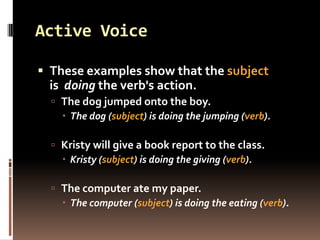
 These examples show that the subject
  is doing the verb's action.
   The dog jumped onto the boy.
     The dog (subject) is doing the jumping (verb).

   Kristy will give a book report to the class.
     Kristy (subject) is doing the giving (verb).

   The computer ate my paper.
     The computer (subject) is doing the eating (verb).
Passive Voice

 In a passive voice sentence, the subject and
  object flip-flop. The subject becomes the
  passive recipient of the action.

 Because the subject is being "acted upon" (or
  is passive), such sentences are said to be in
  the passive voice.
Passive Voice

 These examples show the subject being
  acted upon by the verb.
 The boy was jumped on by the dog.
   Boy (subject) was being jumped on (verb)
 A book report will be given by Kristy to the
  class.
   Report (subject) will be given (verb).
 My paper was eaten by the computer.
   Paper (subject) was being eaten (verb).
Reasons to Use the Active Voice

 Most writers prefer to use active voice
  because it is more direct.
 Compare
   Active: The waiter dropped the tray of
    food.
   Passive: The tray of food was dropped
    by the waiter.
Reasons to Use the Active Voice

 The active voice is less awkward and clearly
  states relationship between subject and action.
 Compare
   Passive:Your request for funding has been denied by
    the review committee.
   Active: The review committee denied your request for
    funding.
 The active voice sentence pattern propels the
  reader forward through your writing thus
  avoiding weak prose.
When to Use Passive Voice

 In general, the passive voice is less direct, less
  forceful, and less concise than the active
  voice.
 Use the passive voice in the following
      situations:
      Use passive voice when you do not know or
       do not want to reveal the performer of an
       action.
      Use passive voice when you want to
       emphasize the receiver of an action.
Examples

 Awkward Passive: My bicycle was
  repainted by John.
 Deliberate Passive: My bicycle was
  repainted. (The performer is not mentioned
  and the emphasis is on the bicycle.)
Form of Passive Voice Verbs

 The passive voice requires a "double verb"
  and will always consist of a form of the verb
  "to be" and the past participle (usually the
  "en/ed/t" form) of another verb.
 Example:
    Active: John baked the bread.
    Passive: The bread was baked by John. (Was is
    a form of the verb “be”.)
Form of Passive Voice Verbs
 Writers should be familiar with the forms of
  "to be" , often called linking verbs, so that
  they can easily identify the passive voice in
  their work.

 Review the forms of "to be":
 am, is, are, was, were, be, being, been

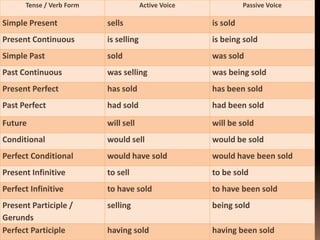
  Study the following active tenses and their
  passive equivalents:
Tense / Verb Form                Active Voice             Passive Voice

Simple Present            sells                       is sold
Present Continuous        is selling                  is being sold
Simple Past               sold                        was sold
Past Continuous           was selling                 was being sold
Present Perfect           has sold                    has been sold
Past Perfect              had sold                    had been sold

Future                    will sell                   will be sold
Conditional               would sell                  would be sold
Perfect Conditional       would have sold             would have been sold
Present Infinitive        to sell                     to be sold
Perfect Infinitive        to have sold                to have been sold
Present Participle /      selling                     being sold
Gerunds
Perfect Participle        having sold                 having been sold
Form of Passive Voice Verbs

 Often passive voice sentences will contain a
  "by" phrase indicting who or what performed
  the action.
 Passive sentences can be easily transformed
  into active sentences when the object of the
  preposition "by" is moved to the subject
  position in the sentence.
Form of Passive Voice Verbs

 Examples:
   Passive: The cookies were eaten by the children.
   Active: The children ate the cookies.


   Passive: The tunnels are dug by the gophers.
   Active: The gophers dug the tunnels.
** In Passive sentences, the
  subject of the sentences is NOT
  the doer of the verb (‘the agent’)

 Normally, the agent is NOT INCLUDED in a
  passive sentence because it is unimportant or
  obvious who the agent is.

 Someone    stole my purse.        Active

 My purse   was stolen.       Passive
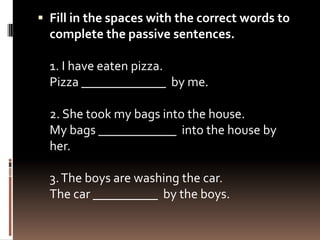
 Fill in the spaces with the correct words to
  complete the passive sentences.

  1. I have eaten pizza.
  Pizza _____________ by me.

  2. She took my bags into the house.
  My bags ____________ into the house by
  her.

  3. The boys are washing the car.
  The car __________ by the boys.
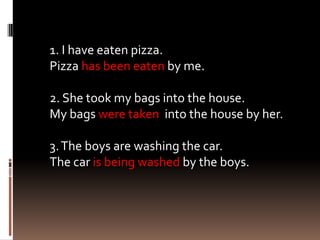
1. I have eaten pizza.
Pizza has been eaten by me.

2. She took my bags into the house.
My bags were taken into the house by her.

3. The boys are washing the car.
The car is being washed by the boys.
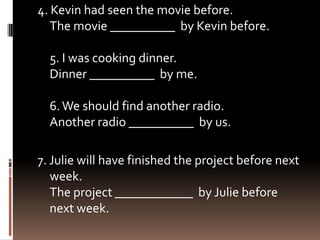
4. Kevin had seen the movie before.
   The movie __________ by Kevin before.

  5. I was cooking dinner.
  Dinner __________ by me.

  6. We should find another radio.
  Another radio __________ by us.

7. Julie will have finished the project before next
   week.
   The project ____________ by Julie before
   next week.
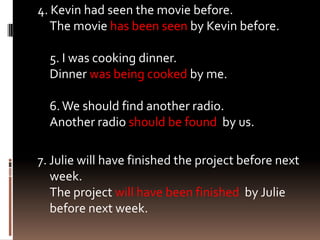
4. Kevin had seen the movie before.
   The movie has been seen by Kevin before.

  5. I was cooking dinner.
  Dinner was being cooked by me.

  6. We should find another radio.
  Another radio should be found by us.

7. Julie will have finished the project before next
   week.
   The project will have been finished by Julie
   before next week.
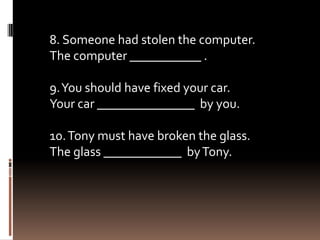
8. Someone had stolen the computer.
The computer ___________ .

9. You should have fixed your car.
Your car _______________ by you.

10. Tony must have broken the glass.
The glass ____________ by Tony.
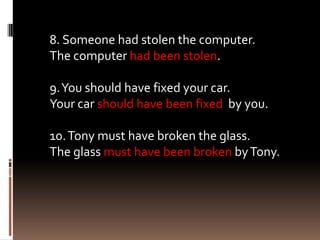
8. Someone had stolen the computer.
The computer had been stolen.

9. You should have fixed your car.
Your car should have been fixed by you.

10. Tony must have broken the glass.
The glass must have been broken by Tony.
Active and passive voice

Active and passive voice

  • 2.
    Verbs and Voice Voice is the form a verb takes to indicate whether the subject of the verb performs or receives the action.  There are two types of voice: active voice and passive voice.
  • 3.
    Active Voice  ActiveVoice – indicates that the subject of the verb is acting  Because the subject does or "acts upon" the verb in such sentences, the sentences are said to be in the active voice.
  • 4.
    Active Voice  Theseexamples show that the subject is doing the verb's action.  The dog jumped onto the boy.  The dog (subject) is doing the jumping (verb).  Kristy will give a book report to the class.  Kristy (subject) is doing the giving (verb).  The computer ate my paper.  The computer (subject) is doing the eating (verb).
  • 5.
    Passive Voice  Ina passive voice sentence, the subject and object flip-flop. The subject becomes the passive recipient of the action.  Because the subject is being "acted upon" (or is passive), such sentences are said to be in the passive voice.
  • 6.
    Passive Voice  Theseexamples show the subject being acted upon by the verb.  The boy was jumped on by the dog.  Boy (subject) was being jumped on (verb)  A book report will be given by Kristy to the class.  Report (subject) will be given (verb).  My paper was eaten by the computer.  Paper (subject) was being eaten (verb).
  • 7.
    Reasons to Usethe Active Voice  Most writers prefer to use active voice because it is more direct.  Compare  Active: The waiter dropped the tray of food.  Passive: The tray of food was dropped by the waiter.
  • 8.
    Reasons to Usethe Active Voice  The active voice is less awkward and clearly states relationship between subject and action.  Compare  Passive:Your request for funding has been denied by the review committee.  Active: The review committee denied your request for funding.  The active voice sentence pattern propels the reader forward through your writing thus avoiding weak prose.
  • 9.
    When to UsePassive Voice  In general, the passive voice is less direct, less forceful, and less concise than the active voice.  Use the passive voice in the following situations:  Use passive voice when you do not know or do not want to reveal the performer of an action.  Use passive voice when you want to emphasize the receiver of an action.
  • 10.
    Examples  Awkward Passive:My bicycle was repainted by John.  Deliberate Passive: My bicycle was repainted. (The performer is not mentioned and the emphasis is on the bicycle.)
  • 11.
    Form of PassiveVoice Verbs  The passive voice requires a "double verb" and will always consist of a form of the verb "to be" and the past participle (usually the "en/ed/t" form) of another verb.  Example: Active: John baked the bread. Passive: The bread was baked by John. (Was is a form of the verb “be”.)
  • 12.
    Form of PassiveVoice Verbs  Writers should be familiar with the forms of "to be" , often called linking verbs, so that they can easily identify the passive voice in their work.  Review the forms of "to be":  am, is, are, was, were, be, being, been Study the following active tenses and their passive equivalents:
  • 13.
    Tense / VerbForm Active Voice Passive Voice Simple Present sells is sold Present Continuous is selling is being sold Simple Past sold was sold Past Continuous was selling was being sold Present Perfect has sold has been sold Past Perfect had sold had been sold Future will sell will be sold Conditional would sell would be sold Perfect Conditional would have sold would have been sold Present Infinitive to sell to be sold Perfect Infinitive to have sold to have been sold Present Participle / selling being sold Gerunds Perfect Participle having sold having been sold
  • 14.
    Form of PassiveVoice Verbs  Often passive voice sentences will contain a "by" phrase indicting who or what performed the action.  Passive sentences can be easily transformed into active sentences when the object of the preposition "by" is moved to the subject position in the sentence.
  • 15.
    Form of PassiveVoice Verbs  Examples:  Passive: The cookies were eaten by the children.  Active: The children ate the cookies.  Passive: The tunnels are dug by the gophers.  Active: The gophers dug the tunnels.
  • 16.
    ** In Passivesentences, the subject of the sentences is NOT the doer of the verb (‘the agent’)  Normally, the agent is NOT INCLUDED in a passive sentence because it is unimportant or obvious who the agent is. Someone stole my purse. Active My purse was stolen. Passive
  • 17.
     Fill inthe spaces with the correct words to complete the passive sentences. 1. I have eaten pizza. Pizza _____________ by me. 2. She took my bags into the house. My bags ____________ into the house by her. 3. The boys are washing the car. The car __________ by the boys.
  • 18.
    1. I haveeaten pizza. Pizza has been eaten by me. 2. She took my bags into the house. My bags were taken into the house by her. 3. The boys are washing the car. The car is being washed by the boys.
  • 19.
    4. Kevin hadseen the movie before. The movie __________ by Kevin before. 5. I was cooking dinner. Dinner __________ by me. 6. We should find another radio. Another radio __________ by us. 7. Julie will have finished the project before next week. The project ____________ by Julie before next week.
  • 20.
    4. Kevin hadseen the movie before. The movie has been seen by Kevin before. 5. I was cooking dinner. Dinner was being cooked by me. 6. We should find another radio. Another radio should be found by us. 7. Julie will have finished the project before next week. The project will have been finished by Julie before next week.
  • 21.
    8. Someone hadstolen the computer. The computer ___________ . 9. You should have fixed your car. Your car _______________ by you. 10. Tony must have broken the glass. The glass ____________ by Tony.
  • 22.
    8. Someone hadstolen the computer. The computer had been stolen. 9. You should have fixed your car. Your car should have been fixed by you. 10. Tony must have broken the glass. The glass must have been broken by Tony.