THE PERFECT TENSES
Past, Present and Future Tense
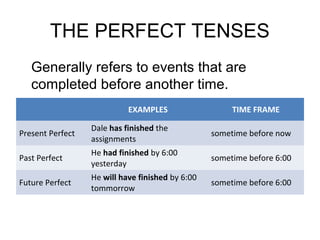
THE PERFECT TENSES
Generally refers to events that are
completed before another time.
EXAMPLES TIME FRAME
Present Perfect
Dale has finished the
assignments
sometime before now
Past Perfect
He had finished by 6:00
yesterday
sometime before 6:00
Future Perfect
He will have finished by 6:00
tommorrow
sometime before 6:00
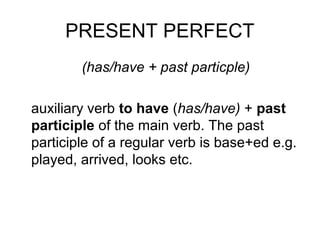
PRESENT PERFECT
(has/have + past particple)
auxiliary verb to have (has/have) + past
participle of the main verb. The past
participle of a regular verb is base+ed e.g.
played, arrived, looks etc.
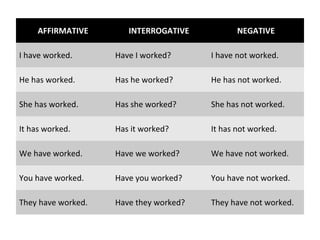
AFFIRMATIVE INTERROGATIVE NEGATIVE
I have worked. Have I worked? I have not worked.
He has worked. Has he worked? He has not worked.
She has worked. Has she worked? She has not worked.
It has worked. Has it worked? It has not worked.
We have worked. Have we worked? We have not worked.
You have worked. Have you worked? You have not worked.
They have worked. Have they worked? They have not worked.
THE PRESENT PERFECT
denotes...
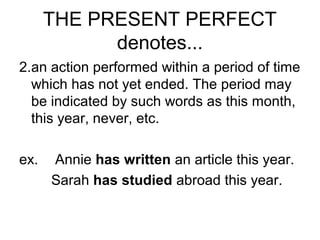
2.an action performed within a period of time
which has not yet ended. The period may
be indicated by such words as this month,
this year, never, etc.
ex. Annie has written an article this year.
Sarah has studied abroad this year.
THE PRESENT PERFECT
denotes..
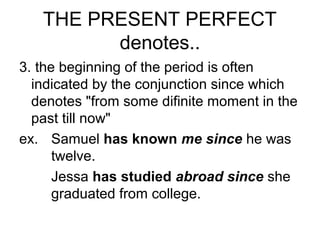
3. the beginning of the period is often
indicated by the conjunction since which
denotes "from some difinite moment in the
past till now"
ex. Samuel has known me since he was
twelve.
Jessa has studied abroad since she
graduated from college.
THE PRESENT PERFECT
denotes...
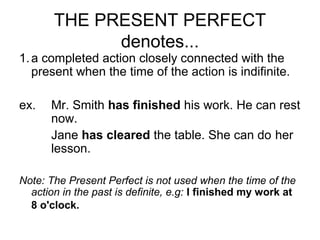
1.a completed action closely connected with the
present when the time of the action is indifinite.
ex. Mr. Smith has finished his work. He can rest
now.
Jane has cleared the table. She can do her
lesson.
Note: The Present Perfect is not used when the time of the
action in the past is definite, e.g: I finished my work at
8 o'clock.
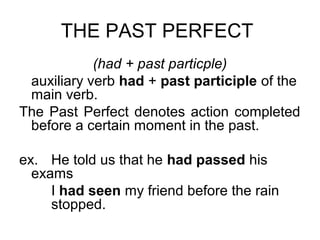
THE PAST PERFECT
(had + past particple)
auxiliary verb had + past participle of the
main verb.
The Past Perfect denotes action completed
before a certain moment in the past.
ex. He told us that he had passed his
exams
I had seen my friend before the rain
stopped.
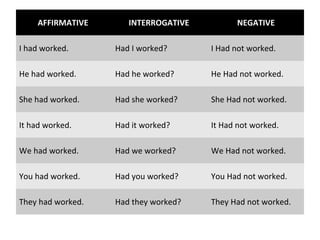
AFFIRMATIVE INTERROGATIVE NEGATIVE
I had worked. Had I worked? I Had not worked.
He had worked. Had he worked? He Had not worked.
She had worked. Had she worked? She Had not worked.
It had worked. Had it worked? It Had not worked.
We had worked. Had we worked? We Had not worked.
You had worked. Had you worked? You Had not worked.
They had worked. Had they worked? They Had not worked.
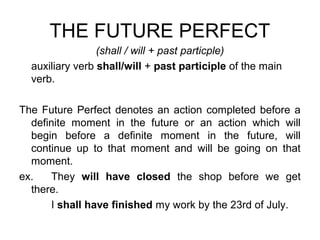
THE FUTURE PERFECT
(shall / will + past particple)
auxiliary verb shall/will + past participle of the main
verb.
The Future Perfect denotes an action completed before a
definite moment in the future or an action which will
begin before a definite moment in the future, will
continue up to that moment and will be going on that
moment.
ex. They will have closed the shop before we get
there.
I shall have finished my work by the 23rd of July.
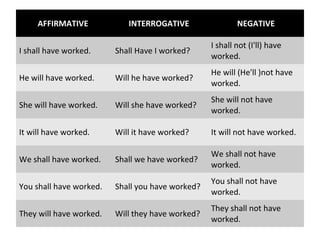
AFFIRMATIVE INTERROGATIVE NEGATIVE
I shall have worked. Shall Have I worked?
I shall not (I'll) have
worked.
He will have worked. Will he have worked?
He will (He'll )not have
worked.
She will have worked. Will she have worked?
She will not have
worked.
It will have worked. Will it have worked? It will not have worked.
We shall have worked. Shall we have worked?
We shall not have
worked.
You shall have worked. Shall you have worked?
You shall not have
worked.
They will have worked. Will they have worked?
They shall not have
worked.
GROUP ACTVITY
Construct a sentence using Present, Past
and Future Perfect of the following words:
1. to write
2. to dance
3. to prepare
4. to bake
5. to clear
USES OF THE PRESENT
PERFECT
Use 1: Unspecified Time Before Now
We use the present perfect to say that an
action happened at an unspecified time
before now. The exact time is not
important.
You CANNOT use the Present Perfect with
specific time expression such as:
yesterday, one year ago, last week, when i
was a child, at that moment, one day, etc.
We CAN use the present perfect with
unspecific expressions such as: ever,
never, once, many times, several times,
before, so far already, yet, etc.
ex. I have seen that movie twenty times
I think I have met him once before.
How do you actually use the
Present Perfect?
• Experience
ex: I have been to France
I think I have not seen that
movie before
• Change Over Time
ex. You have grown since the last time I saw
you.
My English has really improved since I
moved to Australia.
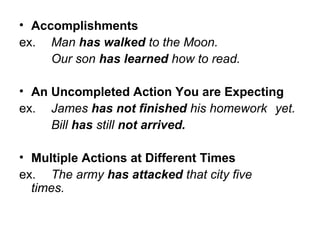
• Accomplishments
ex. Man has walked to the Moon.
Our son has learned how to read.
• An Uncompleted Action You are Expecting
ex. James has not finished his homework yet.
Bill has still not arrived.
• Multiple Actions at Different Times
ex. The army has attacked that city five
times.
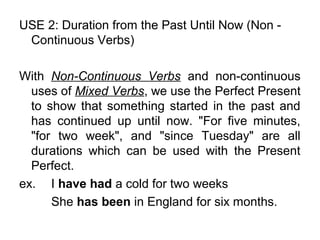
USE 2: Duration from the Past Until Now (Non -
Continuous Verbs)
With Non-Continuous Verbs and non-continuous
uses of Mixed Verbs, we use the Perfect Present
to show that something started in the past and
has continued up until now. "For five minutes,
"for two week", and "since Tuesday" are all
durations which can be used with the Present
Perfect.
ex. I have had a cold for two weeks
She has been in England for six months.

The perfect tenses

  • 1.
    THE PERFECT TENSES Past,Present and Future Tense
  • 2.
    THE PERFECT TENSES Generallyrefers to events that are completed before another time. EXAMPLES TIME FRAME Present Perfect Dale has finished the assignments sometime before now Past Perfect He had finished by 6:00 yesterday sometime before 6:00 Future Perfect He will have finished by 6:00 tommorrow sometime before 6:00
  • 3.
    PRESENT PERFECT (has/have +past particple) auxiliary verb to have (has/have) + past participle of the main verb. The past participle of a regular verb is base+ed e.g. played, arrived, looks etc.
  • 4.
    AFFIRMATIVE INTERROGATIVE NEGATIVE Ihave worked. Have I worked? I have not worked. He has worked. Has he worked? He has not worked. She has worked. Has she worked? She has not worked. It has worked. Has it worked? It has not worked. We have worked. Have we worked? We have not worked. You have worked. Have you worked? You have not worked. They have worked. Have they worked? They have not worked.
  • 5.
    THE PRESENT PERFECT denotes... 2.anaction performed within a period of time which has not yet ended. The period may be indicated by such words as this month, this year, never, etc. ex. Annie has written an article this year. Sarah has studied abroad this year.
  • 6.
    THE PRESENT PERFECT denotes.. 3.the beginning of the period is often indicated by the conjunction since which denotes "from some difinite moment in the past till now" ex. Samuel has known me since he was twelve. Jessa has studied abroad since she graduated from college.
  • 7.
    THE PRESENT PERFECT denotes... 1.acompleted action closely connected with the present when the time of the action is indifinite. ex. Mr. Smith has finished his work. He can rest now. Jane has cleared the table. She can do her lesson. Note: The Present Perfect is not used when the time of the action in the past is definite, e.g: I finished my work at 8 o'clock.
  • 8.
    THE PAST PERFECT (had+ past particple) auxiliary verb had + past participle of the main verb. The Past Perfect denotes action completed before a certain moment in the past. ex. He told us that he had passed his exams I had seen my friend before the rain stopped.
  • 9.
    AFFIRMATIVE INTERROGATIVE NEGATIVE Ihad worked. Had I worked? I Had not worked. He had worked. Had he worked? He Had not worked. She had worked. Had she worked? She Had not worked. It had worked. Had it worked? It Had not worked. We had worked. Had we worked? We Had not worked. You had worked. Had you worked? You Had not worked. They had worked. Had they worked? They Had not worked.
  • 10.
    THE FUTURE PERFECT (shall/ will + past particple) auxiliary verb shall/will + past participle of the main verb. The Future Perfect denotes an action completed before a definite moment in the future or an action which will begin before a definite moment in the future, will continue up to that moment and will be going on that moment. ex. They will have closed the shop before we get there. I shall have finished my work by the 23rd of July.
  • 11.
    AFFIRMATIVE INTERROGATIVE NEGATIVE Ishall have worked. Shall Have I worked? I shall not (I'll) have worked. He will have worked. Will he have worked? He will (He'll )not have worked. She will have worked. Will she have worked? She will not have worked. It will have worked. Will it have worked? It will not have worked. We shall have worked. Shall we have worked? We shall not have worked. You shall have worked. Shall you have worked? You shall not have worked. They will have worked. Will they have worked? They shall not have worked.
  • 12.
    GROUP ACTVITY Construct asentence using Present, Past and Future Perfect of the following words: 1. to write 2. to dance 3. to prepare 4. to bake 5. to clear
  • 13.
    USES OF THEPRESENT PERFECT Use 1: Unspecified Time Before Now We use the present perfect to say that an action happened at an unspecified time before now. The exact time is not important.
  • 14.
    You CANNOT usethe Present Perfect with specific time expression such as: yesterday, one year ago, last week, when i was a child, at that moment, one day, etc. We CAN use the present perfect with unspecific expressions such as: ever, never, once, many times, several times, before, so far already, yet, etc. ex. I have seen that movie twenty times I think I have met him once before.
  • 15.
    How do youactually use the Present Perfect? • Experience ex: I have been to France I think I have not seen that movie before • Change Over Time ex. You have grown since the last time I saw you. My English has really improved since I moved to Australia.
  • 16.
    • Accomplishments ex. Manhas walked to the Moon. Our son has learned how to read. • An Uncompleted Action You are Expecting ex. James has not finished his homework yet. Bill has still not arrived. • Multiple Actions at Different Times ex. The army has attacked that city five times.
  • 17.
    USE 2: Durationfrom the Past Until Now (Non - Continuous Verbs) With Non-Continuous Verbs and non-continuous uses of Mixed Verbs, we use the Perfect Present to show that something started in the past and has continued up until now. "For five minutes, "for two week", and "since Tuesday" are all durations which can be used with the Present Perfect. ex. I have had a cold for two weeks She has been in England for six months.