



GECDSB NTIP 2 2009/2010
Clear   Targets
Bell Work: Minds On Activity Write one example of a success that you’ve experienced this school year. Mentee (on blue index card) Mentor (white index card)
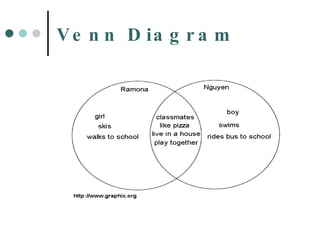
Icebreaker – Getting to Know You Use the Venn Diagram to chart your similarities and differences Consider:  Favourite sports, music, foods, etc. Family Learning/Teaching styles Others
Venn Diagram
Successes!!!
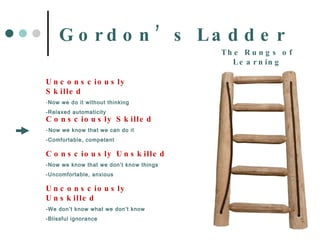
Gordon’s Ladder The Rungs of Learning Unconsciously Skilled - Now we do it without thinking -Relaxed automaticity Consciously Skilled - Now we know that we can do it -Comfortable, competent Consciously Unskilled -Now we know that we don’t know things -Uncomfortable, anxious Unconsciously Unskilled -We don’t know what we don’t know -Blissful ignorance
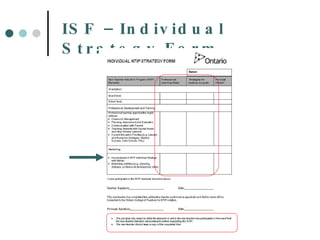
ISF –Individual Strategy Form
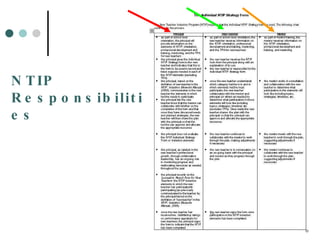
NTIP Responsibilities
Observation Logs No formal reports to be submitted
Brainstorm How to best use Observation Days?
Purposeful Observation Norm’s Video
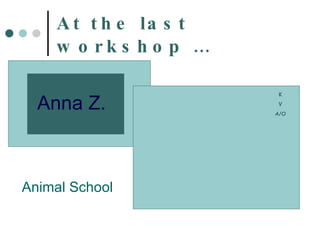
At the last workshop … Anna Z. K V A/O Animal School
Triarchic Intelligence Theory  Self-Assessment (Sternberg) Follow the instructions printed on the page. Activity
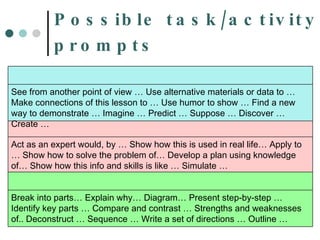
Possible task/activity prompts   Break into parts… Explain why… Diagram… Present step-by-step … Identify key parts … Compare and contrast … Strengths and weaknesses of.. Deconstruct … Sequence … Write a set of directions … Outline … Act as an expert would, by … Show how this is used in real life… Apply to … Show how to solve the problem of… Develop a plan using knowledge of… Show how this info and skills is like … Simulate …  See from another point of view … Use alternative materials or data to … Make connections of this lesson to … Use humor to show … Find a new way to demonstrate … Imagine … Predict … Suppose … Discover … Create …
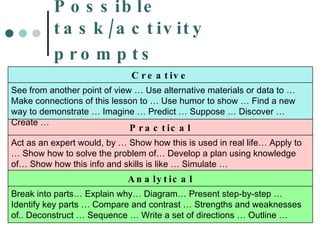
Possible task/activity prompts   Break into parts… Explain why… Diagram… Present step-by-step … Identify key parts … Compare and contrast … Strengths and weaknesses of.. Deconstruct … Sequence … Write a set of directions … Outline … Analytical Act as an expert would, by … Show how this is used in real life… Apply to … Show how to solve the problem of… Develop a plan using knowledge of… Show how this info and skills is like … Simulate …  Practical See from another point of view … Use alternative materials or data to … Make connections of this lesson to … Use humor to show … Find a new way to demonstrate … Imagine … Predict … Suppose … Discover … Create … Creative
On your index card … First Name & First Initial of Last Name Written in marker  Large enough to see across the room C A P
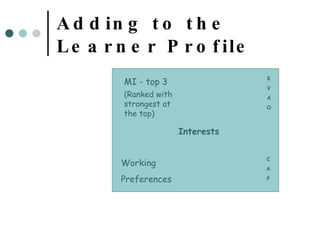
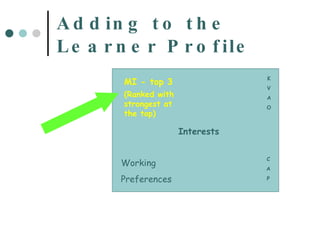
Adding to the Learner Profile K V A O C A P MI - top 3 (Ranked with strongest at the top) Working Preferences Interests
Activity Eight Ways of Being Smart Read the descriptors for the 8 intelligences. Reflect on your own strengths, likes and learning experiences. Determine: which 2 or 3 intelligences are your strongest. which ones are your weakest?
Adding to the Learner Profile K V A O C A P MI - top 3 (Ranked with strongest at the top) Working Preferences Interests
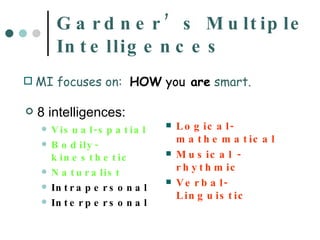
Gardner’s Multiple Intelligences 8 intelligences: Visual-spatial Bodily-kinesthetic Naturalist Intrapersonal Interpersonal Logical-mathematical Musical - rhythmic Verbal-Linguistic MI focuses on:  HOW   you  are  smart.
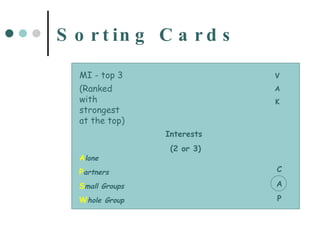
Sorting Cards First Name & First Initial of Last Name Written in marker  Large enough to see across the room C A P MI - top 3 (Ranked with strongest at the top) A lone P artners S mall Groups W hole   Group Interests  (2 or 3) V A K
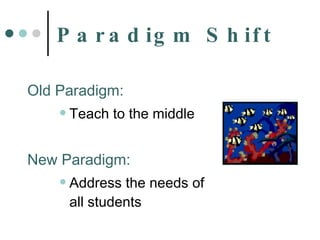
Paradigm Shift Old Paradigm:   Teach to the middle New Paradigm: Address the needs of all students
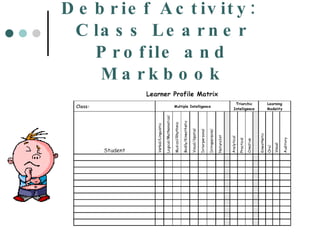
Debrief Activity:  Class Learner Profile and Markbook
Design Down Curriculum Planning Backgrounder As you read the backgrounder, question the text.  Jot your questions in the margins of the article. As we work through the content, refer back to your questions:  Were they answered?  What more information do you need?
Planning for Curriculum and Assessment:  Design Down Design Down Model or Backwards Design Model Clarify results and evidence before designing the lessons and activities Way of thinking more accurately, being more strategic Overcomes the prevalence of “Aimless Activity and Superficial Coverage”
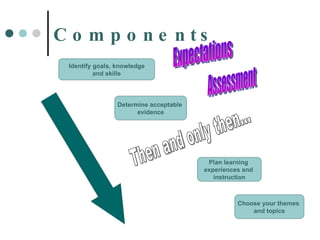
Components Identify goals, knowledge and skills Determine acceptable  evidence Plan learning  experiences and  instruction Choose your themes  and topics Then and only then... Expectations Assessment
Identify Desired Results Expectations from the curriculum guide(s) What expectations do you want to meet? What learning skills do you want to assess? Enduring Understandings/Big Ideas What is the “So What?”
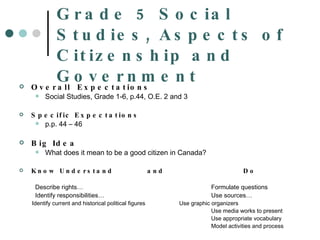
Model:  Grade 5 Social Studies, Aspects of Citizenship and Government Overall  Expectations Social Studies, Grade 1-6, p.44, O.E. 2 and 3 Specific Expectations p.p. 44 – 46 Big Idea What does it mean to be a good citizen in Canada? Know Understand and  Do Describe rights… Formulate questions Identify responsibilities… Use sources… Identify current and historical political figures Use graphic organizers Use media works to present Use appropriate vocabulary Model activities and process
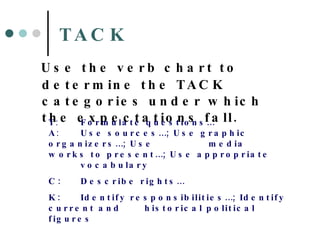
TACK Use the verb chart to determine the TACK categories under which the expectations fall. T :  Formulate questions… A :  Use sources…; Use graphic organizers…; Use  media  works to present…; Use appropriate  vocabulary C:  Describe rights… K:  Identify responsibilities…; Identify current and  historical political figures
Determine Acceptable Evidence Think like an assessor Variety of formal and informal assessments
Continuum of Assessment Methods Informal checks for  understanding Observation/Conferencing Quiz/Test Reflective writing prompt Performance task/project
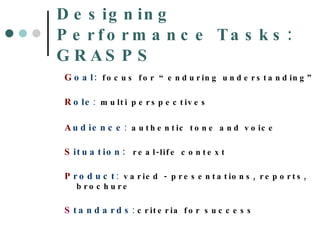
Designing Performance Tasks: GRASPS G oal:   focus for “enduring understanding” R ole :   multi perspectives   A udience :   authentic tone and voice   S ituation:   real-life context   P roduct :   varied - presentations, reports, brochure S tandards :  criteria for success
Model: Performance Task Hall of Citizenship Recognition
Performance Task Analysis GRASPS Does it contain all components?  Does it allow for summative assessment of the expectations (targets)? Differentiation Does it differentiate for product, process, content according to the student’s readiness, interests and learning profile?
What Formative Assessment Methods will you use? Know  Describe rights… Identify responsibilities… Identify current and historical political figures… Do Formulate questions… Use sources… Use graphic organizers… Use media works… Use appropriate vocabulary…. Model activities and processes…
Teaching/Learning Strategies Examine the expectations and summative tasks. What lessons do I need to teach to help students reach these targets? Where will I build formative assessments to provide feedback? How will I accommodate or modify my spec ed and ELL students
Topic/Themes/Resources What topics relate to the expectations selected? What resources do I have? What resources do I need to get?
Your Turn! Choose an overall expectation Choose specific expectations Big Idea Know, Understand, Do Assessment Task Lessons, activities, formative assessments Topic, Themes Resources
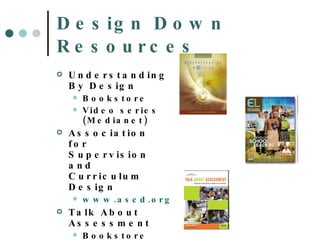
Design Down Resources Understanding By Design Bookstore Video series (Medianet) Association for Supervision and Curriculum Design  www.ascd.org Talk About Assessment Bookstore
Consolidation Making the Shift to Expectation-Based Planning Self-assessment: At what stage are you in making the shift? Reflect upon your stage of development in Design Down.
Lunch http:// www.gecdsb.on.ca/staff/teachers/ntip /   Freaks and Geeks
Four Corners Procedures and Routines Jones pg. 123-135 Wong pg. 167-194 Working the Room/Classroom Environment Jones pg. 21-39 Wong pg. 105-107 Planning an Effective Classroom Jones pg. 111-135 Wong pg. 82-100 Motivation Jones pg. 85-97 Wong pg. 61-78, 197-228 Minds On
101 “Answers” for NEW TEACHERS and THEIR MENTORS Pick a number from the hat. Read and discuss with shoulder partner. Anything to share with the large group.
Planning Time
Ticket Out the Door What does mentoring mean to you? Minimum 2 words

New Teacher Induction Program Session 2A

  • 1.
    GECDSB NTIP 22009/2010
  • 2.
    Clear Targets
  • 3.
    Bell Work: MindsOn Activity Write one example of a success that you’ve experienced this school year. Mentee (on blue index card) Mentor (white index card)
  • 4.
    Icebreaker – Gettingto Know You Use the Venn Diagram to chart your similarities and differences Consider: Favourite sports, music, foods, etc. Family Learning/Teaching styles Others
  • 5.
  • 6.
  • 7.
    Gordon’s Ladder TheRungs of Learning Unconsciously Skilled - Now we do it without thinking -Relaxed automaticity Consciously Skilled - Now we know that we can do it -Comfortable, competent Consciously Unskilled -Now we know that we don’t know things -Uncomfortable, anxious Unconsciously Unskilled -We don’t know what we don’t know -Blissful ignorance
  • 8.
  • 9.
  • 10.
    Observation Logs Noformal reports to be submitted
  • 11.
    Brainstorm How tobest use Observation Days?
  • 12.
  • 13.
    At the lastworkshop … Anna Z. K V A/O Animal School
  • 14.
    Triarchic Intelligence Theory Self-Assessment (Sternberg) Follow the instructions printed on the page. Activity
  • 15.
    Possible task/activity prompts Break into parts… Explain why… Diagram… Present step-by-step … Identify key parts … Compare and contrast … Strengths and weaknesses of.. Deconstruct … Sequence … Write a set of directions … Outline … Act as an expert would, by … Show how this is used in real life… Apply to … Show how to solve the problem of… Develop a plan using knowledge of… Show how this info and skills is like … Simulate … See from another point of view … Use alternative materials or data to … Make connections of this lesson to … Use humor to show … Find a new way to demonstrate … Imagine … Predict … Suppose … Discover … Create …
  • 16.
    Possible task/activity prompts Break into parts… Explain why… Diagram… Present step-by-step … Identify key parts … Compare and contrast … Strengths and weaknesses of.. Deconstruct … Sequence … Write a set of directions … Outline … Analytical Act as an expert would, by … Show how this is used in real life… Apply to … Show how to solve the problem of… Develop a plan using knowledge of… Show how this info and skills is like … Simulate … Practical See from another point of view … Use alternative materials or data to … Make connections of this lesson to … Use humor to show … Find a new way to demonstrate … Imagine … Predict … Suppose … Discover … Create … Creative
  • 17.
    On your indexcard … First Name & First Initial of Last Name Written in marker Large enough to see across the room C A P
  • 18.
    Adding to theLearner Profile K V A O C A P MI - top 3 (Ranked with strongest at the top) Working Preferences Interests
  • 19.
    Activity Eight Waysof Being Smart Read the descriptors for the 8 intelligences. Reflect on your own strengths, likes and learning experiences. Determine: which 2 or 3 intelligences are your strongest. which ones are your weakest?
  • 20.
    Adding to theLearner Profile K V A O C A P MI - top 3 (Ranked with strongest at the top) Working Preferences Interests
  • 21.
    Gardner’s Multiple Intelligences8 intelligences: Visual-spatial Bodily-kinesthetic Naturalist Intrapersonal Interpersonal Logical-mathematical Musical - rhythmic Verbal-Linguistic MI focuses on: HOW you are smart.
  • 22.
    Sorting Cards FirstName & First Initial of Last Name Written in marker Large enough to see across the room C A P MI - top 3 (Ranked with strongest at the top) A lone P artners S mall Groups W hole Group Interests (2 or 3) V A K
  • 23.
    Paradigm Shift OldParadigm: Teach to the middle New Paradigm: Address the needs of all students
  • 24.
    Debrief Activity: Class Learner Profile and Markbook
  • 25.
    Design Down CurriculumPlanning Backgrounder As you read the backgrounder, question the text. Jot your questions in the margins of the article. As we work through the content, refer back to your questions: Were they answered? What more information do you need?
  • 26.
    Planning for Curriculumand Assessment: Design Down Design Down Model or Backwards Design Model Clarify results and evidence before designing the lessons and activities Way of thinking more accurately, being more strategic Overcomes the prevalence of “Aimless Activity and Superficial Coverage”
  • 27.
    Components Identify goals,knowledge and skills Determine acceptable evidence Plan learning experiences and instruction Choose your themes and topics Then and only then... Expectations Assessment
  • 28.
    Identify Desired ResultsExpectations from the curriculum guide(s) What expectations do you want to meet? What learning skills do you want to assess? Enduring Understandings/Big Ideas What is the “So What?”
  • 29.
    Model: Grade5 Social Studies, Aspects of Citizenship and Government Overall Expectations Social Studies, Grade 1-6, p.44, O.E. 2 and 3 Specific Expectations p.p. 44 – 46 Big Idea What does it mean to be a good citizen in Canada? Know Understand and Do Describe rights… Formulate questions Identify responsibilities… Use sources… Identify current and historical political figures Use graphic organizers Use media works to present Use appropriate vocabulary Model activities and process
  • 30.
    TACK Use theverb chart to determine the TACK categories under which the expectations fall. T : Formulate questions… A : Use sources…; Use graphic organizers…; Use media works to present…; Use appropriate vocabulary C: Describe rights… K: Identify responsibilities…; Identify current and historical political figures
  • 31.
    Determine Acceptable EvidenceThink like an assessor Variety of formal and informal assessments
  • 32.
    Continuum of AssessmentMethods Informal checks for understanding Observation/Conferencing Quiz/Test Reflective writing prompt Performance task/project
  • 33.
    Designing Performance Tasks:GRASPS G oal: focus for “enduring understanding” R ole : multi perspectives A udience : authentic tone and voice S ituation: real-life context P roduct : varied - presentations, reports, brochure S tandards : criteria for success
  • 34.
    Model: Performance TaskHall of Citizenship Recognition
  • 35.
    Performance Task AnalysisGRASPS Does it contain all components? Does it allow for summative assessment of the expectations (targets)? Differentiation Does it differentiate for product, process, content according to the student’s readiness, interests and learning profile?
  • 36.
    What Formative AssessmentMethods will you use? Know Describe rights… Identify responsibilities… Identify current and historical political figures… Do Formulate questions… Use sources… Use graphic organizers… Use media works… Use appropriate vocabulary…. Model activities and processes…
  • 37.
    Teaching/Learning Strategies Examinethe expectations and summative tasks. What lessons do I need to teach to help students reach these targets? Where will I build formative assessments to provide feedback? How will I accommodate or modify my spec ed and ELL students
  • 38.
    Topic/Themes/Resources What topicsrelate to the expectations selected? What resources do I have? What resources do I need to get?
  • 39.
    Your Turn! Choosean overall expectation Choose specific expectations Big Idea Know, Understand, Do Assessment Task Lessons, activities, formative assessments Topic, Themes Resources
  • 40.
    Design Down ResourcesUnderstanding By Design Bookstore Video series (Medianet) Association for Supervision and Curriculum Design www.ascd.org Talk About Assessment Bookstore
  • 41.
    Consolidation Making theShift to Expectation-Based Planning Self-assessment: At what stage are you in making the shift? Reflect upon your stage of development in Design Down.
  • 42.
  • 43.
    Four Corners Proceduresand Routines Jones pg. 123-135 Wong pg. 167-194 Working the Room/Classroom Environment Jones pg. 21-39 Wong pg. 105-107 Planning an Effective Classroom Jones pg. 111-135 Wong pg. 82-100 Motivation Jones pg. 85-97 Wong pg. 61-78, 197-228 Minds On
  • 44.
    101 “Answers” forNEW TEACHERS and THEIR MENTORS Pick a number from the hat. Read and discuss with shoulder partner. Anything to share with the large group.
  • 45.
  • 46.
    Ticket Out theDoor What does mentoring mean to you? Minimum 2 words

Editor's Notes

  • #2 Pete
  • #3 Targets important for all Here are the targets for every GECDSB teacher
  • #4 Tell teachers that they will be sharing what they write on this section Allow time to complete.
  • #5 Materials needed – paper, pens, markers, Two consultants model this activity. Debrief the activity.
  • #6 Getting to know you.
  • #7 Share with your mentor/mentee what is on index card.
  • #8 Pete
  • #9 Don
  • #10 Don
  • #12 Pete
  • #13 Pete Show Norm video (4:45 min.) Distribute handouts (8 page)
  • #14 Pete At the last workshop you began a Learner Profile card You discovered your Learning Modality (K,V,A/O) Your homework was to begin building Learner Profiles with at least one of your classes Show Animal School Video (the reason why we are doing all this). (5 min. roughly)
  • #15 11:15 – 11:40 Pete Distribute the handout: “Triarchic Intelligence Theory Self-Assessment” Participants will need a pen/pencil After completing the exercise, have the participants tally their # of check marks for each intelligence and record in the spaces provided. (# for Creative, # Analytical, # Practical) Survey the audience – “How many had Creative as their top preference? how many … Analytical ?…Practical?” “ Did anyone have two or more intelligences that had the same number of check marks? (or close)” “ This handout as well as all others you receive in this session are intended for use with your students. Blackline masters will be available on the conference.
  • #16 “Here are some possible prompts for tasks/activities that engage each of the Sternberg intelligences.” “If you were asked to perform a task/complete an activity, which of these prompts would engage you the most ? “ Choose 1 (or 2). (Give participants time to make a selection from the lists BEFORE advancing to the next slide.)
  • #17 “ How does your selection compare with the results of your Triarchic self-assessment?” (that was the check mark activity) “Chances are , it was aligned.” (e.g., Practical prompt & practical intelligence). “ Think about the assignments you give your students. In general, do they reflect your learning preferences?” (wait for a second) Write down one learning assignment from an intelligence outside your dominant one, and share with elbow partner.
  • #18 Ask the participants to take out their index cards, flip it over to the side without their name. In the lower right-hand corner, they are to print: “C A P” as indicated. Have them circle their strongest Triarchic Intelligence(s). “ In a DI classroom, the teacher can use these cards to sort students into groups. We’ll add to the card later.”
  • #19 Don Today, we are going to add to your Learner Profile. We’ll be adding Multiple Intelligences, Working Preferences, and Interests Refer to “Sorting Cards” handout (note that you might use other information that’s important to your discipline)
  • #20 – Distribute the handouts: “Eight Ways of Being Smart” , Multiple Intelligences Inventory, MI inventory 2.pdf Advance to next slide.
  • #21 On your index card, in the top left-hand corner (as indicated on slide), identify your top 3 Multiple Intelligences in order,
  • #22 “The theory of Multiple Intelligences asks “ How are you smart?” as opposed to the old, “How smart are you?” Interesting to know when you start to look at addressing the learning needs of your students is that these intelligences can be groups into 3 categories: Based on MATERIAL OBJECTS PERSON related SYMBOL related Just before leaving this slide : “Teachers who know their students’ strong intelligences can provide opportunities for everyone in the class to demonstrate their knowledge and skills through their stronger intelligences.”
  • #23 On the index card, print the top 3 Multiple Intelligences in order, in the top left-hand corner (as indicated on slide). - See other handout for inventories of MI and VAK Before we move on – complete Learner Profile/Sorting cards In bottom left corner, indicate your working preferences – A, P, S,W In centre – list 2 or 3 key interests of yours (hockey, reading, playing instrument, hiking, etc.)
  • #24 Dario “The old paradigm can be likened to the fishermen aboard a fishing trawler. Their sonar alerts them to the fact that a school of fish is nearby. They lower their nets and when they pull them up, the nets are full of fish. What they missed, however, were all the fish that were swimming ahead of rest, as well as those that were lagging behind the majority. We need to include all of the fish. Our target is an 85% graduation rate.”
  • #25 Using this information find patterns and gaps that you can use to inform your teaching and the delivery of your program/ compare with your Markbook printout. Another Form for recording Learner Preferences Learner Form -distribute
  • #26 Handout: Design Down Curriculum Planning Sharon
  • #28 Refer to A&E doc, Section Planning Your Program Teacher Resource 3-1
  • #29 Handout: Design Down template, one page completed as a model.
  • #30 See model handout
  • #31 Handout: Gr 5 Model – label the expectations on the model page Connect to achievement chart. Refer to the achievement chart
  • #32 Refer to Planning Your Program – Design Down in A&E document, resource 3-7 So if we want to meet the expectations and answer the BIG Idea question what is best?
  • #33 If we are assessing a number of expectations over all or most of the TACK categories, then performance assessment provides the best assessment method.
  • #34 See handout from Wigggins and Mctighe, in A&E document 3-10 and 3-11, 3-13
  • #35 Place on an organizer Determine each GRASPS component. Goal: nominate a good Canadian citizen Role: nominator Audience: Hall of recognition Selection Committee Situation: establishment of Hall of Recognition, needs nominations Product: nomination letter Standards: give reasons for choice based on candidate’s actions
  • #36 With your elbow partner, analyze the task using the organizer.
  • #37 Use the chart on page 14 to identify some of the methods and tools. Go back to your TACK identification to see what methods and tools are best for assessing each
  • #40 Let mentor and mentee work on this for a few minutes Can continue designing a unit at one of the release days
  • #42 Handout: Changing Our Approach to Curriculum Design
  • #43 Freaks and Geeks video: 1:34 min.
  • #44 Show Minds On: Douglas Reeves Video: Toxic Practices (6:30 min.) Procedures and Routines -Pete Jones pg. 123-135 Wong pg. 167-194 Working the Room/Classroom Environment -Dan Jones pg. 21-39 Wong pg. 105-107 Planning an Effective Classroom -Don Jones pg. 111-135 Wong pg. 82-100 Motivation -Sharon Jones pg. 85-97 Wong pg. 61-78, 197-228
  • #45 Pete/Dan
  • #47 Pete/Don