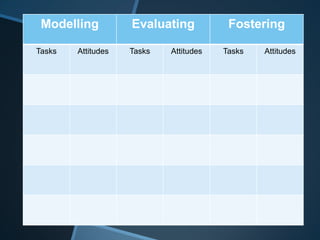





Modelling
Tasks

Attitudes

Evaluating
Tasks

Attitudes

Fostering
Tasks

Attitudes
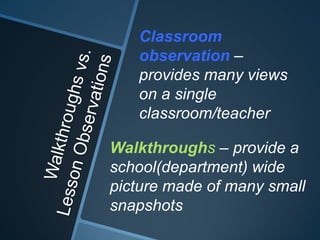
Classroom
observation –
provides many views
on a single
classroom/teacher

Walkthroughs – provide a
school(department) wide
picture made of many small
snapshots
Common characteristics:
- Intensity of communication
- Informal communication
- Management by Wandering
Around (United Airlines and
Hewlett-Packard)
One way for a system to evolve is
when a group can identify a problem
and create a plan to collaboratively
solve it.
Used to evaluate instructional and
curricular practices, not people.
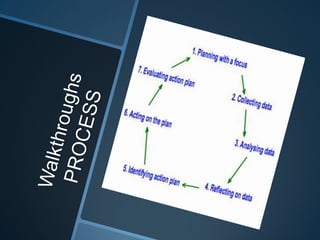
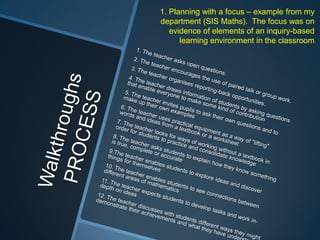
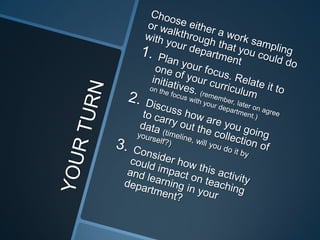
1. Planning with a focus – example from my
department (SIS Maths). The focus was on
evidence of elements of an inquiry-based
learning environment in the classroom
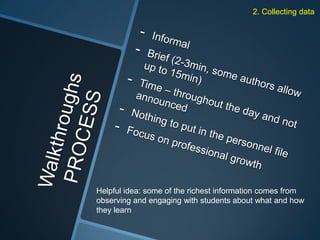
2. Collecting data

Helpful idea: some of the richest information comes from
observing and engaging with students about what and how
they learn
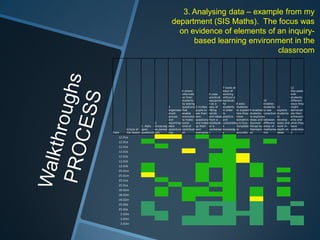
3. Analysing data – example from my
department (SIS Maths). The focus was
on evidence of elements of an inquirybased learning environment in the
classroom

Date

7 looks at
12
4 draws
ways of
discusses
informati
6 uses
working
with
on from
practical without a
students
students
equipmen textbook
10
different
by asking
t as a
for
8 asks
enables
ways they
3
questions 5 invites way of
students students
students 11
might
organises that
pupils to lifting
in order to explain 9 enables to see
expects demonstr
small
enable
ask their words
to
how they students conection students ate their
groups
everyone own
and ideas practice know
to explores
to
achievem
and
to make questions from a
and
somethin ideas and between develop ents and
2
reporting-some
and make textbook consolidatg is true, discover different tasks and what they
1. Asks encourag back
kind of
up their or a
e
complete things by areas of work in- have
b/m/e of qpen
es paired opportuni contributi own
workshee knowledg or
themselv mathema depth on understoo
the lesson questions talk
ties
on
examples t
e
accurate es
tics
ideas
d

12.01e
12.01e
12.01e
12.01b
12.01b
12.01b
12.01b
25.01m
25.01m
25.01e
25.01e
18.02m
18.02m
18.02m
25.02e
25.02e
3.03m
3.03m
3.03m
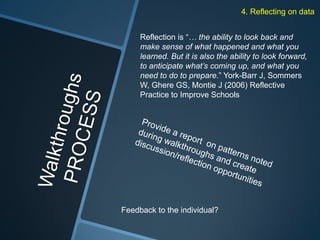
4. Reflecting on data
Reflection is “… the ability to look back and
make sense of what happened and what you
learned. But it is also the ability to look forward,
to anticipate what’s coming up, and what you
need to do to prepare.” York-Barr J, Sommers
W, Ghere GS, Montie J (2006) Reflective
Practice to Improve Schools

Feedback to the individual?
HoD_module 2
HoD_module 2
HoD_module 2

HoD_module 2

  • 8.
  • 36.
    Classroom observation – provides manyviews on a single classroom/teacher Walkthroughs – provide a school(department) wide picture made of many small snapshots
  • 37.
    Common characteristics: - Intensityof communication - Informal communication - Management by Wandering Around (United Airlines and Hewlett-Packard)
  • 38.
    One way fora system to evolve is when a group can identify a problem and create a plan to collaboratively solve it.
  • 39.
    Used to evaluateinstructional and curricular practices, not people.
  • 41.
    1. Planning witha focus – example from my department (SIS Maths). The focus was on evidence of elements of an inquiry-based learning environment in the classroom
  • 42.
    2. Collecting data Helpfulidea: some of the richest information comes from observing and engaging with students about what and how they learn
  • 43.
    3. Analysing data– example from my department (SIS Maths). The focus was on evidence of elements of an inquirybased learning environment in the classroom Date 7 looks at 12 4 draws ways of discusses informati 6 uses working with on from practical without a students students equipmen textbook 10 different by asking t as a for 8 asks enables ways they 3 questions 5 invites way of students students students 11 might organises that pupils to lifting in order to explain 9 enables to see expects demonstr small enable ask their words to how they students conection students ate their groups everyone own and ideas practice know to explores to achievem and to make questions from a and somethin ideas and between develop ents and 2 reporting-some and make textbook consolidatg is true, discover different tasks and what they 1. Asks encourag back kind of up their or a e complete things by areas of work in- have b/m/e of qpen es paired opportuni contributi own workshee knowledg or themselv mathema depth on understoo the lesson questions talk ties on examples t e accurate es tics ideas d 12.01e 12.01e 12.01e 12.01b 12.01b 12.01b 12.01b 25.01m 25.01m 25.01e 25.01e 18.02m 18.02m 18.02m 25.02e 25.02e 3.03m 3.03m 3.03m
  • 44.
    4. Reflecting ondata Reflection is “… the ability to look back and make sense of what happened and what you learned. But it is also the ability to look forward, to anticipate what’s coming up, and what you need to do to prepare.” York-Barr J, Sommers W, Ghere GS, Montie J (2006) Reflective Practice to Improve Schools Feedback to the individual?

Editor's Notes

  • #39 1) First talk about the classroom walkthrough model = a series of frequent classroom visits where the observer(s) are looking for a pre-determined evidence of specific practices. Time: 2-10min.2) Many models available, Carolyn Downey has an extensive work on this. Develop whatever suits your department’s needs.Instructional Leadership – strengthen your leadership role by being acquainted and involved with actual classroom practices.Professional development – determine strengths and weaknesses in your department. Build on using the strengths to .. weaknesses. Create a collaborative learning environment in your department. Increase in coaching, peer coaching and mentoring in the department (be careful, walkthroughs and not judgmentalData-driven decision making – HoDs will be called upon to make decisions regarding the curriculum and to assess the degree of implementation of various classroom practices
  • #42 I strongly believe that the focus/foci should be agreed in the department. In this example we wanted, in the maths department at SIS, to see what on the types on practices used for effective teaching in an inquiry-based learning environment are commonly used in the department and on which ones we should still focus. What teachers are better at some of the less used practices and how can they share their expertise with the other members of the department.
  • #45 Feedback to the individual – though some work on walkthroughs recommend these, I am reluctant, as we want to make the walkthroughs non-threatening, non-judgmental. I use these to create a collaborative, trusty environment in the department and easy the transition to the lesson observations. However, if repeated, long-term occuring patterns occur, then these could inform the need of a ont-to-one with the teacher, followed by formal lesson observation.