I. Eliminating Irrelevant Barriers to the Performance
II. Avoiding Unintended Clues in Objective Test Items
 The  validity of the assessment may be
  undermined by the influence of construct-
  irrelevant factors or abilities that are
  ancillary to the intent of the assessment.

 Ifstudents have achieved a particular
  learning outcomes, we would want them to
  answer correctly those test items that
  measure the attainment of that learning
  outcome.
 Factors, such as complex sentence structure,
 difficult vocabulary, and unclear type of
 response called for, are extraneous to the
 central purpose of the assessment; hence,
 they limit and modify the students’ responses
 and prevent them from showing their true
 levels of achievement.
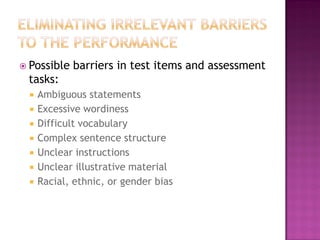
 Possible   barriers in test items and assessment
 tasks:
     Ambiguous statements
     Excessive wordiness
     Difficult vocabulary
     Complex sentence structure
     Unclear instructions
     Unclear illustrative material
     Racial, ethnic, or gender bias
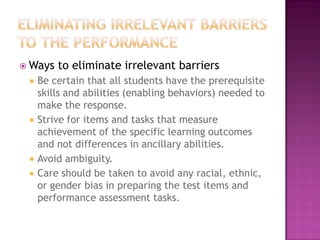
 Ways   to eliminate irrelevant barriers
    Be certain that all students have the prerequisite
     skills and abilities (enabling behaviors) needed to
     make the response.
    Strive for items and tasks that measure
     achievement of the specific learning outcomes
     and not differences in ancillary abilities.
    Avoid ambiguity.
    Care should be taken to avoid any racial, ethnic,
     or gender bias in preparing the test items and
     performance assessment tasks.
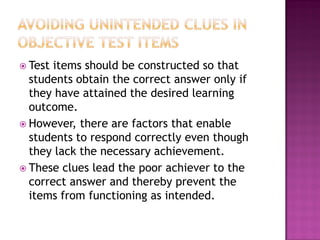
 Test items should be constructed so that
  students obtain the correct answer only if
  they have attained the desired learning
  outcome.
 However, there are factors that enable
  students to respond correctly even though
  they lack the necessary achievement.
 These clues lead the poor achiever to the
  correct answer and thereby prevent the
  items from functioning as intended.
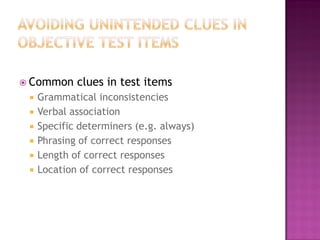
 Common     clues in test items
    Grammatical inconsistencies
    Verbal association
    Specific determiners (e.g. always)
    Phrasing of correct responses
    Length of correct responses
    Location of correct responses

Planning Classroom Tests and Assessments

  • 1.
    I. Eliminating IrrelevantBarriers to the Performance II. Avoiding Unintended Clues in Objective Test Items
  • 2.
     The validity of the assessment may be undermined by the influence of construct- irrelevant factors or abilities that are ancillary to the intent of the assessment.  Ifstudents have achieved a particular learning outcomes, we would want them to answer correctly those test items that measure the attainment of that learning outcome.
  • 3.
     Factors, suchas complex sentence structure, difficult vocabulary, and unclear type of response called for, are extraneous to the central purpose of the assessment; hence, they limit and modify the students’ responses and prevent them from showing their true levels of achievement.
  • 4.
     Possible barriers in test items and assessment tasks:  Ambiguous statements  Excessive wordiness  Difficult vocabulary  Complex sentence structure  Unclear instructions  Unclear illustrative material  Racial, ethnic, or gender bias
  • 5.
     Ways to eliminate irrelevant barriers  Be certain that all students have the prerequisite skills and abilities (enabling behaviors) needed to make the response.  Strive for items and tasks that measure achievement of the specific learning outcomes and not differences in ancillary abilities.  Avoid ambiguity.  Care should be taken to avoid any racial, ethnic, or gender bias in preparing the test items and performance assessment tasks.
  • 6.
     Test itemsshould be constructed so that students obtain the correct answer only if they have attained the desired learning outcome.  However, there are factors that enable students to respond correctly even though they lack the necessary achievement.  These clues lead the poor achiever to the correct answer and thereby prevent the items from functioning as intended.
  • 7.
     Common clues in test items  Grammatical inconsistencies  Verbal association  Specific determiners (e.g. always)  Phrasing of correct responses  Length of correct responses  Location of correct responses