




Security Issues And
      Attacks in
Mobile Ad hoc Network
1. Objective
2. Motivation
3. Introduction To MANET
4. Flooding attack and its types
5. DSR Routing protocol
6. Literature survey
7. Proposed Technique
8. About Simulator (NS-2)
9. Results and analysis
10. Conclusion
11. Future Work
The general objectives can be outlined as follows:
 Get a general understanding of Mobile Ad Hoc Networks.

 Literature survey of various intrusion detection systems for
  MANET.
 Analysis of effect of node Mobility Speed and Pause time.

 Analysis of RREQ flooding Attack in MANET.

 Simulation and Analysis of our flooding attack prevention
  algorithm for the networks with higher node mobility.
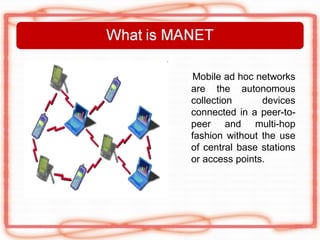
Mobile ad hoc networks
are the autonomous
collection      devices
connected in a peer-to-
peer and multi-hop
fashion without the use
of central base stations
or access points.
 Each node have communication capabilities.
 Nodes can communicate directly with each other if they falls in
   the radio coverage range of each other otherwise use the
   concept of multi hop.
 Each node behaves like station and Router.
 All the nodes participate in the routing and the performance
   depend upon the cooperation between the nodes.
 MANET are useful where infrastructure is absent or installation
   is not possible.
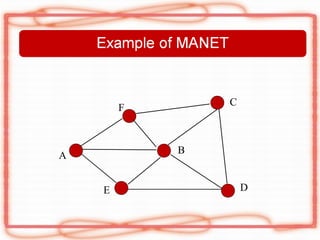
C
        F


            B
A


    E               D
Characteristics of MANET
  Operating without any central coordinator/base station.

  Dynamic topology.

  Energy-constrained operation

  Longer transmission range due to multi-hop relay.

  Self-configuring.

  Constraint Bandwidth.

  Distributed Operation
Security Goals
   Availability
   Confidentiality
   Integrity
   Authentication
   Non-repudiation
   Access Control
The following are the advantages of MANETs:
 Rapid deployable.
 Self Configurable.
 Mobility.
 Does not requires any infrastructure to work.
 Cost Effective.
 Less time consuming.
 More robust than cellular system.
 Dynamic changing topology
 Limited Bandwidth.
 Limited battery power.
 Security issues.
Security problems in MANET

 Open Media
 Routing Protocol Does not have any security mechanism
 Continuous changing topology.
 Unavailability of central coordinator
 Requires cooperation between the devices
Attacks in MANET can be classified as
    Passive Attack
    Active Attacks.
 Attacker snoops the data exchanged in the network without
  altering it.
 This attack target the confidentiality attribute of the system.
 Passive attack is very difficult to detect because the operation of
  the network is not affected by this type attack.
 Passive attacks are generally used to gather the information
  about the network or know the communication pattern between
  the communicating parties. This attack is easy to launch and it
  may lead to active attack.
 Attacker attempts to modify or alter the data being exchanged in
  the network.
 It may disrupts the normal functioning of the network.
 In active attack the intruders can modify the packets, inject the
  packets, drops the packet, or it can use the various feature of
  the network to launch the attack.
 Active attacks are very dangerous.
ATTACKS IN MANET
                      (Classification-II)
Attacks in MANET can also be classified as
 External Attack: Carried out by nodes that do not
  belong to the domain of the network.
 Internal Attack: Internal attacks are from compromised
  nodes, which are actually part of the network.
•   A Black-hole is a malicious node that falsely replies for route
    requests without having an active route to the destination and
    exploits the Routing Protocol to advertise itself as having a shortest
    route to destination.
•   By advertizing the shortest route ,source station starts sending data
    through the black hole node and it become the active element in the
    route.
•   In this Attack, an attacker records packets at one location in the
    network and tunnels them to another location.
•   This tunnel between two colluding attackers is referred as a
    wormhole .
•   Routing can be disrupted when routing control messages are
    tunnelled.
•   when a wormhole attack is used against an on-demand routing
    protocol the attack could prevent the discovery of any routes other
    than through the wormhole.
Byzantine Attack
•   A compromised intermediate node works alone, or a set of
    compromised intermediate nodes works in collusion and carry out
    attacks.
•   These attacker node creates routing loops, forwarding packets
    through non-optimal paths or selectively dropping packets, which
    results in disruption or degradation of the routing services
Sleep Deprivation

 It is also called as resource consumption attack

 An attacker or a compromised node can attempt to consume battery
   life by requesting excessive route discovery, or by forwarding
   unnecessary packets to the victim node.
Location Disclosure

 An attacker reveals information regarding the location of nodes or
   the structure of the network. It gathers the node location information,
   such as a route map, and then plans further attack scenarios.
 Adversaries try to figure out the identities of communication parties

  and analyze traffic to learn the network traffic pattern the traffic
   pattern. The leakage of such information is devastating in security
   sensitive scenarios.
Eavesdropping
 The main goal of eavesdropping is to obtain some confidential
   information that should be kept secret during the communication.
 This confidential information may include the location, public key,
   private key or even passwords of the nodes.
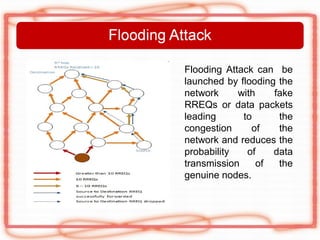
Flooding Attack can be
launched by flooding the
network     with    fake
RREQs or data packets
leading      to      the
congestion     of    the
network and reduces the
probability   of    data
transmission     of  the
genuine nodes.
Depending upon the types of packet used to flood the
network, flooding attack is classified in two categories:

  RREQ FLOODING
  DATA FLOODING
 In the RREQ flooding attack, the attacker broadcast the many
   RREQ packets for the IP which does not exists in the network.
 To perform RREQ flooding ,Intruders disable the
   RREQ_ratelimit parameter.

Effects:
1.Consumes network bandwidth
2.consumes nodes battery power
3.Legitimated user can not able to use the network for valid
   communication.
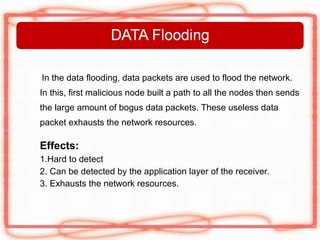
In the data flooding, data packets are used to flood the network.
In this, first malicious node built a path to all the nodes then sends
the large amount of bogus data packets. These useless data
packet exhausts the network resources.

Effects:
1.Hard to detect
2. Can be detected by the application layer of the receiver.
3. Exhausts the network resources.
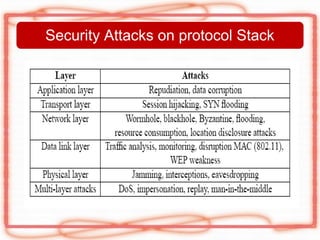
Security Attacks on protocol Stack
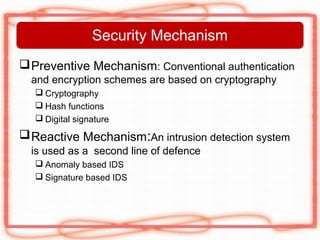
Security Mechanism
 Preventive Mechanism: Conventional authentication
  and encryption schemes are based on cryptography
   Cryptography
   Hash functions
   Digital signature
 Reactive Mechanism:An intrusion detection system
  is used as a second line of defence
   Anomaly based IDS
   Signature based IDS
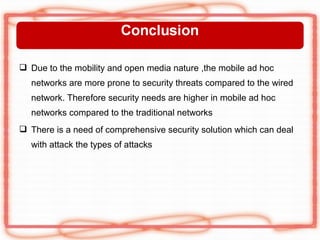
 Due to the mobility and open media nature ,the mobile ad hoc
  networks are more prone to security threats compared to the wired
  network. Therefore security needs are higher in mobile ad hoc
  networks compared to the traditional networks
 There is a need of comprehensive security solution which can deal
  with attack the types of attacks
[1] Manel Guerrero Zapata & N. Asokan “Securing Ad Hoc Routing Protocols” Wise’02 September
     28,2002,Atlanta Georgia, USA inedxed in ACM 1-58113-585-8/02/009
[2] Nishu Garg, R.P.Mahapatra. “MANET Security Issues”. IJCSNS International Journal of Computer
     Science and Network Security, Volume.9, No.8, 2009.
[3]Mouhcine Guennoun and Khalil El-khatib “A scalable wireless intrusion detection system”,IJCSIS,
     Vol 1,No. 1, may 2009.
[4] Abhay Kumar Rai, Rajiv Ranjan Tewari & Saurabh Kant Upadhyay “Different Types of Attacks
     on Integrated MANET-Internet Communication” International Journal of Computer Science
     and Security (IJCSS) Volume (4): Issue (3)
[5] Malcolm Parsons and Peter Ebinger “Performance Evaluation of the Impact of Attacks on Mobile
     Ad hoc Networks”.
[6] H Deng, W. Li, and D. Agrawal, Routing Security in Wireless Ad Hoc Networks.IEEE
     Communications Magazine. Vol. 40, No. 10, 2002
[7]Y. Zhang and W. Lee, “Intrusion Detection in Wireless Ad hoc Networks”, In Proc. ACM/IEEE Int’l.
     Conf. on Mobile Computing and Networking, pp 275-283, 2000.
 [8]Satria Mandala, Md. Asri Ngadi, A.Hanan Abdullah “A Survey on MANET Intrusion Detection”
     International Journal of Computer Science and Security, Volume (2) : Issue (1)
[9] N.SHANTHI, 2DR.LGANESAN AND 3DR.K.RAMAR” STUDY OF DIFFERENT ATTACKS ON
     MULTICAST MOBILE AD HOC NETWORK” Journal of Theoretical and Applied Information
     Technology.
[10]Hassen Redwan and Ki-Hyung Kim s “Survey of Security Requirements, Attacks and Network
     Integration in Wireless Mesh Networks” 2008 Japan-China Joint Workshop on Frontier of
     Computer Science and Technology.
[11]Marianne A. Azer,Sherif M. El-Kassas,Magdy S. El-Soudani “Security in Ad Hoc Networks,From
     Vulnerability to Risk Management”2009 Third International Conference on Emerging Security
     Information, Systems and Technologies
[12] Marjan Kuchaki Rafsanjani, Ali Movaghar, and Faroukh Koroupi “Investigating Intrusion Detection
     Systems in
MANET and Comparing IDSs for Detecting Misbehaving Nodes” World Academy of Science,
     Engineering and
Technology, 44, 2008.
[13] Pradip M. Jawandhiya et. Al “A Survey of Mobile Ad Hoc Network Attacks” International
     Journal of Engineering Science and Technology Vol. 2(9), 2010, 4063-4071
[14] Adam Burg “ Ad hoc network specific attacks”Seminar Ad hoc networking: concepts,
     applications, and security Technische Universität München, 2003
[15] Pradeep rai and Shubha singh “A Review of ‘MANET’s Security Aspects and
     Challenges”IJCA Special Issue on “Mobile Ad-hoc Networks”MANETs, 2010 of Information
     Technology & Knowledge Management ,Jul – Dec 2010,Vol-II, No2 PP 305-310
Attacks in MANET

Attacks in MANET

  • 1.
    Security Issues And Attacks in Mobile Ad hoc Network
  • 2.
    1. Objective 2. Motivation 3.Introduction To MANET 4. Flooding attack and its types 5. DSR Routing protocol 6. Literature survey 7. Proposed Technique 8. About Simulator (NS-2) 9. Results and analysis 10. Conclusion 11. Future Work
  • 3.
    The general objectivescan be outlined as follows:  Get a general understanding of Mobile Ad Hoc Networks.  Literature survey of various intrusion detection systems for MANET.  Analysis of effect of node Mobility Speed and Pause time.  Analysis of RREQ flooding Attack in MANET.  Simulation and Analysis of our flooding attack prevention algorithm for the networks with higher node mobility.
  • 4.
    Mobile ad hocnetworks are the autonomous collection devices connected in a peer-to- peer and multi-hop fashion without the use of central base stations or access points.
  • 5.
     Each nodehave communication capabilities.  Nodes can communicate directly with each other if they falls in the radio coverage range of each other otherwise use the concept of multi hop.  Each node behaves like station and Router.  All the nodes participate in the routing and the performance depend upon the cooperation between the nodes.  MANET are useful where infrastructure is absent or installation is not possible.
  • 6.
    C F B A E D
  • 7.
    Characteristics of MANET  Operating without any central coordinator/base station.  Dynamic topology.  Energy-constrained operation  Longer transmission range due to multi-hop relay.  Self-configuring.  Constraint Bandwidth.  Distributed Operation
  • 8.
    Security Goals  Availability  Confidentiality  Integrity  Authentication  Non-repudiation  Access Control
  • 9.
    The following arethe advantages of MANETs:  Rapid deployable.  Self Configurable.  Mobility.  Does not requires any infrastructure to work.  Cost Effective.  Less time consuming.  More robust than cellular system.
  • 10.
     Dynamic changingtopology  Limited Bandwidth.  Limited battery power.  Security issues.
  • 11.
    Security problems inMANET  Open Media  Routing Protocol Does not have any security mechanism  Continuous changing topology.  Unavailability of central coordinator  Requires cooperation between the devices
  • 12.
    Attacks in MANETcan be classified as  Passive Attack  Active Attacks.
  • 13.
     Attacker snoopsthe data exchanged in the network without altering it.  This attack target the confidentiality attribute of the system.  Passive attack is very difficult to detect because the operation of the network is not affected by this type attack.  Passive attacks are generally used to gather the information about the network or know the communication pattern between the communicating parties. This attack is easy to launch and it may lead to active attack.
  • 14.
     Attacker attemptsto modify or alter the data being exchanged in the network.  It may disrupts the normal functioning of the network.  In active attack the intruders can modify the packets, inject the packets, drops the packet, or it can use the various feature of the network to launch the attack.  Active attacks are very dangerous.
  • 15.
    ATTACKS IN MANET (Classification-II) Attacks in MANET can also be classified as  External Attack: Carried out by nodes that do not belong to the domain of the network.  Internal Attack: Internal attacks are from compromised nodes, which are actually part of the network.
  • 16.
    A Black-hole is a malicious node that falsely replies for route requests without having an active route to the destination and exploits the Routing Protocol to advertise itself as having a shortest route to destination. • By advertizing the shortest route ,source station starts sending data through the black hole node and it become the active element in the route.
  • 17.
    In this Attack, an attacker records packets at one location in the network and tunnels them to another location. • This tunnel between two colluding attackers is referred as a wormhole . • Routing can be disrupted when routing control messages are tunnelled. • when a wormhole attack is used against an on-demand routing protocol the attack could prevent the discovery of any routes other than through the wormhole.
  • 18.
    Byzantine Attack • A compromised intermediate node works alone, or a set of compromised intermediate nodes works in collusion and carry out attacks. • These attacker node creates routing loops, forwarding packets through non-optimal paths or selectively dropping packets, which results in disruption or degradation of the routing services
  • 19.
    Sleep Deprivation  Itis also called as resource consumption attack  An attacker or a compromised node can attempt to consume battery life by requesting excessive route discovery, or by forwarding unnecessary packets to the victim node.
  • 20.
    Location Disclosure  Anattacker reveals information regarding the location of nodes or the structure of the network. It gathers the node location information, such as a route map, and then plans further attack scenarios.  Adversaries try to figure out the identities of communication parties and analyze traffic to learn the network traffic pattern the traffic pattern. The leakage of such information is devastating in security sensitive scenarios.
  • 21.
    Eavesdropping  The maingoal of eavesdropping is to obtain some confidential information that should be kept secret during the communication.  This confidential information may include the location, public key, private key or even passwords of the nodes.
  • 22.
    Flooding Attack canbe launched by flooding the network with fake RREQs or data packets leading to the congestion of the network and reduces the probability of data transmission of the genuine nodes.
  • 23.
    Depending upon thetypes of packet used to flood the network, flooding attack is classified in two categories:  RREQ FLOODING  DATA FLOODING
  • 24.
     In theRREQ flooding attack, the attacker broadcast the many RREQ packets for the IP which does not exists in the network.  To perform RREQ flooding ,Intruders disable the RREQ_ratelimit parameter. Effects: 1.Consumes network bandwidth 2.consumes nodes battery power 3.Legitimated user can not able to use the network for valid communication.
  • 25.
    In the dataflooding, data packets are used to flood the network. In this, first malicious node built a path to all the nodes then sends the large amount of bogus data packets. These useless data packet exhausts the network resources. Effects: 1.Hard to detect 2. Can be detected by the application layer of the receiver. 3. Exhausts the network resources.
  • 26.
    Security Attacks onprotocol Stack
  • 27.
    Security Mechanism  PreventiveMechanism: Conventional authentication and encryption schemes are based on cryptography  Cryptography  Hash functions  Digital signature  Reactive Mechanism:An intrusion detection system is used as a second line of defence  Anomaly based IDS  Signature based IDS
  • 28.
     Due tothe mobility and open media nature ,the mobile ad hoc networks are more prone to security threats compared to the wired network. Therefore security needs are higher in mobile ad hoc networks compared to the traditional networks  There is a need of comprehensive security solution which can deal with attack the types of attacks
  • 29.
    [1] Manel GuerreroZapata & N. Asokan “Securing Ad Hoc Routing Protocols” Wise’02 September 28,2002,Atlanta Georgia, USA inedxed in ACM 1-58113-585-8/02/009 [2] Nishu Garg, R.P.Mahapatra. “MANET Security Issues”. IJCSNS International Journal of Computer Science and Network Security, Volume.9, No.8, 2009. [3]Mouhcine Guennoun and Khalil El-khatib “A scalable wireless intrusion detection system”,IJCSIS, Vol 1,No. 1, may 2009. [4] Abhay Kumar Rai, Rajiv Ranjan Tewari & Saurabh Kant Upadhyay “Different Types of Attacks on Integrated MANET-Internet Communication” International Journal of Computer Science and Security (IJCSS) Volume (4): Issue (3) [5] Malcolm Parsons and Peter Ebinger “Performance Evaluation of the Impact of Attacks on Mobile Ad hoc Networks”. [6] H Deng, W. Li, and D. Agrawal, Routing Security in Wireless Ad Hoc Networks.IEEE Communications Magazine. Vol. 40, No. 10, 2002 [7]Y. Zhang and W. Lee, “Intrusion Detection in Wireless Ad hoc Networks”, In Proc. ACM/IEEE Int’l. Conf. on Mobile Computing and Networking, pp 275-283, 2000. [8]Satria Mandala, Md. Asri Ngadi, A.Hanan Abdullah “A Survey on MANET Intrusion Detection” International Journal of Computer Science and Security, Volume (2) : Issue (1)
  • 30.
    [9] N.SHANTHI, 2DR.LGANESANAND 3DR.K.RAMAR” STUDY OF DIFFERENT ATTACKS ON MULTICAST MOBILE AD HOC NETWORK” Journal of Theoretical and Applied Information Technology. [10]Hassen Redwan and Ki-Hyung Kim s “Survey of Security Requirements, Attacks and Network Integration in Wireless Mesh Networks” 2008 Japan-China Joint Workshop on Frontier of Computer Science and Technology. [11]Marianne A. Azer,Sherif M. El-Kassas,Magdy S. El-Soudani “Security in Ad Hoc Networks,From Vulnerability to Risk Management”2009 Third International Conference on Emerging Security Information, Systems and Technologies [12] Marjan Kuchaki Rafsanjani, Ali Movaghar, and Faroukh Koroupi “Investigating Intrusion Detection Systems in MANET and Comparing IDSs for Detecting Misbehaving Nodes” World Academy of Science, Engineering and Technology, 44, 2008. [13] Pradip M. Jawandhiya et. Al “A Survey of Mobile Ad Hoc Network Attacks” International Journal of Engineering Science and Technology Vol. 2(9), 2010, 4063-4071 [14] Adam Burg “ Ad hoc network specific attacks”Seminar Ad hoc networking: concepts, applications, and security Technische Universität München, 2003 [15] Pradeep rai and Shubha singh “A Review of ‘MANET’s Security Aspects and Challenges”IJCA Special Issue on “Mobile Ad-hoc Networks”MANETs, 2010 of Information Technology & Knowledge Management ,Jul – Dec 2010,Vol-II, No2 PP 305-310