Acid Base Balance-1
Discuss the concept of acid base balance
Interpret metabolic and respiratory disorders of acid
base balance on the basis of sign, symptoms and ABG
findings
Describe the Clinical interpretation of acid base balance
Specific Learning Objectives
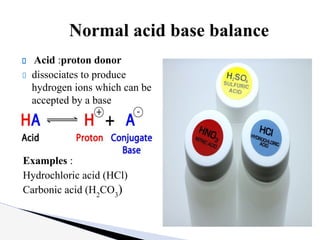
Acid :proton donor
dissociates to produce
hydrogen ions which can be
accepted by a base
Examples :
Hydrochloric acid (HCl)
Carbonic acid (H2
CO3
)
Normal acid base balance
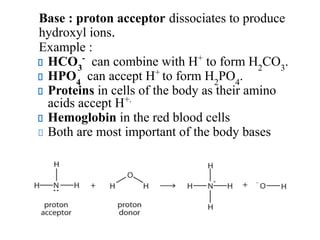
Base : proton acceptor dissociates to produce
hydroxyl ions.
Example :
HCO3
-
can combine with H+
to form H2
CO3
.
HPO4
can accept H+
to form H2
PO4
.
Proteins in cells of the body as their amino
acids accept H+.
Hemoglobin in the red blood cells
Both are most important of the body bases
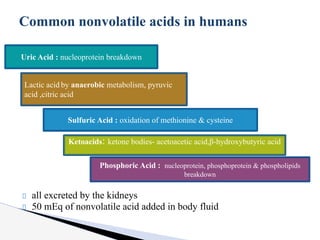
all excreted by the kidneys
50 mEq of nonvolatile acid added in body fluid
Common nonvolatile acids in humans
Sulfuric Acid : oxidation of methionine & cysteine
Phosphoric Acid : nucleoprotein, phosphoprotein & phospholipids
breakdown
Uric Acid : nucleoprotein breakdown
Ketoacids: ketone bodies- acetoacetic acid,β-hydroxybutyric acid
Lactic acid by anaerobic metabolism, pyruvic
acid ,citric acid
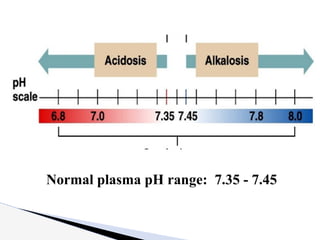
Normal plasma pH range: 7.35 - 7.45
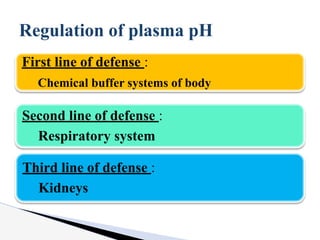
First line of defense :
Chemical buffer systems of body
Second line of defense :
Respiratory system
Third line of defense :
Kidneys
Regulation of plasma pH
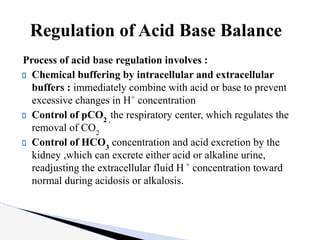
Regulation of Acid Base Balance
Process of acid base regulation involves :
Chemical buffering by intracellular and extracellular
buffers : immediately combine with acid or base to prevent
excessive changes in H+
concentration
Control of pCO2 ,
the respiratory center, which regulates the
removal of CO2
Control of HCO3
concentration and acid excretion by the
kidney ,which can excrete either acid or alkaline urine,
readjusting the extracellular fluid H +
concentration toward
normal during acidosis or alkalosis.
Buffer solution is one that tends to maintain its pH when
small amounts of acid or base are added to it
Physiological Buffers :
chemicals used by the body to prevent sudden, rapid changes
in the pH of a fluid. When there is a change in H+
concentration, the buffer systems of the body fluids react
within seconds to minimize these changes.
Buffer systems do not eliminate H+
from or add them to
the body but only keep them tied up until balance can be
re-established.
First line of defense
Weakly dissociating acid (proton donor) and its
conjugate base or salt (proton acceptor)
Examples : H2
CO3
/NaHCO3
NaH2
PO4
/Na2
HPO4
2-
Buffer solution
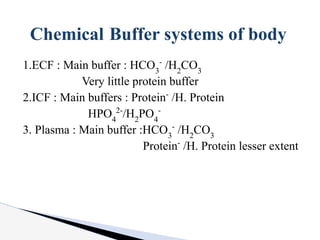
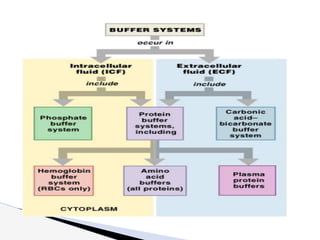
1.ECF : Main buffer : HCO3
-
/H2
CO3
Very little protein buffer
2.ICF : Main buffers : Protein-
/H. Protein
HPO4
2-
/H2
PO4
-
3. Plasma : Main buffer :HCO3
-
/H2
CO3
Protein-
/H. Protein lesser extent
Chemical Buffer systems of body
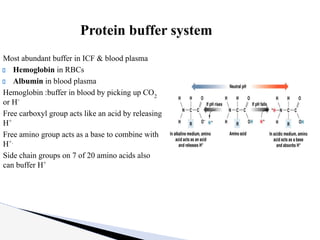
Most abundant buffer in ICF & blood plasma
Hemoglobin in RBCs
Albumin in blood plasma
Hemoglobin :buffer in blood by picking up CO2
or H⁺
Free carboxyl group acts like an acid by releasing
H+
Free amino group acts as a base to combine with
H+.
Side chain groups on 7 of 20 amino acids also
can buffer H+
Protein buffer system
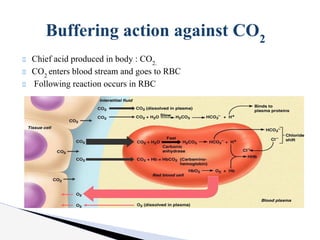
Chief acid produced in body : CO2.
CO2
enters blood stream and goes to RBC
Following reaction occurs in RBC
Buffering action against CO2
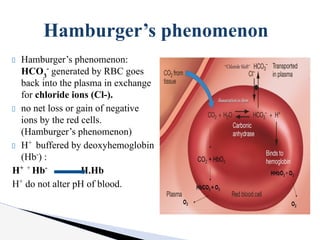
Hamburger’s phenomenon:
HCO3
-
generated by RBC goes
back into the plasma in exchange
for chloride ions (Cl-).
no net loss or gain of negative
ions by the red cells.
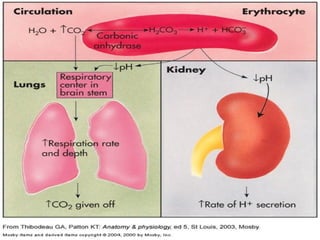
(Hamburger’s phenomenon)
H+
buffered by deoxyhemoglobin
(Hb-
) :
H+ +
Hb-
H.Hb
H+
do not alter pH of blood.
Hamburger’s phenomenon
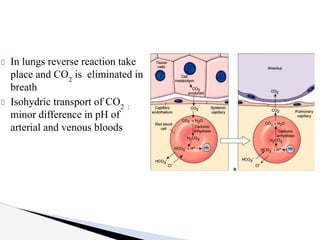
In lungs reverse reaction take
place and CO2
is eliminated in
breath
Isohydric transport of CO2 :
minor difference in pH of
arterial and venous bloods
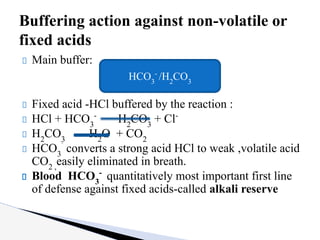
Main buffer:
Fixed acid -HCl buffered by the reaction :
HCl + HCO3
-
H2
CO3
+ Cl-
H2
CO3
H2
O + CO2
HCO3
⁻
converts a strong acid HCl to weak ,volatile acid
CO2 ,
easily eliminated in breath.
Blood HCO3
-
quantitatively most important first line
of defense against fixed acids-called alkali reserve
Buffering action against non-volatile or
fixed acids
HCO3
-
/H2
CO3
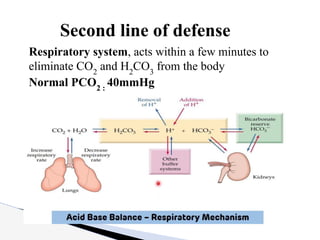
Respiratory system, acts within a few minutes to
eliminate CO2
and H2
CO3
from the body
Normal PCO2 :
40mmHg
Second line of defense
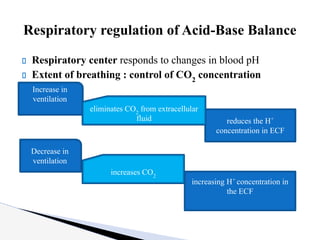
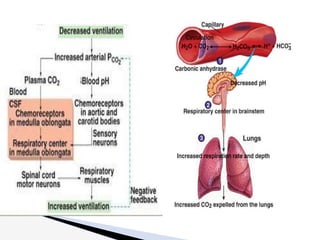
Respiratory center responds to changes in blood pH
Extent of breathing : control of CO2
concentration
Respiratory regulation of Acid-Base Balance
Increase in
ventilation
reduces the H+
concentration in ECF
eliminates CO2
from extracellular
fluid
Decrease in
ventilation
increases CO2
increasing H+
concentration in
the ECF
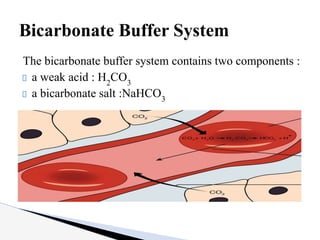
The bicarbonate buffer system contains two components :
a weak acid : H2
CO3
a bicarbonate salt :NaHCO3
Bicarbonate Buffer System
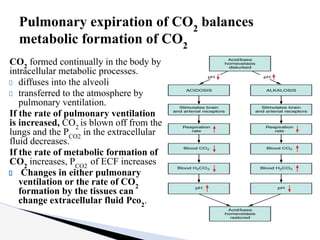
CO2
formed continually in the body by
intracellular metabolic processes.
diffuses into the alveoli
transferred to the atmosphere by
pulmonary ventilation.
If the rate of pulmonary ventilation
is increased, CO2
is blown off from the
lungs and the PCO2
in the extracellular
fluid decreases.
If the rate of metabolic formation of
CO2
increases, PCO2
of ECF increases
Changes in either pulmonary
ventilation or the rate of CO2
formation by the tissues can
change extracellular fluid Pco2
.
Pulmonary expiration of CO2
balances
metabolic formation of CO2
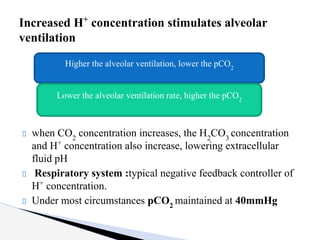
when CO2
concentration increases, the H2
CO3
concentration
and H+
concentration also increase, lowering extracellular
fluid pH
Respiratory system :typical negative feedback controller of
H+
concentration.
Under most circumstances pCO2
maintained at 40mmHg
Increased H+
concentration stimulates alveolar
ventilation
Higher the alveolar ventilation, lower the pCO2
Lower the alveolar ventilation rate, higher the pCO2
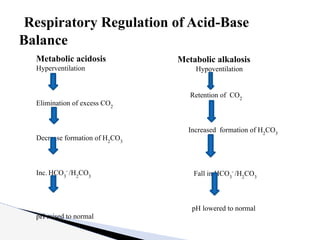
Metabolic acidosis
Hyperventilation
Elimination of excess CO2
Decrease formation of H2
CO3
Inc. HCO3
-
/H2
CO3
pH raised to normal
Metabolic alkalosis
Hypoventilation
Retention of CO2
Increased formation of H2
CO3
Fall in HCO3
-
/H2
CO3
pH lowered to normal
Respiratory Regulation of Acid-Base
Balance
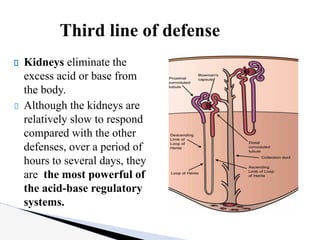
Kidneys eliminate the
excess acid or base from
the body.
Although the kidneys are
relatively slow to respond
compared with the other
defenses, over a period of
hours to several days, they
are the most powerful of
the acid-base regulatory
systems.
Third line of defense
Kidneys control acid-base balance : excreting either acidic or basic
urine.
Excreting acidic urine reduces the amount of acid in extracellular
fluid
Excreting basic urine removes base from the extracellular fluid
Most effective regulator of pH
Renal control of Acid-Base Balance
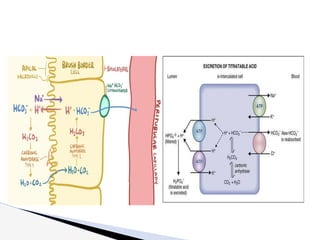
Secretion of H +
ions into tubular fluid
in proximal convoluted tubules via Na+
H +
exchange
in distal segments by aldosterone dependent
mechanisms including H +
- ATPase pump
Acidosis and aldosterone stimulate while alkalosis
inhibits H +
secretion into tubular lumen
Role of Kidneys in acid base regulation
Retention of extracellular
HCO3
-
Excretion of H+
ions produced
by metabolic reactions
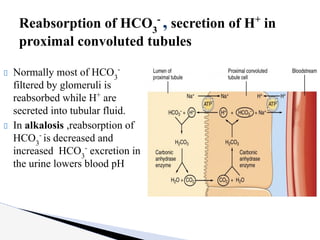
Normally most of HCO3
-
filtered by glomeruli is
reabsorbed while H+
are
secreted into tubular fluid.
In alkalosis ,reabsorption of
HCO3
-
is decreased and
increased HCO3
-
excretion in
the urine lowers blood pH
Reabsorption of HCO3
-
, secretion of H+
in
proximal convoluted tubules
Role of DCT and CD in acid base
balance
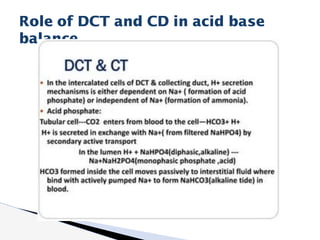
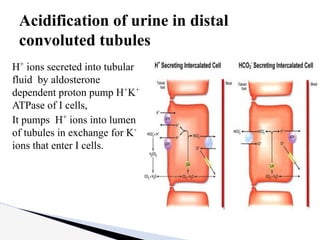
H+
ions secreted into tubular
fluid by aldosterone
dependent proton pump H+
K+
ATPase of I cells,
It pumps H+
ions into lumen
of tubules in exchange for K⁺
ions that enter I cells.
Acidification of urine in distal
convoluted tubules
HCO3
- /
H2
CO3
buffer
system –
only to small
extent as most of tubular
HCO3
- has been
reabsorbed in PCT
Mechanisms of Buffering of H+
ions
entering lumen
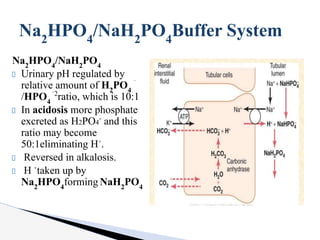
Na2
HPO4
/NaH2
PO4
Urinary pH regulated by
relative amount of H2
PO4
⁻
/HPO4
⁻2
ratio, which is 10:1
In acidosis more phosphate
excreted as H2PO4
-
and this
ratio may become
50:1eliminating H⁺.
Reversed in alkalosis.
H ⁺taken up by
Na2
HPO4
forming NaH2
PO4
Na2
HPO4
/NaH2
PO4
Buffer System
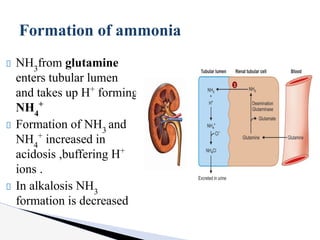
NH3
from glutamine
enters tubular lumen
and takes up H+
forming
NH4
+
Formation of NH3
and
NH4
+
increased in
acidosis ,buffering H+
ions .
In alkalosis NH3
formation is decreased
Formation of ammonia
• In ketoacidosis ,filtration of abnormally large amounts
of acidic ketone bodies i.e. acetoacetic acid and β
hydroxybutyric acid as anions in combination with Na⁺
• They combine with H⁺ ions to form corresponding
acids in tubular lumen.
• Kidneys excrete H⁺ ions to reverse acidosis
Excretion of H+
as free acids
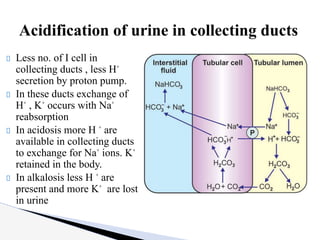
Less no. of I cell in
collecting ducts , less H⁺
secretion by proton pump.
In these ducts exchange of
H⁺ , K⁺ occurs with Na⁺
reabsorption
In acidosis more H ⁺ are
available in collecting ducts
to exchange for Na⁺ ions. K⁺
retained in the body.
In alkalosis less H ⁺ are
present and more K⁺ are lost
in urine
Acidification of urine in collecting ducts
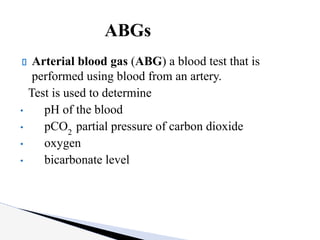
Arterial blood gas (ABG) a blood test that is
performed using blood from an artery.
Test is used to determine
• pH of the blood
• pCO2
partial pressure of carbon dioxide
• oxygen
• bicarbonate level
ABGs
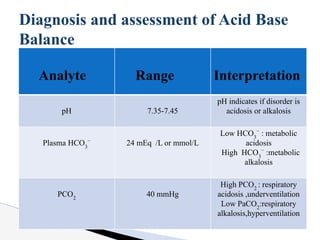
Analyte Range Interpretation
pH 7.35-7.45
pH indicates if disorder is
acidosis or alkalosis
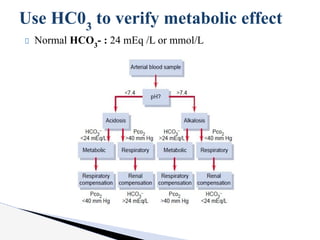
Plasma HCO3
−
24 mEq /L or mmol/L
Low HCO3
−
: metabolic
acidosis
High HCO3
−
:metabolic
alkalosis
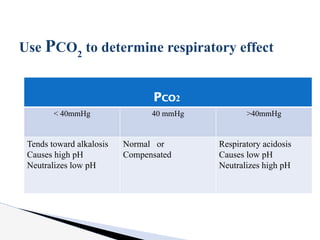
PCO2
40 mmHg
High PCO2
: respiratory
acidosis ,underventilation
Low PaCO2
:respiratory
alkalosis,hyperventilation
Diagnosis and assessment of Acid Base
Balance
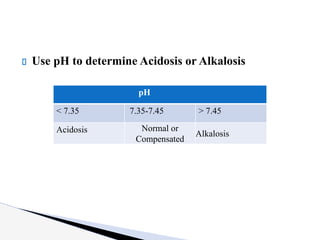
Use pH to determine Acidosis or Alkalosis
pH
< 7.35 7.35-7.45 > 7.45
Acidosis Normal or
Compensated
Alkalosis
PCO2
< 40mmHg 40 mmHg >40mmHg
Tends toward alkalosis
Causes high pH
Neutralizes low pH
Normal or
Compensated
Respiratory acidosis
Causes low pH
Neutralizes high pH
Use PCO2
to determine respiratory effect
Normal HCO3
- : 24 mEq /L or mmol/L
Use HC03
to verify metabolic effect
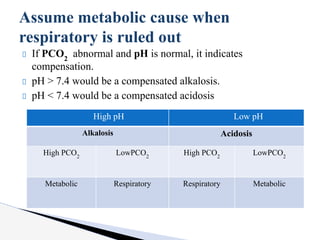
If PCO2
abnormal and pH is normal, it indicates
compensation.
pH > 7.4 would be a compensated alkalosis.
pH < 7.4 would be a compensated acidosis
Assume metabolic cause when
respiratory is ruled out
High pH Low pH
Alkalosis Acidosis
High PCO2
LowPCO2
High PCO2
LowPCO2
Metabolic Respiratory Respiratory Metabolic
Essentials of Medical Biochemistry Vol-2
Mushtaq Ahmad
Guyton and Hall
Textbook of Medical Physiology
References

Acid base balance disorders, compensations , buffers

  • 1.
  • 2.
    Discuss the conceptof acid base balance Interpret metabolic and respiratory disorders of acid base balance on the basis of sign, symptoms and ABG findings Describe the Clinical interpretation of acid base balance Specific Learning Objectives
  • 3.
    Acid :proton donor dissociatesto produce hydrogen ions which can be accepted by a base Examples : Hydrochloric acid (HCl) Carbonic acid (H2 CO3 ) Normal acid base balance
  • 4.
    Base : protonacceptor dissociates to produce hydroxyl ions. Example : HCO3 - can combine with H+ to form H2 CO3 . HPO4 can accept H+ to form H2 PO4 . Proteins in cells of the body as their amino acids accept H+. Hemoglobin in the red blood cells Both are most important of the body bases
  • 5.
    all excreted bythe kidneys 50 mEq of nonvolatile acid added in body fluid Common nonvolatile acids in humans Sulfuric Acid : oxidation of methionine & cysteine Phosphoric Acid : nucleoprotein, phosphoprotein & phospholipids breakdown Uric Acid : nucleoprotein breakdown Ketoacids: ketone bodies- acetoacetic acid,β-hydroxybutyric acid Lactic acid by anaerobic metabolism, pyruvic acid ,citric acid
  • 6.
    Normal plasma pHrange: 7.35 - 7.45
  • 7.
    First line ofdefense : Chemical buffer systems of body Second line of defense : Respiratory system Third line of defense : Kidneys Regulation of plasma pH
  • 8.
    Regulation of AcidBase Balance Process of acid base regulation involves : Chemical buffering by intracellular and extracellular buffers : immediately combine with acid or base to prevent excessive changes in H+ concentration Control of pCO2 , the respiratory center, which regulates the removal of CO2 Control of HCO3 concentration and acid excretion by the kidney ,which can excrete either acid or alkaline urine, readjusting the extracellular fluid H + concentration toward normal during acidosis or alkalosis.
  • 9.
    Buffer solution isone that tends to maintain its pH when small amounts of acid or base are added to it Physiological Buffers : chemicals used by the body to prevent sudden, rapid changes in the pH of a fluid. When there is a change in H+ concentration, the buffer systems of the body fluids react within seconds to minimize these changes. Buffer systems do not eliminate H+ from or add them to the body but only keep them tied up until balance can be re-established. First line of defense
  • 10.
    Weakly dissociating acid(proton donor) and its conjugate base or salt (proton acceptor) Examples : H2 CO3 /NaHCO3 NaH2 PO4 /Na2 HPO4 2- Buffer solution
  • 11.
    1.ECF : Mainbuffer : HCO3 - /H2 CO3 Very little protein buffer 2.ICF : Main buffers : Protein- /H. Protein HPO4 2- /H2 PO4 - 3. Plasma : Main buffer :HCO3 - /H2 CO3 Protein- /H. Protein lesser extent Chemical Buffer systems of body
  • 12.
    Most abundant bufferin ICF & blood plasma Hemoglobin in RBCs Albumin in blood plasma Hemoglobin :buffer in blood by picking up CO2 or H⁺ Free carboxyl group acts like an acid by releasing H+ Free amino group acts as a base to combine with H+. Side chain groups on 7 of 20 amino acids also can buffer H+ Protein buffer system
  • 14.
    Chief acid producedin body : CO2. CO2 enters blood stream and goes to RBC Following reaction occurs in RBC Buffering action against CO2
  • 15.
    Hamburger’s phenomenon: HCO3 - generated byRBC goes back into the plasma in exchange for chloride ions (Cl-). no net loss or gain of negative ions by the red cells. (Hamburger’s phenomenon) H+ buffered by deoxyhemoglobin (Hb- ) : H+ + Hb- H.Hb H+ do not alter pH of blood. Hamburger’s phenomenon
  • 16.
    In lungs reversereaction take place and CO2 is eliminated in breath Isohydric transport of CO2 : minor difference in pH of arterial and venous bloods
  • 17.
    Main buffer: Fixed acid-HCl buffered by the reaction : HCl + HCO3 - H2 CO3 + Cl- H2 CO3 H2 O + CO2 HCO3 ⁻ converts a strong acid HCl to weak ,volatile acid CO2 , easily eliminated in breath. Blood HCO3 - quantitatively most important first line of defense against fixed acids-called alkali reserve Buffering action against non-volatile or fixed acids HCO3 - /H2 CO3
  • 18.
    Respiratory system, actswithin a few minutes to eliminate CO2 and H2 CO3 from the body Normal PCO2 : 40mmHg Second line of defense
  • 19.
    Respiratory center respondsto changes in blood pH Extent of breathing : control of CO2 concentration Respiratory regulation of Acid-Base Balance Increase in ventilation reduces the H+ concentration in ECF eliminates CO2 from extracellular fluid Decrease in ventilation increases CO2 increasing H+ concentration in the ECF
  • 20.
    The bicarbonate buffersystem contains two components : a weak acid : H2 CO3 a bicarbonate salt :NaHCO3 Bicarbonate Buffer System
  • 21.
    CO2 formed continually inthe body by intracellular metabolic processes. diffuses into the alveoli transferred to the atmosphere by pulmonary ventilation. If the rate of pulmonary ventilation is increased, CO2 is blown off from the lungs and the PCO2 in the extracellular fluid decreases. If the rate of metabolic formation of CO2 increases, PCO2 of ECF increases Changes in either pulmonary ventilation or the rate of CO2 formation by the tissues can change extracellular fluid Pco2 . Pulmonary expiration of CO2 balances metabolic formation of CO2
  • 22.
    when CO2 concentration increases,the H2 CO3 concentration and H+ concentration also increase, lowering extracellular fluid pH Respiratory system :typical negative feedback controller of H+ concentration. Under most circumstances pCO2 maintained at 40mmHg Increased H+ concentration stimulates alveolar ventilation Higher the alveolar ventilation, lower the pCO2 Lower the alveolar ventilation rate, higher the pCO2
  • 23.
    Metabolic acidosis Hyperventilation Elimination ofexcess CO2 Decrease formation of H2 CO3 Inc. HCO3 - /H2 CO3 pH raised to normal Metabolic alkalosis Hypoventilation Retention of CO2 Increased formation of H2 CO3 Fall in HCO3 - /H2 CO3 pH lowered to normal Respiratory Regulation of Acid-Base Balance
  • 25.
    Kidneys eliminate the excessacid or base from the body. Although the kidneys are relatively slow to respond compared with the other defenses, over a period of hours to several days, they are the most powerful of the acid-base regulatory systems. Third line of defense
  • 26.
    Kidneys control acid-basebalance : excreting either acidic or basic urine. Excreting acidic urine reduces the amount of acid in extracellular fluid Excreting basic urine removes base from the extracellular fluid Most effective regulator of pH Renal control of Acid-Base Balance
  • 27.
    Secretion of H+ ions into tubular fluid in proximal convoluted tubules via Na+ H + exchange in distal segments by aldosterone dependent mechanisms including H + - ATPase pump Acidosis and aldosterone stimulate while alkalosis inhibits H + secretion into tubular lumen Role of Kidneys in acid base regulation Retention of extracellular HCO3 - Excretion of H+ ions produced by metabolic reactions
  • 28.
    Normally most ofHCO3 - filtered by glomeruli is reabsorbed while H+ are secreted into tubular fluid. In alkalosis ,reabsorption of HCO3 - is decreased and increased HCO3 - excretion in the urine lowers blood pH Reabsorption of HCO3 - , secretion of H+ in proximal convoluted tubules
  • 30.
    Role of DCTand CD in acid base balance
  • 31.
    H+ ions secreted intotubular fluid by aldosterone dependent proton pump H+ K+ ATPase of I cells, It pumps H+ ions into lumen of tubules in exchange for K⁺ ions that enter I cells. Acidification of urine in distal convoluted tubules
  • 32.
    HCO3 - / H2 CO3 buffer system – onlyto small extent as most of tubular HCO3 - has been reabsorbed in PCT Mechanisms of Buffering of H+ ions entering lumen
  • 33.
    Na2 HPO4 /NaH2 PO4 Urinary pH regulatedby relative amount of H2 PO4 ⁻ /HPO4 ⁻2 ratio, which is 10:1 In acidosis more phosphate excreted as H2PO4 - and this ratio may become 50:1eliminating H⁺. Reversed in alkalosis. H ⁺taken up by Na2 HPO4 forming NaH2 PO4 Na2 HPO4 /NaH2 PO4 Buffer System
  • 34.
    NH3 from glutamine enters tubularlumen and takes up H+ forming NH4 + Formation of NH3 and NH4 + increased in acidosis ,buffering H+ ions . In alkalosis NH3 formation is decreased Formation of ammonia
  • 35.
    • In ketoacidosis,filtration of abnormally large amounts of acidic ketone bodies i.e. acetoacetic acid and β hydroxybutyric acid as anions in combination with Na⁺ • They combine with H⁺ ions to form corresponding acids in tubular lumen. • Kidneys excrete H⁺ ions to reverse acidosis Excretion of H+ as free acids
  • 36.
    Less no. ofI cell in collecting ducts , less H⁺ secretion by proton pump. In these ducts exchange of H⁺ , K⁺ occurs with Na⁺ reabsorption In acidosis more H ⁺ are available in collecting ducts to exchange for Na⁺ ions. K⁺ retained in the body. In alkalosis less H ⁺ are present and more K⁺ are lost in urine Acidification of urine in collecting ducts
  • 38.
    Arterial blood gas(ABG) a blood test that is performed using blood from an artery. Test is used to determine • pH of the blood • pCO2 partial pressure of carbon dioxide • oxygen • bicarbonate level ABGs
  • 39.
    Analyte Range Interpretation pH7.35-7.45 pH indicates if disorder is acidosis or alkalosis Plasma HCO3 − 24 mEq /L or mmol/L Low HCO3 − : metabolic acidosis High HCO3 − :metabolic alkalosis PCO2 40 mmHg High PCO2 : respiratory acidosis ,underventilation Low PaCO2 :respiratory alkalosis,hyperventilation Diagnosis and assessment of Acid Base Balance
  • 40.
    Use pH todetermine Acidosis or Alkalosis pH < 7.35 7.35-7.45 > 7.45 Acidosis Normal or Compensated Alkalosis
  • 41.
    PCO2 < 40mmHg 40mmHg >40mmHg Tends toward alkalosis Causes high pH Neutralizes low pH Normal or Compensated Respiratory acidosis Causes low pH Neutralizes high pH Use PCO2 to determine respiratory effect
  • 42.
    Normal HCO3 - :24 mEq /L or mmol/L Use HC03 to verify metabolic effect
  • 43.
    If PCO2 abnormal andpH is normal, it indicates compensation. pH > 7.4 would be a compensated alkalosis. pH < 7.4 would be a compensated acidosis Assume metabolic cause when respiratory is ruled out High pH Low pH Alkalosis Acidosis High PCO2 LowPCO2 High PCO2 LowPCO2 Metabolic Respiratory Respiratory Metabolic
  • 44.
    Essentials of MedicalBiochemistry Vol-2 Mushtaq Ahmad Guyton and Hall Textbook of Medical Physiology References