ACID-BASE DISORDERS
INVESTIGATING AND INTERPRETING
RESULTS
BY
Dr O.M Akinosun
INTRODUCTION
Acids: An acid is defined as any compound,
which forms hydrogen ions in solution. For
this reason acids are sometimes referred
to as "proton donors".
Bases: A base is a compound that
combines with hydrogen ions in solution.
Therefore, bases can be referred to as
"proton acceptors".
• Acid-base balance is critical for
maintaining the narrow pH range that is
required for various enzyme systems to
function optimally in the body.
• Normal blood pH ranges from 7.35-7.45
• Decreased pH is termed acidemia and is
caused by an increase in the
concentration of hydrogen ions ([H+]).
• Increased blood pH is termed alkalemia
and is caused by a decrease in the [H+].
• The bicarbonate system is the only buffer
measured for the calculation of acid-base
status in patients and is represented by
the equilibrium equation: CO2 + H2O <—>
H2CO3 <—> H+ + HCO3
-.
• Addition of CO2 to the system will cause
the equation to shift to the right, increasing
the [H+] and, therefore, lowering the pH.
• Addition of HCO3
- to the system will cause
the equation to shift to the left, lowering
the [H+] and increasing the pH
• In addition to buffers, the lungs and
kidneys play a major role in acid-base
homeostasis.
• The lungs function in ventilation and they
are responsible for regulating the amount
of CO2 present in plasma.
• The kidneys are responsible for controlling
the amount of HCO3
- in the blood by
reclaiming or excreting it in the proximal
tubule
• Abnormalities in acid-base status are
classified as to whether the primary
abnormality lies with the CO2
concentration or the HCO3
- concentration
([HCO3
-]).
• If CO2 is primarily affected, then a
respiratory disturbance is present.
• If HCO3
- is primarily affected, then a
metabolic disturbance is present.
Addition of acid
• First the acid binds to extracellular buffers, then
intracellular buffers and finally to alkaline salts in
bones.
• PCO2 is lowered by stimulation of respiratory
center
• Finally, the kidneys increase the excretion of
acids.
• If all these mechanisms fail, patient develops
acidemia
ACID-BASE DISORDERS
• ACIDEMIA: lower than normal arterial blood pH
• ALKALEMIA: higher than normal arterial blood pH
• ACIDOSIS: a process that tends to acidify body fluids
and may lead to acidemia. Could result from metabolic
or respiratory dysfunction or compensatory response.
• ALKALOSIS: a process that tends to alkalinize body
fluids and may lead to alkalemia. Could result from
metabolic or respiratory dysfunction or compensatory
response.
• Acidosis and alkalosis may or may not be associated
with abnormal pH in the same direction..
ACID_BASE DISORDERS
• SIMPLE ACID BASE DISORDER: when there is only
one primary disorder
• MIXED ACID BASE DISORDER: when there are two or
more primary disorders present at the same time
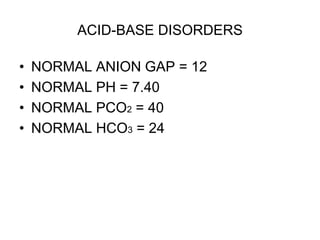
ACID-BASE DISORDERS
• NORMAL ANION GAP = 12
• NORMAL PH = 7.40
• NORMAL PCO2 = 40
• NORMAL HCO3 = 24
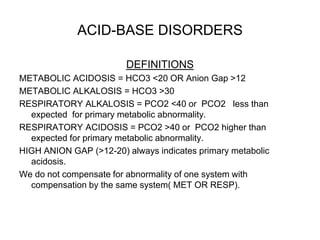
ACID-BASE DISORDERS
DEFINITIONS
METABOLIC ACIDOSIS = HCO3 <20 OR Anion Gap >12
METABOLIC ALKALOSIS = HCO3 >30
RESPIRATORY ALKALOSIS = PCO2 <40 or PCO2 less than
expected for primary metabolic abnormality.
RESPIRATORY ACIDOSIS = PCO2 >40 or PCO2 higher than
expected for primary metabolic abnormality.
HIGH ANION GAP (>12-20) always indicates primary metabolic
acidosis.
We do not compensate for abnormality of one system with
compensation by the same system( MET OR RESP).
ACID BASE DISORDERS
• PRIMARY PRIMARY COMPENSATORY
DISORDER ABNORMALITY CHANGE
MET. ACIDOSIS LOWER HCO3 LOWER PCO2
MET. ALKALOSIS HIGHER HCO3 HIGHER PCO2
RESP. ACIDOSIS HIGHER PCO2 HIGHER HCO3
RESP. ALKALOSIS LOWER PCO2 LOWER HCO3
REMEMBER: compensatory response never brings the pH back to
normal, therefore, if the pH is in acidic direction, it tells you that the
process or processes in acidic direction are the primary disorders.
Respiratory Acidosis and Alkalosis
• Result from failure of the respiratory
system to balance pH
• PCO2 is the single most important
indicator of respiratory inadequacy
• PCO2 levels - normal PCO2 fluctuates
between 35 and 45 mm Hg
– Values above 45 mm Hg signal respiratory
acidosis
– Values below 35 mm Hg indicate
respiratory alkalosis
• Respiratory acidosis is the most common
cause of acid-base imbalance
– Occurs when a person breathes shallowly, or
gas exchange is hampered by diseases such
as pneumonia, cystic fibrosis, or emphysema
• Respiratory alkalosis is a common result
of hyperventilation
Metabolic Alkalosis
• Rising blood pH and bicarbonate levels
indicate metabolic alkalosis
• Typical causes are:
– Vomiting of the acid contents of the stomach
– Intake of excess base (e.g., from antacids)
– Constipation, in which excessive bicarbonate
is reabsorbed
Metabolic Acidosis
• All pH imbalances except those caused by
abnormal blood carbon dioxide levels
• Metabolic acid-base imbalance -
bicarbonate ion levels above or below
normal (20-30 mEq/L)
Metabolic Acidosis
• Caused by excess acid production which overwhelms
renal capacity to excrete acids ( DKA ) , loss of alkali
(diarrhea) or renal failure
• Tissues and RBCs act to increase the serum HCO3 by
exchanging intracellular Na & K for extracellular H ,
resulting in increased serum K and HCO3
• Increased pulmonary ventilation leads to decreased
pCO2 and change in pH toward normal
• HCO3 <10 OR Anion Gap > 12 always suggest primary
metabolic acidosis
• There are two types of metabolic acidosis.
• Both are characterized by a decrease in
the [HCO3
-] but they differ in how that
decrease occurs
• Secretional metabolic acidosis is caused
by a direct loss of bicarbonate-rich fluid
such as diarrhea or saliva.
• Titrational metabolic acidosis is caused by
the presence of non-CO2 acids that titrate
bicarbonate causing a decreased [HCO3
-].
• Titration-type metabolic acidosis is the
result of increased endogenous or
exogenous acids in the plasma.
• Exogenous acids include ethylene glycol
metabolites and salicylate.
• Endogenous acids include lactic acid,
uremic acids, and ketones.
• It follows then that shock, renal failure,
and diabetic ketoacidosis, respectively are
common causes of titration-type metabolic
acidosis
• Secretional and titrational metabolic
acidosis can be differentiated by their
effects on the anion gap (AG)
• The anion gap is a calculated value based
on the principle of electroneutrality which
states that the total anions in the body
must always be equal to the total cations.
• We regularly measure the most significant
ions: Na+, K+, Cl- and HCO3
-.
• The ions we do not regularly measure are
referred to as unmeasured ions.
• There are unmeasured cations (Ca+2,
Mg+2, and gamma globulins) and
unmeasured anions (albumin, phosphates,
sulfates, and organic acids).
• The unmeasured anions outnumber the
unmeasured cations and the difference is
the anion gap
Anion Gap
• The anion gap is easily calculated from the
ions we do measure: AG = (Na+ + K+) –
(Cl- + HCO3
-).
• Unmeasured cations do not undergo
significant changes in health or disease
and so changes in the anion gap are
almost always associated with changes in
the unmeasured anions.
Normal anion gap metabolic acidosis with
increased osmolal gap
• Isopropyl alcohol. (Suspect in an
intoxicated patient with normal acid-base
status and “fruity” breath: acetone gets
blown off in the course of the
metabolism of isopropyl alcohol. There is
no anion gap because the metabolite of
isopropyl alcohol is volatile, doesn’t stick
around to cause an anion gap.
This also explains why all the smart
chemists put isopropyl alcohol in their
rubbing alcohol formulations, instead of,
say, methanol or ethylene glycol.
• Ethanol
• Mannitol
• Glycine
Normal anion gap metabolic acidosis
with normal osmolal gap
– Diarrhea (most common cause of normal
anion gap metabolic acidosis)
– intestinal or pancreatic fistulas or drainage
– dilutional
– post-hypocapnic metabolic acidosis
– Acetazolamide
NOTE
• Decreased serum anions such as albumin
can falsely lower the anion gap and make
an anion gap metabolic acidosis look like a
normal anion gap metabolic acidosis.
“Always remember to correct the expected
anion gap for a decreased serum albumin
concentration
High anion gap metabolic acidosis with
normal osmolal gap
• Lactic acidosis (most common cause of
high anion gap in hospitalized patients)
• Renal failure (late)
• Ketoacidosis (diabetic, alcoholic,
starvation; confirm by checking serum
for ketones, unless diagnosis is clear; also
check serum glucose to distinguish
diabetic ketoacidosis from starvation, and
alcoholic ketoacidosis)
• Salicylate poisoning: check serum
salicylate level and look for concomitant
respiratory alkalosis (drop in pCO2 is more
than ten times the drop in bicarbonate),
which in the setting of toxic ingestions,
tinnitus and altered mental status, is fairly
specific for salicylate poisoning
• Metformin
High anion gap metabolic acidosis with
increased osmolal gap
• Ethanol (check levels)
• Methanol (suspect in a patient with severe, particularly
unexplained, high-anion gap metabolic
acidosis associated with altered mental status, vision
problems or severe gastrointestinal distress; check
vision, funduscopy for optic disc hyperemia, and serum
methanol levels)
• Ethylene glycol (check serum ethylene glycol levels,
serum calcium levels, urine for fluorescence, and
sediment for calcium oxalate crystals)
• Propylene glycol
• A key point here is that “high osmolal gap
is also seen in diabetic or alcoholic
ketoacidosis, lactic acidosis, and in
chronic, but not acute renal failure
• Thus, an elevated osmolal gap alone is
not diagnostic of a particular disorder in
the patient with a high anion gap metabolic
acidosis
Compensatory Process
• Tends to return ratio of HCO3 to PCO2 back toward
normal and therefore normalize the arterial pH
• Does not return pH to normal except in primary
respiratory alkalosis of chronic duration.
• Require normal function of kidneys and lungs
• Lack of appropriate compensation suggests second
primary disorder
• Compensatory response creates second lab abnormality
• Appropriate degree of compensation can be predicted.
• Rapid chemical buffering: this occurs almost
instantly but buffers are rapidly exhausted,
requiring the elimination of hydrogen ions to
remain effective.
• Respiratory compensation: the respiratory
centre in the brainstem responds rapidly to
changes in CSF pH. Thus, a change in plasma
pH or pCO2 results in a change in ventilation
within minutes
Compensation
• maintenance of pH as near normal is vital,
therefore dysfunction in one system will
result in compensatory changes in the
others.
• The three mechanisms for compensation
mentioned earlier occur at different speeds
and remain effective for different periods.
• Renal compensation: the kidneys respond
to disturbances in acid base balance by
altering the amount of bicarbonate
reabsorbed and hydrogen ions excreted.
• However, it may take up to 2 days for
bicarbonate concentration to reach a new
equilibrium.
• These compensatory mechanisms are
efficient and often return the plasma pH to
near normal.
• However, it is uncommon for complete
compensation to occur and over
compensation does not occur
SYSTEMATIC ANALYSIS OF ACID-
BASE DISORDER
• 1, Find out which one is the primary process or processes. If the pH
is abnormal, there has to be a minimum of one primary process (
Acidosis or Alkalosis ). We can not identify more than three primary
processes at one time with our current knowledge of acid-base
analysis.
• 2, Do not apply equations for primary respiratory disorders, if there
is also a concurrent primary metabolic disorder present.
• 3, Do not try to calculate expected PCO2 for primary metabolic
acidosis, if there is also a concurrent primary respiratory disorder or
if HCO3 >30.
• Use as many equations of acid-base disorders that can be applied in
the case, to get the maximum information.
Mixed acid-base disorders
• A mixed acid-base disorder is one in which
two different primary conditions are acting
at the same time.
• Mixed disorders can be a combination of
metabolic and respiratory disorders or a
combination of different metabolic
disorders.
• The separate processes may have either a
neutralizing or additive effect on the pH.
• First, there are mixed disorders which
have a neutralizing effect on pH.
• In these cases, the body may appear to
be overcompensating because the pH is
normal or close to normal.
• Since the body does not overcompensate,
a mixed disorder should be suspected.
Example
• vomiting leading to dehydration.
• The loss of stomach acid leads to
alkalosis while the dehydration and
subsequent lactic acid buildup leads to
acidosis.
• Second, it is possible to have mixed
disorders which have an additive effect on
pH.
• For example, a respiratory acidosis and
metabolic acidosis can occur concurrently
in thoracic trauma with lactic acidosis due
to shock.
• In this case the pH would be dangerously
low.
• Mixed disorders that have an additive
effective on the pH will always have an
abnormal pH.
MIXED ACID_BASE DISORDERS
CLINICAL SYNDROME MET
ALK.
MET
ACID
RESP
ALK
RESP
ACID
CARD_PULM ARREST RX + RX +
PULMONARY EDEMA + +
ETHYLENE GLYCOL &
PULMO EDEMA
+ +
METHANOL +
HYPOVENTILATION
+ +
SEVERE
HYPO_PHOSPHATEMIA
+ +
ALCOHOL BINGE VOMIT + +
SEPSIS + +
MIXED ACID BASE DISORDERS
CLINICAL SYNDROME MET
ALK
MET
ACID
RESP
ALK
RESP
ACID
LIVER FAILURE Vomit/
Diarrhe
a
+ +
ASA OVERDOSE + +
PREGNANCY Vomit +
RENAL FAILURE OR D.K.A. Vomit +
COPD Diuretic +
SEVERE HYPOKALEMIA + +
Clinical Implications
• Serum ionized calcium concentration can
be affected by acid-base abnormalities.
• Acidosis causes displacement of calcium
ions from their binding sites on albumin as
the binding sites become protonated and
an increase in ionized calcium
concentration results.
• Conversely, alkalosis will cause a
decrease in ionized calcium concentration
and may lead to muscle twitching
• The distribution of potassium ions between
the intracellular and the extracellular fluids
(and therefore the blood [K+]) may be
affected by acid-base disorders as well.
• As the blood [H+] rises in cases of
acidosis, more H+ ions are pumped
intracellularly in exchange for K+ ions that
are pumped extracellularly
Thank you

acid base disorder physiology notes byme

  • 1.
    ACID-BASE DISORDERS INVESTIGATING ANDINTERPRETING RESULTS BY Dr O.M Akinosun
  • 2.
    INTRODUCTION Acids: An acidis defined as any compound, which forms hydrogen ions in solution. For this reason acids are sometimes referred to as "proton donors". Bases: A base is a compound that combines with hydrogen ions in solution. Therefore, bases can be referred to as "proton acceptors".
  • 3.
    • Acid-base balanceis critical for maintaining the narrow pH range that is required for various enzyme systems to function optimally in the body. • Normal blood pH ranges from 7.35-7.45 • Decreased pH is termed acidemia and is caused by an increase in the concentration of hydrogen ions ([H+]).
  • 4.
    • Increased bloodpH is termed alkalemia and is caused by a decrease in the [H+]. • The bicarbonate system is the only buffer measured for the calculation of acid-base status in patients and is represented by the equilibrium equation: CO2 + H2O <—> H2CO3 <—> H+ + HCO3 -.
  • 5.
    • Addition ofCO2 to the system will cause the equation to shift to the right, increasing the [H+] and, therefore, lowering the pH. • Addition of HCO3 - to the system will cause the equation to shift to the left, lowering the [H+] and increasing the pH • In addition to buffers, the lungs and kidneys play a major role in acid-base homeostasis.
  • 6.
    • The lungsfunction in ventilation and they are responsible for regulating the amount of CO2 present in plasma. • The kidneys are responsible for controlling the amount of HCO3 - in the blood by reclaiming or excreting it in the proximal tubule
  • 7.
    • Abnormalities inacid-base status are classified as to whether the primary abnormality lies with the CO2 concentration or the HCO3 - concentration ([HCO3 -]). • If CO2 is primarily affected, then a respiratory disturbance is present. • If HCO3 - is primarily affected, then a metabolic disturbance is present.
  • 8.
    Addition of acid •First the acid binds to extracellular buffers, then intracellular buffers and finally to alkaline salts in bones. • PCO2 is lowered by stimulation of respiratory center • Finally, the kidneys increase the excretion of acids. • If all these mechanisms fail, patient develops acidemia
  • 9.
    ACID-BASE DISORDERS • ACIDEMIA:lower than normal arterial blood pH • ALKALEMIA: higher than normal arterial blood pH • ACIDOSIS: a process that tends to acidify body fluids and may lead to acidemia. Could result from metabolic or respiratory dysfunction or compensatory response. • ALKALOSIS: a process that tends to alkalinize body fluids and may lead to alkalemia. Could result from metabolic or respiratory dysfunction or compensatory response. • Acidosis and alkalosis may or may not be associated with abnormal pH in the same direction..
  • 11.
    ACID_BASE DISORDERS • SIMPLEACID BASE DISORDER: when there is only one primary disorder • MIXED ACID BASE DISORDER: when there are two or more primary disorders present at the same time
  • 12.
    ACID-BASE DISORDERS • NORMALANION GAP = 12 • NORMAL PH = 7.40 • NORMAL PCO2 = 40 • NORMAL HCO3 = 24
  • 13.
    ACID-BASE DISORDERS DEFINITIONS METABOLIC ACIDOSIS= HCO3 <20 OR Anion Gap >12 METABOLIC ALKALOSIS = HCO3 >30 RESPIRATORY ALKALOSIS = PCO2 <40 or PCO2 less than expected for primary metabolic abnormality. RESPIRATORY ACIDOSIS = PCO2 >40 or PCO2 higher than expected for primary metabolic abnormality. HIGH ANION GAP (>12-20) always indicates primary metabolic acidosis. We do not compensate for abnormality of one system with compensation by the same system( MET OR RESP).
  • 14.
    ACID BASE DISORDERS •PRIMARY PRIMARY COMPENSATORY DISORDER ABNORMALITY CHANGE MET. ACIDOSIS LOWER HCO3 LOWER PCO2 MET. ALKALOSIS HIGHER HCO3 HIGHER PCO2 RESP. ACIDOSIS HIGHER PCO2 HIGHER HCO3 RESP. ALKALOSIS LOWER PCO2 LOWER HCO3 REMEMBER: compensatory response never brings the pH back to normal, therefore, if the pH is in acidic direction, it tells you that the process or processes in acidic direction are the primary disorders.
  • 15.
    Respiratory Acidosis andAlkalosis • Result from failure of the respiratory system to balance pH • PCO2 is the single most important indicator of respiratory inadequacy • PCO2 levels - normal PCO2 fluctuates between 35 and 45 mm Hg – Values above 45 mm Hg signal respiratory acidosis – Values below 35 mm Hg indicate respiratory alkalosis
  • 16.
    • Respiratory acidosisis the most common cause of acid-base imbalance – Occurs when a person breathes shallowly, or gas exchange is hampered by diseases such as pneumonia, cystic fibrosis, or emphysema • Respiratory alkalosis is a common result of hyperventilation
  • 17.
    Metabolic Alkalosis • Risingblood pH and bicarbonate levels indicate metabolic alkalosis • Typical causes are: – Vomiting of the acid contents of the stomach – Intake of excess base (e.g., from antacids) – Constipation, in which excessive bicarbonate is reabsorbed
  • 19.
    Metabolic Acidosis • AllpH imbalances except those caused by abnormal blood carbon dioxide levels • Metabolic acid-base imbalance - bicarbonate ion levels above or below normal (20-30 mEq/L)
  • 20.
    Metabolic Acidosis • Causedby excess acid production which overwhelms renal capacity to excrete acids ( DKA ) , loss of alkali (diarrhea) or renal failure • Tissues and RBCs act to increase the serum HCO3 by exchanging intracellular Na & K for extracellular H , resulting in increased serum K and HCO3 • Increased pulmonary ventilation leads to decreased pCO2 and change in pH toward normal • HCO3 <10 OR Anion Gap > 12 always suggest primary metabolic acidosis
  • 21.
    • There aretwo types of metabolic acidosis. • Both are characterized by a decrease in the [HCO3 -] but they differ in how that decrease occurs • Secretional metabolic acidosis is caused by a direct loss of bicarbonate-rich fluid such as diarrhea or saliva. • Titrational metabolic acidosis is caused by the presence of non-CO2 acids that titrate bicarbonate causing a decreased [HCO3 -].
  • 22.
    • Titration-type metabolicacidosis is the result of increased endogenous or exogenous acids in the plasma. • Exogenous acids include ethylene glycol metabolites and salicylate. • Endogenous acids include lactic acid, uremic acids, and ketones. • It follows then that shock, renal failure, and diabetic ketoacidosis, respectively are common causes of titration-type metabolic acidosis
  • 23.
    • Secretional andtitrational metabolic acidosis can be differentiated by their effects on the anion gap (AG) • The anion gap is a calculated value based on the principle of electroneutrality which states that the total anions in the body must always be equal to the total cations.
  • 24.
    • We regularlymeasure the most significant ions: Na+, K+, Cl- and HCO3 -. • The ions we do not regularly measure are referred to as unmeasured ions. • There are unmeasured cations (Ca+2, Mg+2, and gamma globulins) and unmeasured anions (albumin, phosphates, sulfates, and organic acids). • The unmeasured anions outnumber the unmeasured cations and the difference is the anion gap
  • 25.
    Anion Gap • Theanion gap is easily calculated from the ions we do measure: AG = (Na+ + K+) – (Cl- + HCO3 -). • Unmeasured cations do not undergo significant changes in health or disease and so changes in the anion gap are almost always associated with changes in the unmeasured anions.
  • 27.
    Normal anion gapmetabolic acidosis with increased osmolal gap • Isopropyl alcohol. (Suspect in an intoxicated patient with normal acid-base status and “fruity” breath: acetone gets blown off in the course of the metabolism of isopropyl alcohol. There is no anion gap because the metabolite of isopropyl alcohol is volatile, doesn’t stick around to cause an anion gap.
  • 28.
    This also explainswhy all the smart chemists put isopropyl alcohol in their rubbing alcohol formulations, instead of, say, methanol or ethylene glycol. • Ethanol • Mannitol • Glycine
  • 29.
    Normal anion gapmetabolic acidosis with normal osmolal gap – Diarrhea (most common cause of normal anion gap metabolic acidosis) – intestinal or pancreatic fistulas or drainage – dilutional – post-hypocapnic metabolic acidosis – Acetazolamide
  • 30.
    NOTE • Decreased serumanions such as albumin can falsely lower the anion gap and make an anion gap metabolic acidosis look like a normal anion gap metabolic acidosis. “Always remember to correct the expected anion gap for a decreased serum albumin concentration
  • 33.
    High anion gapmetabolic acidosis with normal osmolal gap • Lactic acidosis (most common cause of high anion gap in hospitalized patients) • Renal failure (late) • Ketoacidosis (diabetic, alcoholic, starvation; confirm by checking serum for ketones, unless diagnosis is clear; also check serum glucose to distinguish diabetic ketoacidosis from starvation, and alcoholic ketoacidosis)
  • 34.
    • Salicylate poisoning:check serum salicylate level and look for concomitant respiratory alkalosis (drop in pCO2 is more than ten times the drop in bicarbonate), which in the setting of toxic ingestions, tinnitus and altered mental status, is fairly specific for salicylate poisoning • Metformin
  • 35.
    High anion gapmetabolic acidosis with increased osmolal gap • Ethanol (check levels) • Methanol (suspect in a patient with severe, particularly unexplained, high-anion gap metabolic acidosis associated with altered mental status, vision problems or severe gastrointestinal distress; check vision, funduscopy for optic disc hyperemia, and serum methanol levels) • Ethylene glycol (check serum ethylene glycol levels, serum calcium levels, urine for fluorescence, and sediment for calcium oxalate crystals) • Propylene glycol
  • 36.
    • A keypoint here is that “high osmolal gap is also seen in diabetic or alcoholic ketoacidosis, lactic acidosis, and in chronic, but not acute renal failure • Thus, an elevated osmolal gap alone is not diagnostic of a particular disorder in the patient with a high anion gap metabolic acidosis
  • 37.
    Compensatory Process • Tendsto return ratio of HCO3 to PCO2 back toward normal and therefore normalize the arterial pH • Does not return pH to normal except in primary respiratory alkalosis of chronic duration. • Require normal function of kidneys and lungs • Lack of appropriate compensation suggests second primary disorder • Compensatory response creates second lab abnormality • Appropriate degree of compensation can be predicted.
  • 38.
    • Rapid chemicalbuffering: this occurs almost instantly but buffers are rapidly exhausted, requiring the elimination of hydrogen ions to remain effective. • Respiratory compensation: the respiratory centre in the brainstem responds rapidly to changes in CSF pH. Thus, a change in plasma pH or pCO2 results in a change in ventilation within minutes
  • 39.
    Compensation • maintenance ofpH as near normal is vital, therefore dysfunction in one system will result in compensatory changes in the others. • The three mechanisms for compensation mentioned earlier occur at different speeds and remain effective for different periods.
  • 40.
    • Renal compensation:the kidneys respond to disturbances in acid base balance by altering the amount of bicarbonate reabsorbed and hydrogen ions excreted. • However, it may take up to 2 days for bicarbonate concentration to reach a new equilibrium.
  • 41.
    • These compensatorymechanisms are efficient and often return the plasma pH to near normal. • However, it is uncommon for complete compensation to occur and over compensation does not occur
  • 42.
    SYSTEMATIC ANALYSIS OFACID- BASE DISORDER • 1, Find out which one is the primary process or processes. If the pH is abnormal, there has to be a minimum of one primary process ( Acidosis or Alkalosis ). We can not identify more than three primary processes at one time with our current knowledge of acid-base analysis. • 2, Do not apply equations for primary respiratory disorders, if there is also a concurrent primary metabolic disorder present. • 3, Do not try to calculate expected PCO2 for primary metabolic acidosis, if there is also a concurrent primary respiratory disorder or if HCO3 >30. • Use as many equations of acid-base disorders that can be applied in the case, to get the maximum information.
  • 43.
    Mixed acid-base disorders •A mixed acid-base disorder is one in which two different primary conditions are acting at the same time. • Mixed disorders can be a combination of metabolic and respiratory disorders or a combination of different metabolic disorders. • The separate processes may have either a neutralizing or additive effect on the pH.
  • 44.
    • First, thereare mixed disorders which have a neutralizing effect on pH. • In these cases, the body may appear to be overcompensating because the pH is normal or close to normal. • Since the body does not overcompensate, a mixed disorder should be suspected.
  • 45.
    Example • vomiting leadingto dehydration. • The loss of stomach acid leads to alkalosis while the dehydration and subsequent lactic acid buildup leads to acidosis.
  • 46.
    • Second, itis possible to have mixed disorders which have an additive effect on pH. • For example, a respiratory acidosis and metabolic acidosis can occur concurrently in thoracic trauma with lactic acidosis due to shock. • In this case the pH would be dangerously low. • Mixed disorders that have an additive effective on the pH will always have an abnormal pH.
  • 47.
    MIXED ACID_BASE DISORDERS CLINICALSYNDROME MET ALK. MET ACID RESP ALK RESP ACID CARD_PULM ARREST RX + RX + PULMONARY EDEMA + + ETHYLENE GLYCOL & PULMO EDEMA + + METHANOL + HYPOVENTILATION + + SEVERE HYPO_PHOSPHATEMIA + + ALCOHOL BINGE VOMIT + + SEPSIS + +
  • 48.
    MIXED ACID BASEDISORDERS CLINICAL SYNDROME MET ALK MET ACID RESP ALK RESP ACID LIVER FAILURE Vomit/ Diarrhe a + + ASA OVERDOSE + + PREGNANCY Vomit + RENAL FAILURE OR D.K.A. Vomit + COPD Diuretic + SEVERE HYPOKALEMIA + +
  • 49.
    Clinical Implications • Serumionized calcium concentration can be affected by acid-base abnormalities. • Acidosis causes displacement of calcium ions from their binding sites on albumin as the binding sites become protonated and an increase in ionized calcium concentration results. • Conversely, alkalosis will cause a decrease in ionized calcium concentration and may lead to muscle twitching
  • 50.
    • The distributionof potassium ions between the intracellular and the extracellular fluids (and therefore the blood [K+]) may be affected by acid-base disorders as well. • As the blood [H+] rises in cases of acidosis, more H+ ions are pumped intracellularly in exchange for K+ ions that are pumped extracellularly
  • 53.