Simplified approach for 
ABG analysis 
Dr.Hossam Elafify 
Assistant cosultanat intensivist 
KAMC
Why PH is important ?
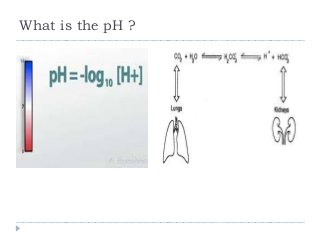
What is the pH ?
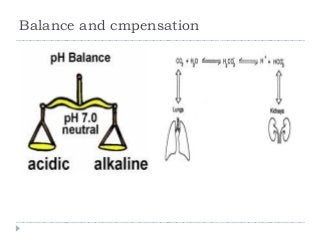
Balance and cmpensation
What is your method ?
Our method will be ……!!!!!!!
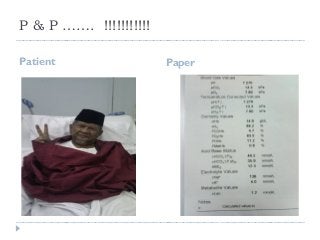
P & P ……. !!!!!!!!!!! 
Patient Paper
Why the patient is important ? 
History S & S 
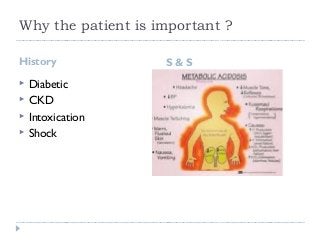
 Diabetic 
 CKD 
 Intoxication 
 Shock
Why the patient is important ? 
History S & S 
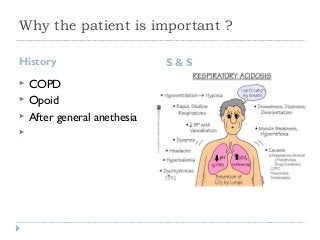
 COPD 
 Opoid 
 After general anethesia 

Why the patient is important ? 
History S & S 
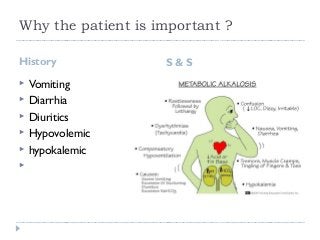
 Vomiting 
 Diarrhia 
 Diuritics 
 Hypovolemic 
 hypokalemic 

Why the patient is important ? 
History S & S 
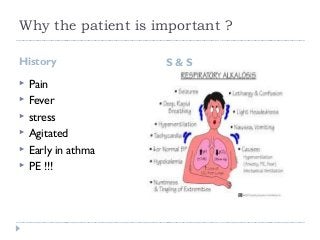
 Pain 
 Fever 
 stress 
 Agitated 
 Early in athma 
 PE !!!
Test your self …..???? 
 45 y/o male patient with past history of repeated ICU 
admissions and mechanical ventilation 
 he is COPD patient and heavy smoker 
 NOW …. The patient in ER drowsy and very weak 
?
 18 y/o female patient with past history of DM ( type I ) 
 Missed 2 doses of her regular insulin 
 Admitted to the ER with decrease LOC , rapid deep 
breathing , vomiting 
?
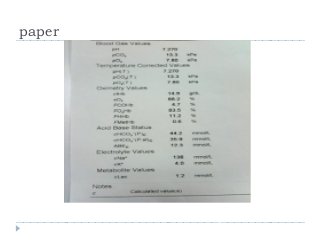
paper
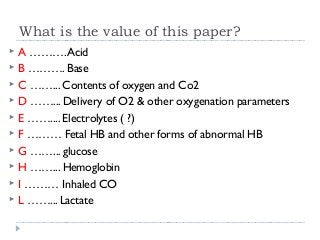
What is the value of this paper? 
 A ………. Acid 
 B ………. Base 
 C ……... Contents of oxygen and Co2 
 D ……... Delivery of O2 & other oxygenation parameters 
 E …….... Electrolytes ( ?) 
 F ……… Fetal HB and other forms of abnormal HB 
 G ……... glucose 
 H ……... Hemoglobin 
 I ……… Inhaled CO 
 L ……... Lactate
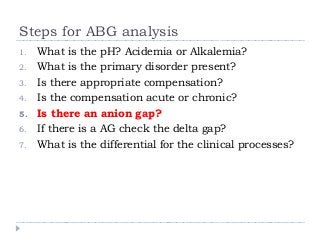
Steps for ABG analysis 
1. What is the pH? Acidemia or Alkalemia? 
2. What is the primary disorder present? 
3. Is there appropriate compensation? 
4. Is the compensation acute or chronic? 
5. Is there an anion gap? 
6. If there is a AG check the delta gap? 
7. What is the differential for the clinical processes?
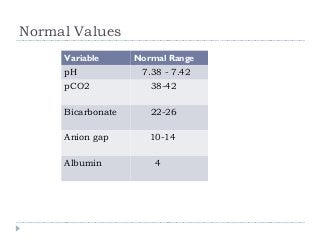
Normal Values 
Variable Normal Range 
pH 7.38 - 7.42 
pCO2 38-42 
Bicarbonate 22-26 
Anion gap 10-14 
Albumin 4
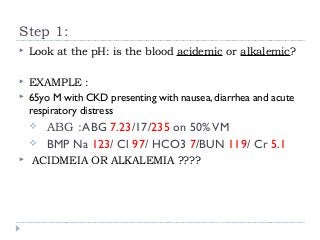
Step 1: 
 Look at the pH: is the blood acidemic or alkalemic? 
 EXAMPLE : 
 65yo M with CKD presenting with nausea, diarrhea and acute 
respiratory distress 
 ABG :ABG 7.23/17/235 on 50% VM 
 BMP Na 123/ Cl 97/ HCO3 7/BUN 119/ Cr 5.1 
 ACIDMEIA OR ALKALEMIA ????
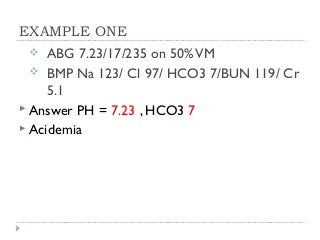
EXAMPLE ONE 
 ABG 7.23/17/235 on 50% VM 
 BMP Na 123/ Cl 97/ HCO3 7/BUN 119/ Cr 
5.1 
 Answer PH = 7.23 , HCO3 7 
 Acidemia
Steps for ABG analysis 
1. What is the pH? Acidemia or Alkalemia? 
2. What is the primary disorder present? 
3. Is there appropriate compensation? 
4. Is the compensation acute or chronic? 
5. Is there an anion gap? 
6. If there is a AG check the delta gap? 
7. What is the differential for the clinical processes?
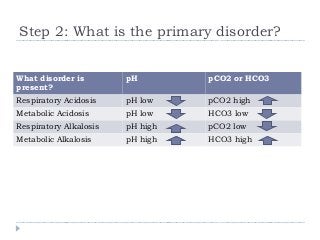
Step 2: What is the primary disorder? 
What disorder is 
present? 
pH pCO2 or HCO3 
Respiratory Acidosis pH low pCO2 high 
Metabolic Acidosis pH low HCO3 low 
Respiratory Alkalosis pH high pCO2 low 
Metabolic Alkalosis pH high HCO3 high
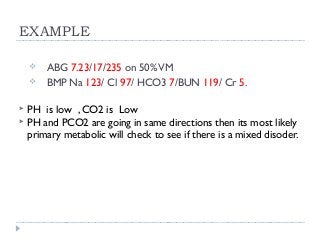
EXAMPLE 
 ABG 7.23/17/235 on 50% VM 
 BMP Na 123/ Cl 97/ HCO3 7/BUN 119/ Cr 5. 
 PH is low , CO2 is Low 
 PH and PCO2 are going in same directions then its most likely 
primary metabolic will check to see if there is a mixed disoder.
Steps for ABG analysis 
1. What is the pH? Acidemia or Alkalemia? 
2. What is the primary disorder present? 
3. Is there appropriate compensation? 
4. Is the compensation acute or chronic? 
5. Is there an anion gap? 
6. If there is a AG check the delta gap? 
7. What is the differential for the clinical processes?
Step 3-4: Is there appropriate 
compensation? Is it chronic or acute? 
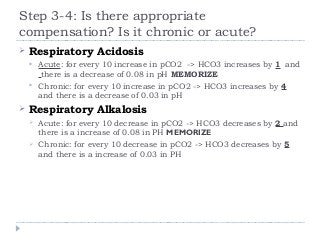
 Respiratory Acidosis 
 Acute: for every 10 increase in pCO2 -> HCO3 increases by 1 and 
there is a decrease of 0.08 in pH MEMORIZE 
 Chronic: for every 10 increase in pCO2 -> HCO3 increases by 4 
and there is a decrease of 0.03 in pH 
 Respiratory Alkalosis 
 Acute: for every 10 decrease in pCO2 -> HCO3 decreases by 2 and 
there is a increase of 0.08 in PH MEMORIZE 
 Chronic: for every 10 decrease in pCO2 -> HCO3 decreases by 5 
and there is a increase of 0.03 in PH
Step 3-4: Is there appropriate 
compensation? Is it acute or chronic ? 
 Metabolic Acidosis 
 Winter’s formula: pCO2 = 1.5[HCO3] + 8 ± 2 MEMORIZE 
 If serum pCO2 > expected pCO2 -> additional respiratory 
acidosis 
 Metabolic Alkalosis 
 pCO2 = 0.9 [HCO3] + 9 
 For every 10 increase in HCO3 -> pCO2 increases by 6
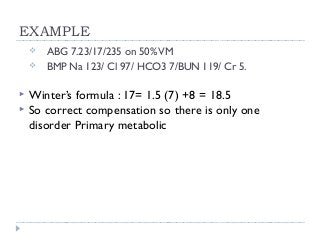
EXAMPLE 
 ABG 7.23/17/235 on 50% VM 
 BMP Na 123/ Cl 97/ HCO3 7/BUN 119/ Cr 5. 
 Winter’s formula : 17= 1.5 (7) +8 = 18.5 
 So correct compensation so there is only one 
disorder Primary metabolic
Steps for ABG analysis 
1. What is the pH? Acidemia or Alkalemia? 
2. What is the primary disorder present? 
3. Is there appropriate compensation? 
4. Is the compensation acute or chronic? 
5. Is there an anion gap? 
6. If there is a AG check the delta gap? 
7. What is the differential for the clinical processes?
Step 5: Calculate the anion gap 
 AG = Na – (Cl +HCO3 )(normal 12 ± 2) 
 AG corrected = AG + 2.5[4 – albumin] 
 If there is an anion Gap then calculate the 
Delta/delta gap (step 6). Only need to calculate 
delta gap (excess anion gap) when there is an anion 
gap to determine additional hidden metabolic 
disorders (nongap metabolic acidosis or metabolic 
alkalosis) 
 If there is no anion gap then start analyzing for 
non-anion acidosis
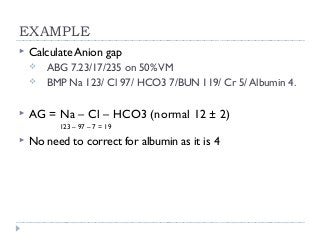
EXAMPLE 
 Calculate Anion gap 
 ABG 7.23/17/235 on 50% VM 
 BMP Na 123/ Cl 97/ HCO3 7/BUN 119/ Cr 5/ Albumin 4. 
 AG = Na – Cl – HCO3 (normal 12 ± 2) 
123 – 97 – 7 = 19 
 No need to correct for albumin as it is 4
Steps for ABG analysis 
1. What is the pH? Acidemia or Alkalemia? 
2. What is the primary disorder present? 
3. Is there appropriate compensation? 
4. Is the compensation acute or chronic? 
5. Is there an anion gap? 
6. If there is a AG check the delta /delta? 
7. What is the differential for the clinical processes?
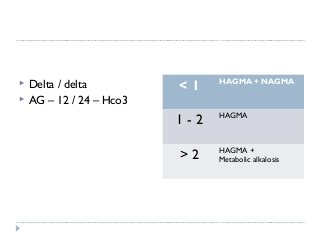
 Delta / delta 
 AG – 12 / 24 – Hco3 
< 1 HAGMA + NAGMA 
1 - 2 HAGMA 
> 2 HAGMA + 
Metabolic alkalosis
Steps for ABG analysis 
1. What is the pH? Acidemia or Alkalemia? 
2. What is the primary disorder present? 
3. Is there appropriate compensation? 
4. Is the compensation acute or chronic? 
5. Is there an anion gap? 
6. If there is a AG check the delta gap? 
7. What is the differential for the clinical 
processes?
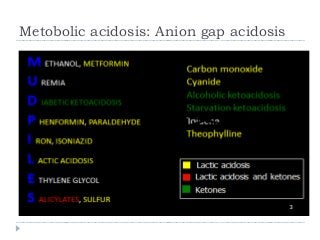
Metobolic acidosis: Anion gap acidosis
yes
EXAMPLE: WHY ANION GAP? 
 65yo M with CKD presenting with nausea, diarrhea and acute 
respiratory distress 
 ABG :ABG 7.23/17/235 on 50% VM 
 BMP Na 123/ Cl 97/ HCO3 7/BUN 119/ Cr 5.1 
 So for our patient for anion gap portion its due to BUN 
of 119 UREMIA 
 But would still check lactic acid
Nongap metabolic acidosis 
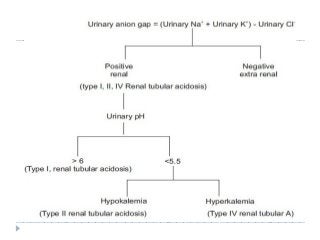
For non-gap metabolic acidosis, calculate the urine anion gap 
UAG = UNA + UK – UCL 
If UAG>0: renal problem 
If UAG<0: nonrenal problem (most commonly GI) 
Causes of nongap metabolic acidosis - DURHAM 
Diarrhea, ileostomy, colostomy, enteric fistulas 
Ureteral diversions or pancreatic fistulas 
RTA type I or IV, early renal failure 
Hyperailmentation, hydrochloric acid administration 
Acetazolamide, Addison’s 
Miscellaneous – post-hypocapnia, toulene, sevelamer, cholestyramine ingestion
EXAMPLE : NON ANION GAP ACIDOSIS 
 65yo M with CKD presenting with nausea, diarrhea and acute 
respiratory distress 
 ABG :ABG 7.23/17/235 on 50% VM 
 BMP Na 123/ Cl 97/ HCO3 7/BUN 119/ Cr 5.1 
 Most likely due to the diarrhea
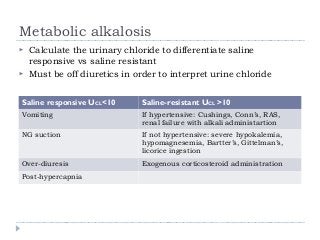
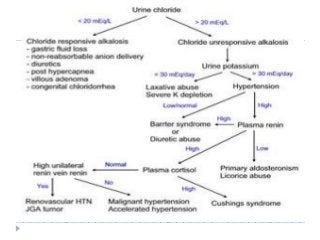
Metabolic alkalosis 
 Calculate the urinary chloride to differentiate saline 
responsive vs saline resistant 
 Must be off diuretics in order to interpret urine chloride 
Saline responsive UCL<10 Saline-resistant UCL >10 
Vomiting If hypertensive: Cushings, Conn’s, RAS, 
renal failure with alkali administartion 
NG suction If not hypertensive: severe hypokalemia, 
hypomagnesemia, Bartter’s, Gittelman’s, 
licorice ingestion 
Over-diuresis Exogenous corticosteroid administration 
Post-hypercapnia
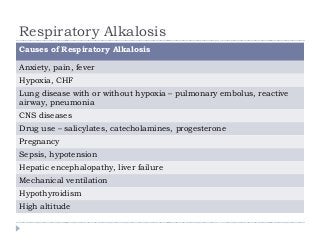
Respiratory Alkalosis 
Causes of Respiratory Alkalosis 
Anxiety, pain, fever 
Hypoxia, CHF 
Lung disease with or without hypoxia – pulmonary embolus, reactive 
airway, pneumonia 
CNS diseases 
Drug use – salicylates, catecholamines, progesterone 
Pregnancy 
Sepsis, hypotension 
Hepatic encephalopathy, liver failure 
Mechanical ventilation 
Hypothyroidism 
High altitude
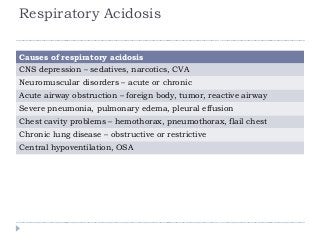
Respiratory Acidosis 
Causes of respiratory acidosis 
CNS depression – sedatives, narcotics, CVA 
Neuromuscular disorders – acute or chronic 
Acute airway obstruction – foreign body, tumor, reactive airway 
Severe pneumonia, pulmonary edema, pleural effusion 
Chest cavity problems – hemothorax, pneumothorax, flail chest 
Chronic lung disease – obstructive or restrictive 
Central hypoventilation, OSA
All together
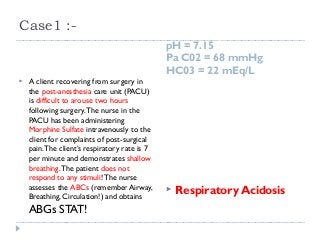
Case1 :- 
pH = 7.15 
Pa C02 = 68 mmHg 
HC03 = 22 mEq/L 
 A client recovering from surgery in 
the post-anesthesia care unit (PACU) 
is difficult to arouse two hours 
following surgery. The nurse in the 
PACU has been administering 
Morphine Sulfate intravenously to the 
client for complaints of post-surgical 
pain. The client’s respiratory rate is 7 
per minute and demonstrates shallow 
breathing. The patient does not 
respond to any stimuli! The nurse 
assesses the ABCs (remember Airway, 
Breathing, Circulation!) and obtains 
ABGs STAT! 
 Respiratory Acidosis
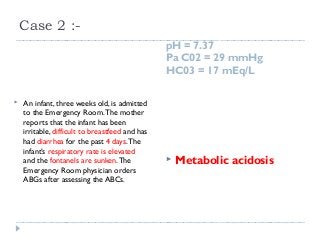
Case 2 :- 
pH = 7.37 
Pa C02 = 29 mmHg 
HC03 = 17 mEq/L 
 An infant, three weeks old, is admitted 
to the Emergency Room. The mother 
reports that the infant has been 
irritable, difficult to breastfeed and has 
had diarrhea for the past 4 days. The 
infant’s respiratory rate is elevated 
and the fontanels are sunken. The 
Emergency Room physician orders 
ABGs after assessing the ABCs. 
 Metabolic acidosis
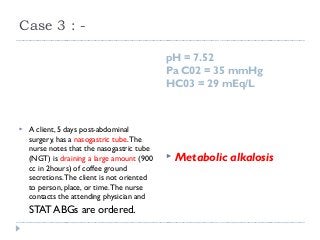
Case 3 : - 
pH = 7.52 
Pa C02 = 35 mmHg 
HC03 = 29 mEq/L 
 A client, 5 days post-abdominal 
surgery, has a nasogastric tube. The 
nurse notes that the nasogastric tube 
(NGT) is draining a large amount (900 
cc in 2hours) of coffee ground 
secretions. The client is not oriented 
to person, place, or time. The nurse 
contacts the attending physician and 
STAT ABGs are ordered. 
 Metabolic alkalosis
Case 4 :- 
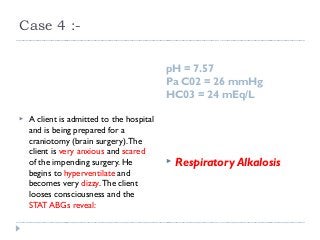
pH = 7.57 
Pa C02 = 26 mmHg 
HC03 = 24 mEq/L 
 A client is admitted to the hospital 
and is being prepared for a 
craniotomy (brain surgery). The 
client is very anxious and scared 
of the impending surgery. He 
begins to hyperventilate and 
becomes very dizzy. The client 
looses consciousness and the 
STAT ABGs reveal: 
 Respiratory Alkalosis
Case 5 :- 
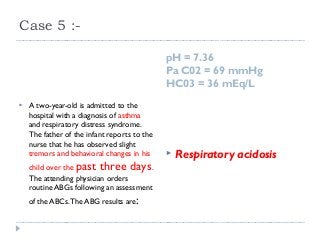
pH = 7.36 
Pa C02 = 69 mmHg 
HC03 = 36 mEq/L 
 A two-year-old is admitted to the 
hospital with a diagnosis of asthma 
and respiratory distress syndrome. 
The father of the infant reports to the 
nurse that he has observed slight 
tremors and behavioral changes in his 
child over the past three days. 
The attending physician orders 
routine ABGs following an assessment 
of the ABCs. The ABG results are: 
 Respiratory acidosis
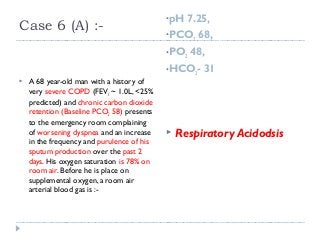
Case 6 (A) :- •pH 7.25, 
•PCO2 68, 
•PO2 48, 
•HCO3- 31 
 A 68 year-old man with a history of 
very severe COPD (FEV1 ~ 1.0L, <25% 
predicted) and chronic carbon dioxide 
retention (Baseline PCO2 58) presents 
to the emergency room complaining 
of worsening dyspnea and an increase 
in the frequency and purulence of his 
sputum production over the past 2 
days. His oxygen saturation is 78% on 
room air. Before he is place on 
supplemental oxygen, a room air 
arterial blood gas is :- 
 Respiratory Acidodsis
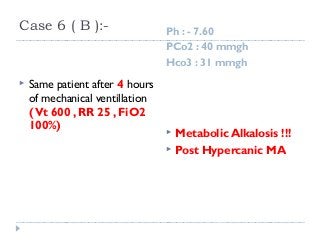
Case 6 ( B ):- Ph : - 7.60 
PCo2 : 40 mmgh 
Hco3 : 31 mmgh 
 Same patient after 4 hours 
of mechanical ventillation 
( Vt 600 , RR 25 , FiO2 
100%)  Metabolic Alkalosis !!! 
 Post Hypercanic MA
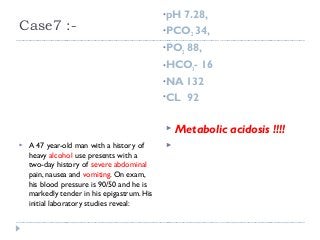
Case7 :- 
•pH 7.28, 
•PCO2 34, 
•PO2 88, 
•HCO3- 16 
•NA 132 
•CL 92 
 A 47 year-old man with a history of 
heavy alcohol use presents with a 
two-day history of severe abdominal 
pain, nausea and vomiting. On exam, 
his blood pressure is 90/50 and he is 
markedly tender in his epigastrum. His 
initial laboratory studies reveal: 
 Metabolic acidosis !!!! 

Thank YOU……….

ABG ptt

  • 1.
    Simplified approach for ABG analysis Dr.Hossam Elafify Assistant cosultanat intensivist KAMC
  • 2.
    Why PH isimportant ?
  • 3.
  • 4.
  • 5.
    What is yourmethod ?
  • 6.
    Our method willbe ……!!!!!!!
  • 7.
    P & P……. !!!!!!!!!!! Patient Paper
  • 8.
    Why the patientis important ? History S & S  Diabetic  CKD  Intoxication  Shock
  • 9.
    Why the patientis important ? History S & S  COPD  Opoid  After general anethesia 
  • 10.
    Why the patientis important ? History S & S  Vomiting  Diarrhia  Diuritics  Hypovolemic  hypokalemic 
  • 11.
    Why the patientis important ? History S & S  Pain  Fever  stress  Agitated  Early in athma  PE !!!
  • 12.
    Test your self…..????  45 y/o male patient with past history of repeated ICU admissions and mechanical ventilation  he is COPD patient and heavy smoker  NOW …. The patient in ER drowsy and very weak ?
  • 13.
     18 y/ofemale patient with past history of DM ( type I )  Missed 2 doses of her regular insulin  Admitted to the ER with decrease LOC , rapid deep breathing , vomiting ?
  • 15.
  • 16.
    What is thevalue of this paper?  A ………. Acid  B ………. Base  C ……... Contents of oxygen and Co2  D ……... Delivery of O2 & other oxygenation parameters  E …….... Electrolytes ( ?)  F ……… Fetal HB and other forms of abnormal HB  G ……... glucose  H ……... Hemoglobin  I ……… Inhaled CO  L ……... Lactate
  • 18.
    Steps for ABGanalysis 1. What is the pH? Acidemia or Alkalemia? 2. What is the primary disorder present? 3. Is there appropriate compensation? 4. Is the compensation acute or chronic? 5. Is there an anion gap? 6. If there is a AG check the delta gap? 7. What is the differential for the clinical processes?
  • 19.
    Normal Values VariableNormal Range pH 7.38 - 7.42 pCO2 38-42 Bicarbonate 22-26 Anion gap 10-14 Albumin 4
  • 20.
    Step 1: Look at the pH: is the blood acidemic or alkalemic?  EXAMPLE :  65yo M with CKD presenting with nausea, diarrhea and acute respiratory distress  ABG :ABG 7.23/17/235 on 50% VM  BMP Na 123/ Cl 97/ HCO3 7/BUN 119/ Cr 5.1  ACIDMEIA OR ALKALEMIA ????
  • 21.
    EXAMPLE ONE ABG 7.23/17/235 on 50% VM  BMP Na 123/ Cl 97/ HCO3 7/BUN 119/ Cr 5.1  Answer PH = 7.23 , HCO3 7  Acidemia
  • 22.
    Steps for ABGanalysis 1. What is the pH? Acidemia or Alkalemia? 2. What is the primary disorder present? 3. Is there appropriate compensation? 4. Is the compensation acute or chronic? 5. Is there an anion gap? 6. If there is a AG check the delta gap? 7. What is the differential for the clinical processes?
  • 23.
    Step 2: Whatis the primary disorder? What disorder is present? pH pCO2 or HCO3 Respiratory Acidosis pH low pCO2 high Metabolic Acidosis pH low HCO3 low Respiratory Alkalosis pH high pCO2 low Metabolic Alkalosis pH high HCO3 high
  • 24.
    EXAMPLE  ABG7.23/17/235 on 50% VM  BMP Na 123/ Cl 97/ HCO3 7/BUN 119/ Cr 5.  PH is low , CO2 is Low  PH and PCO2 are going in same directions then its most likely primary metabolic will check to see if there is a mixed disoder.
  • 25.
    Steps for ABGanalysis 1. What is the pH? Acidemia or Alkalemia? 2. What is the primary disorder present? 3. Is there appropriate compensation? 4. Is the compensation acute or chronic? 5. Is there an anion gap? 6. If there is a AG check the delta gap? 7. What is the differential for the clinical processes?
  • 26.
    Step 3-4: Isthere appropriate compensation? Is it chronic or acute?  Respiratory Acidosis  Acute: for every 10 increase in pCO2 -> HCO3 increases by 1 and there is a decrease of 0.08 in pH MEMORIZE  Chronic: for every 10 increase in pCO2 -> HCO3 increases by 4 and there is a decrease of 0.03 in pH  Respiratory Alkalosis  Acute: for every 10 decrease in pCO2 -> HCO3 decreases by 2 and there is a increase of 0.08 in PH MEMORIZE  Chronic: for every 10 decrease in pCO2 -> HCO3 decreases by 5 and there is a increase of 0.03 in PH
  • 27.
    Step 3-4: Isthere appropriate compensation? Is it acute or chronic ?  Metabolic Acidosis  Winter’s formula: pCO2 = 1.5[HCO3] + 8 ± 2 MEMORIZE  If serum pCO2 > expected pCO2 -> additional respiratory acidosis  Metabolic Alkalosis  pCO2 = 0.9 [HCO3] + 9  For every 10 increase in HCO3 -> pCO2 increases by 6
  • 28.
    EXAMPLE  ABG7.23/17/235 on 50% VM  BMP Na 123/ Cl 97/ HCO3 7/BUN 119/ Cr 5.  Winter’s formula : 17= 1.5 (7) +8 = 18.5  So correct compensation so there is only one disorder Primary metabolic
  • 29.
    Steps for ABGanalysis 1. What is the pH? Acidemia or Alkalemia? 2. What is the primary disorder present? 3. Is there appropriate compensation? 4. Is the compensation acute or chronic? 5. Is there an anion gap? 6. If there is a AG check the delta gap? 7. What is the differential for the clinical processes?
  • 30.
    Step 5: Calculatethe anion gap  AG = Na – (Cl +HCO3 )(normal 12 ± 2)  AG corrected = AG + 2.5[4 – albumin]  If there is an anion Gap then calculate the Delta/delta gap (step 6). Only need to calculate delta gap (excess anion gap) when there is an anion gap to determine additional hidden metabolic disorders (nongap metabolic acidosis or metabolic alkalosis)  If there is no anion gap then start analyzing for non-anion acidosis
  • 31.
    EXAMPLE  CalculateAnion gap  ABG 7.23/17/235 on 50% VM  BMP Na 123/ Cl 97/ HCO3 7/BUN 119/ Cr 5/ Albumin 4.  AG = Na – Cl – HCO3 (normal 12 ± 2) 123 – 97 – 7 = 19  No need to correct for albumin as it is 4
  • 32.
    Steps for ABGanalysis 1. What is the pH? Acidemia or Alkalemia? 2. What is the primary disorder present? 3. Is there appropriate compensation? 4. Is the compensation acute or chronic? 5. Is there an anion gap? 6. If there is a AG check the delta /delta? 7. What is the differential for the clinical processes?
  • 33.
     Delta /delta  AG – 12 / 24 – Hco3 < 1 HAGMA + NAGMA 1 - 2 HAGMA > 2 HAGMA + Metabolic alkalosis
  • 34.
    Steps for ABGanalysis 1. What is the pH? Acidemia or Alkalemia? 2. What is the primary disorder present? 3. Is there appropriate compensation? 4. Is the compensation acute or chronic? 5. Is there an anion gap? 6. If there is a AG check the delta gap? 7. What is the differential for the clinical processes?
  • 35.
  • 36.
  • 37.
    EXAMPLE: WHY ANIONGAP?  65yo M with CKD presenting with nausea, diarrhea and acute respiratory distress  ABG :ABG 7.23/17/235 on 50% VM  BMP Na 123/ Cl 97/ HCO3 7/BUN 119/ Cr 5.1  So for our patient for anion gap portion its due to BUN of 119 UREMIA  But would still check lactic acid
  • 38.
    Nongap metabolic acidosis For non-gap metabolic acidosis, calculate the urine anion gap UAG = UNA + UK – UCL If UAG>0: renal problem If UAG<0: nonrenal problem (most commonly GI) Causes of nongap metabolic acidosis - DURHAM Diarrhea, ileostomy, colostomy, enteric fistulas Ureteral diversions or pancreatic fistulas RTA type I or IV, early renal failure Hyperailmentation, hydrochloric acid administration Acetazolamide, Addison’s Miscellaneous – post-hypocapnia, toulene, sevelamer, cholestyramine ingestion
  • 40.
    EXAMPLE : NONANION GAP ACIDOSIS  65yo M with CKD presenting with nausea, diarrhea and acute respiratory distress  ABG :ABG 7.23/17/235 on 50% VM  BMP Na 123/ Cl 97/ HCO3 7/BUN 119/ Cr 5.1  Most likely due to the diarrhea
  • 41.
    Metabolic alkalosis Calculate the urinary chloride to differentiate saline responsive vs saline resistant  Must be off diuretics in order to interpret urine chloride Saline responsive UCL<10 Saline-resistant UCL >10 Vomiting If hypertensive: Cushings, Conn’s, RAS, renal failure with alkali administartion NG suction If not hypertensive: severe hypokalemia, hypomagnesemia, Bartter’s, Gittelman’s, licorice ingestion Over-diuresis Exogenous corticosteroid administration Post-hypercapnia
  • 43.
    Respiratory Alkalosis Causesof Respiratory Alkalosis Anxiety, pain, fever Hypoxia, CHF Lung disease with or without hypoxia – pulmonary embolus, reactive airway, pneumonia CNS diseases Drug use – salicylates, catecholamines, progesterone Pregnancy Sepsis, hypotension Hepatic encephalopathy, liver failure Mechanical ventilation Hypothyroidism High altitude
  • 44.
    Respiratory Acidosis Causesof respiratory acidosis CNS depression – sedatives, narcotics, CVA Neuromuscular disorders – acute or chronic Acute airway obstruction – foreign body, tumor, reactive airway Severe pneumonia, pulmonary edema, pleural effusion Chest cavity problems – hemothorax, pneumothorax, flail chest Chronic lung disease – obstructive or restrictive Central hypoventilation, OSA
  • 45.
  • 46.
    Case1 :- pH= 7.15 Pa C02 = 68 mmHg HC03 = 22 mEq/L  A client recovering from surgery in the post-anesthesia care unit (PACU) is difficult to arouse two hours following surgery. The nurse in the PACU has been administering Morphine Sulfate intravenously to the client for complaints of post-surgical pain. The client’s respiratory rate is 7 per minute and demonstrates shallow breathing. The patient does not respond to any stimuli! The nurse assesses the ABCs (remember Airway, Breathing, Circulation!) and obtains ABGs STAT!  Respiratory Acidosis
  • 47.
    Case 2 :- pH = 7.37 Pa C02 = 29 mmHg HC03 = 17 mEq/L  An infant, three weeks old, is admitted to the Emergency Room. The mother reports that the infant has been irritable, difficult to breastfeed and has had diarrhea for the past 4 days. The infant’s respiratory rate is elevated and the fontanels are sunken. The Emergency Room physician orders ABGs after assessing the ABCs.  Metabolic acidosis
  • 48.
    Case 3 :- pH = 7.52 Pa C02 = 35 mmHg HC03 = 29 mEq/L  A client, 5 days post-abdominal surgery, has a nasogastric tube. The nurse notes that the nasogastric tube (NGT) is draining a large amount (900 cc in 2hours) of coffee ground secretions. The client is not oriented to person, place, or time. The nurse contacts the attending physician and STAT ABGs are ordered.  Metabolic alkalosis
  • 49.
    Case 4 :- pH = 7.57 Pa C02 = 26 mmHg HC03 = 24 mEq/L  A client is admitted to the hospital and is being prepared for a craniotomy (brain surgery). The client is very anxious and scared of the impending surgery. He begins to hyperventilate and becomes very dizzy. The client looses consciousness and the STAT ABGs reveal:  Respiratory Alkalosis
  • 50.
    Case 5 :- pH = 7.36 Pa C02 = 69 mmHg HC03 = 36 mEq/L  A two-year-old is admitted to the hospital with a diagnosis of asthma and respiratory distress syndrome. The father of the infant reports to the nurse that he has observed slight tremors and behavioral changes in his child over the past three days. The attending physician orders routine ABGs following an assessment of the ABCs. The ABG results are:  Respiratory acidosis
  • 51.
    Case 6 (A):- •pH 7.25, •PCO2 68, •PO2 48, •HCO3- 31  A 68 year-old man with a history of very severe COPD (FEV1 ~ 1.0L, <25% predicted) and chronic carbon dioxide retention (Baseline PCO2 58) presents to the emergency room complaining of worsening dyspnea and an increase in the frequency and purulence of his sputum production over the past 2 days. His oxygen saturation is 78% on room air. Before he is place on supplemental oxygen, a room air arterial blood gas is :-  Respiratory Acidodsis
  • 52.
    Case 6 (B ):- Ph : - 7.60 PCo2 : 40 mmgh Hco3 : 31 mmgh  Same patient after 4 hours of mechanical ventillation ( Vt 600 , RR 25 , FiO2 100%)  Metabolic Alkalosis !!!  Post Hypercanic MA
  • 53.
    Case7 :- •pH7.28, •PCO2 34, •PO2 88, •HCO3- 16 •NA 132 •CL 92  A 47 year-old man with a history of heavy alcohol use presents with a two-day history of severe abdominal pain, nausea and vomiting. On exam, his blood pressure is 90/50 and he is markedly tender in his epigastrum. His initial laboratory studies reveal:  Metabolic acidosis !!!! 
  • 55.

Editor's Notes

  • #3 -Objective slide
  • #19 Just read the steps off the slides. Quick overview . Determine if you have acidemia or alkalemia based on the PH Here we determine primary disorder is it respiratory or metabolic Check to see if there is appropriate compensation for the primary disorder in order to figure if its simple or mixed disorder Then analyze if this is an acute event or chronic Always look to see if there is an anion gap Due the other calculation depending on the underlying primary source . Such as if AG acidosis check to see if there is also a Delta gap to see if there is also non-anion gap present And lastly then come up with a DDX
  • #20 Memorize these values . Just read off slides.
  • #23 Just read the steps off the slides. Quick overview . Determine if you have acidemia or alkalemia based on the PH Here we determine primary disorder is it respiratory or metabolic Check to see if there is appropriate compensation for the primary disorder in order to figure if its simple or mixed disorder Then analyze if this is an acute event or chronic Always look to see if there is an anion gap Due the other calculation depending on the underlying primary source . Such as if AG acidosis check to see if there is also a Delta gap to see if there is also non-anion gap present And lastly then come up with a DDX
  • #24 Just go over the table Then point out the arrows :A quick trick is to determine respiratory versus metabolic is : If PH and PCO2 are going in the opposite direction : then its respiratory, If PH and PCO2 are going in same directions then its metabolic. - Be careful with the mixed disorders using the trick.
  • #26 Just read the steps off the slides. Quick overview . Determine if you have acidemia or alkalemia based on the PH Here we determine primary disorder is it respiratory or metabolic Check to see if there is appropriate compensation for the primary disorder in order to figure if its simple or mixed disorder Then analyze if this is an acute event or chronic Always look to see if there is an anion gap Due the other calculation depending on the underlying primary source . Such as if AG acidosis check to see if there is also a Delta gap to see if there is also non-anion gap present And lastly then come up with a DDX
  • #27 You need to memorize these and know it by heart . Then quickly go over the changes Then summarize : The easiest one is that for acute situations for every change of 10 in the PCO2 there is should be a change of 0.08 in PH and in chronic situation there should be a change of 0.03 . - If there is a different change then know that there is most likely a mixed disorder
  • #28 Metabolic acidosis is the disorder you will mostly encounter in the hospital. You must memorize Winter’s formula Winter’s formula calculates the expected pCO2 in the setting of metabolic acidosis. If the serum pCO2 &amp;gt; expected pCO2 then there is additional respiratory acidosis in which the etiology needs to also be determined.
  • #30 Just read the steps off the slides. Quick overview . Determine if you have acidemia or alkalemia based on the PH Here we determine primary disorder is it respiratory or metabolic Check to see if there is appropriate compensation for the primary disorder in order to figure if its simple or mixed disorder Then analyze if this is an acute event or chronic Always look to see if there is an anion gap Due the other calculation depending on the underlying primary source . Such as if AG acidosis check to see if there is also a Delta gap to see if there is also non-anion gap present And lastly then come up with a DDX
  • #31 Always calculate the AG . (fyi most BMP ordered calculate the gap for you but need to memorize the formula) Don’t forget to look at albumin and adjust the calculated gap. If albumin is less than 4 then add 2.5 to your gap for every decrease of 1 Delta/Delta gap needs to be calculated to see if there is other underlying acidosis/alkolosis that are present
  • #33 Just read the steps off the slides. Quick overview . Determine if you have acidemia or alkalemia based on the PH Here we determine primary disorder is it respiratory or metabolic Check to see if there is appropriate compensation for the primary disorder in order to figure if its simple or mixed disorder Then analyze if this is an acute event or chronic Always look to see if there is an anion gap Due the other calculation depending on the underlying primary source . Such as if AG acidosis check to see if there is also a Delta gap to see if there is also non-anion gap present And lastly then come up with a DDX
  • #35 Just read the steps off the slides. Quick overview . Determine if you have acidemia or alkalemia based on the PH Here we determine primary disorder is it respiratory or metabolic Check to see if there is appropriate compensation for the primary disorder in order to figure if its simple or mixed disorder Then analyze if this is an acute event or chronic Always look to see if there is an anion gap Due the other calculation depending on the underlying primary source . Such as if AG acidosis check to see if there is also a Delta gap to see if there is also non-anion gap present And lastly then come up with a DDX
  • #36 Go over the table One thing to watch out for is Toluene (initially high gap, subsequent excretion of metabolites normalizes gap) Calculate osmol gap to determine if osmotically active ingestions (methanol, paraldehyde) are the cause of the gap metabolic acidosis. Other ingestions are toluene, isopropyl alcohol.
  • #39 - Go over the table - Most common cause in the hospital is IV fluids and Diarrhea
  • #42 For metabolic alkalosis , check urine cholride (must be off diuretics) Urine chloride &amp;lt; 10 implies responsivenss to saline : extracelluar fluid volume depletion Urine chloride &amp;gt;10 implies resistance to sailne : severe poatssium depletion , mineralcorticoid excees syndrome Etc
  • #44 Read the chart then summarize Can divide into three categories 1. systemic : (sepsis , asa , liver failure , endocrine , chf) 2. Central causes (respiratory center, ischmia , CNS tumor ) 3. Lungs (pna, asthma , PE )
  • #45 Respiratory acidosis . Read the chart. Can divide into three categories 1. Chest cavity (flail chest , pneumothorax Etc.) 2. Central causes (sedation , CVA etc) 3. Lungs (pna, asthma etc)