HOW
to optimize source control ?
Dr Hossam Afify
MD , PhD , SFCCM , EDIC
Adult critical care consultant ( KAMC , KSA)
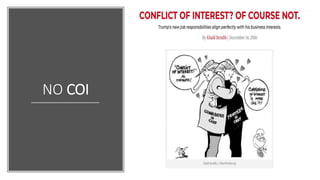
NO COI
Introduction
• there is consensus that antibiotic therapy and source control are the
major therapies for severe infections,
• source control has been consistently ignored by many studies, and its
exact role, particularly the timing and methodology used, remains
uncertain.
• Source control is receiving only limited attention in the first hour of
sepsis treatment, disproportional to its impact on outcome.
The objectives
• clarifing the importance of proper source control
• Understanding the proper ways by which we can control the sepsis
• Explaininig how is the team work and plan decrease mortality
• Finally , the role of point of care ultrasound ?
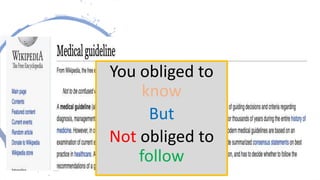
You obliged to
know
But
Not obliged to
follow
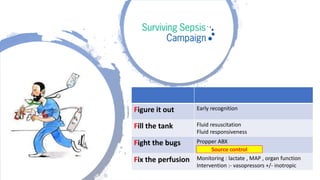
Figure it out Early recognition
Fill the tank Fluid resuscitation
Fluid responsiveness
Fight the bugs Propper ABX
Source control
Fix the perfusion Monitoring : lactate , MAP , organ function
Intervention :- vasopressors +/- inotropic
Source control
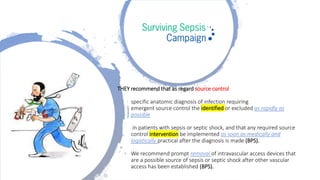
THEY recommend that as regard source control
specific anatomic diagnosis of infection requiring
emergent source control the identified or excluded as rapidly as
possible
in patients with sepsis or septic shock, and that any required source
control intervention be implemented as soon as medically and
logistically practical after the diagnosis is made (BPS).
We recommend prompt removal of intravascular access devices that
are a possible source of sepsis or septic shock after other vascular
access has been established (BPS).
Impact on survival
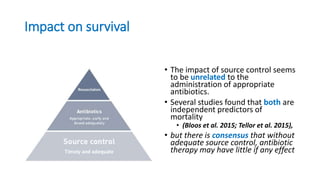
• The impact of source control seems
to be unrelated to the
administration of appropriate
antibiotics.
• Several studies found that both are
independent predictors of
mortality
• (Bloos et al. 2015; Tellor et al. 2015),
• but there is consensus that without
adequate source control, antibiotic
therapy may have little if any effect
Impact on survival
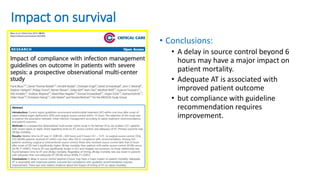
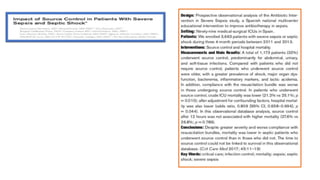
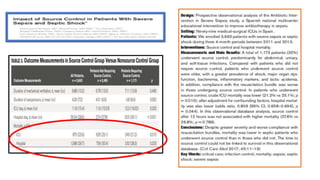
• Conclusions:
• A delay in source control beyond 6
hours may have a major impact on
patient mortality.
• Adequate AT is associated with
improved patient outcome
• but compliance with guideline
recommendation requires
improvement.
Impact on survival
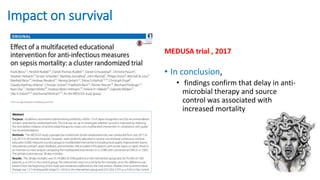
MEDUSA trial , 2017
• In conclusion,
• findings confirm that delay in anti-
microbial therapy and source
control was associated with
increased mortality
Who?
When?
How?
Infection
source
Source
control
Doctors
enemy
Who for
source control
?
How to
control this
source ?
When we
should
control this
source ?
Infection
source
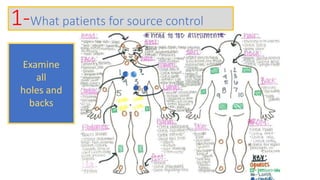
1-What patients for source control
Source of infection
Not amenable for
source control
measures
Meningitis
Sinusitis
Pneumonia
Infectious
diarrhea
Cellulitis
Amenable for source
control measures
Para-pnumonic
effusion
Acalcular
cholecystitis
Abscess
Git ischemia
and perforation
Pyelonephrit
is with
obstruction
Line
associated
infection
Examine
all
holes and
backs
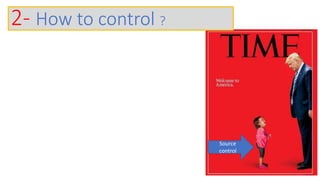
Source
control
2- How to control ?
2- How to control ?
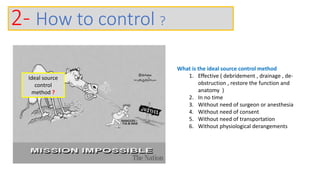
Ideal source
control
method ?
What is the ideal source control method
1. Effective ( debridement , drainage , de-
obstruction , restore the function and
anatomy )
2. In no time
3. Without need of surgeon or anesthesia
4. Without need of consent
5. Without need of transportation
6. Without physiological derangements
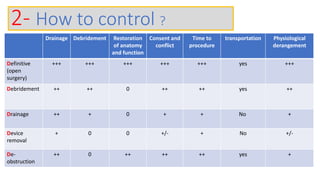
2- How to control ?
2- How to control ?
Drainage Debridement Restoration
of anatomy
and function
Consent and
conflict
Time to
procedure
transportation Physiological
derangement
Definitive
(open
surgery)
+++ +++ +++ +++ +++ yes +++
Debridement ++ ++ 0 ++ ++ yes ++
Drainage ++ + 0 + + No +
Device
removal
+ 0 0 +/- + No +/-
De-
obstruction
++ 0 ++ ++ ++ yes +
Doctors enemy
3- when we should control ?
• The SSC guidelines
• recommend controlling the
source of the infection as
soon as medically and
logistically practical after
the diagnosis is made
• with the suggestion to do so
within a 6-12-hour window
after diagnosis
Rhodes et al. 2017
3- when we should control ?
• whereas the English Royal
College of Surgeons
• recommends controlling
the source of the infection
within 6 hours in patients
with sepsis and immediately
in patients with septic shock
Royal College of Surgeons of
England 2011
3- when we should control ?
• The latest update of the
Surgical Infection Society
guideline on intra-abdominal
infections cites
• 24 hours as the window in
which the source needs to be
controlled,
• unless when patients have
sepsis or septic shock, when
the intervention needs to be
undertaken in a more urgent
manner
• (Mazuski et al. 2017).
3- when we should control ?
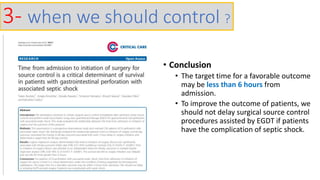
• Conclusion
• The target time for a favorable outcome
may be less than 6 hours from
admission.
• To improve the outcome of patients, we
should not delay surgical source control
procedures assisted by EGDT if patients
have the complication of septic shock.
3- when we should control ?
Delay in
source
control !!!!
Delay in source
control !!!!
• in 2017 there were 48.9 million cases and
11 million sepsis-related deaths
worldwide, which accounted for almost
20% of all global deaths
Analysis of the delay
Delay of the diagnosis
• Underestimate the sepsis
• No formal clinical assessment in
sepsis patients
• Reluctance to use the POCUS
• Use the improper diagnostic tool
• (ct abdomen without contrast to
r/o abdominal sepsis)
Correction
• Continuous education
• Formal local guideline for sepsis
management
• Optimize the use of POCUS
• Multi-discplinary approach
Analysis of the delay
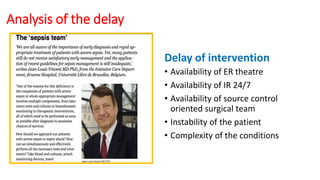
Delay of intervention
• Availability of ER theatre
• Availability of IR 24/7
• Availability of source control
oriented surgical team
• Instability of the patient
• Complexity of the conditions
Sepsis team
• The management of such patients in-
volves multiple elements, including
(tasks)
1. insertion of intravenous/arterial lines and
2. setting up of hemodynamic monitoring
systems,
3. blood sampling for cultures and laboratory
testing,
4. administration of antibiotics, fluid
resuscitation, and administration of
vasoactive agents for cardiovascular
support, all of which need to be started as
soon as possible
Sepsis team
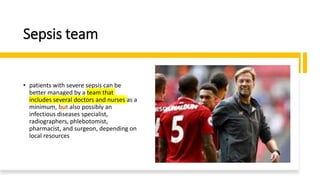
• patients with severe sepsis can be
better managed by a team that
includes several doctors and nurses as a
minimum, but also possibly an
infectious diseases specialist,
radiographers, phlebotomist,
pharmacist, and surgeon, depending on
local resources
Sepsis team
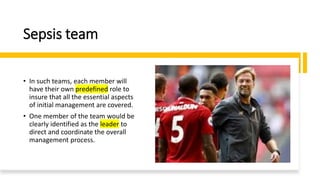
• In such teams, each member will
have their own predefined role to
insure that all the essential aspects
of initial management are covered.
• One member of the team would be
clearly identified as the leader to
direct and coordinate the overall
management process.
Sepsis team
• The ‘sepsis team’ should be available
24/7
Sepsis team
• dedicated ‘shock room’ rather than a mobile
sepsis team, which is
1. staffed permanently by a team of nurses and doc- tors
trained in shock management, including septic shock,
2. and is equipped with all the necessary monitoring
devices, intravascular lines and phlebotomy
equipment, a ventilator ready for use, and essential
intravenous solutions and drugs.
Not only the team but also the plan
Case Break
• 50 y leukemic patient on mechanical ventilation because HAP
• at 3:00 AM he developed new onset of hypotension , no clear source
of sepsis but his abdomen is markedly tense and tender
• however the adequate resuscitation and broad spectrum ABX he
remained refractory shocked and rising lactate
• Vasopressors + hydrocortisone started
• POCUS : free turbid Intra abdominal fluid , normal LV and RV size and
function
• One hour later he became anuric , hypothermic and HAGMA
• WHAT IS BEST MANAGMNT PLAN ?
Case
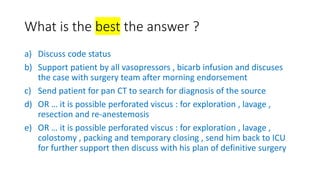
What is the best the answer ?
a) Discuss code status
b) Support patient by all vasopressors , bicarb infusion and discuses
the case with surgery team after morning endorsement
c) Send patient for pan CT to search for diagnosis of the source
d) OR … it is possible perforated viscus : for exploration , lavage ,
resection and re-anestemosis
e) OR … it is possible perforated viscus : for exploration , lavage ,
colostomy , packing and temporary closing , send him back to ICU
for further support then discuss with his plan of definitive surgery
Surg Clin North Am. 2012 Apr;92(2):243-57, viii. doi:
10.1016/j.suc.2012.01.006. Epub 2012 Jan 26
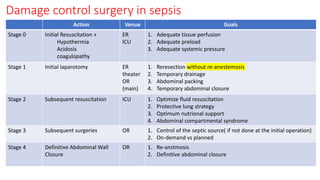
Damage control surgery in sepsis
Action Venue Goals
Stage 0 Initial Resuscitation +
Hypothermia
Acidosis
coagulopathy
ER
ICU
1. Adequate tissue perfusion
2. Adequate preload
3. Adequate systemic pressure
Stage 1 Initial laparotomy ER
theater
OR
(main)
1. Reresection without re-anestemosis
2. Temporary drainage
3. Abdominal packing
4. Temporary abdominal closure
Stage 2 Subsequent resuscitation ICU 1. Optimize fluid resuscitation
2. Protective lung strategy
3. Optimum nutrional support
4. Abdominal compartmental syndrome
Stage 3 Subsequent surgeries OR 1. Control of the septic source( if not done at the initial operation)
2. On-demand vs planned
Stage 4 Definitive Abdominal Wall
Closure
OR 1. Re-anstmosis
2. Definitive abdominal closure
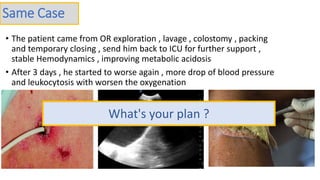
• The patient came from OR exploration , lavage , colostomy , packing
and temporary closing , send him back to ICU for further support ,
stable Hemodynamics , improving metabolic acidosis
• After 3 days , he started to worse again , more drop of blood pressure
and leukocytosis with worsen the oxygenation
Same Case
What's your plan ?
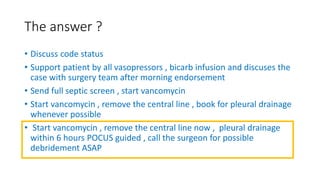
The answer ?
• Discuss code status
• Support patient by all vasopressors , bicarb infusion and discuses the
case with surgery team after morning endorsement
• Send full septic screen , start vancomycin
• Start vancomycin , remove the central line , book for pleural drainage
whenever possible
• Start vancomycin , remove the central line now , pleural drainage
within 6 hours POCUS guided , call the surgeon for possible
debridement ASAP
Role of
POCUS is
septic shock
Role of POCUS in sepsis
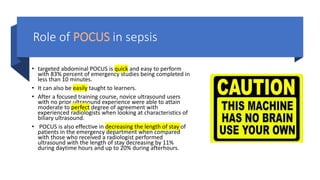
• targeted abdominal POCUS is quick and easy to perform
with 83% percent of emergency studies being completed in
less than 10 minutes.
• It can also be easily taught to learners.
• After a focused training course, novice ultrasound users
with no prior ultrasound experience were able to attain
moderate to perfect degree of agreement with
experienced radiologists when looking at characteristics of
biliary ultrasound.
• POCUS is also effective in decreasing the length of stay of
patients in the emergency department when compared
with those who received a radiologist performed
ultrasound with the length of stay decreasing by 11%
during daytime hours and up to 20% during afterhours.
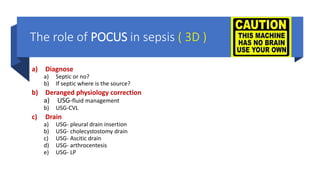
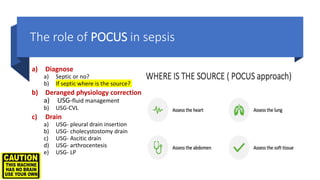
The role of POCUS in sepsis ( 3D )
a) Diagnose
a) Septic or no?
b) If septic where is the source?
b) Deranged physiology correction
a) USG-fluid management
b) USG-CVL
c) Drain
a) USG- pleural drain insertion
b) USG- cholecystostomy drain
c) USG- Ascitic drain
d) USG- arthrocentesis
e) USG- LP
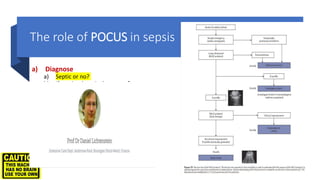
The role of POCUS in sepsis
a) Diagnose
a) Septic or no?
b) If septic where is the source?
b) Deranged physiology correction
a) USG-fluid management
b) USG-CVL
c) Drain
a) USG- pleural drain insertion
b) USG- cholecystostomy drain
c) USG- Ascitic drain
d) USG- arthrocentesis
e) USG- LP
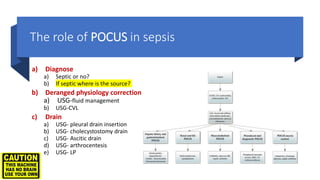
The role of POCUS in sepsis
a) Diagnose
a) Septic or no?
b) If septic where is the source?
b) Deranged physiology correction
a) USG-fluid management
b) USG-CVL
c) Drain
a) USG- pleural drain insertion
b) USG- cholecystostomy drain
c) USG- Ascitic drain
d) USG- arthrocentesis
e) USG- LP
The role of POCUS in sepsis
a) Diagnose
a) Septic or no?
b) If septic where is the source?
b) Deranged physiology correction
a) USG-fluid management
b) USG-CVL
c) Drain
a) USG- pleural drain insertion
b) USG- cholecystostomy drain
c) USG- Ascitic drain
d) USG- arthrocentesis
e) USG- LP
WHERE IS THE SOURCE ( POCUS approach)
Assess the heart Assess the lung
Assess the abdomen Assess the soft tissue
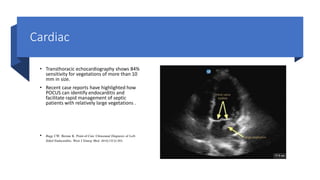
Cardiac
• Transthoracic echocardiography shows 84%
sensitivity for vegetations of more than 10
mm in size.
• Recent case reports have highlighted how
POCUS can identify endocarditis and
facilitate rapid management of septic
patients with relatively large vegetations .
• Bugg CW, Berona K. Point-of-Care Ultrasound Diagnosis of Left-
Sided Endocarditis. West J Emerg Med. 2016;17(3):383.
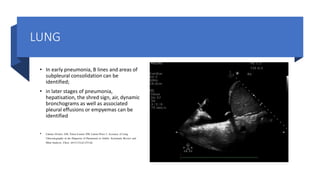
LUNG
• In early pneumonia, B lines and areas of
subpleural consolidation can be
identified;
• in later stages of pneumonia,
hepatisation, the shred sign, air, dynamic
bronchograms as well as associated
pleural effusions or empyemas can be
identified
• Llamas-Alvarez AM, Tenza-Lozano EM, Latour-Perez J. Accuracy of Lung
Ultrasonography in the Diagnosis of Pneumonia in Adults: Systematic Review and
Meta-Analysis. Chest. 2017;151(2):374-82.
Abodomen
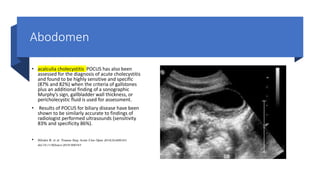
• acalculia cholecystitis POCUS has also been
assessed for the diagnosis of acute cholecystitis
and found to be highly sensitive and specific
(87% and 82%) when the criteria of gallstones
plus an additional finding of a sonographic
Murphy’s sign, gallbladder wall thickness, or
pericholecystic fluid is used for assessment.
• Results of POCUS for biliary disease have been
shown to be similarly accurate to findings of
radiologist performed ultrasounds (sensitivity
83% and specificity 86%).
• Hilsden R, et al. Trauma Surg Acute Care Open 2018;3:e000164.
doi:10.1136/tsaco-2018-000164
Abodomen
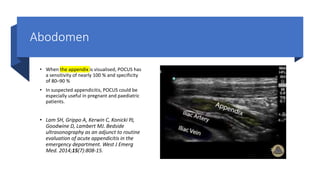
• When the appendix is visualised, POCUS has
a sensitivity of nearly 100 % and specificity
of 80–90 %
• In suspected appendicitis, POCUS could be
especially useful in pregnant and paediatric
patients.
• Lam SH, Grippo A, Kerwin C, Konicki PJ,
Goodwine D, Lambert MJ. Bedside
ultrasonography as an adjunct to routine
evaluation of acute appendicitis in the
emergency department. West J Emerg
Med. 2014;15(7):808-15.
Abodomen
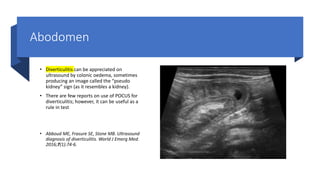
• Diverticulitis can be appreciated on
ultrasound by colonic oedema, sometimes
producing an image called the “pseudo
kidney” sign (as it resembles a kidney).
• There are few reports on use of POCUS for
diverticulitis; however, it can be useful as a
rule in test
• Abboud ME, Frasure SE, Stone MB. Ultrasound
diagnosis of diverticulitis. World J Emerg Med.
2016;7(1):74-6.
Abodomen
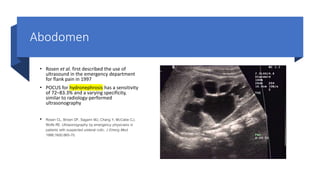
• Rosen et al. first described the use of
ultrasound in the emergency department
for flank pain in 1997
• POCUS for hydronephrosis has a sensitivity
of 72–83.3% and a varying specificity,
similar to radiology-performed
ultrasonography
• Rosen CL, Brown DF, Sagarin MJ, Chang Y, McCabe CJ,
Wolfe RE. Ultrasonography by emergency physicians in
patients with suspected ureteral colic. J Emerg Med.
1998;16(6):865-70.
Soft tissue infection
• Musculoskeletal POCUS is the next step, especially if no obvious source of
infection has yet been identified.
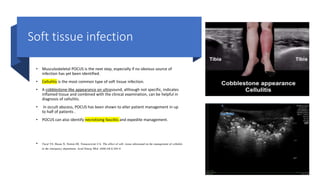
• Cellulitis is the most common type of soft tissue infection.
• A cobblestone-like appearance on ultrasound, although not specific, indicates
inflamed tissue and combined with the clinical examination, can be helpful in
diagnosis of cellulitis.
• In occult abscess, POCUS has been shown to alter patient management in up
to half of patients .
• POCUS can also identify necrotising fasciitis and expedite management.
• Tayal VS, Hasan N, Norton HJ, Tomaszewski CA. The effect of soft- tissue ultrasound on the management of cellulitis
in the emergency department. Acad Emerg Med. 2006;13(4):384-8
Take Home Messages
THM
•Patient assessment
•Players
•Plan
•POCUS
•Policy and protocol
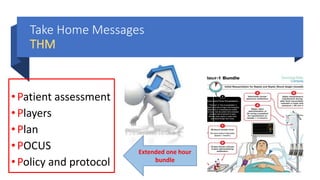
Extended one hour
bundle
Any Question
THANK YOU

sepsis Source control

  • 1.
    HOW to optimize sourcecontrol ? Dr Hossam Afify MD , PhD , SFCCM , EDIC Adult critical care consultant ( KAMC , KSA)
  • 2.
  • 3.
    Introduction • there isconsensus that antibiotic therapy and source control are the major therapies for severe infections, • source control has been consistently ignored by many studies, and its exact role, particularly the timing and methodology used, remains uncertain. • Source control is receiving only limited attention in the first hour of sepsis treatment, disproportional to its impact on outcome.
  • 4.
    The objectives • clarifingthe importance of proper source control • Understanding the proper ways by which we can control the sepsis • Explaininig how is the team work and plan decrease mortality • Finally , the role of point of care ultrasound ?
  • 5.
    You obliged to know But Notobliged to follow
  • 9.
    Figure it outEarly recognition Fill the tank Fluid resuscitation Fluid responsiveness Fight the bugs Propper ABX Source control Fix the perfusion Monitoring : lactate , MAP , organ function Intervention :- vasopressors +/- inotropic Source control
  • 10.
    THEY recommend thatas regard source control specific anatomic diagnosis of infection requiring emergent source control the identified or excluded as rapidly as possible in patients with sepsis or septic shock, and that any required source control intervention be implemented as soon as medically and logistically practical after the diagnosis is made (BPS). We recommend prompt removal of intravascular access devices that are a possible source of sepsis or septic shock after other vascular access has been established (BPS).
  • 11.
    Impact on survival •The impact of source control seems to be unrelated to the administration of appropriate antibiotics. • Several studies found that both are independent predictors of mortality • (Bloos et al. 2015; Tellor et al. 2015), • but there is consensus that without adequate source control, antibiotic therapy may have little if any effect
  • 12.
    Impact on survival •Conclusions: • A delay in source control beyond 6 hours may have a major impact on patient mortality. • Adequate AT is associated with improved patient outcome • but compliance with guideline recommendation requires improvement.
  • 13.
    Impact on survival MEDUSAtrial , 2017 • In conclusion, • findings confirm that delay in anti- microbial therapy and source control was associated with increased mortality
  • 16.
  • 17.
    Infection source Source control Doctors enemy Who for source control ? Howto control this source ? When we should control this source ?
  • 18.
  • 19.
    1-What patients forsource control Source of infection Not amenable for source control measures Meningitis Sinusitis Pneumonia Infectious diarrhea Cellulitis Amenable for source control measures Para-pnumonic effusion Acalcular cholecystitis Abscess Git ischemia and perforation Pyelonephrit is with obstruction Line associated infection Examine all holes and backs
  • 20.
  • 21.
    2- How tocontrol ? Ideal source control method ? What is the ideal source control method 1. Effective ( debridement , drainage , de- obstruction , restore the function and anatomy ) 2. In no time 3. Without need of surgeon or anesthesia 4. Without need of consent 5. Without need of transportation 6. Without physiological derangements
  • 22.
    2- How tocontrol ?
  • 23.
    2- How tocontrol ? Drainage Debridement Restoration of anatomy and function Consent and conflict Time to procedure transportation Physiological derangement Definitive (open surgery) +++ +++ +++ +++ +++ yes +++ Debridement ++ ++ 0 ++ ++ yes ++ Drainage ++ + 0 + + No + Device removal + 0 0 +/- + No +/- De- obstruction ++ 0 ++ ++ ++ yes +
  • 24.
    Doctors enemy 3- whenwe should control ?
  • 25.
    • The SSCguidelines • recommend controlling the source of the infection as soon as medically and logistically practical after the diagnosis is made • with the suggestion to do so within a 6-12-hour window after diagnosis Rhodes et al. 2017 3- when we should control ?
  • 26.
    • whereas theEnglish Royal College of Surgeons • recommends controlling the source of the infection within 6 hours in patients with sepsis and immediately in patients with septic shock Royal College of Surgeons of England 2011 3- when we should control ?
  • 27.
    • The latestupdate of the Surgical Infection Society guideline on intra-abdominal infections cites • 24 hours as the window in which the source needs to be controlled, • unless when patients have sepsis or septic shock, when the intervention needs to be undertaken in a more urgent manner • (Mazuski et al. 2017). 3- when we should control ?
  • 28.
    • Conclusion • Thetarget time for a favorable outcome may be less than 6 hours from admission. • To improve the outcome of patients, we should not delay surgical source control procedures assisted by EGDT if patients have the complication of septic shock. 3- when we should control ?
  • 29.
  • 30.
    Delay in source control!!!! • in 2017 there were 48.9 million cases and 11 million sepsis-related deaths worldwide, which accounted for almost 20% of all global deaths
  • 32.
    Analysis of thedelay Delay of the diagnosis • Underestimate the sepsis • No formal clinical assessment in sepsis patients • Reluctance to use the POCUS • Use the improper diagnostic tool • (ct abdomen without contrast to r/o abdominal sepsis) Correction • Continuous education • Formal local guideline for sepsis management • Optimize the use of POCUS • Multi-discplinary approach
  • 33.
    Analysis of thedelay Delay of intervention • Availability of ER theatre • Availability of IR 24/7 • Availability of source control oriented surgical team • Instability of the patient • Complexity of the conditions
  • 34.
    Sepsis team • Themanagement of such patients in- volves multiple elements, including (tasks) 1. insertion of intravenous/arterial lines and 2. setting up of hemodynamic monitoring systems, 3. blood sampling for cultures and laboratory testing, 4. administration of antibiotics, fluid resuscitation, and administration of vasoactive agents for cardiovascular support, all of which need to be started as soon as possible
  • 35.
    Sepsis team • patientswith severe sepsis can be better managed by a team that includes several doctors and nurses as a minimum, but also possibly an infectious diseases specialist, radiographers, phlebotomist, pharmacist, and surgeon, depending on local resources
  • 36.
    Sepsis team • Insuch teams, each member will have their own predefined role to insure that all the essential aspects of initial management are covered. • One member of the team would be clearly identified as the leader to direct and coordinate the overall management process.
  • 37.
    Sepsis team • The‘sepsis team’ should be available 24/7
  • 38.
    Sepsis team • dedicated‘shock room’ rather than a mobile sepsis team, which is 1. staffed permanently by a team of nurses and doc- tors trained in shock management, including septic shock, 2. and is equipped with all the necessary monitoring devices, intravascular lines and phlebotomy equipment, a ventilator ready for use, and essential intravenous solutions and drugs.
  • 39.
    Not only theteam but also the plan
  • 40.
  • 41.
    • 50 yleukemic patient on mechanical ventilation because HAP • at 3:00 AM he developed new onset of hypotension , no clear source of sepsis but his abdomen is markedly tense and tender • however the adequate resuscitation and broad spectrum ABX he remained refractory shocked and rising lactate • Vasopressors + hydrocortisone started • POCUS : free turbid Intra abdominal fluid , normal LV and RV size and function • One hour later he became anuric , hypothermic and HAGMA • WHAT IS BEST MANAGMNT PLAN ? Case
  • 42.
    What is thebest the answer ? a) Discuss code status b) Support patient by all vasopressors , bicarb infusion and discuses the case with surgery team after morning endorsement c) Send patient for pan CT to search for diagnosis of the source d) OR … it is possible perforated viscus : for exploration , lavage , resection and re-anestemosis e) OR … it is possible perforated viscus : for exploration , lavage , colostomy , packing and temporary closing , send him back to ICU for further support then discuss with his plan of definitive surgery
  • 43.
    Surg Clin NorthAm. 2012 Apr;92(2):243-57, viii. doi: 10.1016/j.suc.2012.01.006. Epub 2012 Jan 26
  • 44.
    Damage control surgeryin sepsis Action Venue Goals Stage 0 Initial Resuscitation + Hypothermia Acidosis coagulopathy ER ICU 1. Adequate tissue perfusion 2. Adequate preload 3. Adequate systemic pressure Stage 1 Initial laparotomy ER theater OR (main) 1. Reresection without re-anestemosis 2. Temporary drainage 3. Abdominal packing 4. Temporary abdominal closure Stage 2 Subsequent resuscitation ICU 1. Optimize fluid resuscitation 2. Protective lung strategy 3. Optimum nutrional support 4. Abdominal compartmental syndrome Stage 3 Subsequent surgeries OR 1. Control of the septic source( if not done at the initial operation) 2. On-demand vs planned Stage 4 Definitive Abdominal Wall Closure OR 1. Re-anstmosis 2. Definitive abdominal closure
  • 45.
    • The patientcame from OR exploration , lavage , colostomy , packing and temporary closing , send him back to ICU for further support , stable Hemodynamics , improving metabolic acidosis • After 3 days , he started to worse again , more drop of blood pressure and leukocytosis with worsen the oxygenation Same Case What's your plan ?
  • 46.
    The answer ? •Discuss code status • Support patient by all vasopressors , bicarb infusion and discuses the case with surgery team after morning endorsement • Send full septic screen , start vancomycin • Start vancomycin , remove the central line , book for pleural drainage whenever possible • Start vancomycin , remove the central line now , pleural drainage within 6 hours POCUS guided , call the surgeon for possible debridement ASAP
  • 47.
  • 48.
    Role of POCUSin sepsis • targeted abdominal POCUS is quick and easy to perform with 83% percent of emergency studies being completed in less than 10 minutes. • It can also be easily taught to learners. • After a focused training course, novice ultrasound users with no prior ultrasound experience were able to attain moderate to perfect degree of agreement with experienced radiologists when looking at characteristics of biliary ultrasound. • POCUS is also effective in decreasing the length of stay of patients in the emergency department when compared with those who received a radiologist performed ultrasound with the length of stay decreasing by 11% during daytime hours and up to 20% during afterhours.
  • 49.
    The role ofPOCUS in sepsis ( 3D ) a) Diagnose a) Septic or no? b) If septic where is the source? b) Deranged physiology correction a) USG-fluid management b) USG-CVL c) Drain a) USG- pleural drain insertion b) USG- cholecystostomy drain c) USG- Ascitic drain d) USG- arthrocentesis e) USG- LP
  • 50.
    The role ofPOCUS in sepsis a) Diagnose a) Septic or no? b) If septic where is the source? b) Deranged physiology correction a) USG-fluid management b) USG-CVL c) Drain a) USG- pleural drain insertion b) USG- cholecystostomy drain c) USG- Ascitic drain d) USG- arthrocentesis e) USG- LP
  • 51.
    The role ofPOCUS in sepsis a) Diagnose a) Septic or no? b) If septic where is the source? b) Deranged physiology correction a) USG-fluid management b) USG-CVL c) Drain a) USG- pleural drain insertion b) USG- cholecystostomy drain c) USG- Ascitic drain d) USG- arthrocentesis e) USG- LP
  • 52.
    The role ofPOCUS in sepsis a) Diagnose a) Septic or no? b) If septic where is the source? b) Deranged physiology correction a) USG-fluid management b) USG-CVL c) Drain a) USG- pleural drain insertion b) USG- cholecystostomy drain c) USG- Ascitic drain d) USG- arthrocentesis e) USG- LP
  • 53.
    WHERE IS THESOURCE ( POCUS approach) Assess the heart Assess the lung Assess the abdomen Assess the soft tissue
  • 54.
    Cardiac • Transthoracic echocardiographyshows 84% sensitivity for vegetations of more than 10 mm in size. • Recent case reports have highlighted how POCUS can identify endocarditis and facilitate rapid management of septic patients with relatively large vegetations . • Bugg CW, Berona K. Point-of-Care Ultrasound Diagnosis of Left- Sided Endocarditis. West J Emerg Med. 2016;17(3):383.
  • 55.
    LUNG • In earlypneumonia, B lines and areas of subpleural consolidation can be identified; • in later stages of pneumonia, hepatisation, the shred sign, air, dynamic bronchograms as well as associated pleural effusions or empyemas can be identified • Llamas-Alvarez AM, Tenza-Lozano EM, Latour-Perez J. Accuracy of Lung Ultrasonography in the Diagnosis of Pneumonia in Adults: Systematic Review and Meta-Analysis. Chest. 2017;151(2):374-82.
  • 56.
    Abodomen • acalculia cholecystitisPOCUS has also been assessed for the diagnosis of acute cholecystitis and found to be highly sensitive and specific (87% and 82%) when the criteria of gallstones plus an additional finding of a sonographic Murphy’s sign, gallbladder wall thickness, or pericholecystic fluid is used for assessment. • Results of POCUS for biliary disease have been shown to be similarly accurate to findings of radiologist performed ultrasounds (sensitivity 83% and specificity 86%). • Hilsden R, et al. Trauma Surg Acute Care Open 2018;3:e000164. doi:10.1136/tsaco-2018-000164
  • 57.
    Abodomen • When theappendix is visualised, POCUS has a sensitivity of nearly 100 % and specificity of 80–90 % • In suspected appendicitis, POCUS could be especially useful in pregnant and paediatric patients. • Lam SH, Grippo A, Kerwin C, Konicki PJ, Goodwine D, Lambert MJ. Bedside ultrasonography as an adjunct to routine evaluation of acute appendicitis in the emergency department. West J Emerg Med. 2014;15(7):808-15.
  • 58.
    Abodomen • Diverticulitis canbe appreciated on ultrasound by colonic oedema, sometimes producing an image called the “pseudo kidney” sign (as it resembles a kidney). • There are few reports on use of POCUS for diverticulitis; however, it can be useful as a rule in test • Abboud ME, Frasure SE, Stone MB. Ultrasound diagnosis of diverticulitis. World J Emerg Med. 2016;7(1):74-6.
  • 59.
    Abodomen • Rosen etal. first described the use of ultrasound in the emergency department for flank pain in 1997 • POCUS for hydronephrosis has a sensitivity of 72–83.3% and a varying specificity, similar to radiology-performed ultrasonography • Rosen CL, Brown DF, Sagarin MJ, Chang Y, McCabe CJ, Wolfe RE. Ultrasonography by emergency physicians in patients with suspected ureteral colic. J Emerg Med. 1998;16(6):865-70.
  • 60.
    Soft tissue infection •Musculoskeletal POCUS is the next step, especially if no obvious source of infection has yet been identified. • Cellulitis is the most common type of soft tissue infection. • A cobblestone-like appearance on ultrasound, although not specific, indicates inflamed tissue and combined with the clinical examination, can be helpful in diagnosis of cellulitis. • In occult abscess, POCUS has been shown to alter patient management in up to half of patients . • POCUS can also identify necrotising fasciitis and expedite management. • Tayal VS, Hasan N, Norton HJ, Tomaszewski CA. The effect of soft- tissue ultrasound on the management of cellulitis in the emergency department. Acad Emerg Med. 2006;13(4):384-8
  • 61.
    Take Home Messages THM •Patientassessment •Players •Plan •POCUS •Policy and protocol Extended one hour bundle
  • 62.
  • 63.

Editor's Notes

  • #34 Here, we can learn much from other fields of medicine. For example, severe trauma patients are now never (or very rarely) managed by single physicians, but rather by a team including, as a minimum several doctors and nurses, but which may also include anaesthesiologists, paramedics, radiographers, specialist surgeons, etc. Similarly, in-hospital patients who experience cardiorespiratory arrest will not be managed by one individual, but by a Crash or Code Team of personnel specially trained in resuscitation techniques and able to travel rapidly to the patient in need. Each member of the team has a specific role so that all aspects of management are covered. Importantly too, all necessary equipment is immediately available in a single mobile unit, the ‘Crash Cart’. In the same way, patients with severe sepsis should be managed by a ‘Sepsis Team’ comprising several physicians and nurses, and also possibly an infectious diseases specialist, radiographer, phlebotomist, etc. The Sepsis Team should be available 24/7 and responsible for stabilisation and early treatment of all patients with severe sepsis. Critically, one member of the team must be allocated as leader, to direct and drive ongoing management and ensure that all aspects of care are covered in the most efficient and effective way. Without a good Team Captain, the process risks becoming disorganised and chaotic with no clear instructions as to who should be doing what, when. In our hospital, rather than a mobile sepsis team, we have a dedicated ‘shock lab’, which treats all patients in the hospital or emergency department who develop shock, including septic shock. This unit is staffed by a team of nurses and doctors trained in shock management and equipped with all the necessary monitoring devices, a respirator on ‘stand-by’ mode, and intravenous solutions and drugs ready to use. Several studies have now demonstrated that sepsis teams can improve outcomes for patients with severe sepsis and we must encourage their development. By ensuring rapid initiation of all necessary treatments, specialised sepsis teams or units can effectively increase the chances of survival for patients with severe sepsis.   20.10.2011 More on the subject:emergency medicine (247)  ICU (199)  infections (476)  laboratory (826)  laws & regulations (341)  monitoring (276)  security (418)  sepsis (66)  therapy (636) I'm interested in more information …Read all latest stories Related articles The 31st ISICEM Jean-Louis Vincent, Chairman of the Dept of Intensive Care, Erasme Hospital, Université Libre de Bruxelles, welcomes visitors to this year’s International Symposium on Intensive Care and Emergency… #congresses #education #emergency medicine #ICU #infections #monitoring #security #sepsis Treating Ebola An isolation unit flying on 60-metre wings The ‘Robert Koch’ plane for medical evacuations (MedEvac) is the winged equivalent of a German hospital isolation ward. Within it, medics with viral haemorrhagic fever while working on the Ebola… #diagnostics #economy #emergency medicine #infections #laboratory #laws & regulations #therapy #virus Organisation and technology as factors of success in A&E Point of care technologies (POCT) have an important, quality enhancing, risk-reducing and cost-impacting role within the extremely time-critical medical decision structures of a central Accident and… #economy #emergency medicine #ICU #laboratory #medication #security #therapy #workflow Related products Infectious diseases testing Atlas Genetics - Atlas Genetics io system Atlas Genetics Ltd LIS, Middleware, POCT i-Solutions Health – LabCentre i-SOLUTIONS Health GmbH LIS, Middleware, POCT Medat – Laboratory Information System Medat Computer-Systeme GmbH Infectious Disease Siemens Healthineers – Fast Track Diagnostics Real-time PCR assays Siemens Healthineers LIS, Middleware, POCT Siemens Healthineers - syngo Lab Inventory Manager (sLIM) Siemens Healthineers Robotics Siemens Healthineers – VersaCell X3 Solution Siemens Healthineers Categories Diagnostic imaging Laboratory/pathology Treatment   Management Health IT Research General LabBook RadBook Manufacturer-Index   Media Kits Newsletter Contact   Facebook Twitter Vimeo   RSS-Feed Privacy policy Imprint Home Deutsch Latest News Diagnostic imaging Laboratory/pathology Treatment Management Health IT Research Manufacturer-Index European Hospital Publications LabBook RadBook Media Kits Events Newsletter Contact
  • #52 Protocols for Point-of-Care-Ultrasound (POCUS) in a Patient with Sepsis; An Algorithmic Approach Joaquín Valle Alonso1*, John Turpie1, Islam Farhad1, Gabrielle Ruffino1 Bull Emerg Trauma 2019;7(1):67-71.
  • #53 Protocols for Point-of-Care-Ultrasound (POCUS) in a Patient with Sepsis; An Algorithmic Approach Joaquín Valle Alonso1*, John Turpie1, Islam Farhad1, Gabrielle Ruffino1 Bull Emerg Trauma 2019;7(1):67-71.
  • #61 Mnemonic from Castleberg et al (2014): "STAFF" subcutaneous thickening air fascial fluid may help make this dx with us.