Allan M. Canonigo
http://love4mathed.com
PRINCIPLES OF HIGH
QUALITY ASSESSMENT
1. Clarity of learning targets
2. (knowledge, reasoning, skills, products, affects)
3. Appropriateness of Assessment Methods
4. Validity
5. Reliability
6. Fairness
7. Positive Consequences
8. Practicality and Efficiency
9. Ethics
PRINCIPLES OF HIGH QUALITY
ASSESSMENT
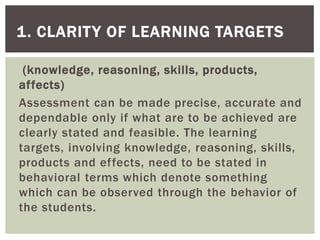
(knowledge, reasoning, skills, products,
affects)
Assessment can be made precise, accurate and
dependable only if what are to be achieved are
clearly stated and feasible. The learning
targets, involving knowledge, reasoning, skills,
products and effects, need to be stated in
behavioral terms which denote something
which can be observed through the behavior of
the students.
1. CLARITY OF LEARNING TARGETS
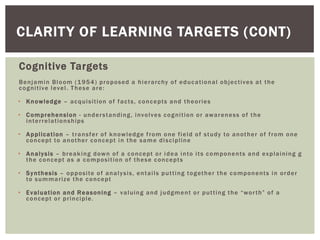
Cognitive Targets
Benjamin Bloom (1954) proposed a hierarchy of educational objectives at the
cognitive level. These are:
• Knowledge – acquisition of facts, concepts and theories
• Comprehension - understanding, involves cognition or awareness of the
interrelationships
• Application – transfer of knowledge from one field of study to another of from one
concept to another concept in the same discipline
• Analysis – breaking down of a concept or idea into its components and explaining g
the concept as a composition of these concepts
• Synthesis – opposite of analysis, entails putting together the components in order
to summarize the concept
• Evaluation and Reasoning – valuing and judgment or putting the “worth” of a
concept or principle.
CLARITY OF LEARNING TARGETS (CONT)
Skills, Competencies and Abilities Targets
 Skills – specific activities or tasks that a student can
proficiently do
 Competencies – cluster of skills
 Abilities – made up of relate competencies categorized as:
i. Cognitive
ii. Affective
iii. Psychomotor
Products, Outputs and Project Targets
- tangible and concrete evidence of a student’s ability
- need to clearly specify the level of workmanship of projects
i. expert
ii. skilled
iii. novice
CLARITY OF LEARNING TARGETS(CONT)
a. Written-Response Instruments
 Objective tests – appropriate for assessing the various levels
of hierarchy of educational objectives
 Essays – can test the students’ grasp of the higher level
cognitive skills
 Checklists – list of several characteristics or activities
presented to the subjects of a study, where they will analyze
and place a mark opposite to the characteristics.
2. APPROPRIATENESS OF ASSESSMENT
METHODS
b. Product Rating Scales
 Used to rate products like book reports, maps, charts,
diagrams, notebooks, creative endeavors
 Need to be developed to assess various products over the
years
c. Performance Tests - Performance checklist
 Consists of a list of behaviors that make up a certain type
of performance
 Used to determine whether or not an individual behaves
in a certain way when asked to complete a particular task
2. APPROPRIATENESS OF ASSESSMENT
METHODS
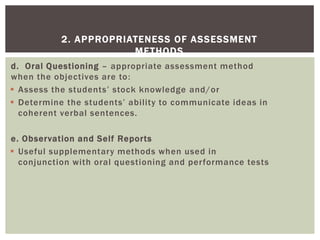
d. Oral Questioning – appropriate assessment method
when the objectives are to:
 Assess the students’ stock knowledge and/or
 Determine the students’ ability to communicate ideas in
coherent verbal sentences.
e. Observation and Self Reports
 Useful supplementary methods when used in
conjunction with oral questioning and performance tests
2. APPROPRIATENESS OF ASSESSMENT
METHODS
Validity
Reliability
Fairness
Positive Consequences
Practicality and Efficiency
Ethics
3. PROPERTIES OF ASSESSMENT METHODS
 Something valid is something fair.
 A valid test is one that measures what it
is supposed to measure.
Types of Validity
 Face: What do students think of the test?
 Construct: Am I testing in the way I
taught?
 Content: Am I testing what I taught?
 Criterion-related: How does this compare
with the existing valid test?
Tests can be made more valid by making
them more subjective (open items).
3. VALIDITY
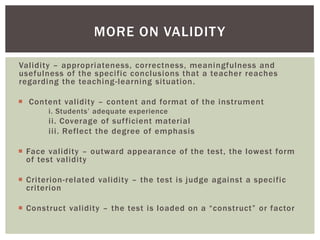
Validity – appropriateness, correctness, meaningfulness and
usefulness of the specific conclusions that a teacher reaches
regarding the teaching-learning situation.
 Content validity – content and format of the instrument
i. Students’ adequate experience
ii. Coverage of sufficient material
iii. Reflect the degree of emphasis
 Face validity – outward appearance of the test, the lowest form
of test validity
 Criterion-related validity – the test is judge against a specific
criterion
 Construct validity – the test is loaded on a “construct” or factor
MORE ON VALIDITY
 Something reliable is something that works well
and that you can trust.
 A reliable test is a consistent measure of what
it is supposed to measure.
Questions:
 Can we trust the results of the test?
 Would we get the same results if the tests were
taken again and scored by a different person?
Tests can be made more reliable by making
them more objective (controlled items).
RELIABILITY
Reliability is the extent to which
an experiment, test, or any
measuring procedure yields the
same result on repeated trials.
Equivalency reliability is the extent to
which two items measure identical
concepts at an identical level of
difficulty. Equivalency reliability is
determined by relating two sets of test
scores to one another to highlight the
degree of relationship or association.
Stability reliability (sometimes
called test, re-test reliability) is the
agreement of measuring
instruments over time. To determine
stability, a measure or test is
repeated on the same subjects at a
future date.
Internal consistency is the extent to
which tests or procedures assess the
same characteristic, skill or quality.
It is a measure of the precision
between the observers or of the
measuring instruments used in a
study.
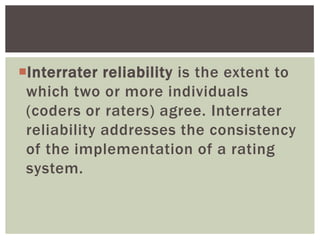
Interrater reliability is the extent to
which two or more individuals
(coders or raters) agree. Interrater
reliability addresses the consistency
of the implementation of a rating
system.
 Split-half method
 Calculated using the
i. Spearman-Brown prophecy formula
ii. Kuder-Richardson – KR 20 and KR21
 Consistency of test results when the same test is
administered at two different time periods
i. Test-retest method
ii. Correlating the two test results
RELIABILITY – CONSISTENCY, DEPENDABILITY,
STABILITY WHICH CAN BE ESTIMATED BY
The concept that assessment should be 'fair' covers a
number of aspects.
Student Knowledge and learning targets of
assessment
Opportunity to learn
Prerequisite knowledge and skills
Avoiding teacher stereotype
Avoiding bias in assessment tasks and
procedures
5. FAIRNESS
Learning assessments provide students with
effective feedback and potentially improve
their motivation and/or self-esteem. Moreover,
assessments of learning gives students the
tools to assess themselves and understand
how to improve.
- Positive consequence on students, teachers,
parents, and other stakeholders
6. POSITIVE CONSEQUENCES
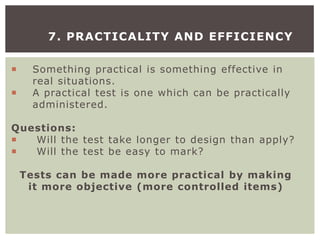
 Something practical is something effective in
real situations.
 A practical test is one which can be practically
administered.
Questions:
 Will the test take longer to design than apply?
 Will the test be easy to mark?
Tests can be made more practical by making
it more objective (more controlled items)
7. PRACTICALITY AND EFFICIENCY
 Teacher Familiarity with
the Method
 Time required
 Complexity of
Administration
 Ease of scoring
 Ease of Interpretation
 Cost
Teachers should be
familiar with the test,
- does not require too
much time
- implementable
The problem:
 The more reliable a test is, the less valid.
 The more valid a test is, the less reliable.
 The more practical a test is, (generally)
the less
valid.
The solution:
As in everything, we need a balance (in
both exams and exam items)
RELIABILITY, VALIDITY &
PRACTICALITY
Informed consent
Anonymity and Confidentiality
1. Gathering data
2. Recording Data
3. Reporting Data
8. ETHICS
 Conforming to the standards of conduct of a given
profession or group
 Ethical issues that may be raised
i. Possible harm to the participants.
ii. Confidentiality.
iii. Presence of concealment or deception.
iv. Temptation to assist students.
ETHICS IN ASSESSMENT – “RIGHT AND
WRONG”

Principlesofhighqualityassessment 121028212944-phpapp02 (1)

  • 1.
  • 2.
    1. Clarity oflearning targets 2. (knowledge, reasoning, skills, products, affects) 3. Appropriateness of Assessment Methods 4. Validity 5. Reliability 6. Fairness 7. Positive Consequences 8. Practicality and Efficiency 9. Ethics PRINCIPLES OF HIGH QUALITY ASSESSMENT
  • 3.
    (knowledge, reasoning, skills,products, affects) Assessment can be made precise, accurate and dependable only if what are to be achieved are clearly stated and feasible. The learning targets, involving knowledge, reasoning, skills, products and effects, need to be stated in behavioral terms which denote something which can be observed through the behavior of the students. 1. CLARITY OF LEARNING TARGETS
  • 4.
    Cognitive Targets Benjamin Bloom(1954) proposed a hierarchy of educational objectives at the cognitive level. These are: • Knowledge – acquisition of facts, concepts and theories • Comprehension - understanding, involves cognition or awareness of the interrelationships • Application – transfer of knowledge from one field of study to another of from one concept to another concept in the same discipline • Analysis – breaking down of a concept or idea into its components and explaining g the concept as a composition of these concepts • Synthesis – opposite of analysis, entails putting together the components in order to summarize the concept • Evaluation and Reasoning – valuing and judgment or putting the “worth” of a concept or principle. CLARITY OF LEARNING TARGETS (CONT)
  • 5.
    Skills, Competencies andAbilities Targets  Skills – specific activities or tasks that a student can proficiently do  Competencies – cluster of skills  Abilities – made up of relate competencies categorized as: i. Cognitive ii. Affective iii. Psychomotor Products, Outputs and Project Targets - tangible and concrete evidence of a student’s ability - need to clearly specify the level of workmanship of projects i. expert ii. skilled iii. novice CLARITY OF LEARNING TARGETS(CONT)
  • 6.
    a. Written-Response Instruments Objective tests – appropriate for assessing the various levels of hierarchy of educational objectives  Essays – can test the students’ grasp of the higher level cognitive skills  Checklists – list of several characteristics or activities presented to the subjects of a study, where they will analyze and place a mark opposite to the characteristics. 2. APPROPRIATENESS OF ASSESSMENT METHODS
  • 7.
    b. Product RatingScales  Used to rate products like book reports, maps, charts, diagrams, notebooks, creative endeavors  Need to be developed to assess various products over the years c. Performance Tests - Performance checklist  Consists of a list of behaviors that make up a certain type of performance  Used to determine whether or not an individual behaves in a certain way when asked to complete a particular task 2. APPROPRIATENESS OF ASSESSMENT METHODS
  • 8.
    d. Oral Questioning– appropriate assessment method when the objectives are to:  Assess the students’ stock knowledge and/or  Determine the students’ ability to communicate ideas in coherent verbal sentences. e. Observation and Self Reports  Useful supplementary methods when used in conjunction with oral questioning and performance tests 2. APPROPRIATENESS OF ASSESSMENT METHODS
  • 9.
    Validity Reliability Fairness Positive Consequences Practicality andEfficiency Ethics 3. PROPERTIES OF ASSESSMENT METHODS
  • 10.
     Something validis something fair.  A valid test is one that measures what it is supposed to measure. Types of Validity  Face: What do students think of the test?  Construct: Am I testing in the way I taught?  Content: Am I testing what I taught?  Criterion-related: How does this compare with the existing valid test? Tests can be made more valid by making them more subjective (open items). 3. VALIDITY
  • 11.
    Validity – appropriateness,correctness, meaningfulness and usefulness of the specific conclusions that a teacher reaches regarding the teaching-learning situation.  Content validity – content and format of the instrument i. Students’ adequate experience ii. Coverage of sufficient material iii. Reflect the degree of emphasis  Face validity – outward appearance of the test, the lowest form of test validity  Criterion-related validity – the test is judge against a specific criterion  Construct validity – the test is loaded on a “construct” or factor MORE ON VALIDITY
  • 12.
     Something reliableis something that works well and that you can trust.  A reliable test is a consistent measure of what it is supposed to measure. Questions:  Can we trust the results of the test?  Would we get the same results if the tests were taken again and scored by a different person? Tests can be made more reliable by making them more objective (controlled items). RELIABILITY
  • 13.
    Reliability is theextent to which an experiment, test, or any measuring procedure yields the same result on repeated trials.
  • 14.
    Equivalency reliability isthe extent to which two items measure identical concepts at an identical level of difficulty. Equivalency reliability is determined by relating two sets of test scores to one another to highlight the degree of relationship or association.
  • 15.
    Stability reliability (sometimes calledtest, re-test reliability) is the agreement of measuring instruments over time. To determine stability, a measure or test is repeated on the same subjects at a future date.
  • 16.
    Internal consistency isthe extent to which tests or procedures assess the same characteristic, skill or quality. It is a measure of the precision between the observers or of the measuring instruments used in a study.
  • 17.
    Interrater reliability isthe extent to which two or more individuals (coders or raters) agree. Interrater reliability addresses the consistency of the implementation of a rating system.
  • 18.
     Split-half method Calculated using the i. Spearman-Brown prophecy formula ii. Kuder-Richardson – KR 20 and KR21  Consistency of test results when the same test is administered at two different time periods i. Test-retest method ii. Correlating the two test results RELIABILITY – CONSISTENCY, DEPENDABILITY, STABILITY WHICH CAN BE ESTIMATED BY
  • 19.
    The concept thatassessment should be 'fair' covers a number of aspects. Student Knowledge and learning targets of assessment Opportunity to learn Prerequisite knowledge and skills Avoiding teacher stereotype Avoiding bias in assessment tasks and procedures 5. FAIRNESS
  • 20.
    Learning assessments providestudents with effective feedback and potentially improve their motivation and/or self-esteem. Moreover, assessments of learning gives students the tools to assess themselves and understand how to improve. - Positive consequence on students, teachers, parents, and other stakeholders 6. POSITIVE CONSEQUENCES
  • 21.
     Something practicalis something effective in real situations.  A practical test is one which can be practically administered. Questions:  Will the test take longer to design than apply?  Will the test be easy to mark? Tests can be made more practical by making it more objective (more controlled items) 7. PRACTICALITY AND EFFICIENCY
  • 22.
     Teacher Familiaritywith the Method  Time required  Complexity of Administration  Ease of scoring  Ease of Interpretation  Cost Teachers should be familiar with the test, - does not require too much time - implementable
  • 23.
    The problem:  Themore reliable a test is, the less valid.  The more valid a test is, the less reliable.  The more practical a test is, (generally) the less valid. The solution: As in everything, we need a balance (in both exams and exam items) RELIABILITY, VALIDITY & PRACTICALITY
  • 24.
    Informed consent Anonymity andConfidentiality 1. Gathering data 2. Recording Data 3. Reporting Data 8. ETHICS
  • 25.
     Conforming tothe standards of conduct of a given profession or group  Ethical issues that may be raised i. Possible harm to the participants. ii. Confidentiality. iii. Presence of concealment or deception. iv. Temptation to assist students. ETHICS IN ASSESSMENT – “RIGHT AND WRONG”