GST
(Goods and Services Tax)
Biggest Tax Reform Since Independence…..
Swapnil W Borekar
MBA ++
Department Of Management
Sci. (PUMBA)
GST
‘G’ – Goods
‘S’ – Services
‘T’ – Tax
 Goods and Service Tax (GST) is a comprehensive
tax levy on manufacture, sale and consumption
of goods and service at a national level.
 GST is a tax on goods and services with value
addition at each stage.
 GST will include many state and central level
indirect taxes
 It overcomes drawback present tax system
Tax Structure in India
 Direct Tax :
Incident and Impact at same point
e.g.: Income Tax, Corporate Tax, Wealth Tax
 Indirect Tax :
Incident Impact are at different point.
e.g.: Excise duty, custom duty, Service Tax, Octrai Tax,
VAT, CENVAT.
Method Of Taxation
 Progressive Tax :
Increasing rate of tax for Increasing Value or
Volume.
 Regressive Tax :
Decreasing rate tax for Increasing Value or
Volume
 Proportional Tax :
Fixed rate of tax for every level of income or
production
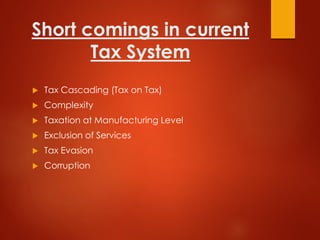
Short comings in current
Tax System
 Tax Cascading (Tax on Tax)
 Complexity
 Taxation at Manufacturing Level
 Exclusion of Services
 Tax Evasion
 Corruption
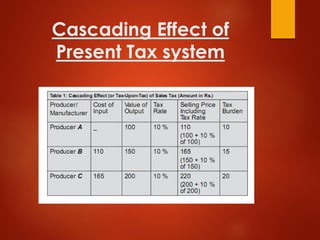
Cascading Effect of
Present Tax system
Reform In Tax System
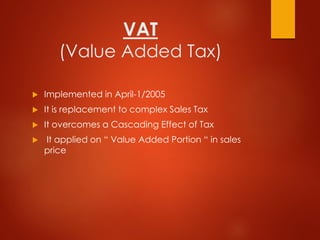
VAT
(Value Added Tax)
 Implemented in April-1/2005
 It is replacement to complex Sales Tax
 It overcomes a Cascading Effect of Tax
 It applied on “ Value Added Portion “ in sales
price
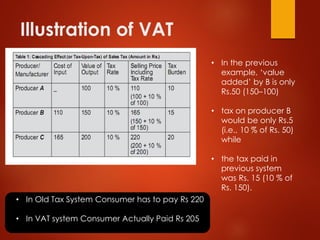
Illustration of VAT
• In the previous
example, ‘value
added’ by B is only
Rs.50 (150–100)
• tax on producer B
would be only Rs.5
(i.e., 10 % of Rs. 50)
while
• the tax paid in
previous system
was Rs. 15 (10 % of
Rs. 150).
• In Old Tax System Consumer has to pay Rs 220
• In VAT system Consumer Actually Paid Rs 205
Problems with VAT
 A major problem with VAT is the way it taxes
inputs and outputs.
 Input are taxed at 4 percent and outputs at 12.5
percent
 Some goods are included in both CENVAT and
VAT
 It is not uniform in nature
 VAT is different for different States
 number of exemptions for some sensitive
 different rates of taxation for different goods
What is GST
 GST is a comprehensive value added tax on goods and
services
 It is collected on value added at each stage of sale or
purchase in the supply chain
 No differentiation between Goods and Services as GST is
levied at each stage in the supply chain
 Seamless input tax credit throughout the supply chain
 At all stages of production and distribution, taxes are a
pass through and tax is borne by the final consumer
 All sectors are taxed with very few exceptions /
exemptions
History
 Feb, 2006 : First time introduced concept of GST
and announced the date of its implementation in
2010
 Jan. 2007: First GST study by ASSOCHAM released
by Dr. Shome
 Feb. 2007: F.M. Announced introduction of GST
from 1 April 2010 in Budget
 The Government came out with a First Discussion
Paper on GST in November, 2009
 Introduced the 115th Constitution Amendment
(GST) Bill in the year 2011.
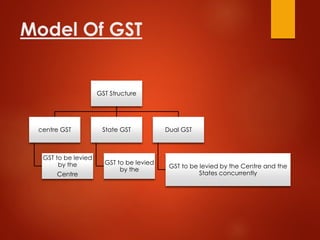
Model Of GST
GST Structure
centre GST
GST to be levied
by the
Centre
State GST
GST to be levied
by the
Dual GST
GST to be levied by the Centre and the
States concurrently
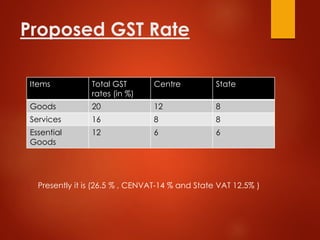
Proposed GST Rate
Items Total GST
rates (in %)
Centre State
Goods 20 12 8
Services 16 8 8
Essential
Goods
12 6 6
Presently it is (26.5 % , CENVAT-14 % and State VAT 12.5% )
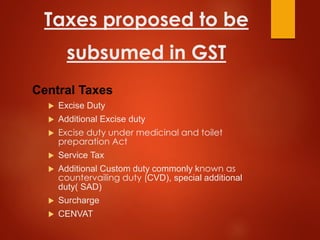
Taxes proposed to be
subsumed in GST
Central Taxes
 Excise Duty
 Additional Excise duty
 Excise duty under medicinal and toilet
preparation Act
 Service Tax
 Additional Custom duty commonly known as
countervailing duty (CVD), special additional
duty( SAD)
 Surcharge
 CENVAT
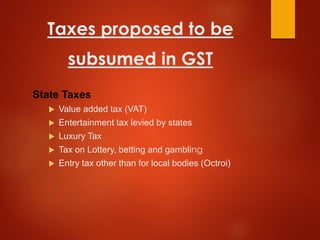
Taxes proposed to be
subsumed in GST
State Taxes
 Value added tax (VAT)
 Entertainment tax levied by states
 Luxury Tax
 Tax on Lottery, betting and gambling
 Entry tax other than for local bodies (Octroi)
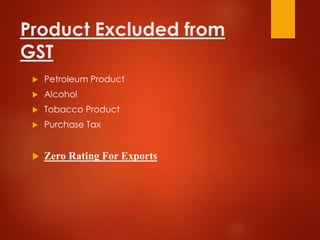
Product Excluded from
GST
 Petroleum Product
 Alcohol
 Tobacco Product
 Purchase Tax
 Zero Rating For Exports
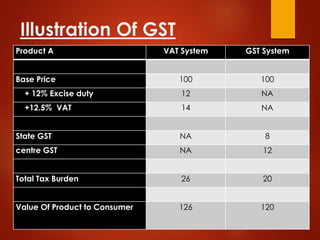
Illustration Of GST
Product A VAT System GST System
Base Price 100 100
+ 12% Excise duty 12 NA
+12.5% VAT 14 NA
State GST NA 8
centre GST NA 12
Total Tax Burden 26 20
Value Of Product to Consumer 126 120
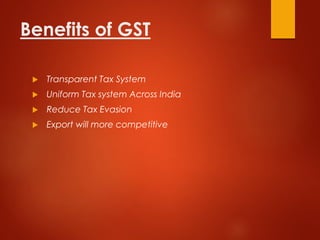
Benefits of GST
 Transparent Tax System
 Uniform Tax system Across India
 Reduce Tax Evasion
 Export will more competitive
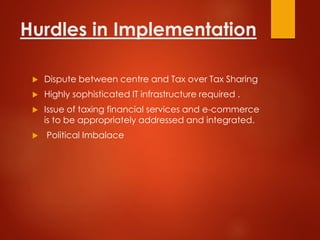
Hurdles in Implementation
 Dispute between centre and Tax over Tax Sharing
 Highly sophisticated IT infrastructure required .
 Issue of taxing financial services and e-commerce
is to be appropriately addressed and integrated.
 Political Imbalace
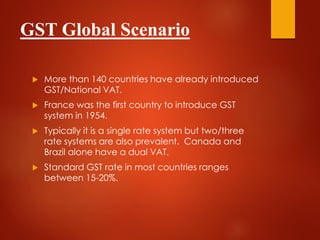
GST Global Scenario
 More than 140 countries have already introduced
GST/National VAT.
 France was the first country to introduce GST
system in 1954.
 Typically it is a single rate system but two/three
rate systems are also prevalent. Canada and
Brazil alone have a dual VAT.
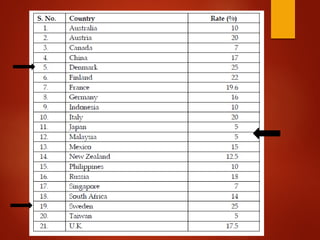
 Standard GST rate in most countries ranges
between 15-20%.
Thank You

GST INDIA

  • 1.
    GST (Goods and ServicesTax) Biggest Tax Reform Since Independence….. Swapnil W Borekar MBA ++ Department Of Management Sci. (PUMBA)
  • 2.
    GST ‘G’ – Goods ‘S’– Services ‘T’ – Tax  Goods and Service Tax (GST) is a comprehensive tax levy on manufacture, sale and consumption of goods and service at a national level.  GST is a tax on goods and services with value addition at each stage.  GST will include many state and central level indirect taxes  It overcomes drawback present tax system
  • 3.
    Tax Structure inIndia  Direct Tax : Incident and Impact at same point e.g.: Income Tax, Corporate Tax, Wealth Tax  Indirect Tax : Incident Impact are at different point. e.g.: Excise duty, custom duty, Service Tax, Octrai Tax, VAT, CENVAT.
  • 4.
    Method Of Taxation Progressive Tax : Increasing rate of tax for Increasing Value or Volume.  Regressive Tax : Decreasing rate tax for Increasing Value or Volume  Proportional Tax : Fixed rate of tax for every level of income or production
  • 5.
    Short comings incurrent Tax System  Tax Cascading (Tax on Tax)  Complexity  Taxation at Manufacturing Level  Exclusion of Services  Tax Evasion  Corruption
  • 6.
  • 7.
  • 8.
    VAT (Value Added Tax) Implemented in April-1/2005  It is replacement to complex Sales Tax  It overcomes a Cascading Effect of Tax  It applied on “ Value Added Portion “ in sales price
  • 9.
    Illustration of VAT •In the previous example, ‘value added’ by B is only Rs.50 (150–100) • tax on producer B would be only Rs.5 (i.e., 10 % of Rs. 50) while • the tax paid in previous system was Rs. 15 (10 % of Rs. 150). • In Old Tax System Consumer has to pay Rs 220 • In VAT system Consumer Actually Paid Rs 205
  • 10.
    Problems with VAT A major problem with VAT is the way it taxes inputs and outputs.  Input are taxed at 4 percent and outputs at 12.5 percent  Some goods are included in both CENVAT and VAT  It is not uniform in nature  VAT is different for different States  number of exemptions for some sensitive  different rates of taxation for different goods
  • 11.
    What is GST GST is a comprehensive value added tax on goods and services  It is collected on value added at each stage of sale or purchase in the supply chain  No differentiation between Goods and Services as GST is levied at each stage in the supply chain  Seamless input tax credit throughout the supply chain  At all stages of production and distribution, taxes are a pass through and tax is borne by the final consumer  All sectors are taxed with very few exceptions / exemptions
  • 12.
    History  Feb, 2006: First time introduced concept of GST and announced the date of its implementation in 2010  Jan. 2007: First GST study by ASSOCHAM released by Dr. Shome  Feb. 2007: F.M. Announced introduction of GST from 1 April 2010 in Budget  The Government came out with a First Discussion Paper on GST in November, 2009  Introduced the 115th Constitution Amendment (GST) Bill in the year 2011.
  • 13.
    Model Of GST GSTStructure centre GST GST to be levied by the Centre State GST GST to be levied by the Dual GST GST to be levied by the Centre and the States concurrently
  • 14.
    Proposed GST Rate ItemsTotal GST rates (in %) Centre State Goods 20 12 8 Services 16 8 8 Essential Goods 12 6 6 Presently it is (26.5 % , CENVAT-14 % and State VAT 12.5% )
  • 15.
    Taxes proposed tobe subsumed in GST Central Taxes  Excise Duty  Additional Excise duty  Excise duty under medicinal and toilet preparation Act  Service Tax  Additional Custom duty commonly known as countervailing duty (CVD), special additional duty( SAD)  Surcharge  CENVAT
  • 16.
    Taxes proposed tobe subsumed in GST State Taxes  Value added tax (VAT)  Entertainment tax levied by states  Luxury Tax  Tax on Lottery, betting and gambling  Entry tax other than for local bodies (Octroi)
  • 17.
    Product Excluded from GST Petroleum Product  Alcohol  Tobacco Product  Purchase Tax  Zero Rating For Exports
  • 18.
    Illustration Of GST ProductA VAT System GST System Base Price 100 100 + 12% Excise duty 12 NA +12.5% VAT 14 NA State GST NA 8 centre GST NA 12 Total Tax Burden 26 20 Value Of Product to Consumer 126 120
  • 19.
    Benefits of GST Transparent Tax System  Uniform Tax system Across India  Reduce Tax Evasion  Export will more competitive
  • 20.
    Hurdles in Implementation Dispute between centre and Tax over Tax Sharing  Highly sophisticated IT infrastructure required .  Issue of taxing financial services and e-commerce is to be appropriately addressed and integrated.  Political Imbalace
  • 21.
    GST Global Scenario More than 140 countries have already introduced GST/National VAT.  France was the first country to introduce GST system in 1954.  Typically it is a single rate system but two/three rate systems are also prevalent. Canada and Brazil alone have a dual VAT.  Standard GST rate in most countries ranges between 15-20%.
  • 23.