http://www.dcaccounting.org
Washington, DC Accounting

THE ACCOUNTING CYCLE
THE ACCOUNTING CYCLE OF A BUSINESS

         Let’s take a look at the entire
         accounting cycle of a business.
     Business transactions are recorded in
          a “Journal” during the month.
      At the end of the month “Adjusting
       Entries” are prepared, and placed
                 in the “Journal”.
THE ACCOUNTING CYCLE OF A BUSINESS

      A final set of “Closing Entries “are
        then placed in the “Journal”, and
         the “Financial Statements” are
                      prepared.

     The process begins again for the next
              accounting period.
THE ACCOUNTING CYCLE OF A BUSINESS

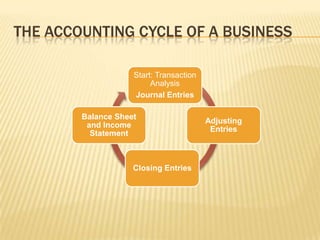
                    Start: Transaction
                         Analysis
                    Journal Entries

        Balance Sheet
                                         Adjusting
         and Income
                                          Entries
          Statement


                    Closing Entries
BASIC ACCOUNTING TERMINOLOGY

  Journal
    The book of original entry. All transaction are
    recorded here first.

  Adjusting Entries
   These are entries to assign revenue and
   expenses in the period incurred. These
   additional month-end entries match expired
   costs and unrecorded revenues to the period
BASIC ACCOUNTING TERMINOLOGY

  Closing Entries
    Entries made to zero balance all temporary
    accounts at the end of the accounting period.

  Income Statement
    The profit or loss of the business based on
    earnings less expense. This statement reflects
    a period of time (usually one month)
BASIC ACCOUNTING TERMINOLOGY

  Balance Sheet
    A “snapshot” of the business’ assets, liabilities
    and owner’s equity (also known as “net
    worth”). Assets are property. Liabilities are
    what is owed. Owner’s equity is the difference
    between the assets and liabilities.

  Transactions
    Business papers and source documents.
Thank you! 
http://www.dcaccounting.org

The Accounting Cycle

  • 1.
  • 2.
    THE ACCOUNTING CYCLEOF A BUSINESS Let’s take a look at the entire accounting cycle of a business. Business transactions are recorded in a “Journal” during the month. At the end of the month “Adjusting Entries” are prepared, and placed in the “Journal”.
  • 3.
    THE ACCOUNTING CYCLEOF A BUSINESS A final set of “Closing Entries “are then placed in the “Journal”, and the “Financial Statements” are prepared. The process begins again for the next accounting period.
  • 4.
    THE ACCOUNTING CYCLEOF A BUSINESS Start: Transaction Analysis Journal Entries Balance Sheet Adjusting and Income Entries Statement Closing Entries
  • 5.
    BASIC ACCOUNTING TERMINOLOGY Journal The book of original entry. All transaction are recorded here first. Adjusting Entries These are entries to assign revenue and expenses in the period incurred. These additional month-end entries match expired costs and unrecorded revenues to the period
  • 6.
    BASIC ACCOUNTING TERMINOLOGY Closing Entries Entries made to zero balance all temporary accounts at the end of the accounting period. Income Statement The profit or loss of the business based on earnings less expense. This statement reflects a period of time (usually one month)
  • 7.
    BASIC ACCOUNTING TERMINOLOGY Balance Sheet A “snapshot” of the business’ assets, liabilities and owner’s equity (also known as “net worth”). Assets are property. Liabilities are what is owed. Owner’s equity is the difference between the assets and liabilities. Transactions Business papers and source documents.
  • 8.